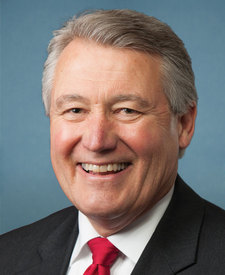
See how Rick W. Allen's votes line up with your values.
DeepSyte scores Rick W. Allen's record on the issues you care about — not party, not press releases. Take the 2-minute values quiz to see your personal alignment.
Sign in and take the values quiz to see how Rick W. Allen's votes line up with your views.
Prediction track record
How often we called Rick W. Allen's passage votes correctly, from their stated positions on each bill's tagged topics. Excludes “unclear” calls and abstentions.
50%
Accuracy
1
Correct
1
Incorrect
135
Pending
Wrong119-hres-1247
Providing for consideration of the bill (H.R. 2102) to amend title 10, United States Code, to provide for concurrent receipt of veterans' disability compensation and retired pay for disability retirees with combat-related disabilities, and for other purposes.
To prohibit the disclosure of records by the Secretary of Housing and Urban Development of individuals for the purposes of immigration enforcement, and for other purposes.
Based on 2 data points across public statements and recorded votes · AI analysis of public records
118-hr-8070·Consistent
Servicemember Quality of Life Improvement and National Defense Authorization Act for Fiscal Year 2025
75/100
What they said
Mar 10, 2026
Rep. Allen is seeking transparency and accountability regarding reported service cuts at Eisenhower Army Medical Center at Fort Gordon, expressing concern about potential closure of the emergency room, operating room, and in-patient care, and calling for the Defense Health Agency to provide a full report on the causes and solutions within 90 days.
Rep. Allen's statement expresses concern about service cuts at a military hospital and seeks transparency and accountability from the Defense Health Agency. The bill is a broad National Defense Authorization Act for FY2025 that authorizes DOD programs, military construction, and personnel policies, including pay increases for enlisted personnel. Allen's YES vote on the NDAA is generally consistent with supporting military readiness and servicemember quality of life, which aligns with his stated concern for maintaining adequate hospital services and staffing at Fort Gordon. However, the bill does not specifically address the Eisenhower Army Medical Center situation or the Defense Health Agency report Allen was seeking; the vote reflects support for the broader defense authorization rather than a direct response to the specific hospital closure concerns.
Military Construction, Veterans Affairs, and Related Agencies Appropriations Act, 2025
65/100
What they said
Mar 10, 2026
Rep. Allen is seeking transparency and accountability regarding reported service cuts at Eisenhower Army Medical Center at Fort Gordon, expressing concern about potential closure of the emergency room, operating room, and in-patient care, and calling for the Defense Health Agency to provide a full report on the causes and solutions within 90 days.
Rep. Allen's statement expresses concern about service cuts at Eisenhower Army Medical Center and calls for transparency and accountability from the Defense Health Agency. His YES vote on the Military Construction, Veterans Affairs, and Related Agencies Appropriations Act, 2025 is generally consistent with supporting VA and military healthcare funding broadly. However, the bill is a large omnibus appropriations measure that funds multiple agencies and programs; it does not specifically address the Eisenhower hospital situation or guarantee funding to prevent the reported service cuts Allen opposed. The vote reflects support for VA appropriations generally, but the statement's specific concern about potential closure of emergency, operating, and in-patient services at a particular facility is not directly addressed by the bill text.
Pairs with ambiguous language and high uncertainty are withheld until more data is available. Procedural, cloture, and amendment votes are excluded — they don't cleanly signal substantive support or opposition.
Pro analysis
AI rep analysis — Pro
Get an AI-narrated read on Rick W. Allen's full voting record against your stated values — aligned themes, conflicts, notable votes, and what to watch for.
We haven't extracted campaign positions for Rick W. Allen yet. Once their campaign website or position pages are processed, this card will track what they said vs how they voted.
Crossing the aisle
Passage votes where Rick W. Allen broke ranks with ≥75% of Republicans. Threshold catches substantively partisan splits; unanimous-ish or close votes are excluded.
2
Cross-aisle votes
118-hr-3012·Nov 20, 2024·81% of R voted YES
North Korean Human Rights Reauthorization Act of 2023
Congressman Allen, Colleagues Lead Bipartisan Letter Requesting EFRP Funding for Foresters and Landowners
Position: Requests that the House Appropriations Committee provide additional funding for the Emergency Forest Restoration Program to help private forest owners recover from Hurricane Helene and other federally recognized natural disasters.
On Friday, Congressman Rick W. Allen (GA-12) joined a bipartisan group of Members in sending a letter to House Appropriations Committee Chairman Tom Cole and Ranking Member Rosa DeLauro requesting additional funding for the Emergency Forest Restoration Program (EFRP).
Demand for disaster programs, including EFRP, have increased substantially in recent years due to large disaster events, particularly in Georgia. Congressman Allen has consistently heard from growers in the 12th District about the importance of EFRP funding, which currently has less than $1 million available for allocation to states and counties. The current backlog of requests exceeds $255 million.
In the letter, Congressman Allen and his colleagues write: "Hurricane Helene struck the eastern United States on September 26, 2024, causing severe damage across multiple states. While the impacts in the Southeast were especially visible, forestland owners across the country have since faced mounting recovery needs from hurricanes, wildfires, floods, tornadoes, and other qualifying disaster events. EFRP is the only federal program designed to help private forest owners clear debris, prepare sites, and replant after disasters of this scale."
The Members continue: "In several states, only a small share of obligated funding has been disbursed, and others have received no outlays at all, despite documented damage and approved agreements. These figures underscore the widespread demand for forest restoration support following recent disasters, far beyond any one state or storm... With EFRP serving as the primary federal mechanism for forest debris removal and reforestation, the exhaustion of funding places forest owners nationwide at risk."
The Members conclude: "We respectfully ask the Committee to examine options to ensure additional funding for landowners relying on EFRP to complete disaster recovery efforts, both for Hurricane Helene and for other federally recognized natural disasters."
To read the full letter to Chairman Cole and Ranking Member DeLauro, CLICK HERE
Enter your email address to get the latest updates straight to your inbox.
Use the form below to sign up for my newsletter and get the latest news and updates directly to your inbox.
Congressman Rick Allen's Retire through Ownership Act Signed into Law by President Trump
Position: The release supports the Retire through Ownership Act (S. 2403), which provides legal and regulatory clarity for valuing company stock in Employee Stock Ownership Plan transactions by allowing trustees to rely on independent appraisals that follow IRS guidelines. It states the bill promotes retirement security for employee owners.
Yesterday, President Donald J. Trump signed S. 2403, the Retire through Ownership Act, into law. Congressman Rick W. Allen (GA-12) introduced the House version of this bill last year, which would provide legal and regulatory clarity in the formation of new Employee Stock Ownership Plans (ESOPs). Congressman Allen issued the following statement upon the bill becoming public law:
"I recently visited Farmers Home Furniture headquarters in Dublin, Georgia. This innovative company transitioned to 100% employee ownership through an ESOP model in 2013. During my visit, we heard firsthand feedback that the ESOP has undeniably resulted in employee success and retention, in turn allowing the entire company to thrive. That is what the American Dream is all about and exactly why the Retire through Ownership Act is so important. ESOPs are a tried-and-true method for ensuring more Americans can enjoy a secure retirement, and by eliminating the regulatory ambiguity these plans often face, more employees will now share in the success they have helped deliver. I was proud to champion this bill during the 119th Congress and thank President Trump for signing it into law," said Congressman Allen.
"The Retire through Ownership Act is about protecting retirement security and preserving jobs in our local communities, and Rep Rick Allen’s leadership addresses a challenge that has hindered employee ownership for decades," said James Bonham, President and CEO of the ESOP Association. "His efforts will give employee owners in Georgia and everywhere greater confidence in how their shares are valued, and business owners a clearer path toward ESOP transitions. We applaud Rep. Allen for helping deliver this commonsense solution."
BACKGROUND: On September 16, 2026, the House of Representatives passed S. 2403 with overwhelming bipartisan support, sending it to President Trump's desk. Employee Stock Ownership Plans (ESOPs) let workers build retirement savings by owning stock in their company. When an ESOP buys stock in a private company, an independent appraiser helps determine what that stock is worth. The Department of Labor (DOL) has not yet finalized clear rules for how private company stock should be valued in an ESOP transaction. That leaves ESOP trustees without a clear federal standard to follow when deciding whether the price is fair—creating uncertainty and legal risk for trustees and businesses.
S. 2403, the Retire through Ownership Act, gives ESOP trustees a clearer rule to follow: If an independent appraiser follows the Internal Revenue Service’s longstanding guidelines to determine what a company is worth, the ESOP trustee can rely on that appraisal to decide if the price is fair.
Enter your email address to get the latest updates straight to your inbox.
Use the form below to sign up for my newsletter and get the latest news and updates directly to your inbox.
Rick Allen’s retirement security bill heads to Trump’s desk
Position: The release supports the Retire through Ownership Act (S. 2403), which would provide a clearer framework for valuing employer stock in Employee Stock Ownership Plans and reduce regulatory uncertainty for ESOP trustees and businesses.
AUGUSTA, Ga. (WRDW/WAGT) - A bill introduced by Congressman Rick Allen is now headed to President Donald Trump’s desk.
On Wednesday, the U.S. House of Representatives passed the “Retire through Ownership Act,” a bill aimed at giving businesses and workers more certainty when setting up Employee Stock Ownership Plans, or ESOPs.
The measure, S. 2403, cleared the House on a bipartisan 401–14 vote.
Allen, who introduced the House version of the bill, said ESOPs are an important way for workers to build retirement wealth by owning a share of the company where they work.
“True success is measured by the success of your employees,” Allen said in a statement.
“ESOPs are a valuable tool to build wealth for retirement and give employees an ownership stake in their employer. The Retire through Ownership Act will help eliminate the regulatory ambiguity and unnecessary risks these plans often face while providing a clear framework for valuing employer stock.”
ESOPs allow employees to accumulate company stock in a retirement account. But when an ESOP buys shares in a privately held company, federal law currently offers little clear guidance on how that stock should be valued.
The Department of Labor has not finalized detailed rules, leaving ESOP trustees exposed to lawsuits and regulatory uncertainty over whether they paid a fair price.
Supporters say that uncertainty has discouraged some business owners from selling to employees and has made it harder to start new ESOPs. The bill aims to fix that by spelling out when ESOP trustees can rely on an independent appraisal.
If signed into law, the bill would not create new ESOPs on its own, but it is designed to make it easier and less risky for companies to form them by aligning Labor Department expectations with IRS valuation standards.
Enter your email address to get the latest updates straight to your inbox.
Use the form below to sign up for my newsletter and get the latest news and updates directly to your inbox.
Congressman Allen's Retire through Ownership Act Headed to President Trump's Desk
Position: The release describes the House passage of S. 2403, the Retire through Ownership Act, which would give ESOP trustees a federal standard for relying on independent appraisals that follow IRS guidelines when valuing private company stock, and expresses support for the bill as a step toward secure retirement.
Yesterday, the U.S. House of Representatives passed S. 2403, the Retire through Ownership Act. Congressman Rick W. Allen (GA-12) introduced the House version of this bill last year, which would provide legal and regulatory clarity in the formation of new Employee Stock Ownership Plans (ESOPs). Following House passage of S. 2403 by a vote of 401-14, Congressman Allen issued the statement below:
"One of the many lessons I learned over my decades-long career as a small business owner is that true success is measured by the success of your employees. ESOPs are a valuable tool to build wealth for retirement and give employees an ownership stake in their employer. The Retire through Ownership Act will help eliminate the regulatory ambiguity and unnecessary risks these plans often face while providing a clear framework for valuing employer stock. I am proud that this bipartisan, bicameral bill is one step closer to the finish line as we continue to advance policies that ensure more Americans can enjoy a secure retirement," said Congressman Allen, Chairman of the Subcommittee on Health, Employment, Labor, and Pensions.
"ESOPs provide employees with a meaningful foothold in capital ownership—allowing them to share in the success they’ve helped create. Unfortunately, lack of clarity in the law has brought uncertainty and created legal grey areas. S. 2403 fixes this problem by providing clear guidance," said Representative Walberg, Chairman of the Committee on Education and Workforce. "Employee ownership is a proven asset for workers, businesses, and our economy, and it should not be undermined by ambiguity in the law. I’m glad to see this critical legislation make it to the president’s desk—ending over fifty years of confusion and strengthening employee ownership."
BACKGROUND: Employee Stock Ownership Plans (ESOPs) let workers build retirement savings by owning stock in their company. When an ESOP buys stock in a private company, an independent appraiser helps determine what that stock is worth. The Department of Labor (DOL) has not yet finalized clear rules for how private company stock should be valued in an ESOP transaction. That leaves ESOP trustees without a clear federal standard to follow when deciding whether the price is fair—creating uncertainty and legal risk for trustees and businesses.
S. 2403, Retire through Ownership Act, gives ESOP trustees a clearer rule to follow: If an independent appraiser follows the Internal Revenue Service’s longstanding guidelines to determine what a company is worth, the ESOP trustee can rely on that appraisal to decide if the price is fair. This legislation now heads to President Trump's desk. Prior to House passage of the bill, Congressman Allen participated in debate on the House floor. Watch HERE.
Enter your email address to get the latest updates straight to your inbox.
Use the form below to sign up for my newsletter and get the latest news and updates directly to your inbox.
Augusta veterans cemetery celebrated after 27-year-wait
Position: Congressman Rick Allen states that the project will improve burial benefit access for the area's veterans and eligible family members, and he praises local advocates for their work on the cemetery.
Local, state and federal leaders gathered with a roomful of American veterans Wednesday to celebrate the coming of Georgia’s third — and largest — state-run veteran cemetery to Augusta.
“This isn’t just a project for us. This isn’t just a new cemetery. This is the fulfillment of a dream,” Patricia Ross, commissioner of the Georgia Department of Veteran Service, told a crowd of about 100 at the Augusta Marriott.
Ross said she found a newspaper article from 1999 in which former Mayor Bob Young was asking to bring a state veterans cemetery to Augusta. She’s been working with Young and Augusta Commissioner Don Clark on the project since taking office four years ago.
“Sometimes dreams take a long time to happen. Just because it’s taken a long time, doesn’t make them any less worthwhile,” Ross said.
Initial plans to build at Fort Gordon were scuttled after 9/11. Clark and Young revived the project in 2018, but even after securing former state property for the cemetery at Gracewood and state funding, Augusta was deemed too close to existing cemeteries in Milledgeville and Columbia, S.C., to obtain federal grant funding.
For years, Augusta’s application for federal cemetery grant funding hovered around the bottom of a priority list. Then last year, Congress approved a historic amount of funding for veteran cemeteries.
“That historic funding reached down to priority No. 30. And guess where we were? Priority No. 30,” Ross said.
The federal grant is expected to provide $10 million for construction of the project, and bids have already been received to build it. Ross said November is being eyed for a groundbreaking ceremony at the selected site, a former state property off Byrd Road near Gracewood.
Congressman Rick Allen, who spoke Wednesday, said the project will give the area’s more than 66,000 veterans and eligible family members better access to burial benefits.
“After years of work, I am pleased that we are officially moving forward with this project for those who answered the call to serve our nation in uniform. I would also like to thank former Augusta Mayor Bob Young and Augusta Commissioner Don Clark for their tireless advocacy on behalf of veterans in this community,” Allen said.
But the cemetery isn’t just for Georgia veterans. Any honorably discharged veteran and eligible family members can be interred there at no charge, said Clark, a 21-year Army veteran and activist for veteran care.
“This is not just a Georgia thing or an Augusta thing,” Clark said.
Dwight Bradham, executive director of the Aiken County Veterans Service Office, said veterans on both sides of the Savannah River have long complained that existing cemeteries are too far away for their families to visit regularly.
The event paid a special tribute to the late Rep. Henry Wayne Howard, who Clark said was pivotal in securing state support for the project. Howard’s wife Cassandra Howard was presented a ceremonial shovel bearing tribute to his leadership.
Clark also thanked the Augusta Commission, which has been unanimous in its support for the initiative. Several of the commission’s retired Army former members — Bill Lockett, Dennis Williams and Sammie Sias — attended the event, while former Commissioner Bill Fennoy was credited with bringing the item back to a city committee.
Wednesday’s event also introduced the CSRA Veterans Cemetery Fund, a fundraising effort operating under the umbrella of the Community Foundation for the CSRA. The cemetery fund’s chair, Danielle Gonzalez, said the group’s first fundraising goal is $705,000 to pay for things not covered by grant funding.
The first phase is expected to cover a carillon tower, a water feature, benches, paving and vehicle access to the site from Byrd Road.
Other board members include Gary Smith, who has a combined 31 years in the Marine Corps, Army and Georgia National Guard, retired Army Brig. Gen. John Kunstbeck and retired Army veteran Andrew Gonzal
In addition, the board includes Augusta Marriott General Manager Brendan England and Sales and Marketing Director Kat Johnson as well as 20-year Army veteran Thomas Pinkney and retired Marine Corps Master Gunnery Sgt. Linda Roach.
Bids were due Tuesday with the Georgia State Financing and Investment Commission on behalf of the Department of Veteran Service to build the cemetery. While no contractor has been selected, submitting proposals were:
The first phase will include an administration building, maintenance building, open commital shelter and four burial sections. Plans include 1,500 pre-placed crypts, 600 conventional burial spaces, 900 spaces for in-ground cremated remains and 960 columbarium niches.
Enter your email address to get the latest updates straight to your inbox.
Use the form below to sign up for my newsletter and get the latest news and updates directly to your inbox.
Congressman Rick Allen Joins Walberg in Questioning Teachers Union Over Dues
Position: Committee chairmen Walberg and Allen have questioned the American Federation of Teachers president over whether union dues financed a book from which she personally benefited, and they seek a full accounting and cooperation from the union. The release does not advocate for a specific piece of legislation or policy change.
Education and Workforce Committee Chairman Tim Walberg and Health, Employment, Labor, and Pensions Subcommittee Chairman Rick W. Allen demanded answers from American Federation of Teachers President Randi Weingarten on Jul. 7 following reports that teachers’ union dues may have been used to finance the production, publication, and promotion of a book from which she personally benefited.
In a letter addressed to Weingarten, Walberg and Allen said, “The prospect that rank-and-file educators’ dues may have financed a project that generated private financial gain raises serious questions about transparency, accountability, and fiduciary responsibility within one of the nation’s largest labor organizations.”
The letter continued: “Recent reporting and analyses of AFT’s federal labor disclosures raise questions regarding whether union funds, personnel, contractors, and other resources were utilized to support the development and promotion of your book while you simultaneously retained a portion of the resulting royalties and proceeds. According to these reports, AFT expended substantial funds on consultants, legal services, publication-related expenses, fact-checking services, photography, and other activities connected to the book.”
Walberg and Allen also wrote, “The Committee also has a responsibility to ensure that organizations representing American workers operate transparently and that union members receive a full accounting of how their dues are utilized. The allegations surrounding the financing and proceeds relating to the book warrant careful examination, and the Committee expects your full cooperation.”
The House Education and Workforce Committee manages federal programs concerning education, labor, health care policy initiatives such as student loans or worker protections; it serves in the legislative sector with jurisdiction over education- or labor-related matters, according to its official website
This is a press release from Congressman Tim Walberg’s Office.
Enter your email address to get the latest updates straight to your inbox.
Use the form below to sign up for my newsletter and get the latest news and updates directly to your inbox.
Congressman Allen Hosts Education and Workforce Committee Field Hearing in Augusta
Position: Congressman Allen describes AI as a potential engine of economic growth that can enhance worker productivity while automating routine tasks, and states that the United States should continue discussions on AI to win the AI race and keep the technology serving Americans.
Today, Congressman Rick W. Allen (GA-12) hosted an Education and Workforce Committee field hearing in Augusta, Georgia titled "Building an AI-Ready America: How AI Is Creating Opportunities Across America's Workforce."
The hearing was the eighth in a series examining artificial intelligence and was attended by U.S. Representatives Joe Wilson (R-SC) and Lucy McBath (D-GA). The members questioned a panel of four witnesses at the Georgia Cyber Innovation and Training Center-Hull McKnight Building on the impacts of AI in the workforce.
Following the hearing, Congressman Allen issued the statement below:
"There was no better place to hold today's field hearing on AI in the workplace than Augusta, Georgia. AI has the potential to be a powerful engine of economic growth. Across the country, including here in the 12th District, AI is enhancing workers’ knowledge, skills, and productivity while also automating routine tasks and improving efficiency across various industries. Today's witnesses were proof—each providing unique perspectives, valuable insight, and firsthand knowledge on utilizing AI in the agriculture, healthcare, and biotechnology sectors. I am grateful to my colleagues Joe Wilson and Lucy McBath for participating in this hearing, leadership from Augusta University and the Georgia Cyber Center for their hospitality, and our witnesses for their participation. If the United States intends to win the AI race, we must continue these critical discussions and ensure this technology remains a tool that serves Americans."
The full hearing can be viewed here.
Congressman Allen's opening statement can be read here.
Congressman Allen's questions to witnesses can be viewed here.
Enter your email address to get the latest updates straight to your inbox.
Use the form below to sign up for my newsletter and get the latest news and updates directly to your inbox.
Congressman Allen Leads Colleagues in Demanding a Halt in Changes to EAMC
Position: Congressman Allen and colleagues oppose the Defense Health Agency's proposal to downgrade Eisenhower Army Medical Center to an ambulatory care center, citing concerns about national security and servicemember healthcare needs, and urging the agency to halt changes pending congressional review.
Today, Congressman Rick W. Allen (GA-12) was joined by Representatives Joe Wilson (SC-02), Austin Scott (GA-08), Earl "Buddy" Carter (GA-01), Sheri Biggs (SC-03), and Brian Jack (GA-03) in sending a letter to the Honorable Pete Hegseth, Secretary of the Department of War, urging that changes to the Eisenhower Army Medical Center (EAMC) at Fort Gordon be halted immediately.
In the letter, Congressman Allen and the members write: "We are writing to share our strong opposition to the proposal by the Defense Health Agency (DHA) to downgrade the Eisenhower Army Medical Center (EAMC) at Fort Gordon to an ambulatory care center... While DHA has notified Congress about the proposed changes, it is required by law that DHA submit a report to the House Armed Services Committee (HASC) and the Senate Armed Services Committee (SASC) on the proposed plans to restructure EAMC and Congress has 180 days to review the proposal before any changes are made."
The members continue: "It is very concerning that DHA has circumvented the law and has proceeded to downsize the EAMC based on a previous administration’s plan to address their recruiting failures and lack of investment in the men and women of the military... Under these new circumstances, we urge DHA to reconsider the changes made at EAMC and to halt any further actions, with respect to delivery of care and staffing until Congress has assessed the plan."
The members conclude: "While our servicemembers and their families are our priority, there are real national security concerns sending servicemembers into the civilian healthcare system... We are grateful to represent servicemembers and their families who face unique and complex needs due to their service. Again, we urge DHA to follow the letter of the law and halt any further changes to EAMC."
BACKGROUND: On January 20, 2026, Congressman Allen sent a letter to the Honorable David J. Smith, M.D., Acting Director of the Defense Health Agency, seeking answers about potential changes in the scope of services provided at Eisenhower Army Medical Center (EAMC) at Fort Gordon.
To read the full letter to Secretary Hegseth, click here.
Enter your email address to get the latest updates straight to your inbox.
Use the form below to sign up for my newsletter and get the latest news and updates directly to your inbox.
Today, the House of Representatives passed H.R. 7567, the bipartisan Farm, Food, and National Security Act of 2026, which builds on the historic agriculture investments made in H.R. 1, often known as the Working Families Tax Cuts. After voting in support of the bill, Congressman Rick W. Allen (GA-12) issued the following statement:
"Rural America needs a new Farm Bill now, not tomorrow. With today's passage of the Farm, Food, and National Security Act, House Republicans have once again reaffirmed our commitment to American agriculture and delivered for hardworking growers and producers.
"Having grown up on a Hereford cattle farm and traveled throughout the 12th District, I know the uncertainty Georgia's farmers can face—which has been exacerbated in recent years by high input costs, shrinking margins, devastating natural disasters, and market uncertainty. The best way to reinvigorate our farm economy and bring certainty back to farm country is to send a modern Farm Bill that addresses today's challenges to President Trump's desk. This bill is the answer.
"With agriculture being the number one industry in the 12th District and across our state, I was proud to support this Farm Bill that not only delivers sound agriculture policy but also provides our farmers with the tools and resources they need."
More specifically, H.R. 7567:
NOTE: Following Hurricane Helene's destruction, Congressman Allen co-introduced the Farmers’ AID Relief Act, which updates the Hurricane Insurance Protection - Wind Index (HIP-WI) to better reflect real-world storm paths and protect farmers affected by damage. This legislation is included as a marker bill in Sec. 11016 of Title XI of the Farm, Food, and National Security Act. Additionally, H.R. 7567 is supported by more than 500 stakeholder organizations, including the Georgia Farm Bureau, Georgia Agribusiness Council, Georgia Association of Conservation Districts, Georgia Corn Growers Association, Georgia Cotton Commission, and others.
Read the full bill text HERE.
Read a section-by-section HERE.
Enter your email address to get the latest updates straight to your inbox.
Use the form below to sign up for my newsletter and get the latest news and updates directly to your inbox.
Congressman Allen Votes for Budget Framework to Fund ICE and Border Protection
Position: Congressman Allen supports funding for ICE and CBP through the end of President Trump's term, arguing that these agencies require resources to enforce immigration law and secure the border.
Last night, House Republicans passed S. Con. Res. 33, which establishes a congressional budget to responsibly fund Immigration and Customs Enforcement (ICE) and Customs and Border Protection (CBP) through the end of President Trump’s term, ensuring these agencies are able to keep the American people safe from threats. Upon passage of S. Con. Res. 33, Congressman Rick W. Allen (GA-12) issued the following statement:
"House and Senate Democrats have made it abundantly clear that their loyalty lies with illegal immigrants, not with the American people, and not with the brave individuals tasked with securing our border and deporting criminals who have illegally entered our country. While Democrats continue to obstruct funding for the Department of Homeland Security, House Republicans are working to ensure these vital national security agencies have the resources they need to keep Americans safe. This was an easy yes vote."
BACKGROUND: Adoption of S. Con. Res. 33 will unlock the process by which Congressional Republicans can fund ICE and CBP through the entirety of President Trump’s term with a simple majority vote in the Senate. This bill makes the FY2026 annual appropriations process whole, ensuring that ICE and CBP can continue the historic progress they have made under the Trump Administration to address the consequences of Democrats’ disastrous open-borders policies.
Enter your email address to get the latest updates straight to your inbox.
Use the form below to sign up for my newsletter and get the latest news and updates directly to your inbox.
Source: GDELT 2.0 GKG, filtered to a curated list of national outlets. Inclusion is not endorsement; opinion pieces and reported news are mixed.
Recent stock activity
Periodic transaction reports filed under the STOCK Act — disclosed by the rep, sourced from public filings.
No disclosed trades on record.
Source: open-data mirrors of the Senate eFD and House Clerk financial-disclosure systems. Disclosure within 30 days of trade is required by law (45 for spouse/dependent trades).
Top PAC donors · 2026 cycle
Political action committees that gave the most to this rep's principal campaign committee this cycle. PAC giving is direct organizational support — industry, ideological, or leadership.
1.AFLAC INCORPORATED PAC2 contributions$10,000
2.NATIONAL AUTOMOBILE DEALERS ASSOCIATION POLITICAL ACTION COMMITTEE (NADA PAC)2 contributions$10,000
3.THE HOME DEPOT INC. POLITICAL ACTION COMMITTEEBusiness3 contributionsRetail corporation PAC — supports candidates aligned with business-friendly policies on tax, labor, and regulatory matters.AI$10,000
5.AMERICAN ISRAEL PUBLIC AFFAIRS COMMITTEE PACIdeological2 contributionsFederal PAC arm of AIPAC, established 2021. Backs candidates from both parties who support U.S.-Israel security and economic ties.AI$10,000
6.NATIONAL PECAN FEDERATION INC. PAC (PECAN PAC)2 contributions$10,000
7.VERIZON COMMUNICATIONS INC. GOOD GOVERNMENT CLUB (VERIZON PAC)2 contributions$10,000
9.NATIONAL CHICKEN COUNCIL POLITICAL ACTION COMMITTEE2 contributions$10,000
10.INVESTMENT COMPANY INSTITUTE POLITICAL ACTION COMMITTEE3 contributions$10,000
Source: OpenFEC (api.open.fec.gov) Schedule A receipts where contributor type is “committee.” Aggregated by contributing committee. Self-transfers from joint-fundraising / victory committees are excluded.
Top individual contributors · 2026 cycle
Itemized individual contributions over $200 to this rep's campaign committee, aggregated by donor employer. PAC giving is shown above; this section is people, not organizations.
1.SELF$33,650
2.MAU, INC$7,000
3.YANCEY BROS. CO.$7,000
4.POLLARD LUMBER$7,000
5.KOCH$7,000
6.MAU$7,000
7.PATIENTRIGHTSADVOCATE.ORG$7,000
8.HLPR ADVOCACY$7,000
9.DUFFEY SOUTHEAST, INC.$7,000
10.CAPITOL COUNSEL$6,500
Source: OpenFEC Schedule A receipts where contributor type is “individual,” aggregated by the donor's self-reported employer. This is a geographic / industry correlation, not a corporate endorsement.