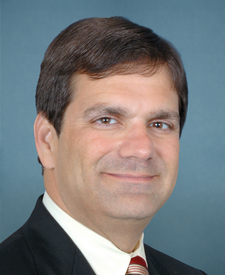
See how Gus M. Bilirakis's votes line up with your values.
DeepSyte scores Gus M. Bilirakis's record on the issues you care about — not party, not press releases. Take the 2-minute values quiz to see your personal alignment.
Sign in and take the values quiz to see how Gus M. Bilirakis's votes line up with your views.
Prediction track record
How often we called Gus M. Bilirakis's passage votes correctly, from their stated positions on each bill's tagged topics. Excludes “unclear” calls and abstentions.
A joint resolution to direct the removal of United States Armed Forces from hostilities within or against the Islamic Republic of Iran that have not been authorized by Congress.
A joint resolution to direct the removal of United States Armed Forces from hostilities within or against the Islamic Republic of Iran that have not been authorized by Congress.
No paired statements and votes yet for Gus M. Bilirakis
We haven't yet found statement/vote pairs on the same topic for Gus M. Bilirakis. This usually means either the rep hasn't taken public positions on bills that have come to a passage vote, or those bills haven't been tagged yet. The checker runs as new press releases and votes come in.
Pro analysis
AI rep analysis — Pro
Get an AI-narrated read on Gus M. Bilirakis's full voting record against your stated values — aligned themes, conflicts, notable votes, and what to watch for.
Positions Gus M. Bilirakis took during their campaign, scored against their subsequent record — public statements cross-checked with related votes. “Kept” means 80%+ of those statement-vs-vote pairs aligned; “Broken” means 30% or fewer.
0 kept0 broken0 mixed0 no action yet
Gus M. Bilirakis has 8 tracked positions but no scored statement-vs-vote pairs touching them yet. Verdicts will appear here as related statements and votes accumulate.
No action yetSupports
Federal enforcement of mental-health insurance parity (equal coverage to medical care) should be strengthened.
“$2M to expand mental-health services at Federally Qualified Health Centers.”
Passage votes where Gus M. Bilirakis broke ranks with ≥75% of Republicans. Threshold catches substantively partisan splits; unanimous-ish or close votes are excluded.
Bilirakis, Soto, Castor Introduce Bipartisan Legislation to Establish Locality Pay Areas for Tampa and Orlando
Position: Representatives Bilirakis, Soto, and Castor introduced the Locality Pay Adjustment Act (H.R. 10898) to establish separate federal locality pay areas for the Orlando and Tampa metropolitan regions, arguing this would help civilian federal agencies recruit and retain employees. The release states that current pay designations do not reflect rising living costs and competitive private-sector wages in those regions.
WASHINGTON, D.C. Representatives Gus Bilirakis (R-FL-12), Darren Soto (D-FL-09), and Kathy Castor (D-FL-14) this week introduced the Locality Pay Adjustment Act (H.R. 10898), bipartisan legislation to establish separate federal locality pay areas for the Orlando and Tampa metropolitan regions, helping civilian federal agencies offer more competitive compensation and attract and retain qualified employees. Currently, federal employees in Orlando and Tampa receive the broad “Rest of U.S.” locality adjustment, while employees in South Florida and the Melbourne/Space Coast areas receive adjustments specific to their regional labor markets. Locality pay is intended to address differences between federal and nonfederal compensation within a geographic area. Despite rising living costs and increasingly competitive private sector wages, Orlando and Tampa lack separate locality pay designations. This affects civilian employees who care for Veterans, assist Social Security beneficiaries, support airport operations, and carry out critical national security missions at MacDill Air Force Base and other military installations. Establishing distinct pay localities would help federal compensation better reflect regional labor markets and strengthen the workforce responsible for delivering essential public services.
“Our civilian federal employees care for our Veterans, support our military, and help protect our nation. Yet Tampa Bay’s outdated pay designation makes it harder to recruit and retain the skilled professionals who carry out these essential missions,” said Rep. Bilirakis. “At MacDill Air Force Base, home to U.S. Special Operations Command and U.S. Central Command, workforce shortages can have real consequences for military readiness and national security. Our bipartisan legislation would establish a pay locality that better reflects our regional labor market and the realities employees face, including rising living costs, traffic, and lengthy commutes. We must give our federal agencies the tools to compete for talent and retain the experienced workforce our country depends on.”
“In Florida’s Ninth Congressional District, so many of our constituents form part of the civilian federal workforce-whether it be by working at the Space Coast, Orlando International Airport, the Lake Nona and Kissimmee VAs, and so many other critical places that help keep Central Florida moving forward,” said Rep. Soto. “I am proud to introduce this bipartisan bill with Reps. Bilirakis and Castor to support our federal employees as the cost of living continues to increase in the region.”
“The cost of living in the Tampa Bay area has escalated rapidly and is pricing out the civilian federal workforce. From our air traffic controllers and TSA agents at Tampa International Airport to our Social Security Administration employees and the more than 8,000 civilians working in critical missions at MacDill Air Force Base, these individuals make an incredible commitment to service every day,” said Rep. Castor. “Tampa’s current lack of a unique locality pay designation - which determines compensation - fails to acknowledge the high cost of living and is harming the ability to hire and retain talent in the public and private sectors. Congress can help fix this, so I am introducing bipartisan legislation with Reps. Soto and Bilirakis to stand up for our hardworking neighbors and proper compensation.”
The legislation has earned support from business and federal workforce leaders who recognize the importance of competitive compensation to maintaining reliable public services and strong regional institutions.
“The Tampa Bay Chamber strongly supports legislation to establish federal locality pay for the Tampa metropolitan area, ensuring compensation better reflects our region’s competitive labor market. From MacDill Air Force Base to our veterans’ healthcare facilities and other federal agencies, these employees play a vital role in our economy, national security, and quality of life,” said Bob Rohrlack, President & CEO of the Tampa Bay Chamber. “Establishing locality pay is an important step toward strengthening workforce competitiveness, attracting and retaining skilled talent, and supporting the long-term success of our region’s federal institutions.”
“AFGE appreciates the bipartisan bill from Representatives Soto, Castor, and Bilirakis to improve pay for federal employees in Orlando and Tampa. Federal employees all across the country are substantially underpaid relative to their counterparts in the private sector and state and local government,” said Tatishka Thomas, National Vice President of AFGE District 5.
Upon introduction, the Locality Pay Adjustment Act was referred to the House Committee on Oversight and Government Reform.
Bilirakis Leads Bipartisan, Bicameral Effort to Expand Access to Benefits for Veterans with Rare Muscle Disease
Position: Urges the Department of Veterans Affairs to recognize Inclusion Body Myositis as a presumptive service-connected condition so that eligible Veterans with the disease do not have to individually prove that military service caused their illness.
WASHINGTON, D.C. – Today, Congressman Gus Bilirakis (R-FL-12) led a bipartisan, bicameral group of lawmakers in urging Department of Veterans Affairs (VA) Secretary Doug Collins to recognize Inclusion Body Myositis (IBM) as a presumptive service-connected condition. The designation would help Veterans living with this rare, progressive, and incurable muscle disease access disability benefits without having to individually prove that their military service caused their illness. The effort builds on a letter Bilirakis sent to the VA earlier this year. He is now joined by 53 lawmakers in calling for action to address the significant obstacles Veterans with IBM face when seeking benefits.
“Our Veterans should not have to spend years fighting a devastating disease while also fighting a burdensome bureaucracy to receive the benefits they have earned,” said Congressman Bilirakis. “Veterans living with Inclusion Body Myositis face progressive muscle weakness, declining independence, and tremendous uncertainty for themselves and their families. With this disease reported at substantially higher rates among Veterans, the VA must take these concerns seriously and establish a fairer pathway to benefits. I am proud to lead this bipartisan effort to ensure these Veterans are heard, treated fairly, and given the support they deserve.”
According to data reviewed by The Myositis Association (TMA), IBM affects approximately 189 out of every one million Veterans, compared with 15 out of every one million civilians - more than 12 times the prevalence. Like Amyotrophic Lateral Sclerosis (ALS), IBM is a progressive, incurable disease that can cause profound physical limitations. Yet, while the VA recognizes ALS as a presumptive service-connected condition for qualifying Veterans, Veterans diagnosed with IBM must establish service connection through an individualized claims process.
“Thank you to each Member of Congress who signed on to this letter and supported military veterans who live with inclusion body myositis. The Myositis Association proudly stands with you in calling upon the Veterans Benefits Administration at the US Department of Veterans Affairs to approve a presumptive service connection for veterans with IBM,” said Rich DeAugustinis, Chair of TMA board of directors. “TMA is especially grateful for the longtime leadership and empathy of Representative Gus Bilirakis, the lead sponsor, who has brought tremendous visibility to the needs of veterans and care partners living with IBM working with Representatives Mike Thompson, Sarah Elfreth, and Senator Tammy Baldwin. Your continued courage in demanding the very best for those who have served is inspirational!”
“Veterans diagnosed with IBM must navigate a lengthy and burdensome individualized claims process to establish direct service connection ... Yet unlike ALS patients, Veterans with IBM are not afforded a presumptive pathway to benefits, resulting in inconsistent adjudications and inequitable outcomes,” the lawmakers wrote.
The consequences for affected Veterans and their families can be substantial. The Myositis Association reports that a review of VA records found an 82% denial rate for IBM claims. Some Veterans have sought professional assistance and spent more than a decade pursuing appeals before securing recognition that their condition is service-connected. These challenges are compounded by the absence of a dedicated VA disability diagnostic code for IBM, which can complicate documentation and accurate disability ratings. Because the disease’s cause remains unclear, establishing an individual medical link to military service presents an additional obstacle. Recognizing IBM as a presumptive service-connected condition would remove the requirement for qualifying Veterans to individually establish that link, helping reduce administrative burdens and promote more consistent decisions.
The National Academies of Sciences, Engineering, and Medicine is reviewing the relationship between selected military exposures and eight conditions, including IBM. Findings are expected in summer 2027. While supporting that research, the lawmakers emphasized the immediate needs of Veterans already living with the disease.
“While we look forward to the findings of that review, we respectfully emphasize that Veterans currently suffering from IBM should not be left waiting for recognition and relief,” the lawmakers continued.
Congressman Bilirakis is leading the House effort alongside Representatives Sarah Elfreth (D-MD) and Mike Thompson (D-CA), with Senator Tammy Baldwin (D-WI) leading the effort in the Senate. The House Members who signed the letter are listed below in alphabetical order.
Ansari, Yassamin
Baird, James
Baldwin, Tammy
Bean, Aaron
Beatty, Joyce
Bilirakis, Gus
Bishop, Sanford
Carson, André
Clarke, Yvette
Davis, Donald
Elfreth, Sarah
Ellzey, Jake
Fields, Cleo
Fitzpatrick, Brian
Foushee, Valerie
Fuller, Clay
Garcia, Sylvia
Gottheimer, Josh
Grijalva, Adelita
Hill, J.
Huffman, Jared
Hurd, Jeff
Johnson, Henry
Kamlager-Dove, Sydney
Landsman, Greg
Lawler, Michael
Leger Fernandez, Teresa
Lofgren, Zoe
Luna, Anna Paulina
Lynch, Stephen
Malliotakis, Nicole
Matsui, Doris
McBath, Lucy
McBride, Sarah
McCormick, Richard
McGovern, James
Miller, Carol
Norman, Ralph
Panetta, Jimmy
Pfluger, August
Quigley, Mike
Randall, Emily
Raskin, Jamie
Salazar, Maria
Sewell, Terri
Sorensen, Eric
Stansbury, Melanie
Suozzi, Thomas
Thompson, Mike
Tokuda, Jill
Van Orden, Derrick
Vasquez, Gabe
Vindman, Eugene
Watson Coleman, Bonnie
Issues:Veterans
Bilirakis Introduces Bipartisan Bill to Fix Medicare Advantage Payments in Puerto Rico
Position: The release supports introduction of the bipartisan Puerto Rico Medicare Advantage Fairness Act, which would set Puerto Rico's average geographic adjustment equal to that of the U.S. Virgin Islands to raise Medicare Advantage benchmark payments on the island.
WASHINGTON, D.C. Congressman Gus Bilirakis (R-FL-12), joined by Representatives Raul Ruiz, M.D. (D-CA-25), Darren Soto (D-FL), and Resident Commissioner Pablo José Hernández (D-PR), have introduced the Puerto Rico Medicare Advantage Fairness Act. This bipartisan bill would correct a long-standing formula gap that underpays Medicare Advantage in Puerto Rico.
How it works: Medicare Advantage plans receive a fixed monthly payment from the federal government for each senior they enroll. Part of that payment is based on the local cost of care, which is measured by the average geographic adjustment (AGA). Puerto Rico's AGA is much lower than it should be. The formula relies on spending in traditional Medicare (fee-for-service), but very few beneficiaries in Puerto Rico use fee-for-service, since most are enrolled in MA. Basing the AGA on such a small population understates what care actually costs on the island, and MA plans receive a lower benchmark payment for each senior as a result.
This bill would set Puerto Rico's AGA equal to that of the U.S. Virgin Islands, a territory with similar socioeconomic circumstances, so that payments reflect the true cost of delivering care.
The problem
Over 680,000 Puerto Rico beneficiaries rely on Medicare Advantage, over 90 percent of all Medicare beneficiaries on the island.
Puerto Rico receives about 40 percent less per beneficiary than the U.S. average.
Benchmark rates run roughly 20 percent below those in the U.S. Virgin Islands.
The payment gap has led to smaller provider networks and reduced benefits, and doctors and hospitals absorb lower reimbursements. This threatens the quality and availability of healthcare services in Puerto Rico.
"Seniors deserve reliable access to the high-quality health care they have earned through Medicare, regardless of where they live," said Congressman Gus Bilirakis. "Medicare Advantage plays an important role in delivering care to beneficiaries across Puerto Rico, and we must ensure the program is funded fairly and sustainably so seniors can continue accessing the doctors, treatments, and benefits they rely upon. I'm proud to join Representatives Ruiz and Soto in introducing the bipartisan Puerto Rico Medicare Advantage Fairness Act to address longstanding disparities, strengthen access to care and provide greater stability for patients and providers."
"As an emergency physician, I know that when care is out of reach, seniors pay the price," said Congressman Raul Ruiz, M.D. "Puerto Ricans pay into Medicare on the same terms as every American, yet their Medicare Advantage plans are paid about 40 percent less. That gap has shrunk provider networks, cut benefits, and strained doctors and hospitals. This bill is a targeted, common-sense fix. I thank Representatives Bilirakis and Soto and Resident Commissioner Hernández for working with me to give seniors the fair coverage they have earned."
“I am proud to join Reps. Bilirakis and Ruiz in introducing the bipartisan Puerto Rico Medicare Advantage Fairness Act to make geographic adjustments to Medicare Advantage benchmarks in Puerto Rico to match those of the U.S. Virgin Islands. This takes us closer to achieving full parity between the Island and the mainland. Puerto Ricans are American citizens, and they deserve access to the same healthcare benefits as all Americans," said Congressman Darren Soto.
“We are prioritizing the basics: ensuring that our seniors have access to the doctors and healthcare services they need. This year, we secured a significant increase in Medicare Advantage funding for Puerto Rico. Now, we are taking the next step to fix a longstanding funding disparity that has affected the Island for years,” said Resident Commissioner Pablo José Hernández.
"I would like to thank my friend and former colleague, Gus Bilirakis, for introducing the Medicare Advantage Fairness Act in support of Medicare enrollees in Puerto Rico. Close to 680,000 Puerto Rico residents choose to receive their care through Medicare Advantage (MA), making it the preferred coverage option on the island. Yet MA rates in Puerto Rico are approximately 41% below the national average and 20% below those in the U.S. Virgin Islands (USVI). This bill proposes a fix that would adjust MA rates based on those in the USVI, providing a much-needed boost to our residents, health care sector, and economy. I look forward to continuing our work together in support of Medicare and Medicaid beneficiaries in Puerto Rico and across our nation, " said Puerto Rico Governor Jenniffer González-Colón.
The legislation would create a self-adjusting link: if the U.S. Virgin Islands' adjustment changes, Puerto Rico's would move with it. It is a targeted fix for a formula that has never reflected the true cost of care on the island.
Issues:Health Care
BILIRAKIS TO HOST HOUSE ENERGY & COMMERCE CHAIRMAN BRETT GUTHRIE FOR TAMPA BAY HEALTH CARE AFFORDABILITY ROUNDTABLE
Position: The release announces a roundtable on health care affordability and access with Federally Qualified Health Centers and calls for Congress to strengthen community-based care and address barriers to access, without taking a specific stance on pending legislation.
TAMPA, FL - On Wednesday, September 30, 2026, at 10:00 a.m., Congressman Gus Bilirakis (FL-12) will host House Energy and Commerce Committee Chairman Brett Guthrie (KY-02) for a regional roundtable with Federally Qualified Health Centers (FQHCs) focused on expanding access to high-quality, affordable health care and ensuring vulnerable patients do not fall through the cracks. The discussion will bring together leaders from community health centers throughout the Tampa Bay region to showcase the innovative work they are doing to deliver high-quality care while keeping services affordable and accessible for the patients and families who need them most. Importantly, the roundtable will give local health care providers and patients an opportunity to bring their real-life experiences directly to one of our nation’s leading health policy makers. Patient stories will help illustrate the challenges families face accessing affordable care and inform a broader discussion about how Congress can strengthen community-based care, address barriers to access, and ensure federal health policy works for patients on the ground. The event will also highlight an innovative partnership with Feeding Tampa Bay that recognizes the important connection between nutrition and health. Through this model, health care and community partners are working together to address patients’ dietary needs and combat food insecurity among vulnerable populations. Members of the media are invited to attend and cover the discussion.
WHAT: Regional Federally Qualified Health Center Roundtable on Health Care Affordability and Access
WHO: U.S. Congressman Gus Bilirakis (FL-12), U.S. Congressman Brett Guthrie (KY-02), Federally Qualified Health Center leaders from throughout the Tampa Bay region, Local patients and community partners
WHEN:Wednesday, September 30, 2026, 10:00 a.m.
WHERE: Tampa, Florida -Reporters must register with Congressman Bilirakis’s office to receive location details. RSVP / LOCATION INFORMATION: Members of the media planning to attend should contact Congressman Bilirakis’s office at 727-232-2921 or via email: summer.blevins@mail.house.gov to register and receive event location details.
Issues:Health Care
Bilirakis-Backed CHANGE Act to Improve Early Alzheimer’s Detection Advances Out of Committee
Position: The release supports the CHANGE Act, bipartisan legislation directing CMS to identify cognitive impairment detection tools to promote earlier diagnosis of Alzheimer's disease and related dementias, and praises its committee advancement as part of the broader ASAP Act (H.R. 6130).
WASHINGTON, D.C. – Congressman Gus Bilirakis (FL-12) applauded the House Ways and Means Committee’s unanimous advancement of bipartisan legislation containing provisions of the Concentrating on High-Value Alzheimer’s Needs to Get to an End (CHANGE) Act, which Bilirakis introduced with Representatives Linda T. Sánchez (D-CA), Darin LaHood (R-IL) and Doris Matsui (D-CA). The CHANGE Act is designed to promote earlier detection and diagnosis of Alzheimer’s disease and related dementias by directing the Centers for Medicare & Medicaid Services (CMS) to identify cognitive impairment detection tools that can help clinicians more effectively detect cognitive decline and connect patients with appropriate follow-up care. Earlier this week, the CHANGE Act was amended into H.R. 6130, the bipartisan Alzheimer’s Screening and Prevention (ASAP) Act, which the Ways and Means Committee approved by a unanimous 40-0 vote. The broader package seeks to improve early detection and treatment of Alzheimer’s disease. More than seven million Americans are currently living with Alzheimer’s disease, and for many patients, a diagnosis comes only after the disease has already taken a significant toll. Advances in testing and treatment have increased the importance of identifying Alzheimer’s and related dementias at earlier stages.
“Alzheimer’s is a devastating disease that has touched my family personally, so I understand the tremendous toll it takes not only on patients, but also on the loved ones who care for them,” said Congressman Bilirakis. “As promising new treatments continue to emerge, early detection and diagnosis are more important than ever. The bipartisan CHANGE Act will help ensure patients and their doctors have better tools to identify cognitive decline earlier, when interventions may have the greatest impact. I am pleased to see this important legislation advance out of Committee as part of a broader package, bringing us another step closer to improving care, preserving quality of life, and ultimately finding a cure for this terrible disease.”
“Alzheimer’s touches millions of families, and identifying the disease early can make a meaningful difference for patients and their loved ones,” said Congresswoman Matsui. “The CHANGE Act brings us closer to giving healthcare providers the tools to recognize the warning signs sooner and connect families with the care and support they need. I’m proud this bipartisan legislation is moving forward so more families can have more time, better care, and greater hope.”
“This is deeply personal for me. I lost both of my parents to Alzheimer’s, and I know firsthand how much earlier detection could have meant for our family,” said Congresswoman Sánchez. “Advancing this bill out of committee brings us one step closer to giving other families that chance. I’m grateful to my Ways and Means colleagues for passing our bipartisan bill and will keep fighting to get it signed into law.”
“Alzheimer’s impacts millions of Americans, and we must do everything we can to support the search for a cure. This bipartisan bill provides help to patients and clinicians through expanded early detection support and improved data collection,” said Congressman LaHood. “The CHANGE Act, coupled with the ASAP Act, will strengthen existing tools to help streamline and broaden the ability for earlier diagnosis of Alzheimer's and other forms of dementia.”
The CHANGE Act is supported by a broad coalition of patient, provider and aging organizations, including UsAgainstAlzheimer’s, the American Academy of Neurology, Alzheimer’s Association, Alzheimer’s Foundation of America, Alliance for Aging Research, Partnership to Fight Chronic Disease, Gerontological Society of America, American Society of Consultant Pharmacists, Latinos Against Alzheimer’s and USAging.
Senators Shelley Moore Capito (R-WV) and Mark Warner (D-VA) have also introduced companion legislation in the Senate.
Issues:Health Care
Bilirakis Secures Major Tampa Bay and Nature Coast Water Infrastructure Priorities in House-Passed WRDA
Position: The release describes the representative's request for, and support of, water infrastructure, storm resiliency, and ecosystem restoration provisions in the House-passed Water Resources Development Act of 2026, including feasibility studies and authorizations for projects in Florida's Tampa Bay and Nature Coast region.
WASHINGTON, D.C. — Congressman Gus Bilirakis announced that the U.S. House of Representatives passed the bipartisan Water Resources Development Act (WRDA) of 2026, which includes several priorities he requested to strengthen water infrastructure, improve storm resiliency, protect natural resources, and support communities throughout Florida’s 12th Congressional District and the greater Tampa Bay region.
WRDA is Congress’s biennial legislation authorizing U.S. Army Corps of Engineers projects and studies related to water infrastructure, ports and harbors, flood and storm risk reduction, ecosystem restoration, and other critical water-resource needs.
“Florida is growing rapidly, and we have to make sure our infrastructure keeps pace while protecting the natural resources that make our communities such special places to live, work and raise a family,” said Congressman Bilirakis. “I worked closely with our local partners to identify their most pressing water infrastructure and resiliency needs, and I’m pleased that the House-passed WRDA includes each of the priorities we submitted. These provisions will help address water and wastewater needs, strengthen our defenses against hurricanes and flooding, protect and restore important ecosystems, and lay the groundwork for future investments throughout our region. I’ll keep working to get these priorities across the finish line.”
At Bilirakis’s request, the House-passed legislation includes:
Pasco County Ecosystem Restoration and Water Supply: Authorizes a U.S. Army Corps of Engineers feasibility study examining opportunities for ecosystem restoration and water supply improvements in Pasco County.
Lower Withlacoochee River Watershed Restoration: Authorizes a feasibility study focused on ecosystem restoration of the Lower Withlacoochee River Watershed, an important natural resource for the Nature Coast.
$29.6 Million Authorization for Hernando County Water Infrastructure: Authorizes a new environmental infrastructure project of up to $29.6 million for water and wastewater infrastructure in Hernando County, including stormwater management and environmental restoration.
$400,000 Authorization for Pasco County Water Infrastructure: Authorizes a new environmental infrastructure project for water and wastewater infrastructure, including distribution systems, in Pasco County.
$100 Million Regional Water Infrastructure Authorization: Authorizes up to $100 million for water infrastructure, including water-supply projects, serving Hillsborough, Pasco, and Pinellas counties and the cities of New Port Richey, St. Petersburg, and Tampa.
Port Tampa Bay and McKay Bay Storm Protection: Directs the expedited completion of a feasibility study for hurricane and storm-damage risk reduction at Port Tampa Bay, including McKay Bay. The study is intended to help identify potential measures to better protect critical infrastructure and surrounding communities from hurricanes, storm surge, and flooding.
The legislation also contains an additional provision benefiting the Tampa Bay region by directing the expedited completion of a feasibility study for hurricane and storm-damage risk reduction and ecosystem restoration in the vicinity of MacDill Air Force Base.
“Our region knows firsthand the damage hurricanes and storm surge can cause, and we also know that investing in resilient infrastructure before disaster strikes is both safer and more cost-effective than rebuilding afterward,”Bilirakis continued. “From protecting MacDill and Port Tampa Bay to improving water systems in Pasco and Hernando counties and restoring the Lower Withlacoochee watershed, these are forward-looking investments in the long-term strength and resiliency of our region.”
Issues:Environment, Energy Production, and Infrastructure
Bilirakis Celebrates House Passage of AM Radio for Every Vehicle Act
Position: The release supports the AM Radio for Every Vehicle Act, which would require automakers to include AM radio as standard equipment in new passenger vehicles without an additional charge to consumers, citing its importance for emergency information during disasters. It urges the Senate to pass the bill.
WASHINGTON, D.C. — Congressman Gus Bilirakis (FL-12) applauded House passage of the bipartisan AM Radio for Every Vehicle Act, legislation he supports to ensure Americans continue to have access to AM radio in new vehicles. AM radio remains an important source of news, weather, emergency information, and community programming for millions of Americans. It is particularly critical during hurricanes and other natural disasters when power, cellular networks, and internet service may be disrupted. The legislation would require automakers to maintain access to AM broadcast radio in new vehicles without an additional charge to consumers.
“Here in Florida, we know firsthand how important it is to have reliable access to emergency information before, during, and after a hurricane,” said Congressman Bilirakis. “When the power goes out, cell towers are overwhelmed, or internet service is disrupted, AM radio can be a lifeline. It also remains an important source of news and information for seniors, rural communities, and millions of Americans traveling our roads each day. As technology continues to evolve, we should not eliminate a proven, reliable communications tool that helps keep people informed and safe. I am proud to lead this bipartisan legislation and pleased to see it pass the House.”
AM radio also plays an important role in the nation’s emergency communications infrastructure. Because AM signals can travel long distances and reach broad geographic areas, local broadcasters can provide critical information to residents throughout a region during an emergency.
The AM Radio for Every Vehicle Act directs the National Highway Traffic Safety Administration to require automakers to include AM radio in new passenger vehicles as standard equipment and ensure consumers are not charged an additional fee for access.
“Public safety should never take a back seat to technological trends,” Bilirakis continued. “Floridians deserve access to every reliable tool available when disaster strikes. I urge the Senate to act quickly so we can send this commonsense legislation to the President’s desk.”
Congressman Bilirakis has consistently supported efforts to strengthen emergency preparedness, protect consumers, and ensure communities have access to reliable communications during disasters.
Bilirakis, Barragán, Cammack, Auchincloss, Kean & Mullin Introduce Bipartisan Bill to Permanently Protect Rare Pediatric Disease Drug Development Program -Legislation Provides Long-Term Certainty to Encourage Investment in Lifesaving Treatments for Childr
Position: The release supports permanently authorizing the FDA Rare Pediatric Disease Priority Review Voucher Program, which awards transferable priority review vouchers to companies that receive FDA approval for qualifying treatments for rare pediatric diseases.
Bilirakis, Barragán, Cammack, Auchincloss, Kean & Mullin Introduce Bipartisan Bill to Permanently Protect Rare Pediatric Disease Drug Development Program
-Legislation Provides Long-Term Certainty to Encourage Investment in Lifesaving Treatments for Children with Rare Diseases-
WASHINGTON, D.C. – Earlier today, U.S. Representatives Gus Bilirakis (R-FL), Nanette Barragán (D-CA), Kat Cammack (R-FL), Jake Auchincloss (D-MA), Tom Kean, Jr. (R-NJ) and Kevin Mullin (D-CA) introduced bipartisan legislation to permanently authorize the U.S. Food and Drug Administration’s (FDA) Rare Pediatric Disease Priority Review Voucher (PRV) Program, an important incentive for developing treatments for children with rare and devastating diseases. Since its creation in 2012, the program has helped bring treatments to market across 47 rare pediatric diseases - only four of which had an FDA-approved treatment before the program existed. The program, currently scheduled to sunset in 2029, awards a transferable priority review voucher to companies that successfully develop and receive FDA approval for qualifying treatments. Because rare-disease drug development can take as long as 15 years, permanent authorization would provide the long-term certainty needed to encourage continued investment in treatments for small patient populations that might otherwise struggle to attract research and development resources.
“Parents of children battling rare diseases should never have to hear that promising research was abandoned because there wasn’t enough incentive to pursue a treatment,”said Congressman Gus Bilirakis. “Medical innovation is advancing at an incredible pace, but no child should be left behind simply because their disease affects too few patients to attract traditional investment. Drug development takes years, and innovators need certainty when making research decisions today. By making this successful program permanent, our bipartisan bill will encourage continued investment in lifesaving treatments and give hope to families who are desperately waiting for the next breakthrough.”
“We should not let a rare disease become a death sentence simply because the market is too small,”said Rep. Nanette Barragán. "The Rare Pediatric Disease Priority Review Voucher Program has helped bring treatments to children who face devastating diseases that previously had few or no options. That is why I am joining Congressman Bilirakis in introducing bipartisan legislation to permanently authorize this program and create certainty for researchers and investors who need to make decisions today for families and children who cannot afford to wait.”
“Every child deserves a chance at life, no matter how rare their disease,” said Congresswoman Kat Cammack. “A rare diagnosis should never mean that a child is left behind in the search for a treatment or cure. The Rare Pediatric Disease Priority Review Voucher Program encourages America’s innovators to take on these devastating diseases and pursue breakthroughs that can give children and their families hope. I’m proud to join this bipartisan effort to make this important program permanent.”
“Every child deserves a shot at a healthy future,” said Congressman Mullin. “The Rare Pediatric Disease Priority Review Voucher Program is bringing lifesaving treatments to kids who desperately need them, and we can’t let that progress stall. I’m proud to join this bipartisan effort to make the program permanent and give families hope that more rare pediatric treatments will be developed. When a child’s life is on the line, we can’t afford to wait.”
"Children with rare cancers need cures just as much as everyone else. Yet, many companies who want to develop those cures can’t find the necessary financing for such a small group of patients. The Rare Pediatric Disease PRV program provides these companies a vital incentive to invest millions of dollars to find cures for only a handful of children. Congress must permanently reauthorize this program to help these kids and give families hope that treatments and therapies will continue to advance for these devastating conditions,”said Congressman Tom Kean, Jr.
“The medical science to cure pediatric diseases has never been more promising. The vouchers have been an important tool to turn that science into therapies. Congress must not abandon what's working – we should make the vouchers permanent,” said Congressman Jake Auchincloss.
Although the program does not sunset until 2029, investment decisions are being made now. During the program’s lapse from December 2024 to February 2026, the Rare Disease Company Coalition identified roughly 200 therapies at risk of losing eligibility and reported that investors were pulling back from the space. Permanent authorization would provide greater certainty for continued investment in rare pediatric disease research. The legislation is supported by the National Organization for Rare Disorders (NORD), Rare Foundation (formerly EveryLife Foundation for Rare Diseases), Biotechnology Innovation Organization (BIO), and Rare Disease Company Coalition (RDCC).
“The Rare Pediatric Disease Priority Review Voucher program is a proven, budget-neutral incentive that spurs innovation and supports the development of new therapies for children living with rare diseases,”said Chris Porter, Chair of the Rare Disease Company Coalition. “During the program's lapse from December 2024 to February 2026, over 200 pipeline assets were at risk of not receiving a priority review voucher, representing more than $4 billion in potential lost reinvestment capacity. Permanently reauthorizing the program will provide the certainty and predictability rare disease innovators need to continue investing into rare disease research and development for patients with few or no existing options. The Rare Disease Company Coalition applauds Representatives Bilirakis, Auchincloss, Barragán, Cammack, Mullin and Kean for their leadership and for taking action to make the PPRV program a permanent part of our nation’s rare disease innovation ecosystem.”
“For families facing a rare pediatric disease, time isn't a luxury. The Rare Pediatric Disease Priority Review Voucher Program has proven to be one of the most effective tools we have for enabling companies to translate promising science into new treatments. Developing a treatment for a devastating pediatric disease takes years, sometimes decades. Making the PRV permanent gives drug developers and the patient communities counting on them the certainty to make that long-term bet. The RARE Foundation, formerly known as the EveryLife Foundation for Rare Diseases, is grateful to Representatives Bilirakis, Barragán, Cammack, Auchincloss, Kean, and Mullin for introducing the Priority for Pediatric Cures Act so that we can build on the incredible momentum of the first 14 years of the PRV Program, which has enabled over 70 new treatments for pediatric rare diseases,” Annie Kennedy, Chief Mission Officer, Rare Foundation.
“The Rare Pediatric Disease PRV program provides critical incentives for rare disease research and development at no cost to taxpayers. Permanent reauthorization of this vital program would bring hope to children and families touched by rare disease who have no more time to wait, and stability and confidence for biotech innovators who are leading the way in the discovery of breakthrough treatments,” said BIO President & CEO John F. Crowley. “Previous lapses in the PPRV program have devastated families who have run out of treatment options. We are grateful to Representatives Bilirakis, Barragan, and the bipartisan leadership of all the bill’s cosponsors for making the PRV permanent on behalf of pediatric patients and their families.”
Background
Roughly one in ten Americans lives with a rare disease. Of the more than 10,000 known rare diseases, approximately 95 percent still have no FDA-approved treatment, and half of all patients diagnosed with a rare disease are children. Because rare diseases affect relatively small patient populations, promising treatments can struggle to attract the investment necessary to support years of costly research and development.
The Rare Pediatric Disease PRV Program helps address that challenge by awarding a priority review voucher following FDA approval of a qualifying treatment. The voucher may be used for another eligible application or transferred to another company. FDA has awarded 63 vouchers to date, with more than 90 percent going to therapies for indications that previously had no approved treatment. Making the program permanent would provide greater certainty for continued investment in treatments and cures for children with rare diseases.
Issues:Health Care
Bilirakis: Seniors Should Get the Relief - Not Insurance Companies
Position: Introduces the Part D Premium Protection Act of 2026, which would preserve average Part D premium relief for seniors for one final year in 2027 by crediting beneficiaries directly, without restoring federal loss protections for insurance companies.
WASHINGTON, D.C. – Congressman Gus Bilirakis (R-FL), a senior member of the House Energy and Commerce Committee, introduced the Part D Premium Protection Act of 2026, legislation designed around a simple principle: when Washington provides relief from rising prescription drug premiums, the benefit should go to seniors - not insurance companies. The Biden Administration created the temporary Part D Premium Stabilization Demonstration after changes made under the Inflation Reduction Act threatened to drive premiums sharply higher for seniors enrolled in stand-alone Medicare prescription drug plans. The demonstration lowered premiums for beneficiaries, but it also provided participating insurance companies with additional taxpayer-backed protection against losses. That additional protection for insurance companies has been eliminated, effective 2026. Insurance companies have had two years to adjust and do not need additional taxpayer protection. However, the remaining premium assistance that is helping seniors with their monthly prescription drug costs is also scheduled to disappear after 2026. Bilirakis believes seniors should not lose that relief. The Part D Premium Protection Act of 2026 would preserve the average premium relief seniors received under the demonstration for one final year in 2027, without restoring or extending the additional federal loss protections that the Biden Administration previously provided to insurance companies.
“Insurance companies have had two years to adjust and do not need additional taxpayer protection. But seniors living on fixed incomes shouldn’t be left holding the bag,” said Congressman Bilirakis. “My bill puts the relief where it belongs - with seniors. If Washington has a choice between protecting an insurance company’s bottom line and lowering a senior’s monthly prescription drug bill, I’m going to choose the senior every single time.”
Under Bilirakis’s legislation, seniors enrolled in stand-alone Medicare Part D plans would receive a uniform credit directly on their 2027 premium bills, based on the average premium relief beneficiaries received during 2025 and 2026. Every dollar of the credit must go toward lowering the senior’s premium. Insurance companies would have no discretion over the amount and would be reimbursed only for the amount actually credited to beneficiaries. Importantly, the legislation does not reinstate the Biden-era protections against insurance company losses that the Trump Administration eliminated for 2026. Instead, it preserves the portion of the temporary program that directly benefits seniors while keeping those insurer protections off the books.
“Everywhere I go, seniors tell me that every dollar matters. Groceries cost more. Utilities cost more. Insurance costs more. Healthcare costs more,” Bilirakis continued. “They worked their entire lives, paid into Medicare and Social Security, and played by the rules. They shouldn’t have to choose between filling a prescription, buying groceries or keeping the lights on. I’ll keep fighting to make Washington work for them instead of protecting the profits of big insurance companies.”
The legislation applies to beneficiaries enrolled in stand-alone Medicare Part D prescription drug plans and provides the premium credit for 2027, preserving relief for seniors for the final year originally envisioned under the temporary premium stabilization effort without bringing back additional taxpayer protections for insurance companies.
Issues:Health Care
Bilirakis Plans to Seek Re-Election to U.S. House of Representatives
Earlier today, U.S. Congressman Gus Bilirakis issued the statement below regarding his plans to seek re-election to the U.S. House of Representatives.
“I’m proud of what I’ve accomplished for Florida families this term, and I look forward to building on that success, which is why I’m running for re-election in 2026,” said Congressman Gus Bilirakis. “We’ve made real progress on affordability through policies like no tax on tips and overtime, and a new senior tax deduction, but there is still more work ahead to expand opportunity and ease the burden on workers, families, seniors, and small businesses. As Florida's Most Effective Legislator, I remain committed to results-driven leadership and strong constituent service as we work to lower costs, reduce burdensome taxes and regulations, and secure a brighter, stronger future for seniors, Veterans and families throughout Florida's 12th Congressional district and beyond.”
Source: GDELT 2.0 GKG, filtered to a curated list of national outlets. Inclusion is not endorsement; opinion pieces and reported news are mixed.
Recent stock activity
Periodic transaction reports filed under the STOCK Act — disclosed by the rep, sourced from public filings.
No disclosed trades on record.
Source: open-data mirrors of the Senate eFD and House Clerk financial-disclosure systems. Disclosure within 30 days of trade is required by law (45 for spouse/dependent trades).
Top PAC donors · 2026 cycle
Political action committees that gave the most to this rep's principal campaign committee this cycle. PAC giving is direct organizational support — industry, ideological, or leadership.
6.LABORATORY CORPORATION OF AMERICA HOLDINGS PAC2 contributions$10,000
7.SPACE EXPLORATION TECHNOLOGIES CORP PACDefense2 contributionsAerospace and defense contractor PAC — SpaceX backs candidates supporting federal space contracts, national security priorities, and commercial space development.AI$10,000
8.LABPAC AMERICAN CLINICAL LABORATORY ASSOC3 contributions$10,000
9.SOCIETY FOR CARDIOVASCULAR ANGIOGRAPHY AND INTERVENTIONS (SCAI) PAC2 contributions$10,000
10.NATIONAL ASSOCIATION OF BROADCASTERS PAC (NABPAC)Tech2 contributionsBroadcasting-industry PAC — backs candidates supporting media ownership rules, spectrum policy, and regulatory positions favoring traditional broadcast television and radio.AI$10,000
Source: OpenFEC (api.open.fec.gov) Schedule A receipts where contributor type is “committee.” Aggregated by contributing committee. Self-transfers from joint-fundraising / victory committees are excluded.
Top individual contributors · 2026 cycle
Itemized individual contributions over $200 to this rep's campaign committee, aggregated by donor employer. PAC giving is shown above; this section is people, not organizations.
1.SELF$92,400
2.ANDREESSEN HOROWITZ$15,000
3.AIRHEADS HVAC$14,000
4.ROYAL BRUSH MANUFACTURING, INC.$10,500
5.CATALYST PHARMACEUTICALS, INC.$8,000
6.AMSCOT$7,000
7.AI LAB WATCH$7,000
8.SAWYER PRODUCTS$7,000
9.MARINAKIS CATERING$7,000
10.UC DAVIS LAW SCHOOL$7,000
Source: OpenFEC Schedule A receipts where contributor type is “individual,” aggregated by the donor's self-reported employer. This is a geographic / industry correlation, not a corporate endorsement.