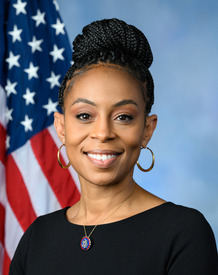
See how Shontel M. Brown's votes line up with your values.
DeepSyte scores Shontel M. Brown's record on the issues you care about — not party, not press releases. Take the 2-minute values quiz to see your personal alignment.
Sign in and take the values quiz to see how Shontel M. Brown's votes line up with your views.
Prediction track record
How often we called Shontel M. Brown's passage votes correctly, from their stated positions on each bill's tagged topics. Excludes “unclear” calls and abstentions.
39 predictions on record · none have been resolved by a passage vote yet. Check back as bills move.
Pending vote119-hr-8656
To require the Department of Justice to procure ballistic-resistant body armor manufactured using domestic ballistic fibers.
No paired statements and votes yet for Shontel M. Brown
We haven't yet found statement/vote pairs on the same topic for Shontel M. Brown. This usually means either the rep hasn't taken public positions on bills that have come to a passage vote, or those bills haven't been tagged yet. The checker runs as new press releases and votes come in.
Pro analysis
AI rep analysis — Pro
Get an AI-narrated read on Shontel M. Brown's full voting record against your stated values — aligned themes, conflicts, notable votes, and what to watch for.
Positions Shontel M. Brown took during their campaign, scored against their subsequent record — public statements cross-checked with related votes. “Kept” means 80%+ of those statement-vs-vote pairs aligned; “Broken” means 30% or fewer.
0 kept0 broken0 mixed0 no action yet
Shontel M. Brown has 19 tracked positions but no scored statement-vs-vote pairs touching them yet. Verdicts will appear here as related statements and votes accumulate.
No action yetSupports
The government should provide healthcare for everyone.
“I would vote for Medicare for All if it came to the House floor.”
Ghost guns and unfinished firearm components should be regulated as firearms under federal law.
“prohibit the selling of plastic 3D guns online. In addition, I will ban the sale of gun kits that turn semi-automatic weapons into fully automatic weapons.”
The government should set legally enforceable limits on greenhouse gas emissions.
“I support the principles laid out in the Green New Deal and I am committed to aggressive action on climate change with net-zero emissions by 2050 and a carbon-free power sector by 2035.”
No party-break passage votes recorded for Shontel M. Brown. Either they've voted with Democrats on every substantive passage vote in the corpus, or their tenure overlaps few high-threshold party-line votes so far.
Reps. Brown, McClellan, and Salinas Introduce Legislation to Support New and Underserved Farmers
Position: The release supports introduction of the Farming Opportunities Training and Outreach Grant Program Reauthorization Act (H.R. 10914), which would reauthorize the FOTO Program from 2027 to 2031, allow grants for interpretation and translation services, and require USDA to collect and report demographic data on grant recipients.
Washington, DC – Shontel Brown (OH-11), Vice Ranking Member of the House Committee on Agriculture, Congresswoman Jennifer McClellan (VA-04) and Congresswoman Andrea Salinas (OR-06) have introduced the Farming Opportunities Training and Outreach Grant Program Reauthorization Act (H.R. 10914), to better support new, underserved and veteran farmers with improved access to training, education and technical assistance.
Read the full bill text here.
The food and agriculture sector serves as a pillar of Ohio's economy, employing 1 in 8 Ohioans and contributing $124 billion annually to the state's economic output. Despite this baseline stability, family-owned operations face increasing economic strain, culminating in 400 Ohio farms shutting down operations over a single year according to data from the U.S. Department of Agriculture (USDA). New farmers, especially those from underserved communities, can face immense challenges getting their business off the ground. The Farming Opportunities Training and Outreach (FOTO) Program improves success rates for these farmers.
“Agriculture offers an array of rewarding careers and opportunities for people from every background, but we must do more to make sure everyone who wants to get into the industry has a fair shot. That’s why I’m proud to join Congresswoman Jennifer McClellan on the Farming Opportunities Training and Outreach Grant Program Reauthorization Act. This important legislation reauthorizes and strengthens the FOTO program and helps ensure that the USDA reaches the producers it is intended to serve,” said Congresswoman Shontel Brown, Vice Ranking Member House Committee on Agriculture.
This bill reauthorizes the FOTO Program from 2027 to 2031. It would also ensure the program can better serve the growing number of Hispanic, American Indian, Black and Asian farmers by allowing grants to support interpretation and translation services as part of outreach and technical assistance. The bill would additionally strengthen accountability by requiring USDA to collect and report data on FOTO grant awards and recipients, including demographic information, to help ensure the program is effectively reaching the producers it is intended to serve.
“As the number one private industry in Virginia, agriculture keeps our local economies and communities running. Yet Virginia’s farms, more than 90 percent of which are individual or family-owned, often struggle to turn a profit. Extreme weather, rising costs and unstable markets make the difference between a good year and a bad year,” said Congresswoman McClellan. “The FOTO Program exists to lend a helping hand to underserved farmers just starting out to navigate these challenges. My bill will extend this invaluable resource to further ensure that our farmers have every tool at their disposal to thrive.”
“Farmers and ranchers are the backbone of Oregon’s economy, but too many people who want to start a farm have trouble getting the training and resources they need to succeed,” said Congresswoman Salinas. “In the Willamette Valley, we know how important it is to support the next generation of farmers and ensure that everyone has a fair shot at success. This bill will help new farmers access the training, mentorship, and technical assistance they need, while breaking down language barriers that too often stand in their way. I’m proud to help lead this effort to strengthen our agricultural communities and support the next generation of farmers.”
This bill is endorsed by the National Family Farm Coalition, Rural Coalition, Virginia Coalition of Immigrant Rights (VACIR) and Virginia State University.
###
Issues:Economy and Economic DevelopmentNutrition and Agriculture
Brown, Adams, and Rivas Lead Letter Calling on Trump Administration to Reverse Decision to Terminate Minority Science Programs
Position: The members oppose the Department of Justice's decision to terminate three National Science Foundation STEM programs supporting minority participation, and call on the Administration to reverse course and strengthen these programs. They also request documentation supporting the decision and whether the NSF was consulted on the programs' effectiveness.
Washington, DC – Congresswoman Shontel Brown (OH-11), Congresswoman Alma Adams (NC-12) and Congresswoman Luz Rivas (CA-29) have written to the Department of Justice (DOJ) calling on the Administration to reverse their decision to terminate three National Science Foundation (NSF) grant programs supporting minority participation in STEM education and employment.
Brown, Adams, Rivas, and the letter’s cosigners have demanded DOJ’s documentation and evidence supporting their decision and asked if they consulted with the NSF on the programs’ effectiveness. The letter calls for “the Department to reverse course and strengthen, instead of dismantling, the pathways that allow students from every background and community to contribute to our nation’s future.”
On August 12, 2026, the Department of Justice Office of Legal Counsel (OLC) issued an opinion declaring three NSF STEM programs unconstitutional and directing their termination: the Louis Stokes Alliances for Minority Participation (LSAMP), the Alliance for Graduate Education and the Professoriate Program(AGEP), and the Improving Undergraduate STEM Education program (IUSE-HSI).
In 1991, Congress created the Alliances for Minority Participation to support students from underrepresented groups in STEM disciplines. Other programs followed, including AGEP, which is intended to broaden participation in the STEM workforce, and IUSE-HSI, which was designed to strengthen STEM capacity at Hispanic-Serving Institutions. These three programs accounted for approximately $104 million of the $938 million that Congress appropriated to NSF under the STEM Education (EDU) account for the benefit of thousands of students.
Brown, Adams, and Rivas note in their letter that these programs have been supported by Congress for four decades and that the OLC’s opinion “effectively prohibits Congress from addressing systemic disparities.”
The members write, “At a time when the nation should be working to expand its STEM workforce, this Administration is continuously eliminating programs that are designed to ensure that gifted and talented students from all backgrounds have access to training and experience in scientific disciplines. The OLC opinion is part of a broader pattern of attacking diversity, equity, and inclusion initiatives and programs throughout the federal government. It will undermine the work Congress has done for decades to strengthen scientific education, research, and workforce.”
Congressman Louis represented Cleveland and Northeast Ohio for thirty years (1969-1999) and was the first African American elected to Congress from Ohio. The LSAMP program was established in 1991 and renamed for Stokes in 1999.
In addition to Brown, Adams, and Rivas, the letter was cosigned by 15 other members of the House of Representatives: Rep. Yvette Clarke, Rep. Adriano Espaillat, Rep. Adelita Grijalva, Rep. Jonathan Jackson, Rep. Robin Kelly, Del. Eleanor Holmes Norton, Rep. Lucy McBath, Rep. Jennifer McClellan, Rep. Melanie Stansbury, Rep. Shri Thanedar, Rep. Dina Titus, Rep. Paul Tonko, Rep. George Whitesides, Rep. Nikema Williams, and Rep. Frederica Wilson.
The text of the letter is copied below:
The Honorable Todd Blanche
Attorney General
U.S. Department of Justice
950 Pennsylvania Ave, NW
Washington, DC 20530
Elliot Gaiser
Assistant Attorney General
DOJ Office of Legal Counsel
950 Pennsylvania Avenue, NW
Washington, DC 20530
Dear Attorney General Blanche and Assistant Attorney General Gaiser,
We write to express our profound opposition to the Department of Justice Office of Legal Counsel (OLC) opinion issued August 12, 2026, declaring three National Science Foundation (NSF) STEM programs unconstitutional and directing their termination.[1] This opinion is the latest step in a coordinated effort by this Administration to dismantle decades of bipartisan work expanding educational opportunities for minorities historically underrepresented in STEM. Ensuring that students from minority communities have access to STEM programs is vital to strengthening our American scientific workforce and ensuring that the United States remains globally competitive in science and technology.
The opinion targets the Louis Stokes Alliances for Minority Participation (LSAMP), the Alliance for Graduate Education and the Professoriate Program (AGEP), and the Improving Undergraduate STEM Education program (IUSE-HSI). These programs accounted for approximately $104 million of the $938 million that Congress appropriated to NSF under the STEM Education (EDU) account for the benefit of thousands of students.[2]
For most of our nation’s history, Black Americans, Hispanic Americans, Indigenous Americans, and other minority groups were denied access to educational institutions, scientific professions, and research opportunities. Congress has worked diligently to ensure Americans from all backgrounds can participate in STEM. In 1991, Congress created the Alliances for Minority Participation (later renamed the Louis Stokes Alliance for Minority Participation) to support students from underrepresented groups in STEM disciplines.[3]Other programs followed, including AGEP, which is intended to broaden participation in the STEM workforce, and IUSE-HSI, which was designed to strengthen STEM capacity at Hispanic-Serving Institutions.[4]
Moreover, the last four decades have established a clear and consistent record of congressional intent. Congress has held hearings, stood up, funded, and conducted oversight on each of these programs. These efforts have established that these programs achieve a compelling government interest in remedying current and historic discrimination and the underlying statute was successful in narrowly tailoring each of these programs to achieve their purposes. OLC’s opinion ignores both our nation’s social history and congressional intent.
Under OLC’s opinion, the government can only remedy past discrimination through specific identified instances and has no compelling interest to address societal disparities.[5] This narrow interpretation effectively prohibits Congress from addressing systemic disparities.
At a time when the nation should be working to expand its STEM workforce, this Administration is continuously eliminating programs that are designed to ensure that gifted and talented students from all backgrounds have access to training and experience in scientific disciplines. The OLC opinion is part of a broader pattern of attacking diversity, equity, and inclusion initiatives and programs throughout the federal government. It will undermine the work Congress has done for decades to strengthen scientific education, research, and workforce.[6]
We therefore request answers to the following questions no later than November 12, 2026:
Did OLC consult with NSF regarding the effectiveness and outcomes of LSAMP, AGEP, and IUSE-HSI?
What evidence did OLC rely on to conclude the government had no compelling governmental interest in supporting these programs?
Please provide all memoranda, analyses, briefing materials, drafts, and supporting documentation relied upon in reaching the conclusions contained in the August 12 opinion.
Congress has continued to support and fund these programs because our nation cannot afford to leave talent on the sidelines and ignore that discrimination exists. OLC’s decision to ignore this simple principle and instead lead with ideology threatens to weaken not only the scientific workforce but also American innovation and economic growth.
We urge the Department to reverse course and strengthen, instead of dismantling, the pathways that allow students from every background and community to contribute to our nation’s future.
Cc: Brian Stone, Chief of Staff, Performing the Duties of the Director of the National Science
Foundation
[Signatures]
[1] https://www.justice.gov/olc/media/1457731/dl
[2]https://www.appropriations.senate.gov/imo/media/doc/fy26_cjs_jes.pdf
[3] https://www.ncat.edu/provost/nclsamp/index.php
[4] https://www.insidehighered.com/news/government/science-research-policy/2026/08/14/doj-declares-3-race-based-stem-programs
[5] https://www.justice.gov/olc/media/1457731/dl pg 5
[6] https://www.justice.gov/olc/media/1457731/dl pg 5
###
Brown Introduces Legislation to Require Labels on AI-Generated Campaign Content
Position: Introduces legislation to prohibit the use of AI to deprive or defraud individuals of voting rights and to require disclaimers on AI-generated campaign content, enforced by the Federal Trade Commission.
Washington, DC – Congresswoman Shontel Brown (OH-11) has introduced the Securing Elections from AI Deception Act, legislation to prohibit the use of artificial intelligence (AI) to deprive or defraud individuals of their right to vote and require disclaimers on AI-generated content.
The legislation would be enforced by the Federal Trade Commission and applies to federal, state, and local campaign content. The Securing Elections from AI Deception Act is endorsed by the NAACP, the Lawyer’s Committee for Civil Rights Under Law, and NETWORK Lobby for Catholic Social Justice. The legislation has 30 cosponsors in the House. Bill text available here.
This week, the New York Times reported that over $130 million in AI-generated ads have flooded the airwavesthis election year. According to analysis by Wesleyan University, 69% of ads with AI content do not have disclaimers.
Campaign ads featuring deceptive AI-generated have proliferated in recent years (Wall Street Journal, Reuters, New York Times), including ads featuring deepfake video and audio. In 2024, deepfake images of Trump with Black supporters spread online. In addition to deceiving voters, AI could also be used to spread false information regarding election information as a tactic to suppress voting rights. In 2020, robocalls targeting Black voters in Ohio spread deliberately false information relating to voting by mail procedures. AI technology has the potential to encourage similar efforts in the future and make them more persuasive.
“This isn’t complicated: voters deserve to know that the campaign content they see and hear is real. We need labels on AI-generated election content and we need to hold accountable those who use AI to knowingly spread false information. Pairing the latest technology with old-school dirty tricks is a dangerous combination. I’m proud to introduce the Securing Elections from AI Deception Act and will continue to defend the voting rights of every American,” said Congresswoman Shontel Brown.
“Artificial intelligence cannot become another tool for voter deception and suppression. Black communities have long been targeted by efforts to mislead, intimidate, and exclude voters, and new technology can make those tactics more sophisticated and harder to detect. The Securing Elections From AI Deception Act puts necessary guardrails in place to protect voters and our democracy. The NAACP applauds Congresswoman Brown for her continued leadership,” said Cedric C. Haynes, NAACP’s Senior Vice President of Policy and Legislative Affairs.
“Every voter should know that the basic information they receive about how to vote and register is accurate. But without action from Congress, information can be as artificial as the so-called intelligence at creates it. With the growth of AI tools powering dis-information, we need to pass the Securing Elections from AI Deception Act so that Black voters are protected and the sources of dis-information are held accountable,” said Chanel Sherrod, Policy Advisor at the Lawyers’ Committee for Civil Rights Under Law.
Brown serves at the Ranking Member on the Cybersecurity, Information Technology, and Government Innovation Subcommittee on the House Oversight Committee. Brown first introduced the Securing Elections from AI Deception Act in 2024.
The Securing Elections from AI Deception Act
Requires Disclaimers on Election-Related Content Generated by Artificial Intelligence
Requires the use of a disclaimer for AI generated election content related to AI-generated images, text, video, audio or other media that includes
a simulation, alteration, or distortion of an image, video or audio of a candidate for federal, state, or local office
information about the time, place, manner, or requirements for voting or registering to vote for Federal, State, or local office
The disclaimer for AI generated content must include either:
the statement “AI Disclaimer: This output was generated by artificial intelligence” or
a symbol, similar in size and design to the copyright symbol, consisting of the letters “AI” in a circle
The disclaimer requirement would be regulated and enforced by the Federal Trade Commission under the authority of the Federal Trade Commission Act regarding unfair or deceptive practices
The Federal Trade Commission would be required to educate the public on the meaning and use of the disclaimer and report to Congress on its adoption and effectiveness
Prohibits the Use of Artificial Intelligence to Deprive or Defraud Individuals of the Right to Vote
Bars developers or deployers of artificial intelligence from using AI to intentionally deprive or defraud an individual of the right to vote in an election.
Including providing deceptive information regarding:
the time, place, or method of voting
eligibility requirements to vote or register to vote
the counting of ballots
the adjudication of elections
endorsements
the procedures or requirements for voting
Using deception, threats, intimidation, fraud, or coercion to prevent, interfere, or deter, or to attempt to prevent, interfere, or deter an individual’s right to
register to vote, vote, support or advocate for a candidate
serve as an election worker
Establishes a penalty of a fine or imprisonment for violating these prohibitions
###
Issues:Civil Rights
Brown, Casar Demand Answers on FBI’s Plan to Buy Mass Surveillance Systems, Including Flock Cameras
Position: Representatives Brown and Casar request information from the FBI about its planned acquisition of automatic license plate reader systems, including Flock and Motorola Solutions systems, and express concern that such access would expand government surveillance of civilians.
Washington, D.C. – Today, Congresswoman Shontel Brown (OH-11) and Congressman Greg Casar (TX-35) sent a letter demanding answers and transparency from the Federal Bureau of Investigation (FBI) Director Kash Patel on the FBI’s planned increase of mass surveillance systems, such as Flock.
Brown and Casar both serve on the House Committee on Oversight. Brown is Ranking Member on the Subcommittee on Cybersecurity, Information Technology, and Government Innovation, Casar is Ranking Member on the Subcommittee on Federal Law Enforcement.
In May 2026, the FBI issued a Request for Proposals (RFP) to acquire automatic license plate readers (ALPR) systems, including Flock and Motorola Solutions, that offer the ability to search for license plate information “and other descriptive data such as vehicle description information, time/date criteria, and geo-location criteria.” Flock and Motorola Solutions, whose ALPR systems are used by local police departments, likely possess the capabilities to satisfy this RFP. While the FBI already runs a License Plate Reader (LPR) program through the National Crime Information Center (NCIC) to facilitate LPR information sharing with and between its law enforcement partners, the FBI’s plan to obtain direct access to an extensive network of cameras—such as those operated by Flock and Motorola—would dramatically expand the license plate data currently held by the FBI and institute “near real time” surveillance of civilians.
The Members of Congress write: “The American people are clearly concerned about law enforcement having access to Flock data and about government surveillance more broadly. Entering into a contract that would give the nation’s largest law enforcement agency access to Flock data across the country would subvert the clear preference of the American people.”
The Oversight and Government Reform Committee Democrats are requesting information by October 16, 2026.
Read the full letter here.
###
Issues:Congress
As Grocery Prices Skyrocket, Brown Sounds Alarm on New Trump SNAP Cut Taking Effect Today
Position: Opposes the H.R. 1 reconciliation law's cuts to federal SNAP administrative funding and benefits, and calls on Congress to reverse these cuts through the Farm Bill.
Washington, D.C. - Today, Congresswoman Shontel Brown (OH-11), Vice Ranking Member on the House Agriculture Committee, warned that another SNAP cut from H.R. 1, the Republican Reconciliation Law, has gone into effect.
The Supplemental Nutrition Assistance Program (SNAP) is federally funded and administered by states. H.R. 1 cut the federal share of funding for SNAP administrative costs in half, meaning that states are now required to cover 75% of SNAP administrative costs. Nationwide, this represents billions in reduced funding for SNAP.
In Ohio, this has meant a loss of an estimated $38 million in SNAP funding effective today, and potential annual cuts of $67 million. Earlier this year, the Republican-controlled Ohio legislature allocated only $12.5 million to cover this gap, leaving Ohio’s largest counties (which administer SNAP locally) with a substantial funding deficit. Cuyahoga County received the same administrative funding patch as Ohio’s smallest counties and now faces a funding gap of $7 million. For state-by-state estimates of SNAP funding cuts effective today, click here.
The reduction of administrative funding leaves states and counties with fewer resources to process applications, determine eligibility, and ensure families receive the benefits they are eligible for. This massive funding cut also jeopardizes other state and local services as states struggle to replace this lost funding. A similar cost shift, cutting federal payments to states for SNAP benefits, will go into effect October 1, 2027.
“Trump and Republicans in Congress passed tax breaks for millionaires and billionaires on the backs of families who are already struggling to afford sky-high grocery costs. Over 5 million Americans have already lost SNAP food assistance because of Trump’s cuts, and today, another SNAP cut from the Big, Ugly Law kicks in. Trump and Republicans have handed states huge SNAP funding cuts, with more cuts coming next year. Worse still, these administrative cuts are coming as Republicans have also made SNAP more difficult to access. They’ve created new paperwork and new requirements, then cut the funding used to enroll people. It’s a devastating gut punch and it’s intentional: this is a plan to wreck state SNAP programs and push millions off of SNAP and into hunger. Congress must fix these cuts through the Farm Bill and protect families who rely on SNAP to keep food on the table,” said Congresswoman Shontel Brown.
According to USDA data, more than 5 million Americans, including about 2 million children, have already lost SNAP since H.R. 1 was enacted in July 2025. In Ohio, over 120,000 people have already lost SNAP.
H.R.1’s SNAP cuts were enacted alongside cuts to Medicaid and other programs to pay for tax cuts that overwhelmingly benefited large corporations and the wealthiest Americans. The Republican Farm Bill which passed the House and is currently under consideration in the Senate, locks in $187 billion in SNAP cuts. Republicans rejected all Democratic attempts to roll back SNAP cuts in the House Farm Bill.
Separately, a SNAP cost-of-living-adjustment, or COLA, took effect today. The COLA was authorized through the 2008 Farm Bill, and Republicans have repeatedly attempted to kill and weaken SNAP benefit increases. Last year, Brown introduced The Hunger Free Future Act, new legislation to block any changes to the Thrifty Food Plan, which uses economic data to determine benefit size, which would result in benefit cuts.
###
Issues:Nutrition and Agriculture
Brown Introduces Legislation to Address Nationwide Veterinarian Shortage, Encourage Next Generation to Work in Animal Medicine
Position: The release supports federal competitive grants through the USDA for work-based learning programs that expose high school students to veterinary medicine, in order to address nationwide veterinarian shortages. It is endorsed by the AAVMC and The Ohio State University.
Washington, D.C. – Congresswoman Shontel Brown (OH-11), Vice Ranking Member on the House Committee on Agriculture has introduced legislation to create a competitive federal grant program supporting work-based learning programs exposing high school-aged students to veterinarian medicine.
The VET CARE Act (Veterinary Expansion and Training for Comprehensive Animal Resources and Education Act) authorizes the United States Department of Agriculture (USDA) to provide federal grants to schools, 4-H or FFA organizations, veterinary clinics and hospitals, or veterinary and animal health offices to create, develop, or expand work-based learning programs focused on veterinary medicine.
In 2025, the USDA identified veterinarian shortages in 46 states. According to a 2025 report by the Ohio Department of Agriculture, The Ohio State University College of Veterinary Medicine, and the Farm Journal Foundation, Ohio faces a veterinarian shortage of 600 to 1,000 veterinarians by the next decade. That report surveyed Ohio stakeholders who rated the severity of the crisis at a “7.9 out of 10.”
Due to a lack of servicing and providers available, farmers and ranchers in all regions face a bottleneck of services due to overcrowding at shelters, private practices, and emergency care facilities.
Full text of the bill can be found by clicking here.
“If we want more veterinarians serving our ranchers and rural communities, we need to start by showing young people that this is a career they can pursue. The Vet CARE Act would help schools and communities give students hands-on experience and a real look at what it means to work in veterinary medicine. By introducing students to these careers early, we can open doors for young people and build a stronger pipeline of veterinarians for the communities that need them most,” said Congresswoman Shontel Brown.
The VET CARE Act is supported by the American Association of Veterinary Medical Colleges and The Ohio State University.
“Through our mission of promoting excellence in academic veterinary medicine, the American Association of Veterinary Medical Colleges (AAVMC) knows that efforts to alleviate the veterinarian workforce shortage start long before students reach professional school classrooms. That is why we are encouraged by the VET CARE Act's work-based learning programs, which will give high school students real, hands-on exposure to veterinary medicine and a clearer pathway toward long-term employment in large-animal and food-animal veterinary practice, where our nation really needs help. We are proud to endorse a bill that aims to strengthen the veterinary pipeline from the ground up,” said Emma K. Read, Chief Executive Officer of the American Association of Veterinary Medical Colleges
“Addressing veterinary workforce shortages requires a long-term commitment to building and sustaining the pipeline of professionals who protect animal health, public health, and our food systems. Through our Protect One Health in Ohio (Protect OHIO) initiative, we are collaborating with the State of Ohio, agricultural partners, Ohio colleges and communities across the state to recruit and support future rural and large-animal veterinarians, reduce financial barriers to veterinary education and help graduates return to serve the communities that need them most,” said Dr. Rustin M. Moore, Rita Jean Wolfe Endowed Dean at the College of Veterinary Medicine at The Ohio State University. “The VET CARE Act would complement and amplify these efforts by creating additional opportunities for students to gain practical experience and pursue careers in the rural and agricultural communities in Ohio and across the nation where this highly specialized workforce is needed most. We are grateful to Congresswoman Brown for their leadership in advancing this important legislation and for recognizing the critical roles that veterinarians, veterinary technicians, animal scientists, diagnosticians, epidemiologists, food-safety specialists, animal-husbandry professionals and others across the agricultural workforce play in protecting our nation’s animal health, food supply, public health and rural communities.”
"Preparing the next generation of veterinarians and animal health professionals is essential to Ohio agriculture and the strength of our rural communities. The VET CARE Act would strengthen the pipeline of rural and large-animal veterinarians through expanded hands-on experience, rural community immersion, and partnerships with schools, 4-H, FFA, and communities across the state, while training our future workforce. We greatly appreciate Congresswoman Brown leadership in advancing this important legislation," said Dr. Cathann A. Kress, Vice President for Agricultural Administration and Dean of the College of Food, Agricultural, and Environmental Sciences at Ohio State University.
###
Issues:Nutrition and Agriculture
Reps. Brown, McBath, Sen. Merkley Introduce Legislation to Reduce Class Sizes
Position: The release supports federal funding through a $2 billion competitive grant program to reduce K–3 class sizes in low-income public elementary schools to no more than 18 students per class, via the Smaller Class Sizes for Students and Educators Act (H.R. 10631).
Washington, D.C. – Congresswoman Shontel Brown (OH-11), Senator Jeff Merkley (OR) and Congresswoman Lucy McBath (GA-07) have reintroduced the Smaller Class Sizes for Students and Educators Act. This legislation would provide funding for schools to reduce class sizes and increase individualized attention from instructors—improving the overall school experience for both students and educators.
Research shows students achieve better academic results with more individualized attention from instructors, especially in kindergarten through third grade. However, the continued strain on our public education system from staff shortages and tighter budgets has meant class sizes have continued to grow.
The Smaller Class Sizes for Students and Educators Act (H.R. 10631) would establish a $2 billion competitive grant program to help school districts reduce K–3 class sizes in low-income public elementary schools to not more than 18 students per class. The grants could be used to recruit, hire, and support qualified teachers; obtain additional space or renovate school buildings; or provide professional development for teachers, among other purposes.
Full text of the bill can be found by clicking here.
“Smaller class sizes can help ensure that every child gets the time and attention they need to succeed. I am proud to join Congresswoman McBath and Senator Merkley in reintroducing the Smaller Class Sizes for Students and Educators Act so that students get the support they need and educators are able to instruct every student. Importantly, this legislation provides school districts with an opportunity for federal funding to make smaller class sizes a reality,” said Congresswoman Shontel Brown.
“Every student deserves the chance to learn, participate, and get the individual attention they need to thrive,” said Senator Jeff Merkley. “Growing up as an Oregon public school student, I remember having around 20 children in my first-grade class. When I dropped my son off for his first day of school, his class had 34 children, and I wondered how his teacher could organize and teach such a large group. It’s time to make sure our schools have the resources they need to support educators and help every child receive a quality learning experience.”
“Smaller class sizes help personalize education in ways that can fuel a child’s love of learning. When teachers have more opportunities for one-on-one time with their students, they can provide tailored instruction, individualized feedback, and the support each child needs to thrive,” said Congresswoman Lucy McBath. “I am deeply appreciative of Senator Merkley for his continued leadership on this important legislation and his advocacy for students and educators. Investments like these, which strengthen learning environments and support teacher well-being, are essential to improving educational outcomes and ensuring every child has the opportunity to succeed.”
The Smaller Class Sizes for Students and Educators Act is cosponsored by U.S. Senators Richard Blumenthal (D-CT), Cory Booker (D-NJ), Dick Durbin (D-IL), and Elizabeth Warren (D-MA).
The bill is also supported by the American Federation of Teachers, First Focus Campaign for Children, National Education Association, and National Parent Teacher Association.
“Parents, students and educators all agree that overcrowded classrooms do not make a successful learning environment. Class size matters because it is directly linked to higher rates of student success: Students are more engaged and teachers can provide the individualized instruction students need and deserve. The Smaller Class Sizes for Students and Educators Act, led by Sen. Jeff Merkley and Reps. Lucy McBath and Shontel Brown, helps all of America’s school districts reduce class size and is a vote of confidence in the future success of our nation’s public schools,” said Randi Weingarten, president of the American Federation of Teachers.
###
Issues:Education
Brown, Blunt Rochester, Gimenez Introduce Legislation to Preserve and Repair Distressed Affordable Multifamily Housing
Position: The release supports creating a new federal loan program to finance renovation and preservation of HUD-assisted affordable multifamily housing, and giving HUD additional tools to intervene in distressed properties.
Washington, DC – Congresswoman Shontel Brown (OH-11), Senator Lisa Blunt Rochester (DE), and Congressman Carlos Gimenez (FL-28) have introduced legislation to preserve and repair affordable housing and help more families remain in their homes and access affordable housing. The Affordable Housing Preservation and Protection Act creates a new federal loan program for renovations to HUD-assisted housing. This new loan program would improve existing housing stock and help make sure that the affordable housing shortage does not get worse as older properties fall into disuse.
According to National Low Income Housing Coalition (NLIHC), the U.S. has an affordable rental home shortage of 7.2 million. This means that only 35 affordable and available rental homes exist for every 100 low-income households. The NLIHC analysis found that Ohio has an affordable housing gap of over 265,000 units, including a 54,000 affordable unit housing shortage in the Cleveland Metro area. A 2025 study by Cuyahoga County cited “aging infrastructure” and “the need for robust rehabilitation programs” as key local housing challenges. The median home in the Cleveland Metro Area was built in 1963 and is now 63 years old and 22% of homes in Cleveland were built before 1940.
Cleveland has seen firsthand the challenges of preserving distressed federally assisted multifamily housing. Rainbow Terrace, a HUD-assisted apartment complex in the Garden Valley neighborhood, has faced decades of federal intervention, rehabilitation efforts, and resident concerns about property conditions, including a fatal explosion in 2025. The Affordable Housing Preservation and Protection Act would give HUD an additional tool to intervene when assisted multifamily properties face serious physical deficiencies and existing rents cannot support the financing needed for rehabilitation.
“We must address the affordable housing crisis from all angles. This means building more affordable housing, but it also means preserving the housing we already have. I’m proud to partner with Senator Blunt Rochester and Congressman Gimenez on The Affordable Housing Preservation and Protection Act, which provides needed capital to repair, renovate, and preserve HUD-assisted housing. Cleveland has seen at properties like Rainbow Terrace how serious the consequences can be when federally assisted multifamily housing falls into distress. This bill gives HUD another tool to finance critical repairs, preserve long-term affordability, and, when necessary, help qualified new owners step in before affordable housing is lost,” said Congresswoman Shontel Brown.
“Earlier this year, the first comprehensive housing legislation became law after more than three decades, but with a nationwide shortage of nearly 4-7 million affordable housing units, it becomes more important than ever to preserve the affordable units that we do have,” said Senator Blunt Rochester. “I’m proud to introduce this bill alongside Congresswoman Brown to build on the achievements of the 21st Century Road to Housing Act by providing long-overdue support for existing affordable housing units and encouraging investments that contribute to their long-term success.”
The Affordable Housing Preservation and Protection Act is endorsed by: the Local Initiatives Support Coalition (LISC), the National Association of Realtors (NAR), the National Housing Trust (NHT), the National Housing & Rehabilitation Association (NH&RA), the National Leased Housing Association (NLHA), the Housing Partnership Network, the Preservation of Affordable Housing (POAH), the Ohio Credit Union League, Better Homes of Seaford, the Delaware League of Local Governments, the Metropolitan Wilmington Urban League (MWUL), the Wilmington Housing Authority, WRK Group, and YWCA Delaware.
The Affordable Housing Preservation and Protection Act is part of Congresswoman Brown’s Safe and Affordable Housing Agenda, a legislative package announced by Brown in June that also includes legislation to strengthen lead-removal efforts and to encourage more new homebuilding.
Former Ohio Senator Sherrod Brown first introduced the Affordable Housing Preservation and Protection Act in 2024. This is the first time the bill has been filed in the House.
The Affordable Housing Preservation and Protection Act
Provides loans to qualified owners of distressed HUD-assisted multifamily housing to make renovations necessary to preserve and improve the property.
Loans provided would be at 1% interest for the length of the 30-year affordability period.
Eligible recipients would be HUD-approved purchasers and owners of federally assisted multifamily housing.
###
Issues:Infrastructure
Brown Calls on GE HealthCare to Engage in Good-Faith Negotiations with Workers at Aurora Facility
Position: Congresswoman Brown urges GE HealthCare to engage in regular, good-faith collective bargaining with IAM Local 1363 workers at its Aurora, Ohio facility toward a first contract, and references House passage of the Faster Labor Contracts Act, which she cosponsored, to prevent employers from prolonging first-contract negotiations.
Cleveland, OH – Congresswoman Shontel Brown (OH-11) has written to GE HealthCare urging them to negotiate in good faith with workers represented by the International Association of Machinists and Aerospace Workers (IAM) Local 1363 at the facility in Aurora, Ohio.
In her letter to Peter J. Arduini, President and Chief Executive Officer of GE Healthcare, Brown cited “prolonged delays and a lack of meaningful progress at the bargaining table.” Brown called on the company to “meet its obligations under federal labor law, engage in regular and meaningful good-faith negotiations, and work toward a fair first contract in a timely manner.”
In June, the House passed the bipartisan Faster Labor Contracts Act, legislation cosponsored by Brown, to ensure that when workers vote to form a union, employers are not allowed to drag out negotiations on first contracts.
The text of the letter is copied below:
Peter J. Arduini
President and Chief Executive Officer
GE HealthCare
500 W. Monroe Street
Chicago, IL 60661
Dear Mr. Arduini:
I write regarding the ongoing negotiations between GE HealthCare and approximately 130 employees at your Aurora, Ohio facility represented by the International Association of Machinists and Aerospace Workers (IAM) Local 1363. These employees voted in January 2025 to join IAM and have been working to secure their first collective bargaining agreement ever since.
The work performed at the Aurora facility is critical to GE HealthCare’s mission and to Northeast Ohio’s advanced manufacturing economy. Your employees in Aurora manufacture coils used in MRI machines that help physicians diagnose and treat patients around the world.
I have heard from constituents who have described prolonged delays and a lack of meaningful progress at the bargaining table. According to those constituents, negotiations have continued for more than 18 months, while GE HealthCare has declined to meet on a regular bargaining schedule and did not provide comprehensive economic proposals until July 2026. Those proposals reportedly included wages below some employees’ current rates of pay, reductions in paid time off, and increased health care costs for employees and their families.
I also understand that IAM has filed two unfair labor practice charges with the National Labor Relations Board (Cases 08-CA-374224 and 08-CA-385852) concerning GE HealthCare’s conduct during negotiations, including allegations that the company has refused to meet regularly and withheld annual merit raises in 2026.
I recognize that these allegations remain before the NLRB and that the Board is responsible for determining their merits. Nevertheless, the National Labor Relations Act protects employees’ rights to organize and bargain collectively through representatives of their choosing and requires employers and unions to bargain in good faith. I urge GE HealthCare to respect both the letter and spirit of these protections and refrain from any conduct that could interfere with employees’ exercise of their federally protected rights.
I urge GE HealthCare to meet its obligations under federal labor law, engage in regular and meaningful good-faith negotiations, and work toward a fair first contract in a timely manner. I recognize that the terms of any agreement must be determined through the collective bargaining process and do not seek to dictate its outcome. However, after more than 18 months of negotiations, these employees deserve a consistent, constructive, and good-faith bargaining process.
Thank you for your attention to this important matter. I look forward to your response and to a resolution that supports GE HealthCare’s employees, the company, and the patients and communities that depend on their work.
Sincerely,
Shontel M. Brown
Member of Congress
Ag Vice Ranking Member Brown, Ranking Member Craig Press Chairman Thompson on Oversight
Position: The release urges the House Agriculture Committee chairman to hold oversight hearings on the current farm economic crisis and on policy changes needed to address it. It attributes rising farm input costs and food and gas prices in part to the administration's tariffs and military actions in the Middle East.
WASHINGTON – Yesterday, House Agriculture Committee Vice Ranking Member Shontel Brown (OH-11) and Ranking Member Angie Craig (MN-02) and urged Chairman Glenn “GT” Thompson to fulfill Congress’ oversight responsibilities on behalf of America’s farm families. This follows a January 2026 letter, which provided a list of potential oversight hearing topics for the chairman.
The lawmakers write: “Unfortunately, since we sent [the January] letter, things have only gotten worse. The administration launched its seemingly never-ending and illegal war with Iran, which the former agricultural leaders correctly point out is contributing to the challenges farmers are facing with high input prices. […]
“With only 15 legislative days until Congress adjourns for October, the Committee should be using its few legislative days left to conduct oversight examining in depth (1) the current farm crisis and (2) what policy changes or improvements are needed to correct this continued downward spiral the American agricultural economy appears to stuck in.”
Read the letter here.
President Trump’s inflationary tariffs and illegal wars in the Middle East have cost farmers tens of billions of dollars and increased the price of food and gas for everyday Americans. House Republicans have done nothing to speak up against the president’s backward priorities which are costing hardworking Americans and putting farmers out of business.
###
Issues:Nutrition and Agriculture
Source: GDELT 2.0 GKG, filtered to a curated list of national outlets. Inclusion is not endorsement; opinion pieces and reported news are mixed.
Recent stock activity
Periodic transaction reports filed under the STOCK Act — disclosed by the rep, sourced from public filings.
No disclosed trades on record.
Source: open-data mirrors of the Senate eFD and House Clerk financial-disclosure systems. Disclosure within 30 days of trade is required by law (45 for spouse/dependent trades).
Top PAC donors · 2026 cycle
Political action committees that gave the most to this rep's principal campaign committee this cycle. PAC giving is direct organizational support — industry, ideological, or leadership.
1.PEANUTPAC OF ALABAMA4 contributions$12,500
2.Z-PAC3 contributions$10,000
3.ROCKET PAC4 contributions$10,000
4.OHIO CORN & WHEAT GROWERS ASSOCIATION PAC2 contributions$10,000
5.NATIONAL PECAN FEDERATION INC. POLITICAL ACTION COMMITTEE (PECAN PAC)2 contributions$10,000
6.INTERNATIONAL BROTHERHOOD OF ELECTRICAL WORKERS VOLUNTARY FUND2 contributions$10,000
7.BY FARMERS, FOR FARMERS PAC3 contributions$10,000
8.UNITED FOOD AND COMMERCIAL WORKERS INTERNATIONAL UNION ACTIVE BALLOT CLUBLabor2 contributionsTrade-union PAC for the United Food and Commercial Workers — backs candidates supporting union organizing, collective bargaining, worker protections, and labor-friendly workplace standards.AI$10,000
9.TRANSDIGM GROUP INC. EMPLOYEE POLITICAL ACTION COMMITTEE2 contributions$10,000
10.SHEET METAL AIR RAIL TRANSPORATION PAC2 contributions$10,000
Source: OpenFEC (api.open.fec.gov) Schedule A receipts where contributor type is “committee.” Aggregated by contributing committee. Self-transfers from joint-fundraising / victory committees are excluded.
Top individual contributors · 2026 cycle
Itemized individual contributions over $200 to this rep's campaign committee, aggregated by donor employer. PAC giving is shown above; this section is people, not organizations.
1.TRANSDIGM GROUP$14,000
2.SELF$11,722
3.BGR GROUP$8,500
4.SELF EEMPLOYED$7,000
5.THE NRP GROUP LLC$7,000
6.GOLDBERG COMPANIES$7,000
7.BLUE POINT CAPITAL$7,000
8.MCCAULLEY & COMPANY$7,000
9.RIVERSIDE$7,000
10.MINUTEMEN$5,000
Source: OpenFEC Schedule A receipts where contributor type is “individual,” aggregated by the donor's self-reported employer. This is a geographic / industry correlation, not a corporate endorsement.