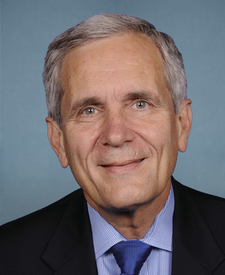
See how Lloyd Doggett's votes line up with your values.
DeepSyte scores Lloyd Doggett's record on the issues you care about — not party, not press releases. Take the 2-minute values quiz to see your personal alignment.
Sign in and take the values quiz to see how Lloyd Doggett's votes line up with your views.
Prediction track record
How often we called Lloyd Doggett's passage votes correctly, from their stated positions on each bill's tagged topics. Excludes “unclear” calls and abstentions.
Based on 1 data point across public statements and recorded votes · AI analysis of public records
119-hr-2913·Consistent
Ukraine Support Act
72/100
What they said
Oct 29, 2026
The release calls on U.S. Customs and Border Protection to enforce the federal ban on Russian energy imports, including Russian diesel, and to refer any attempted importation for prosecution, arguing that a recent Treasury general license does not authorize such imports under the Ending Importation of Russian Oil Act.
The statement demands enforcement of the federal ban on Russian energy imports and opposes a Treasury general license authorizing Russian diesel imports, while the Ukraine Support Act imposes extensive sanctions on Russian energy sectors and reaffirms support for Ukraine, so the two point in the same direction on Russia-related energy sanctions. The bill does not specifically address Customs enforcement or the Ending Importation of Russian Oil Act, and the vote is a passage vote on a broad multi-provision bill, so the match is directional rather than exact.
Pairs with ambiguous language and high uncertainty are withheld until more data is available. Procedural, cloture, and amendment votes are excluded — they don't cleanly signal substantive support or opposition.
Pro analysis
AI rep analysis — Pro
Get an AI-narrated read on Lloyd Doggett's full voting record against your stated values — aligned themes, conflicts, notable votes, and what to watch for.
We haven't extracted campaign positions for Lloyd Doggett yet. Once their campaign website or position pages are processed, this card will track what they said vs how they voted.
Crossing the aisle
Passage votes where Lloyd Doggett broke ranks with ≥75% of Democrats. Threshold catches substantively partisan splits; unanimous-ish or close votes are excluded.
An act to authorize appropriations for the United States Fire Administration and firefighter assistance grant programs, to advance the benefits of nuclear energy, and for other purposes.
Ukraine Caucus Leaders Demand Customs & Border Protection Enforce Federal Law
Position: The release calls on U.S. Customs and Border Protection to enforce the federal ban on Russian energy imports, including Russian diesel, and to refer any attempted importation for prosecution, arguing that a recent Treasury general license does not authorize such imports under the Ending Importation of Russian Oil Act.
WASHINGTON, D.C.—Today, Rep. Lloyd Doggett (D-TX), senior member of the House Ways & Means Trade Subcommittee and active member of the Congressional Ukraine Caucus, and Rep. Marcy Kaptur (D-OH), senior appropriator and Co-Chair of the Congressional Ukraine Caucus, demanded U.S. Customs & Border Protection Commissioner Rodney Scott enforce federal sanctions law prohibiting the import and sale of Russian diesel in the United States and refer any attempted importations for prosecution.
“A Putin diesel tanker is en route to reach an American port in early November. Any business, considering complicity in violating federal law should consider the consequences. Those who import, purchase, or transport banned Russian diesel engage in unlawful conduct. They can expect prompt congressional investigation and eventual prosecution. Trump’s illegal sanctions waiver may protect his pal Putin but will not protect Americans who engage in criminal conduct,” said Congressman Doggett.
“The law is clear—it is illegal to import Russian energy into the United States. Any entity that facilitates such importation or purchases will be directly funding Dictator Vladimir Putin's barbaric war against Ukraine in violation of Federal law. Such actions warrant serious consequences,” said Congresswoman Marcy Kaptur (OH-09). “We expect to see US Customs and Border Protection turn these Russian tankers away at the border.”
On October 9th, after a call between President Trump and Vladimir Putin, the Treasury Department's Office of Foreign Assets Control issued General License 135, authorizing the sale, delivery, offloading, and “importation into the United States” of Russian diesel through April 7, 2027. Now, three vessels carrying roughly 40,000 metric tons of Russian diesel are expected to arrive next week.
This shipment directly violates the Ending Importation of Russian Oil Act, which passed the House 413–9 and the Senate unanimously, and was signed into law on April 8, 2022. Under the law, there is a strict ban on the importation of all Russian energy products classified under chapter 27 of the Harmonized Tariff Schedule, which includes diesel. The law allows the ban to end only if the President certifies that Russia has ended its war on terms Ukraine accepts, after consulting Congress and giving it 90 days to object. The President has done none of this.
In response to the approaching vessels, the Members are demanding CBP enforce federal law and refer any attempted importation of Russian diesel for prosecution.
You can read their letter here and below.
The Honorable Rodney S. Scott
Commissioner
U.S. Customs and Border Protection
1300 Pennsylvania Avenue NW
Washington, DC 20229
Dear Commissioner Scott:
As Members of Congress, including the sponsor of the Ending Importation of Russian Oil Act (Public Law 117-109), we write regarding Russian diesel now bound for American ports. According to press reports, the Agioi Fanendes loaded roughly 40,000 metric tons of diesel at the Russian port of Primorsk and listed the Port of New York and New Jersey as its destination, with arrival expected around November 7. U.S. Customs and Border Protection is the agency charged with enforcing the import prohibitions Congress enacts. We urge you to enforce this one.
The law is clear. Section 2 of the Act bans the importation into the United States of all Russian Federation products classified under chapter 27 of the Harmonized Tariff Schedule, which includes diesel. Section 3 provides the only way to lift that ban: the President must consult with Congress, submit a report, and certify that Russia has reached an agreement to withdraw its forces and end hostilities that Ukraine accepts, poses no immediate military threat to any NATO member, and recognizes the right of Ukrainians to choose their own government. Congress then has 90 days to disapprove. None of these steps has been taken, and Russia continues its war against Ukraine.
General License 135, issued by the Treasury Department at President Trump's direction after his call with Vladimir Putin, purports to authorize these imports but cannot set aside a prohibition Congress wrote into statute. Any Russian diesel brought into the United States is imported contrary to law.
Those who take part face serious criminal exposure. Under 18 U.S.C. § 545, anyone who knowingly imports merchandise contrary to law, or who "receives, conceals, buys, sells, or in any manner facilitates the transportation, concealment, or sale of such merchandise after importation," knowing it was imported contrary to law, may be imprisoned for up to 20 years. Fines can reach $250,000 for an individual and $500,000 for a company, or twice the gross gain from the transaction. The merchandise, or its value, is subject to forfeiture.
That reach is broad. It extends beyond the importer of record to:
buyers and sellers of the fuel, including traders and brokers;
customs brokers who file the entry;
terminal and storage operators that receive or hold it;
pipeline, barge, rail, and truck carriers that move it inland; and
distributors and wholesalers that buy or resell it.
Prosecution under § 545 may be brought up to five years after the offense.
The stakes are real. Reuters valued the first 300,000 tons of diesel Russia has promised at roughly $400 million. At that price, the up to 4.8 million tons President Trump announced after speaking with Putin would be worth more than $6 billion, and the single cargo aboard the Agioi Fanendes more than $50 million. Every sale strengthens the Russian economy that finances Putin's war against Ukraine.
Americans would get almost nothing in return. The Agioi Fanendes cargo amounts to roughly 300,000 barrels, less than three hours of fuel for the U.S. transportation sector, according to Energy Information Administration data. Even the full 4.8 million tons would cover less than two weeks.
Given the expected arrival dates, we ask that you respond to the following questions immediately:
Has CBP received any entry filing or advance notice for a vessel carrying Russian-origin diesel, including the Agioi Fanendes? If so, who is the importer of record, and who are the consignee and customs broker?
What instructions has CBP given its port directors, including at the Port of New York and New Jersey, on the entry of Russian-origin chapter 27 products?
Has CBP received direction from the Department of the Treasury, the Department of Homeland Security, or the White House to admit these products? If so, please provide it.
Will CBP refuse entry to, and seize, Russian-origin diesel imported contrary to the Act? If not, under what legal authority would CBP admit it?
Will CBP issue guidance to the trade community making clear that these imports remain prohibited by statute, and that anyone who imports, buys, sells, or facilitates the sale of this fuel may face criminal penalties of up to 20 years in prison, substantial fines, and forfeiture?
Will CBP refer any attempted importation of Russian-origin diesel to Homeland Security Investigations and the Department of Justice?
Congress enacted this ban, with overwhelming bipartisan support, to deny Putin the resources to wage his war. No one who handles this fuel should be under any illusion about the risks. We urge CBP to enforce the law as written.
Sincerely,
###
Issues:Pushing Back Against Trump
Doggett: Trump's Russian Diesel Deal Violates the Law
Position: Rep. Doggett argues that the Treasury general license authorizing Russian diesel imports into the United States violates the 2022 Ending Importation of Russian Oil Act, and that the statutory conditions for lifting the ban have not been met.
Sponsor of 2022 Russian Energy Import Ban Says Trump Rewards Putin While Blaming Zelensky
WASHINGTON, D.C.—U.S. Representative Lloyd Doggett (D-TX), a longtime champion of cutting off Russian energy revenue whose name is on the 2022 Ending Importation of Russian Oil Act (Public Law 117-109), today said President Trump's deal with Vladimir Putin to allow Russian diesel into the United States directly violates that law.
On Friday, after a Trump call with Putin, the Treasury Department's Office of Foreign Assets Control issued General License 135, authorizing the sale, delivery, offloading, and “importation into the United States” of Russian diesel through April 7, 2027.
“In 2022, my name was on the first law banning Russian fossil fuel imports to deny Putin funding for his brutal invasion of Ukraine,” said Rep. Doggett. “Now Trump is directly violating that law, lifting sanctions to permit the first Russian diesel imports into the United States since the law took effect, without satisfying the specific legal conditions it requires. He illegally rewards his pal Putin while once again blaming Zelensky for not capitulating to Putin. Meanwhile, every day Putin murders more Ukrainian civilians.”
What the law requires
The Ending Importation of Russian Oil Act passed the House 413–9 and the Senate unanimously, and was signed into law on April 8, 2022. It bans the importation of all Russian energy products classified under chapter 27 of the Harmonized Tariff Schedule, which includes diesel.
The law permits the President to end the ban only by certifying to Congress that Russia has:
reached an agreement to withdraw its forces and end hostilities that is accepted by Ukraine's government;
ceased to pose an immediate military threat to any NATO member; and
recognized the right of the Ukrainian people to freely choose their own government.
The President must first consult with the Ways and Means, Foreign Affairs, Finance, and Foreign Relations Committees and submit a report at least 45 days before certifying. Any termination takes effect only after 90 days, during which Congress may enact a resolution of disapproval. None of these steps has occurred, and none of the conditions has been met.
Bipartisan concern
Rep. Doggett's concerns are shared across party lines. A bipartisan group of senators has recognized the illegality of Trump’s action. On NBC's Meet the Press on Sunday, Senator Thom Tillis (R-NC) said there is “a legitimate case for saying the president's not following the law” and warned that the deal will put American lives at risk, citing the Kremlin's ties to Iran. Former Vice President Mike Pence called lifting the sanctions a betrayal of the late Senator Lindsey Graham's legacy.
The deal comes weeks after President Trump signed a sweeping Russia sanctions law, and only weeks after he publicly called on President Zelensky to stop Ukrainian strikes on Russian diesel infrastructure, blaming Ukraine rather than the war with Iran for high fuel prices.
###
Issues:Pushing Back Against Trump
Doggett Statement on New GAO Report on Insurer-Owned Pharmacies
Position: Representative Doggett argues that large health insurers' preferential treatment of their own pharmacies raises consumer and taxpayer costs, and that Congress should act to restrain health care monopolies and oligopolies.
WASHINGTON, D.C.—Today, U.S. Representative Lloyd Doggett (D-TX), Ranking Member of the House Ways & Means Health Subcommittee, released the following statement after a Government Accountability Office (GAO) report he requested found that large health insurers often give their own pharmacies better terms on lower-cost generic drugs:
“There is a real danger that consumers and taxpayers are being ripped off by giant health conglomerates. Three insurer-pharmacy benefit managers control 80% of prescription drug claims. This report is the first detailed study of these insurer-pharmacy contracts and exposes frequent preferential treatment for insurer-owned pharmacies. Americans are struggling with higher and higher costs for medications and other care. Congress must act to restrain health care monopolies and oligopolies.”
The GAO report can be found here.
###
Issues:Healthcare
Doggett Reacts to Today’s ICE Shooting in the District He Represents in Austin
Position: Rep. Doggett criticizes ICE for secrecy and non-responsiveness, and states that ICE is rounding up immigrants, including contributing community members, to meet a deportation quota rather than focusing on those who may pose a danger.
" />
Doggett Reacts to Today’s ICE Shooting in the District He Represents in Austin | Congressman Lloyd Doggett
Skip to main content
About
Biography
Committees
Legislative Center
Our District
Votes and Legislation
Serving You
Constituent Services
Visiting Washington, DC
Flags
Passports
Grant Applicants
Students
Student Loans
Enrolling in the Health Insurance Marketplace
Small Business Assistance
Internships
Tours and Tickets
Military Academy Nominations
Commendations and Greetings
Senior Citizens
Veterans
Community Project Funding Requests
Issues
Timeline of Trump's Economic Policies
Pushing Back Against Trump
Fighting for Students and Teachers
Healthcare
Growing Our Economy
Gun Safety
Immigration
Protecting Our Planet
Technology
Musicians' Caucus
Veterans
Voting Rights
Policing Reform and Social Justice
Gender Equality
Our Families and Children
News
Latest News
In the News
Press Releases
Contact Lloyd
Write to Congressman Lloyd Doggett
Subscribe to Lloyd's List
Take Lloyd's Survey
Office Locations
Home
Media
Press Releases
Doggett Reacts to Today’s ICE Shooting in the District He Represents in Austin
September 20, 2026
Press Release
Austin, T.X.—Rep. Lloyd Doggett has issued the following statement following today’s ICE shooting in Austin:
“While we do not yet have all of the facts about today’s alarming shooting, we do have the facts about ICE, which has recently accelerated its intrusion into our community. And our lack of facts results from ICE secrecy and non-responsiveness. Instead of focusing its work on those who may pose a danger to our neighbors, ICE is eager to fulfill a deportation quota by rounding up any immigrant that it can find, including those who are making a real contribution to our community.”
###
Issues:Gun SafetyImmigrationPushing Back Against Trump
News
Latest News
In the News
Press Releases
Doggett and Sewell Introduce PROOF Act to Stop the Weaponization of the IRS Against Nonprofits
Position: Introduces the PROOF Act of 2026, which would require evidence and due process before the IRS could revoke a nonprofit's tax-exempt status and would write current internal IRS protections into the tax code so they carry the force of law. The sponsors argue this is needed to prevent politically motivated use of the IRS against nonprofits.
Legislation would guarantee that no charity or nonprofit can lose its tax-exempt status without evidence and without due process
WASHINGTON, D.C. — Today, Rep. Lloyd Doggett (D-TX) and Rep. Terri A. Sewell (D-AL), Ranking Member of the Ways and Means Subcommittee on Oversight, introduced the Protecting the Rights Of Organizations Fairly (PROOF) Act of 2026, legislation to guarantee that the IRS cannot strip a nonprofit of its tax-exempt status without evidence and without a fair process.
"The IRS should never be a weapon to punish a President's political enemies. No organization — left, right, or center — should lose its tax-exempt status on an accusation, without evidence, and without a fair chance to be heard” said Representative Doggett. “The PROOF Act is simple: if the government wants to take away a nonprofit's status, it has to show its proof and follow the law. Today, it may be an organization to which the Trump regime objects. Tomorrow, it could be any of us."
“Donald Trump is attempting to weaponize the IRS and intimidate groups that do not align with his radical political agenda. Therefore, nonprofit organizations like the Southern Poverty Law Center must have due process protections so their tax-exempt status cannot be revoked for political purposes,” said Representative Terri Sewell. “That is why I am proud to support The PROOF Act to ensure the government cannot take away a nonprofit’s tax-exempt status without due process protections.”
Under current law, many due process protections that are supposed to apply when the IRS examines most nonprofits exist only in the agency's own internal manual — guidance the IRS can rewrite or suspend on its own authority through an internal memo with no public comment, no rulemaking, and no vote, and that carries no force of law. A targeted organization is left with no way to prevent due process rights from being weakened or withdrawn. The PROOF Act writes those protections into the tax code, so they carry the force of law and cannot be waived, rewritten, or set aside at the discretion of the IRS or the White House.
The bill responds to an unprecedented campaign to weaponize the IRS against Trump’s perceived opponents. In 2025, the administration directed the IRS to begin the process of revoking the tax-exempt status of Harvard University after the university refused to comply with the President's demands — a step the President publicly vowed to carry out. Since then, reporting has revealed that officials compiled a list of Democratic donors and "left-leaning" nonprofit organizations for potential IRS scrutiny, and that the IRS Criminal Investigation division partnered with the FBI to investigate nonprofits over alleged "domestic terrorism" ties. In a December 2025 memo, the Justice Department defined domestic terrorism to reach constitutionally protected speech and advocacy.
Last week, the New York Post reported that the Treasury Department and IRS are drawing up a sweeping audit blueprint that could revoke the tax-exempt status of a list of progressive and advocacy organizations, leaning on a 2025 executive order aimed at nonprofits the administration accuses of a "substantial illegal purpose." Treasury Secretary Bessent had publicly confirmed months earlier that work compiling such a list was underway. These actions break sharply from a commitment the IRS's own chief executive made to the House Ways and Means Committee. In responding to Congressman Doggett’s questioning during a March 2026 hearing, Bisignano assured “100 percent” that the agency would not initiate audits, investigations, or revocations of tax-exempt status based on politics, and “We’re here to administer the law, uphold the law.”
The administration has refused to answer for its weaponization campaign. In April 2026, Congressman Doggett and Congresswoman Terri Sewell wrote to the IRS demanding answers about the targeting of tax-exempt organizations. The response deadline passed months ago with no reply, and the members renewed their demand in a follow-up letter this week.
The PROOF Act guarantees that before the government can take away a nonprofit's tax-exempt status, it has to follow basic due process.
What the PROOF Act Does
In plain terms, the bill guarantees every tax-exempt organization:
Fair notice before an examination begins. Written notice that the organization has been selected, what the examination is about, which years are involved, and who the examiner is.
A reason, in writing. The IRS must explain the legal authority under which it is proceeding. No open-ended fishing expeditions with no stated basis.
Evidence, not accusation. The IRS must build a documented record that actually supports its conclusions — and it cannot revoke an organization's status unless that record supports the decision. No nonprofit can be stripped of its status on an unsupported allegation.
Fair document requests. Requests must be specific and connected to the examination, with a reasonable time to respond — and an organization cannot be punished for failing to answer a defective or improper request.
A right to be heard. The organization can bring a dispute to the examiner's supervisor during the examination, and the IRS must hold a closing conference — explaining its findings, its legal and factual basis, and the organization's appeal rights — before it takes any adverse action.
A clear explanation and a real right to appeal. Before any final action, the organization receives a written explanation of the proposed decision, the specific findings and legal authorities behind it, and at least 30 days to protest and seek review by the IRS Independent Office of Appeals, followed by judicial review in court.
No revocation without proof or process. At its core, the bill establishes a single guarantee: the IRS cannot revoke a nonprofit's tax-exempt status unless the examination supports the decision and the organization's due process rights have been honored.
Rep. Doggett Questions Trump IRS CEO Bisignano March 2026
Doggett: If you would sir, with a simple yes or no, tell us whether you have received either directly or indirectly any communication from anyone in the Trump regime suggesting that specific tax-exempt organizations should be scrutinized because of their political views?
Bisignano: No.
Doggett. You have not. Good. And will you commit today that under your leadership the IRS will not initiate audits, investigations, or revocations of tax-exempt status based on political targeting?
Bisignano: 100%. We're here to administer the law, uphold the law, uphold the law.
Doggett: Thank you. Just to be clear what I'm talking about though, in that regard, the Wall Street Journal reported “the Trump administration is preparing sweeping changes at the Internal Revenue Service that would allow the agency to pursue criminal inquiries of some groups more easily.” So are they in error and no such sweeping changes or any changes are being prepared there to use the IRS?
Bisignano: I hope that you understand that every form of the daily news is not a Bible.
Doggett: That's why I'm asking.
Bisignano: Not a Bible, sir.
Doggett Yeah, that's absolutely right. And I'm asking you about this.
Bisignano: I've actually never heard that or seen.
Doggett: You've never heard that the Trump administration was trying to weaponize the IRS?
Bisignano: 100% not.
Doggett: Then you're not familiar with President Trump's tweet specifically attacking Citizens for Responsibility and Ethics in Washington, or CREW, asking that it's tax-exempt status should be re-evaluated? You didn't . . . you're not aware of that?
Bisignano: I don't track tweets sir.
Doggett: You don't track Truth Social. It doesn't have anything to do with your work?
Bisignano: You will not find my social media presence anywhere.
Doggett: Well, this is the President of course not very interested in ethics so I was very concerned about that.
###
Issues:Pushing Back Against Trump
Doggett, Sewell Renew Demand for Answers as Trump Administration Moves to Strip Nonprofits of Tax-Exempt Status
Position: Representatives Doggett and Sewell are demanding answers from the IRS about reported efforts to audit or revoke tax-exempt status of nonprofit organizations based on political opposition to the Administration, and object to the lack of response to their oversight letter.
IRS confirmed in April that the Members’ oversight letter had been assigned for response — four months later, not one of sixteen questions has been answered
WASHINGTON, D.C. — Rep. Lloyd Doggett (D-TX) and Rep. Terri A. Sewell (D-AL), Ranking Member of the Ways and Means Subcommittee on Oversight, today renewed their demand that Internal Revenue Service Chief Executive Officer Frank Bisignano answer sixteen outstanding questions about the Administration’s use of the IRS against tax-exempt organizations and their donors. The Members first wrote to Bisignano on April 14, 2026. The IRS confirmed receipt on April 22 and told the Members’ staff that the letter had been “assigned for response.” No response has ever come.
The renewed demand follows an August 27 New York Postreport that Treasury Secretary Scott Bessent and his aides are preparing audits, revocations of tax-exempt status, and back-tax and penalty assessments against charitable organizations identified by their perceived opposition to the Administration rather than by any violation of the tax laws. The reported vehicle is a September 2025 presidential memorandum directing scrutiny of nonprofits alleged to operate for a “substantial illegal purpose.”
“With an alarming new report that the Trump regime is weaponizing the Tax Code against civic organizations that oppose the Trump agenda, we are renewing our demand for answers from the IRS. In response to my direct questions in March this year, Mr. Bisignano insisted ‘100 percent’ that he would not initiate audits, investigations, or revocations of tax-exempt status based on political targeting. Yet, he is stonewalling our requests for information about this potential wrongdoing. We need answers now, not after Trump’s attempts to destroy important nonprofit organizations are implemented,” said Rep. Doggett.
“The American people will not stand for Donald Trump’s blatant attempts to weaponize the federal government to attack organizations like the Southern Poverty Law Center - whose mission is to protect the civil rights of all communities and defend our democracy against violent extremism,” said Rep. Sewell. “It is a federal crime for political leaders to direct the IRS to investigate or audit individual taxpayers, and Congress must know why charitable organizations that are not aligned with Donald Trump’s political agenda are being targeted.”
The Members’ letter renews all sixteen requests from April and asks the Service to identify the office to which the letter was assigned, the status of that response, and every official at the IRS, Treasury, or the White House who has handled it.
Opposition to the reported campaign is not confined to one party. Writing the day after the Post report, Walter Olson of the conservative Cato Institute observed that “[t]he IRS is not supposed to apply an ideological line in revoking tax exemption,” and cautioned: “Protect your opponents’ rights, and when the wheel turns, you may find that you’ve protected your own as well.”
BACKGROUND
Section 7217 of the Internal Revenue Code makes it a federal crime for the President, the Vice President, the Treasury Secretary, and members of their staff to request, directly or indirectly, that the IRS audit or investigate any particular taxpayer. It also requires IRS officers and employees to report any such request to the Treasury Inspector General for Tax Administration.
At a March 4, 2026 Ways and Means Committee hearing, Rep. Doggett asked Bisignano whether he had received “either directly or indirectly any communication from anyone in the Trump regime suggesting that specific tax-exempt organizations should be scrutinized because of their political views.” Bisignano answered: “No.” Asked to commit that under his leadership the IRS would not initiate audits, investigations, or revocations of tax-exempt status based on political targeting, he answered: “100%. We’re here to administer the law, uphold the law.”
The April 14, 2026 letter, signed by Doggett, Sewell, and fourteen colleagues, asked the IRS whether the President, the Treasury Secretary, or their staff had requested audits or investigations of particular taxpayers; who assembled the reported list of investigative targets; whether protected taxpayer information had been disclosed to the Department of Justice, Treasury, or White House staff; and what protections exist for IRS employees who decline to participate in politically motivated enforcement.
In October 2025, Ways and Means Democrats asked the Treasury Inspector General for Tax Administration to investigate reports that the Administration was encouraging the IRS to facilitate criminal investigations of Democratic donors and “left-leaning” nonprofit groups.
Full text of the letter is available here.
Full text of the April 2026 letter is available here.
New York Post reporting on the Trump administration’s plans to crack down on nonprofits is available here.
Rep. Doggett Questions Trump IRS CEO Bisignano
Doggett: If you would sir, with a simple yes or no, tell us whether you have received either directly or indirectly any communication from anyone in the Trump regime suggesting that specific tax-exempt organizations should be scrutinized because of their political views?
Bisignano: No.
Doggett. You have not. Good. And will you commit today that under your leadership the IRS will not initiate audits, investigations, or revocations of tax-exempt status based on political targeting?
Bisignano: 100%. We're here to administer the law, uphold the law, uphold the law.
Doggett: Thank you. Just to be clear what I'm talking about though, in that regard, the Wall Street Journal reported “the Trump administration is preparing sweeping changes at the Internal Revenue Service that would allow the agency to pursue criminal inquiries of some groups more easily.” So are they in error and no such sweeping changes or any changes are being prepared there to use the IRS?
Bisignano: I hope that you understand that every form of the daily news is not a Bible.
Doggett: That's why I'm asking.
Bisignano: Not a Bible, sir.
Doggett Yeah, that's absolutely right. And I'm asking you about this.
Bisignano: I've actually never heard that or seen.
Doggett: You've never heard that the Trump administration was trying to weaponize the IRS?
Bisignano: 100% not.
Doggett: Then you're not familiar with President Trump's tweet specifically attacking Citizens for Responsibility and Ethics in Washington, or CREW, asking that it's tax-exempt status should be re-evaluated? You didn't . . . you're not aware of that?
Bisignano: I don't track tweets sir.
Doggett: You don't track Truth Social. It doesn't have anything to do with your work?
Bisignano: You will not find my social media presence anywhere.
Doggett: Well, this is the President of course not very interested in ethics so I was very concerned about that.
###
Issues:Pushing Back Against Trump
Doggett Reacts to Abbott’s Refusal to Fulfill His Constitutional Duty to Extradite Accused Felon
Position: Criticizes Governor Abbott for not signing an extradition order for an ICE agent charged in a Minnesota shooting, and argues he should comply with the law and extradite the accused.
Austin, TX—Today, Representative Lloyd Doggett, who represents the Texas State Capitol, issued the following statement after the State of Minnesota sued Governor Abbott Tuesday to compel the extradition of an ICE agent charged in a Minneapolis shooting:
“As an excuse for shirking his duty to extradite an accused felon, Governor Abbott has attacked Minnesota, the state where the alleged crime occurred. His claim that he does not trust Governor Tim Walz is belied by the fact that less than a week ago, he forwarded an order to extradite another accused to Minnesota.
Abbott has approved every Minnesota extradition request for the past five years, including three this summer while leaving this one unsigned. The only difference is that the accused in this case is an ICE agent charged with the type of unnecessary violence that ICE has permitted. Unless Abbott acts, this accused felon could be back on the street next week. Abbott is more interested in burnishing his well-known anti-immigrant credentials than following the law.”
A letter from all Texas Democratic Congressmembers, urging Governor Abbott to proceed with the requested extradition can be found here.
###
Issues:Immigration
Texas Democratic Congressional Delegation & Natural Resources Committee Ranking Member Urge Answers Before Action Jeopardizing Big Bend
Position: The release urges federal officials to delay work on a proposed patrol road across Big Bend National Park's Mariscal Mountain until project details are released and environmental concerns are answered, arguing the road offers no border security benefit and would cause irreversible damage.
Washington, D.C.—Today, Texas Congressmembers, joined by House Natural Resources Committee Ranking Member Jared Huffman, urged Trump Administration officials to delay work on a proposed road across and over Big Bend National Park’s Mariscal Mountain until specific details of the project are made fully available and questions answered about the potentially irreparable destruction the project poses.
“The potential destruction from road construction over the rugged terrain of Mariscal Mountain is extreme,” Congressman Doggett said. “Tons of rock blasted away could end up impacting Mariscal Canyon, the Rio Grande, and Mexico. An incredible waste of both taxpayer money and an invaluable place of spectacular beauty!”
“Survey work has already begun in Big Bend National Park, with groundbreaking apparently imminent,” Congressman Doggett continued. “It’s urgent that there is broad public understanding of CBP’s overall plans for the park, including Mariscal Mountain and its immediate surroundings – before irreversible damage is inflicted on one of the most significant places in all of Texas.”
“It is hard to understand the added value of a patrol road across Mariscal Mountain. The existing road just north of the mountain is regularly patrolled and sufficient for Border Patrol operations,” the Members wrote. “This new, proposed road would sit 1,700 feet above the border in one of the least trafficked stretches of the entire southern border, where anyone crossing would first climb 1,400-foot cliffs to approach the road. This poses no benefit to border security and would only cause irrevocable damage to the mountain.”
A copy of the letter can be found here.
The letter is addressed to Secretary of State Marco Rubio, Homeland Security Secretary Markwayne Mullin, U.S. Customs and Border Protection Commissioner Rodney S. Scott, and W.C. “Chad” McIntosh, Commissioner of the
International Boundary and Water Commission, United States Section.
The International Boundary and Water Commission (IBWC) is the binational body charged with enforcing the boundary and water treaties between the United States and Mexico. The issue will be of acute interest to both the U.S. and Mexico Sections of the IBWC because of the potential damage to the Rio Grande and immediate environs on both sides of the river.
U.S. Customs and Border Protection has not released details regarding the proposed road aside from a small-scale map with the proposed alignment and that it would be 24 feet wide. The letter asks for road design and engineering details, spoil disposal plans, and line items for rock excavation, controlled blasting, drilling and shooting, vibration monitoring, or embankment placement.
In addition, it asks the IBWC U.S. Section if it has received any notice from the U.S. of the Mariscal Mountain alignment and whether the Mexican Section has been notified. Federal law authorizing waivers that set aside existing regulatory requirements for border wall construction do not apply to U.S.-Mexico Treaty obligations. The letter seeks confirmation that the U.S. acknowledges that fact.
###
Issues:Protecting Our PlanetPushing Back Against Trump
New Bipartisan Legislation to Modernize Vaccine Injury Compensation & Provide Relief to COVID-19 Claimants
Position: Introduces the Vaccine Injury Compensation Modernization Act to update the Vaccine Injury Compensation Program, expedite claims, adjust compensation caps, and move pending COVID-19 vaccine injury claims from the Countermeasures Injury Compensation Program into the VICP.
Washington, D.C.—Today, House Ways and Means Committee members Representatives Lloyd Doggett (D-TX) and Lloyd Smucker (R-PA), introduced the Vaccine Injury Compensation Modernization Act to provide overdue updates and improvements to the Vaccine Injury Compensation Program (VICP) and allow pending COVID-19 vaccine claimants to seek relief under the VICP.
“Vaccines save lives and are an essential public health tool. In the rarest of instances when a related injury is suffered, compensation for medical bills and related losses should be prompt and reasonable,” said Congressman Doggett. “But that has not been happening because of extended delays, outdated compensation caps, and failure to include coverage for COVID-19 vaccines. By making much-needed improvements to assure a prompt and fair response to vaccine-related injuries, this legislation will bolster consumer confidence and help combat misinformation.”
“Vaccines remain an important public health tool, but when rare vaccine-related injuries occur, Americans deserve a compensation system that is fair, transparent, and efficient,” said Rep. Smucker. “Our legislation strengthens the Vaccine Injury Compensation Program while bringing COVID-19 vaccine claims into the program, so they are handled under the same fair and efficient process as other vaccine injury claims."
Established in 1986, the VICP provides a no-fault alternative to the traditional legal system through which consumers can be compensated for rare vaccine-related injuries. The VICP provides necessary protections and certainty for patients, vaccine administrators, and vaccine manufacturers alike, but has not been significantly updated since first established and now has a significant case backlog.
Due to the unique emergency authorizations first granted to COVID-19 vaccines, injury claims were initially filed under the separate Countermeasures Injury Compensation Program (CICP). Despite COVID-19 vaccines receiving full FDA approval and being added to immunization schedules, COVID-19 vaccine claims still remain under the CICP, which has not yet rendered decisions on over 6,745 claims and provided only nominal payouts for the very few approved. Unlike the VICP, the CICP does not offer judicial review and claimants may only recoup medical and work-loss expenses that have not been compensated by other payors. The VICP offers stronger due process protections as well as damages for pain and suffering, though these damages are capped at 1986 levels.
The Vaccine Injury Compensation Modernization Act would:
Permit COVID-19, RSV, Shingles, and Dengue vaccine claims to be filed under the VICP.
Reduce case backlog by expanding the number of Special Masters (judges for the VICP) from a ceiling of 8 to a floor of 10 and by permitting Special Masters to serve for multiple terms.
Expedite claims processing by requiring the Secretary of Health and Human Services and the Attorney General to submit a budget implementation action plan outlining the required resources to eliminate case backlog.
Provide fair compensation by increasing the cap on damages for the first time since 1986.
Ensure adequate program resources by increasing the vaccine excise tax for the first time since 1986.
Ensure consumers have sufficient time to file claims by increasing the statute of limitations from 3 years to 5 years.
Expedite the addition of new vaccines to the program by requiring HHS to promulgate rulemaking to add a CDC-recommended vaccine or injury to the injury table within 6 months of a recommendation rather than 2 years.
Expand the types of vaccines eligible for coverage under the VICP by including vaccines and injuries recommended by the CDC for administration in adults.
Ensure all types of CDC recommendations qualify for VICP coverage, including recommendations that may be qualified for certain pre-existing conditions, age groups, or other factors.
A copy of the bill text can be found here.
###
Issues:Healthcare
Democrats Introduce Saving MEDICARE Act to Stop Insurers’ Profiteering Off Medicare
Position: The release supports introduction of the Saving MEDICARE Act to reduce payments to Medicare Advantage insurers, increase oversight of those plans, and strengthen Traditional Medicare. It argues that Medicare Advantage costs taxpayers more than Traditional Medicare without delivering greater savings.
Washington, D.C.—Today, U.S. Representative Lloyd Doggett (D-TX), Ranking Member of the House Ways & Means Health Subcommittee, joined by 44 colleagues, introduced the Saving Medicare Enrollees from Deceptive Insurers and Creating Ample Resources for Everyone (Saving MEDICARE) Act. This landmark legislation comprehensively addresses the many ways Medicare Advantage insurers are overpaid—with a consistent goal of leveling the playing field so that Traditional Medicare does not remain at a disadvantage to giant private insurance companies.
“Despite their early claims of greater efficiency and lower costs, Medicare Advantage has never saved a penny. It actually costs taxpayers more each year while offering consumers less. This unjustified, costly advantage private Medicare Advantage insurers receive must be ended to save taxpayers and end the disadvantage for Traditional Medicare,” said Rep. Doggett. “As the Trump regime jeopardizes the promise of comprehensive health care for retirees and the disabled, the Saving MEDICARE Act will provide essential resources to achieve better Medicare for more Americans.
"Medicare Advantage insurers have been getting away with robbing the American people for far too long. The Saving MEDICARE Act would finally start to level the playing field between Medicare Advantage and Traditional Medicare by preventing insurer payment shenanigans and enhancing oversight of insurers,” said Robert Weissman, Co-President of Public Citizen. “If we don't take action now, we are on course to waste more than $2.5 trillion over the next decade in overpayments to Medicare Advantage plans, which not only cost more than Traditional Medicare but which also make patients and providers jump through unnecessary hoops, including delays and denials of necessary care. The time has come to put patients ahead of profits and pass this commonsense legislation that will not only save taxpayers money but will help ensure that the Medicare program is on firm financial footing for the future."
“The Saving MEDICARE Act would be an important first step towards righting the Medicare ship and strengthening the traditional Medicare program” said David Lipschutz, Co-Director of the Center for Medicare Advocacy. “Reining in wasteful overpayments to Medicare Advantage plans and enhancing oversight of this private market would provide needed stability to Medicare’s finances, as well as a real opportunity to enhance the Medicare program – to the benefit of all enrollees – by expanding the scope of coverage (such as dental, hearing and vision) and reducing out-of-pocket costs (such as capping such expenses).”
"Medicare Advantage is neither Medicare nor an advantage. It is simply another mechanism Big Insurance uses to pad their profits with taxpayer dollars while the majority of Americans continue to struggle with skyrocketing health care costs. Congress should act to end the abusive and predatory actions of Big Insurance and Congressman Doggett's legislation is an important step to do that. We urge Congress to pass it without delay." - Rachel Madley, Executive Director, Center for Health and Democracy
Medicare Advantage has remained much more expensive than Traditional Medicare—with the nonpartisan, independent Medicare Payment Advisory Commission (MedPAC) estimating MA will cost $2,660 more per enrollee in 2026. MA insurers use a variety of tactics to secure additional payments, including upcoding to make patients appear sicker, and favorable selection to steer healthy consumers into MA plans and sicker patients into Traditional Medicare. Flawed program design and inadequate oversight and enforcement has also resulted in overpayments.
The Saving MEDICARE Act would:
Prevent upcoding by:
Excluding diagnosis codes collected from chart reviews and health risk assessments, as recommended by MedPAC.
Requiring CMS to review diagnosis codes annually as part of the Medicare Advantage payment rulemaking, and eliminate or adjust codes that are most likely to be abused.
Prohibiting percentage of premium contracts and other financial incentives for providers to add unnecessary diagnosis codes, as recommended by the Center for American Progress.
Creating a MedPAC study on establishing an alternative risk adjusted payment system based on consumer survey data, as recommended by the Center for American Progress.
Improve benchmark payments by:
Establishing a favorable selection payment adjustment, as recommended by the Center for American Progress.
Eliminating the county quartile system, as recommended by MedPAC.
Eliminate frivolous payments by:
Ending the failed Quality Bonus Program, as recommended by the Medicare Rights Center.
Permitting the VA to collect reimbursement from MA plans for care delivered to dually-enrolled veterans, just as the VA already does with other commercial insurance. This is supported by the American Legion, Veterans of Foreign Wars, Paralyzed Veterans of America, and other consumer groups.
Enhance oversight by:
Establishing timelines for completion of Risk Adjustment Data Validation (RADV) audits and requiring plans to help finance audits, as recommended by the Center for American Progress.
Permitting state insurance commissioners to enter into agreements with CMS to share enforcement authority over Medicare Advantage plans, as recommended by the National Association of Insurance Commissioners.
Watch Congressman Doggett introduce the legislation on the House floor here.
The bill text can be found here and a fact sheet can be found here.
A 10-year savings estimate of $2.5 trillion from the Brown University Center for Advancing Health Policy through Research (CAHPR) can be found here.
Endorsing organizations include Public Citizen, Families USA, Center for Medicare Advocacy, Medicare Rights Center, National Committee to Protect Social Security and Medicare, Justice in Aging, Center for Health and Democracy, Social Security Works, Healthcare NOW
Original Cosponsors: Reps. Ansari, Balint, Carson, Casar, Chu, Clarke, Cleaver, Cohen, Danny Davis, DeLauro, Deluzio, DeSaulnier, Dingell, Garamendi, C. Garcia, R. Garcia, Green, Grijalva, Huffman, Jackson, Jayapal, H. Johnson, Khanna, McGovern, Mfume, Nadler, Norton, Ocasio-Cortez, Omar, Pingree, Pocan, Ramirez, Randall, Schakowsky, B. Scott, Smith, Takano, Thanedar, B. Thompson, Tlaib, Tokuda, Velazquez, Waters, Watson Coleman
###
Issues:Healthcare
Source: open-data mirrors of the Senate eFD and House Clerk financial-disclosure systems. Disclosure within 30 days of trade is required by law (45 for spouse/dependent trades).
Top PAC donors · 2026 cycle
Political action committees that gave the most to this rep's principal campaign committee this cycle. PAC giving is direct organizational support — industry, ideological, or leadership.
1.MACHINISTS NON PARTISAN POL. LEAGUE OF THE INT'L ASSOC. OF MACHINISTS & AEROSPACE WORKERS1 contribution$5,000
2.OFFICE AND PROFESSIONAL EMPLOYEES INTERNATIONAL UNION (OPEIU) JB MOSS VOICE OF THE ELECTORATE (VOTE)1 contribution$5,000
4.MIDWEST REGION LABORERS' POLITICAL LEAGUELabor1 contributionTrade-union PAC for the Laborers' International Union of North America — backs candidates supporting prevailing-wage standards, infrastructure investment, and union organizing rights.AI$5,000
5.NATIONAL ASSOCIATION OF REAL ESTATE INVESTMENT TRUSTS PAC1 contribution$5,000
6.AMERICAN COLLEGE OF PHYSICIAN SERVICES INC. PAC1 contribution$5,000
7.CULAC THE PAC OF CREDIT UNION NATIONAL ASSOCIATIONFinance1 contributionCredit union industry PAC — supports candidates and policies favoring credit union regulatory treatment, consumer lending, and financial services competition.AI$5,000
8.INTL BROTHERHOOD OF ELECTRICAL WORKERS (IBEW)-COPE PACLabor1 contributionTrade-union PAC for the International Brotherhood of Electrical workers — backs candidates supporting prevailing-wage protections, infrastructure investment, and union organizing rights.AI$5,000
9.AMERICAN FEDERATION OF TEACHERS PACLabor1 contributionTrade-union PAC for the American Federation of Teachers — backs candidates supporting public education funding, teacher compensation, collective bargaining rights, and workplace protections.AI$5,000
10.SHEET METAL WORKERS' INT'L ASSOC. PAL1 contribution$5,000
Source: OpenFEC (api.open.fec.gov) Schedule A receipts where contributor type is “committee.” Aggregated by contributing committee. Self-transfers from joint-fundraising / victory committees are excluded.
Top individual contributors · 2026 cycle
Itemized individual contributions over $200 to this rep's campaign committee, aggregated by donor employer. PAC giving is shown above; this section is people, not organizations.
1.MCELROY SULLIVAN MILLER & WEBER LLP$3,500
2.MASON CONSULTING LLC$3,500
3.HEARD & SMITH L.L.P.$3,300
4.JACKSON WALKER LLP$2,500
5.RELIANCE AIRCRAFT$1,000
6.CAS CONSULTING & SERVICES$500
7.APPLE$500
8.CAPITOL TAX PARTNERS$500
9.CAPITOL COUNSEL$500
10.CAPITALEDGE STRATEGIES LLC$250
Source: OpenFEC Schedule A receipts where contributor type is “individual,” aggregated by the donor's self-reported employer. This is a geographic / industry correlation, not a corporate endorsement.