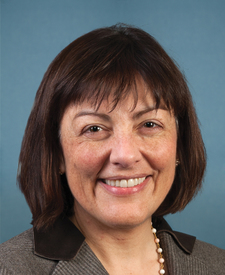
See how Suzan K. DelBene actually votes — against your values.
DeepSyte scores Suzan K. DelBene's record on the issues you care about — not party, not press releases. Take the 2-minute values quiz to see your personal alignment.
Sign in and take the values quiz to see how Suzan K. DelBene's votes line up with your views.
Prediction track record
How often we called Suzan K. DelBene's passage votes correctly, from their stated positions on each bill's tagged topics. Excludes “unclear” calls and abstentions.
12 predictions on record · none have been resolved by a passage vote yet. Check back as bills move.
Pending vote119-hr-5340
To prohibit the disclosure of records by the Secretary of Housing and Urban Development of individuals for the purposes of immigration enforcement, and for other purposes.
No paired statements and votes yet for Suzan K. DelBene
We haven't yet found statement/vote pairs on the same topic for Suzan K. DelBene. This usually means either the rep hasn't taken public positions on bills that have come to a passage vote, or those bills haven't been tagged yet. The checker runs as new press releases and votes come in.
Pro analysis
AI rep analysis — Pro
Get an AI-narrated read on Suzan K. DelBene's full voting record against your stated values — aligned themes, conflicts, notable votes, and what to watch for.
We haven't extracted campaign positions for Suzan K. DelBene yet. Once their campaign website or position pages are processed, this card will track what they said vs how they voted.
Crossing the aisle
Passage votes where Suzan K. DelBene broke ranks with ≥75% of Democrats. Threshold catches substantively partisan splits; unanimous-ish or close votes are excluded.
Position: DelBene opposes the Republican budget resolution, arguing it fails to address cost-of-living concerns for families and instead allocates $70 billion to ICE enforcement while leaving the Department of Homeland Security shutdown unresolved.
Today, Congresswoman Suzan DelBene (WA-01) released the following statement after voting against the Republican budget resolution.
“This budget does absolutely nothing to lower costs when families are struggling with high health care premiums, expensive grocery bills, and unaffordable gas prices due to Republican policies. Instead of addressing the issues that actually matter to families, this bill writes another blank check to ICE, providing $70 billion to continue terrorizing our communities.
“Despite Republican claims, this bill also does nothing to end the Department of Homeland Security shutdown, putting paychecks at risk for countless TSA, Coast Guard, and FEMA employees.
“The American people have been clear – they want a Congress that works to lower costs and keeps our communities safe. The Republican budget is completely out of touch, fails to address the cost-of-living crisis, and only creates more chaos.”
Position: Congresswoman DelBene opposes the Republican farm bill, arguing it fails to address food affordability for struggling Americans, preserves harmful food assistance cuts affecting 40 million people, and does not provide adequate support for farmers facing rising costs and market pressures.
Today, Congresswoman Suzan DelBene (WA-01) released the following statement after voting against the Republican farm bill.
“Too many Americans right now are struggling to put food on the table because of President Trump’s inflation and Republicans’ food assistance cuts. Meanwhile, farmers are facing higher overhead costs, shrinking markets, and unprecedented closures. As a former member of the Agriculture Committee, I know the farm bill can address these challenges and help families put American-grown food on the table.
“Instead, this Republican farm bill deliberately ignores these needs and does nothing to address the affordability crisis. It preserves the food assistance cuts that are ripping away food from 40 million Americans and doesn’t provide the support that farmers need to keep operating. Republicans are making their priorities abundantly clear: sell out farmers and families.”
DelBene: RFK Jr.’s AI Pilot Program Is A Trojan Horse For Privatizing Medicare
Position: Rep. DelBene opposes the WISeR pilot program, which uses AI and for-profit companies to review and deny Medicare claims. She argues the program delays necessary care, creates financial incentives to deny coverage, and represents a step toward privatizing traditional Medicare.
Earlier this year, Joanne, a Medicare patient from Quilcene, Washington, went to her doctor for severe pain in her lower back, down her leg and on the top of her foot. An MRI showed that a herniated disc was pressing on her sciatic nerve. Joanne’s doctor prescribed an epidural steroid injection to help alleviate the pain. Before this year, getting that procedure done would have been quick and routine.
But in January, Medicare started a new pilot program in Washington and five other states: Arizona, New Jersey, Ohio, Oklahoma and Texas. This program, called the Wasteful and Inappropriate Service Reduction (WISeR) Model, allows for-profit companies to use artificial intelligence to review and deny Medicare claims. In just the first few months, the number of stories like Joanne’s, in which care is delayed or denied, have exploded across these six states. Joanne’s doctor recommended this injection more than six weeks ago and it still hasn’t been approved. For over a month, she has had to use crutches or a wheelchair, worsening the arthritis in her hands, knees and ankles and adding to her chronic pain. Joanne is now looking to see if she can pay out of pocket for the procedure because, as she told my office, she “can’t keep living like this.”
WISeR isn’t just making it harder for seniors to get the care their doctors prescribe. It also opens the door to something more troubling. Under WISeR, outside companies are paid a share of the costs they “save” by rejecting claims. This creates a pervasive incentive to deny care. By injecting private companies into traditional Medicare with the goal of limiting care, the Trump administration is testing a new avenue to privatize the program. Congress must recognize and reject this Trojan horse before it fundamentally reshapes Medicare as we know it.
So far, it appears that using AI to speed up claims review has resulted in rapid treatment denials and frustration for patients and providers alike. Months in, doctor’s offices are still in the dark about basic functions of the program, and the Department of Health and Human Services hasn’t provided answers to foundational concerns since WISeR was announced last June.
The practice of requiring procedures to be preapproved, known as prior authorization, is extremely rare in traditional Medicare but already widespread in employer-sponsored health plans and privately run Medicare Advantage plans. Under this deeply flawed process, patients and doctors routinely spend hours fighting on the phone for approval of basic care. Many seniors choose traditional Medicare precisely so they don’t have to deal with this red tape. By injecting prior authorization into traditional Medicare, the differences between it and private Medicare Advantage grow slimmer.
Worse, prior authorization often doesn’t work. Over 4 million prior authorization requests made for Medicare Advantage enrollees were denied in 2024. Eighty percent of the denials were overturned when patients appealed the initial denial, but because appeals denials require considerable time, knowledge and energy, few patients contest coverage decisions.
Even if a denial is reversed, the delay in care frequently leads to more serious health issues and higher long‑term costs. Nearly a third of physicians say that a prior authorization requirement has led to a serious adverse health event for one of their patients. The American Medical Association has said these worse health conditions resulting from delayed care “may actually add significant costs to the nation’s health system.”
Even HHS Secretary Robert F. Kennedy Jr. seemed to acknowledge the problem, saying in June, “Americans shouldn’t have to negotiate with their insurer to get the care they need.” But four days later, HHS announced WISeR.
As Kennedy prepares to testify before the House Ways and Means Committee this week, he should be ready to explain why his department is moving forward with WISeR despite widespread concerns that it delays care and opens the door to privatizing Medicare.
The administration claims that this program is supposed to test new ways to use technology to fight fraud in Medicare. We must develop more ways to detect, stop and hold bad actors accountable, but WISeR simply repeats the same flawed tactics that already delay care, frustrate patients and cost us more money. Kennedy and HHS seem more focused on enriching private companies with tax dollars that should be going to care for seniors.
Congress cannot sit on the sidelines while our constituents linger in pain. I’ve introduced legislation that would stop this program and other AI pilot programs like it. The House should quickly move it forward. This isn’t a partisan issue. Stories like Joanne’s could happen anywhere, from the reddest areas in Texas all the way to the bluest corners of Washington. We need to stand up for our seniors and stop this attempt to privatize Medicare.
Read the op-ed on MS NOW
Everett Herald: As patients ‘get sicker while they wait,’ doctors fight insurance delays
Position: Insurance companies' use of prior authorization delays necessary medical care for patients and creates administrative burden on healthcare providers; reform is needed to expedite treatment approvals.
When doctors diagnosed Robin Sparks with cancer two years ago, they needed to act fast.
The hard lump on her neck was Stage 3 non-Hodgkin lymphoma, a blood cancer that penetrates bone marrow and attacks the immune system.
Sparks, of Marysville, spent weeks wading through tests and appointments to get her diagnosis. Three months into her six-month chemotherapy treatment, Sparks’ doctors wanted to check her progress. But her insurance company, Ambetter, repeatedly denied a CT scan request.
“The reason was that it was ‘just not necessary,’” said Sparks, 61. “Well, I think it was pretty darn necessary to know if my targeted treatment was working or not.”
Patients “can get sicker while they wait days, weeks or even months in many cases for approval of routine treatments,” DelBene, D-Medina, said Tuesday. “We’ve also seen patients just abandon care because they aren’t sure if they’re ever going to hear if it’s covered.”
Health insurance companies sometimes require patients to prove they need medication or treatment before approving coverage, a practice called prior authorization. The practice is time-consuming for health care workers and delays necessary care for patients, said Dr. Brandon Tudor, an emergency physician at Overlake Medical Center in Bellevue.
Click here to read the full article on the Everett Herald.
Source: open-data mirrors of the Senate eFD and House Clerk financial-disclosure systems. Disclosure within 30 days of trade is required by law (45 for spouse/dependent trades).
Top PAC donors · 2026 cycle
Political action committees that gave the most to this rep's principal campaign committee this cycle. PAC giving is direct organizational support — industry, ideological, or leadership.
1.DELBENE DEMOCRATIC MAJORITY FUNDLeadership6 contributionsMember-of-Congress leadership PAC affiliated with Suzan DelBene — directs contributions to allied Democratic candidates and causes.AI$79,994
2.AMERICAN ISRAEL PUBLIC AFFAIRS COMMITTEE POLITICAL ACTION COMMITTEEIdeological7 contributionsPAC arm of the American Israel Public Affairs Committee, federalized in 2021. Backs candidates of both parties who support U.S.-Israel security and economic ties.AI$44,400
3.DEALERS ELECTION ACTION COMMITTEE OF THE NATIONAL AUTOMOTIVE DEALERS ASSOCIATIONTransport6 contributionsTrade association PAC for new-car dealers — backs candidates supporting dealer franchise protections, vehicle sales regulations, and automotive retail interests.AI$30,000
4.NATIONAL ASSOCIATION OF REALTORS POLITICAL ACTION COMMITTEEReal Estate3 contributionsTrade association PAC for U.S. real estate agents and brokers — backs candidates supporting property-rights protections, mortgage-lending access, and tax incentives for homeownership.AI$15,000
5.MACHINISTS NON PARTISAN POL LEAGUE OF THE INT'L ASLabor2 contributionsTrade-union PAC of the International Association of Machinists and Aerospace Workers — backs candidates supporting union organizing, prevailing wages, and aerospace manufacturing jobs.AI$10,000
6.LABORERS' INTERNATIONAL UNION OF NORTH AMERICA (LIUNA) PACLabor2 contributionsTrade-union PAC for construction laborers — backs prevailing-wage standards, infrastructure investment, apprenticeship programs, and project labor agreements.AI$10,000
7.CARPENTERS LEGISLATIVE IMPROVEMENT COMMITTEE UNITED BROTHERHOOD OF CARPENTERS AND JOINERSLabor2 contributionsTrade-union PAC for the United Brotherhood of Carpenters and Joiners — backs prevailing-wage protections, federal infrastructure funding, project labor agreements, and worker safety standards.AI$10,000
8.AMERICAN ASSOCIATION OF ORAL AND MAXILLOFACIAL SURGEONS POLITICAL ACTION COMMITTEEHealth2 contributionsProfessional association PAC for oral and maxillofacial surgeons — supports candidates and policies aligned with dental and surgical practice interests.AI$10,000
9.INTERNATIONAL ASSOCIATION OF SHEET METAL, AIR, RAIL AND TRANSPORTATION WORKERS POLITICAL ACTION LEAGUELabor2 contributionsTrade-union PAC for sheet metal, air, rail, and transportation workers — backs candidates supporting union organizing, prevailing wages, and infrastructure investment.AI$10,000
10.INTERNATIONAL BROTHERHOOD OF ELECTRICAL WORKERS POLITICAL ACTION COMMITTEELabor2 contributionsTrade-union PAC for the International Brotherhood of Electrical Workers (IBEW). Backs candidates supporting prevailing-wage standards, infrastructure investment, apprenticeship programs, and union organizing rights.AI$10,000
Source: OpenFEC (api.open.fec.gov) Schedule A receipts where contributor type is “committee.” Aggregated by contributing committee. Self-transfers from joint-fundraising / victory committees are excluded.
Top individual contributors · 2026 cycle
Itemized individual contributions over $200 to this rep's campaign committee, aggregated by donor employer. PAC giving is shown above; this section is people, not organizations.
1.SELF$28,318
2.MICROSOFT$25,450
3.AMAZON$23,750
4.D4 INVESTMENTS$14,000
5.APOLLO$11,000
6.PERKINS COIE LLP$10,500
7.ARNOLD VENTURES$10,500
8.BURKE MUSEUM$8,000
9.SCOPELY INC$7,000
10.NIERENBERG INVESTMENT MANAGEMENT CO.$7,000
Source: OpenFEC Schedule A receipts where contributor type is “individual,” aggregated by the donor's self-reported employer. This is a geographic / industry correlation, not a corporate endorsement.