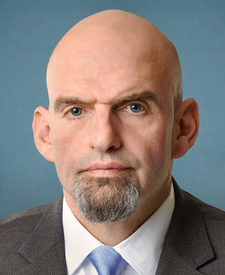
See how John Fetterman actually votes — against your values.
DeepSyte scores John Fetterman's record on the issues you care about — not party, not press releases. Take the 2-minute values quiz to see your personal alignment.
Sign in and take the values quiz to see how John Fetterman's votes line up with your views.
Prediction track record
We haven't made any vote predictions for John Fetterman yet. Predictions are generated for bills with tagged effects; they show up here as soon as the predict-votes job covers this rep's upcoming docket.
Consistency insights
No paired statements and votes yet for John Fetterman
We haven't yet found statement/vote pairs on the same topic for John Fetterman. This usually means either the rep hasn't taken public positions on bills that have come to a passage vote, or those bills haven't been tagged yet. The checker runs as new press releases and votes come in.
Pro analysis
AI rep analysis — Pro
Get an AI-narrated read on John Fetterman's full voting record against your stated values — aligned themes, conflicts, notable votes, and what to watch for.
We haven't extracted campaign positions for John Fetterman yet. Once their campaign website or position pages are processed, this card will track what they said vs how they voted.
Crossing the aisle
Passage votes where John Fetterman broke ranks with ≥75% of Democrats. Threshold catches substantively partisan splits; unanimous-ish or close votes are excluded.
4
Cross-aisle votes
119-sjres-181·Jul 30, 2026·98% of D voted YES
A joint resolution to direct the removal of United States Armed Forces from hostilities within or against the Islamic Republic of Iran that have not been authorized by Congress.
A joint resolution to direct the removal of United States Armed Forces from hostilities within or against the Islamic Republic of Iran that have not been authorized by Congress.
A joint resolution to direct the removal of United States Armed Forces from hostilities within or against the Islamic Republic of Iran that have not been authorized by Congress.
A joint resolution providing for congressional disapproval of the proposed foreign military sale to the Government of Turkiye of certain defense articles and services.
Fetterman, McCormick, Introduce Bill to Stop Spread of Spotted Lanternflies - U.S. Senator John Fetterman
Position: Senators Fetterman and McCormick introduced legislation to designate the Spotted Lanternfly as a high-priority research initiative under the National Institute of Food and Agriculture to combat the invasive species and protect agricultural production.
WASHINGTON, D.C. — Last week, U.S. Senators John Fetterman (D-PA) and Dave McCormick (R-PA), joined by U.S. Senators Ron Wyden (D-OR) and Kirsten Gillibrand (D-NY), introduced the Spotted Lanternfly Research and Development Act to designate the Spotted Lanternfly, an invasive species that poses a significant threat to our nation’s agricultural economy, as a high-priority research initiative for the National Institute of Food and Agriculture.
“Spotted lanternflies have ravaged crops that are critical to Pennsylvania’s economy including grapevines, apples, peaches, hops, and more,” said Senator Fetterman. “For over a decade, they have cost the Commonwealth millions of dollars and thousands of jobs. I’m proud to lead this bipartisan bill to combat this invasive species and protect our farmers.”
“Pennsylvania’s farmers work hard to produce some of the best agricultural products in the world, and it’s concerning that their hard work is at risk of being eaten away by pests,” said Senator McCormick. “By investing in research to combat spotted lanternflies, this bill will help protect our farms, strengthen our agricultural economy, and better control this invasive species.”
Spotted lanternflies were first detected in Pennsylvania in 2014. They have since spread throughout the Commonwealth and are currently found in 51 counties. Studies estimate that the species could cost the state $324 million annually if not contained because of the significant damage they cause many pieces of critical agriculture.
Watch Senator Fetterman’s subcommittee hearing on lanternflies here.
Read the full text of the bill here.
Fetterman Secures Priorities in Bipartisan Water Resources Development Act - U.S. Senator John Fetterman
Position: Senator Fetterman secured provisions in the bipartisan Water Resources Development Act to support Pennsylvania's water infrastructure, river recreation, and watershed planning, and urges Senate passage of the legislation.
WASHINGTON, D.C. — Last week, the U.S. Senate Committee on Environment and Public Works unanimously passed the Water Resources Development Act (WRDA) which included several of U.S. Senator John Fetterman’s (D-PA) priorities to support Pennsylvania’s rivers and recreation.
“Investing in our communities, the rivers they use, and the overall recreation helps boost economies and keeps jobs in Pennsylvania,” said Senator Fetterman. “I’m grateful these priorities were included and urge my colleagues on both sides to support this package.”
The Water Resources Development Act is a biennial legislative package authorizing water infrastructure projects across the United States. Originating in the House Committee on Transportation and Infrastructure, the legislation ensures the U.S. Army Corps of Engineers can make improvements to the nation’s ports, harbors, water navigation systems, flood control, and other water infrastructure and resources.
Senator Fetterman’s Priorities
Watershed Planning Section 729 directs the Army Corps to conduct a study to assess and address water resource needs and issues including the Ohio River Basin of Pennsylvania. The basin begins at the confluence of the Allegheny and Monongahela Rivers in Pittsburgh, Pennsylvania.
Allegheny River Recreation Designation authorizes recreational activities on the Allegheny river. This aims to boost the local economy and tourism industry, taking advantage of the natural attraction in Southwestern PA.
Harmful Algal Bloom Demonstration Program amends prior WRDA section to add lakes and reservoirs in Pennsylvania to the existing program that identifies solutions to reducing the severity and frequency of Harmful Algal Blooms.
Sec. 219 Reimbursement Authority enables the Army Corps to directly issue grants and reimbursements to local municipalities, getting money back to communities faster.
Read a section by section overview of the bill here.
Fetterman, Colleagues Introduce Bipartisan Bill to Protect CFTC Whistleblowers - U.S. Senator John Fetterman
Position: Senators Fetterman, Grassley, Collins, and Warnock introduced bipartisan legislation to strengthen protections for CFTC whistleblowers, increase the Customer Protection Fund cap to ensure timely award disbursements, and improve program stability.
WASHINGTON, D.C. — Ahead of National Whistleblower Day, U.S. Senators John Fetterman (D-PA) and Chuck Grassley (R-IA) introduced the CFTC Whistleblower Protection and Program Improvement Act to provide long-term stability to the Commodity Futures Trading Commission (CFTC) whistleblower program, strengthen protections for whistleblowers, and speed up award processing. The bill is cosponsored by U.S. Senators Susan Collins (R-ME) and Raphael Warnock (D-GA). The CFTC ensures America’s commodity markets remain fair, transparent, and free from fraud and manipulation. This includes the markets farmers rely on to manage the prices of crops, livestock, and other agricultural products.
“Whistleblowers put their jobs and often their lives on the line to call out the most serious offenses in the workplace. Zero doubt that they should be protected,” said Senator Fetterman. “As a member of the Agriculture Committee, I’m proud to introduce this bipartisan bill with Senator Grassley to protect whistleblowers and improve the CFTC whistleblower program.”
“Since I helped get the CFTC whistleblower program up and running, I’m pleased to see it’s been a big success. This program roots out waste, fraud and abuse in the commodities trading industry and operates at no charge to the taxpayer. Now, it’s time for Congress to act so its success can continue. Our bipartisan legislation strengthens protections for patriotic whistleblowers, prevents unnecessary delays in the disbursement of whistleblower awards and ensures the CFTC whistleblower program can operate smoothly,” said Senator Grassley.
“The Commodity Futures Trading Commission plays a crucial role in protecting American commodity markets, and safeguarding its whistleblower program helps maintain public trust in the integrity of those markets,” said Senator Collins. “This bipartisan bill would provide long-term stability for the CFTC whistleblower program by strengthening protections for whistleblowers, promoting the timely processing of claims, and eliminating a loophole that can prevent whistleblowers from receiving awards.”
“No one should be punished for speaking out when they see something wrong. This bipartisan bill promotes accountability and bolsters essential protections for people who risk their careers to stand up to fraud and corruption,” said Senator Warnock. “This legislation will benefit every American taxpayer, and I’m grateful to work with my colleagues across the aisle to strengthen this vital program.”
Under current law, the Customer Protection Fund (CPF) is capped at $100 million. Any fines collected after the cap are sent to the Treasury Department’s general fund. As fines from whistleblower disclosures have increased in volume and value in recent years, reward disbursements have also risen. As a result, the CPF is depleting faster than it can be replenished due to the $100 million collection cap. This leaves the whistleblower office without the resources needed to pay whistleblowers or fund its operations.
The CFTC Whistleblower Protection and Program Improvement Act would:
Read the full text of the bill here.
OPINION: Why I changed my mind about the filibuster - U.S. Senator John Fetterman
Position: Senator Fetterman expresses support for maintaining the Senate filibuster rule, arguing it forces compromise and prevents rapid unilateral policy changes by the majority party, and states he was wrong to support eliminating it during the Biden administration.
The 60-vote Senate rule forces compromise. Democrats were wrong to attack it.
It’s not often you hear someone in D.C. admit they were wrong, let alone horribly wrong — and the entire Democratic Party was, including me.
When Democrats had the presidency and a majority in both chambers, they were frustrated with the 60-vote threshold needed to advance legislation. Senate Democrats attempted to end the filibuster to push through President Joe Biden’s agenda — an effort I fully supported during my 2022 campaign.
Halfway through my first term, I now recognize how important the filibuster is and the state our country would be in without it.
I thought ending the filibuster was necessary to deliver results for working families. I thought it was unlikely for Republicans in the minority to find common ground on legislation Democrats were proposing. I thought Democrats were not being ruthless the way Republicans were, and we needed to be on that level if we were going to relieve the anger that voters were feeling.
Upon reflection, the pursuit of those short-term wins clouded the bigger picture and lasting impact of a Senate without the filibuster — a Senate that ignored the voices of the minority and everyday people.
History has vindicated former senators Kyrsten Sinema (Arizona) and Joe Manchin III (West Virginia), two people who were vilified by the Democratic Party for their support of the filibuster and whose courageous efforts damaged their political careers. The rule is a critical line of defense that prevents President Donald Trump from having a fill-in-the-blank government with new laws, deregulation or procedures of its choosing.
And while I was once vocal in criticizing Manchin and many of his decisions in the Senate, I now wholeheartedly agree with his assessment that scrapping the filibuster is part of “extreme election-year politics that put party power over everything else.” We cannot become a smaller version of the House of Representatives.
Even with the filibuster intact, Biden and Senate Democrats delivered huge wins for working families. Several of those successes — like the Infrastructure Investment and Jobs Act and legislation to help veterans exposed to toxins in Iraq and Afghanistan — were the result of bipartisanship and compromise. Senate Democrats could not have passed these important pieces of legislation along party lines and had to work across the aisle. We find ourselves in the same situation now with the power dynamic flipped.
Trump’s victory and Republicans taking control of both chambers of Congress quickly showed how chaotic a simple majority vote could be in the Senate. Media outlets and political pundits are routinely alarmed and outraged over the constant churn of new policies from the current administration. And if Americans are horrified now, imagine what could be law today if Democrats had eliminated the filibuster.
We’d have the Save America Act by now, which I do not support. We could have extreme policies such as nationwide abortion restrictions, backpedaling on LGBT rights, repeal of birthright citizenship and limited voting rights across the country. With a government trifecta firmly in place, many provisions of Project 2025 would have easily been enacted. Republicans could fundamentally change the entire government and country with a simple majority vote.
The one thing that has stopped many unpopular policies since the beginning of 2025 isn’t the Democrats — it is the filibuster.
With the midterms approaching, Democrats could take back control of Congress. If we win the Senate, we will not have enough votes to override the 60-vote threshold on our own and will once again have to find common ground with our Republican colleagues, assuming the Democratic Party’s narrative on the filibuster remains what it has become under Trump: that we love it. We will need to abandon our worst impulses as a party and work together to find solutions to the problems Americans face.
Some of my colleagues, including myself, have been frustrated when engaging with the minority. But that process isn’t a bug — it’s one of the best features of the Senate. We have a great democracy that is imperfect, but it requires working together.
If we don’t do that willingly, the filibuster will force us to. That’s the way it should be.
Fetterman Joins Colleagues in Reintroducing Federal Marijuana Legalization Bill - U.S. Senator John Fetterman
Position: Senator Fetterman supports federal marijuana legalization through the Cannabis Administration and Opportunity Act, which would remove cannabis from the federal controlled substances list and allow states to establish their own cannabis laws.
WASHINGTON, D.C. — U.S. Senator John Fetterman (D-PA) joined his Senate Democratic colleagues in reintroducing the Cannabis Administration and Opportunity Act, comprehensive legislation that would end the harmful federal prohibition of cannabis by removing cannabis from the list of federally controlled substances and empowering states to create their own laws.
“I’ve always been very pro-weed. In a very libertarian slant: I’m not going to judge anyone for using it to knock the edge off of life. I think your path to wellness should be without judgement or punishment—legal, safe, and regulated. I supported President Biden and President Trump when they took steps on the issue,” said Senator Fetterman. “But it is time for Congress to stop dicking around and make weed legal. This bill is a good step forward.”
The Cannabis Administration and Opportunity Act would:
Encourage cannabis research by:
Strengthen workers’ rights by:
The reintroduction of the Cannabis Administration and Opportunity Act was co-led by U.S. Senators Ron Wyden (D-OR) and Cory Booker (D-NJ), and Senate Minority Leader Chuck Schumer (D-NY). In addition to Fetterman, the legislation was cosponsored by U.S. Senators Alex Padilla (D-CA), Michael Bennet (D-CO), John Hickenlooper (D-CO), Raphael Warnock (D-GA), Ben Ray Luján (D-NM), Kirsten Gillibrand (D-NY), Ed Markey (D-MA), Elizabeth Warren (D-MA), Gary Peters (D-MI), Tina Smith (D-MN), Jeff Merkley (D-OR), Peter Welch (D-VT), and Patty Murray (D-WA).
Read the full text of the bill here.
Legal weed is an issue that Senator Fetterman has championed long before and during his time in our nation’s capital.
As Lieutenant Governor, Fetterman held a statewide listening tour on recreational cannabis legalization and co-launched a pardon program for Pennsylvanians convicted of marijuana possession to apply for a pardon. He consistently advocated to end the failed war on drugs, legalize weed, expunge nonviolent weed offense records, and prevent industry monopolization.
In September 2022, Fetterman pressed then-President Joe Biden to decriminalize marijuana during the president’s visit to Pittsburgh. One month later, the president pardoned those convicted of simple marijuana possession.
In May 2023, Fetterman used his time during a Senate Banking Committee hearing to grill a witness on marijuana legalization opposition and to show support for the Secure and Fair Enforcement (SAFE) Banking Act. He emphasized the need to make “[weed] legal. I just believe it’s a freedom issue. I’ve given hundreds of pardons to people who have had their lives ruined by a B.S. charge.”
In August 2023, Fetterman celebrated the Department of Health and Human Services’ recommendation to the Drug Enforcement Administration to reschedule marijuana from a Schedule I drug to Schedule III, calling the move “a strong step in the right direction on marijuana policy.”
In January 2024, Fetterman co-led a letter with Senator Warren to call on the Biden Administration to completely deschedule marijuana. The letter was signed by several of their Senate Democratic colleagues. “The Biden Administration has a window of opportunity to deschedule marijuana that has not existed in decades and should reach the right conclusion — consistent with the clear scientific and public health rationale for removing marijuana from Schedule I, and with the imperative to relieve the burden of current federal marijuana policy on ordinary people and small businesses,” wrote the senators.
In April 2024, Fetterman spoke with Fox News Digital highlighting that “it’s not complicated” to legalize weed, and that other states, including nearly all states surrounding Pennsylvania, have done that.
In February 2025, Fetterman reiterated his support for legal weed in an interview with AskAPol’s Matt Laslo, noting “we’re still struggling and dicking around and we should just make legal weed.”
In May 2026, Fetterman expressed support of President Trump’s move in “liberalizing marijuana and psychedelics” during an interview with Nick Gillespie. He emphasized that he doesn’t judge or belittle anybody that partakes to “knock their edge off to just make it through in this world,” continuing to say that he thinks “that’s important. That’s a choice that every American of legal age deserves to have, and to participate in a way that doesn’t turn them into a criminal or judge [them] for those things—make it as safe as possible…I think your path for wellness, psychedelics, whatever. I think it all should be legal without judgment and without punishment or a criminal record.”
Senator Fetterman will continue pushing for legal weed and safe access for legal adults.
Fetterman, Thune, Fischer, Introduce Legislation to Improve the FCC’s Broadband Mapping Process - U.S. Senator John Fetterman
Position: The senators introduce bipartisan legislation directing the FCC to evaluate and improve its broadband mapping process to ensure accuracy in identifying unserved and underserved communities, particularly in rural areas.
WASHINGTON, D.C. — Last week, U.S. Senators John Fetterman (D-PA), John Thune (R-SD), and Deb Fischer (R-NE) introduced the Broadband Mapping Accurate Providers (MAP) Act of 2026, bipartisan legislation that directs the Federal Communications Commission (FCC) to evaluate and improve its broadband mapping process. The FCC has made significant strides in enhancing the accuracy of its National Broadband Map, but providers have reported difficulties with the FCC’s challenge process, which allows providers to dispute the serviceability of certain locations. The Broadband MAP Act of 2026 would instruct the FCC to review and assess its mapping and challenge procedures.
“Broadband internet is a necessity, especially for our rural communities. The first step we can take to ensure families have internet access across Pennsylvania and the country is figuring out who still doesn’t,” said Senator Fetterman. “I’m proud to join Senator Thune in introducing this bill to get us one step closer to bringing connectivity to every American. I look forward to working with the FCC when the maps are complete to continue to expand broadband.”
“Broadband providers who are on the ground in South Dakota and across rural America have vital, firsthand knowledge of the communities they serve,” said Senator Thune. “Ensuring the accuracy of the FCC’s broadband map and its corresponding challenge process is critical to build on our progress to make federal broadband investments as effective and efficient as possible. I thank Chairman Carr for supporting our efforts and for his continued commitment to connecting households across our country to the internet.”
“We need a better understanding of where internet connectivity falls short, especially in rural America,” said Senator Fischer. “With broadband maps, we can accomplish this goal; however, they must be accurate. I’m joining Leader Thune to make sure these maps correctly identify unserved and underserved communities. This will safeguard taxpayer dollars while connecting more Americans to high-speed internet.”
This bill is supported by the FCC, NTCA – The Rural Broadband Association, and NCTA – The Internet & Television Association.
“While we have seen improvements to the National Broadband Map over time, precisely because this is an iterative and evolving process, there is more to be done to make sure the map accurately captures where services are in fact available and the locations that could be served,” said Mike Romano, chief executive officer of NTCA – The Rural Broadband Association. “The Broadband MAP Act of 2026 would help spur continuous improvement in the map through a renewed look at the standards and processes used to develop and refine it. I applaud Majority Leader Thune and Senators Fetterman and Fischer for their leadership in seeking to ensure that broadband policy and funding decisions are based upon the best possible real-world data.”
“We appreciate Senators Thune, Fetterman, and Fischer’s leadership in introducing the Broadband MAP Act of 2026,” said Cory Gardner, president and chief executive officer of NCTA – The Internet and Television Association. “This legislation is an important step toward streamlining broadband permitting and accelerating network deployment. We look forward to working with them on bipartisan solutions that comprehensively address permitting challenges and help ensure every American has access to reliable, high-speed broadband.”
Fetterman Urges Federal Reserve to Expedite Payment Speeds for Working Families and Small Businesses - U.S. Senator John Fetterman
Position: Senator Fetterman urges the Federal Reserve to initiate rulemaking under the Expedited Funds Availability Act to accelerate check clearing and direct deposit speeds, arguing that current regulations have not kept pace with technological advances and that faster payment access would reduce financial hardship for working families and small businesses.
WASHINGTON, D.C. — Last week, U.S. Senator John Fetterman (D-PA) penned a letter to Federal Reserve Board Chairman Kevin Warsh urging the board to begin rulemaking under the 1987 Expedited Funds Availability Act to expedite payments and speed up paychecks for every American.
“I write to urge you to begin rulemaking pursuant to the directives of the Expedited Funds Availability Act (EFAA),12 U.S.C. §§ 4001–4010, to expedite check clearing and make Direct Deposit speeds faster. As you may know, EFAA delegated responsibility to the Federal Reserve (Fed) to reduce the time banks can hold onto customers’ funds before making them available. Despite enormous technological innovation since the passage of EFAA and subsequent implementing regulation (Reg CC), the permitted hold times for banks have never been updated,” wrote Senator Fetterman.
Slow access to checks and paychecks creates financial difficulties for working families and small businesses, causing delays in paying bills on time, overdraft fees, and lost interest. In the letter, Senator Fetterman urged Chairman Warsh to make updates to the rules for payment speeds and ensure regulations are keeping pace with improvements in technology, to decrease the time banks need to hold electronic payment funds, and to get money to Americans faster.
“The Federal Reserve has a clear mandate from Congress to fix this problem. The 1987 Expedited Funds Availability Act said that the Fed (and later the CFPB) ‘shall, by regulation, reduce the time periods…to as short a time as possible and equal to the period of time achievable under the improved check clearing system…’ The Fed’s implementing regulation, Reg CC, made this time two business days for local checks. However, the Fed’s regulations have not kept pace with the astonishing innovation in payment technology in recent decades,” continued the senator.
Read the full text of the letter below and here.
I write to urge you to begin rulemaking pursuant to the directives of the Expedited Funds Availability Act (EFAA),12 U.S.C. §§ 4001–4010, to expedite check clearing and make Direct Deposit speeds faster. As you may know, EFAA delegated responsibility to the Federal Reserve (Fed) to reduce the time banks can hold onto customers’ funds before making them available. Despite enormous technological innovation since the passage of EFAA and subsequent implementing regulation (Reg CC), the permitted hold times for banks have never been updated.1 The language of EFAA makes it clear that the Fed has a mandate and a statutory obligation to reduce time periods to “as short a time as possible.”
Slow payments create major costs for workers, retirees, and small business owners. For example, most Americans say they would need to use debt to cover a $500 emergency2 and 78% of Americans say they would face financial hardship if their next paycheck was delayed by just one week.3 When family budgets are tight, earlier access to paychecks allows people to avoid late fees, steer clear of overdrafts, and earn more interest on their savings. Speeding up checks and Direct Deposit through the Fed’s EFAA mandate would be a lifeline to millions of American hard-working families, seniors, and small business owners.
The United States is embarrassingly far behind the rest of the world on payments. Only 3% of U.S. businesses use instant payments technology for payroll, standing in stark contrast to the rest of the world. The United Kingdom’s Faster Payments Service and the European Union’s SEPA Instant Credit Transfer systems have far higher shares of adoption and facilitate faster payments to workers and businesses.4 Innovation in instant payments technologies have the capacity to drastically increase the speed of payroll and peer-to-peer payments. However, hard-working Americans, seniors, and small businesses still have to wait several days to access the money they have earned.
The Federal Reserve has a clear mandate from Congress to fix this problem. The 1987 Expedited Funds Availability Act said that the Fed (and later the CFPB) “shall, by regulation, reduce the time periods…to as short a time as possible and equal to the period of time achievable under the improved check clearing system…”5 The Fed’s implementing regulation, Reg CC, made this time two business days for local checks.6 However, the Fed’s regulations have not kept pace with the astonishing innovation in payment technology in recent decades. The Check 21 Act, passed in 2003, permitted the use of electronic checks, vastly improving efficiency in check processing. Now most Americans deposit funds electronically, with only 3% getting paid with paper checks.7 Payment technology has advanced as well, enabling payments to be cleared and settled in real time.
During your confirmation hearing, you spoke often about how the “Fed must stay in its lane” and stick to its mandate. The Fed has a clear mandate from Congress to lower hold times to ensure working families, seniors, and small businesses get paid faster. The Fed and CFPB previously received a petition asking them to take action on check clearing.8 The CFPB responded to that petition as required by the Administrative Procedure Act (APA) within three months, stating that the Director “agrees with the petition that the time has come” to start the process to speed up funds availability. The Fed has still not responded to the petition, despite the requirements of the APA. I urge the Fed to provide a detailed response to that petition and to begin the mandated rulemaking process to lower check and Direct Deposit times, in order to give working families, seniors, and small businesses access to their hard-earned money more quickly.
Fetterman, Cornyn Introduce Bill to Give American Energy Producers Certainty, Safeguard Against Anti-LNG Policies - U.S. Senator John Fetterman
Position: Senators Fetterman and Cornyn introduced legislation to amend the Natural Gas Act to clarify the definition of 'public interest' in LNG export decisions, providing regulatory certainty to energy producers and preventing future administrations from restricting LNG production and exports through ambiguous statutory language.
WASHINGTON, D.C. — Today, U.S. Senators John Fetterman (D-PA) and John Cornyn (R-TX) introduced the LNG Export Security Act, which would amend current law to provide certainty to American energy producers and ensure administrations regardless of party cannot take advantage of vague language to enact policies that stifle liquified natural gas (LNG) production and exports or harm American ratepayers.
“LNG has played a critical role in promoting America’s energy independence and global leadership. That kind of energy dominance starts in Pennsylvania,” said Senator Fetterman. “I’ve been proud to advocate for solutions that put American jobs first and fully recognize we need guardrails in place to protect this industry and the workers. This bill makes sure decisions are made objectively while protecting the millions of jobs that power communities across Pennsylvania and our great nation.”
“America’s energy producers shouldn’t work in fear that a future administration could kneecap them with burdensome restrictions at a moment’s notice due to ambiguous laws,” said Senator Cornyn. “Our commonsense legislation would clarify the Natural Gas Act to give LNG producers the certainty they need and deserve to continue powering the world.”
The LNG Export Security Act amends the Natural Gas Act by defining “public interest” with the consideration of:
The LNG Export Security Act is endorsed by the American Exploration & Production Council (AXPC) and the Center for LNG.
In response to the Biden Administration’s pause on LNG exports in 2024, Senator Fetterman raised concerns over the decision and the potential long-term impacts it would have on the jobs of hardworking Pennsylvanians. He highlighted the history of Pennsylvania as a leading energy state and second largest natural gas-producing state, and vowed to push back against the administration if energy jobs in the commonwealth were threatened.
Senator Fetterman continues to push for all-of-the-above energy policies that put Pennsylvania at the forefront, protects the jobs of those who keep our country running, and secures the U.S. energy supply.
Source: GDELT 2.0 GKG, filtered to a curated list of national outlets. Inclusion is not endorsement; opinion pieces and reported news are mixed.
Recent stock activity
Periodic transaction reports filed under the STOCK Act — disclosed by the rep, sourced from public filings.
No disclosed trades on record.
Source: open-data mirrors of the Senate eFD and House Clerk financial-disclosure systems. Disclosure within 30 days of trade is required by law (45 for spouse/dependent trades).
Top PAC donors · 2026 cycle
Political action committees that gave the most to this rep's principal campaign committee this cycle. PAC giving is direct organizational support — industry, ideological, or leadership.
1.WHEN DEMOCRATS TURN OUT PAC2 contributions$15,000
2.THE FIGHT TO 51 FUND1 contribution$14,000
3.GREAT LAKES PAC1 contribution$10,000
4.IMPACTOther1 contributionPAC with a generic name — specific sector and policy positions not inferable from the name alone.AI · low$10,000
5.FORWARD TOGETHER PACIdeological1 contributionProgressive-aligned PAC — backs candidates and causes aligned with Democratic and progressive priorities, though specific policy focus is not clear from the name alone.AI · low$10,000
6.MAJORITY 20221 contribution$9,500
7.BLUE SENATE 2022Leadership1 contributionDemocratic Senate leadership PAC — supports Democratic Senate candidates and coordinates party fundraising for federal races.AI$6,685
8.UA UNION PLUMBERS & PIPEFITTERS VOTE! PACLabor1 contributionTrade-union PAC for United Association plumbers and pipefitters — backs prevailing-wage protections, infrastructure funding, project labor agreements, and pro-union labor policies.AI$5,000
9.UNITED STEEL WORKERS POLITICAL ACTION FUND1 contribution$5,000
10.UNITED FOOD AND COMMERCIAL WORKERS INTERNATIONAL UNION ACTIVE BALLOT CLUBLabor1 contributionTrade-union PAC for the United Food and Commercial Workers — backs candidates supporting union organizing, collective bargaining, worker protections, and labor-friendly workplace standards.AI$5,000
Source: OpenFEC (api.open.fec.gov) Schedule A receipts where contributor type is “committee.” Aggregated by contributing committee. Self-transfers from joint-fundraising / victory committees are excluded.
Top individual contributors · 2026 cycle
Itemized individual contributions over $200 to this rep's campaign committee, aggregated by donor employer. PAC giving is shown above; this section is people, not organizations.
1.ROBBINS GELLER RUDMAN AND DOWD LLP$24,000
2.TILEBAR$12,000
3.SEEGER WEISS LLP$12,000
4.GRANT & EISENHOFER$7,000
5.RADICAL VENTURES$7,000
6.ELITE MILES TRAVEL$7,000
7.ARCHIMEDES CAPITAL, LLC$7,000
8.MORGAN & MORGAN$7,000
9.MARQUIS HEALTH$7,000
10.PARKVEST$7,000
Source: OpenFEC Schedule A receipts where contributor type is “individual,” aggregated by the donor's self-reported employer. This is a geographic / industry correlation, not a corporate endorsement.