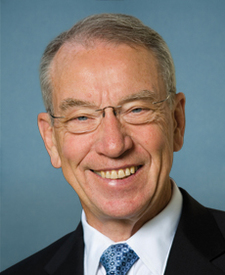
See how Chuck Grassley actually votes — against your values.
DeepSyte scores Chuck Grassley's record on the issues you care about — not party, not press releases. Take the 2-minute values quiz to see your personal alignment.
Sign in and take the values quiz to see how Chuck Grassley's votes line up with your views.
Prediction track record
How often we called Chuck Grassley's passage votes correctly, from their stated positions on each bill's tagged topics. Excludes “unclear” calls and abstentions.
17 predictions on record · none have been resolved by a passage vote yet. Check back as bills move.
A joint resolution providing for congressional disapproval under chapter 8 of title 5, United States Code, of the rule submitted by the Bureau of Consumer Financial Protection relating to the withdrawal of the rule relating to "Examinations for Risks to Active-Duty Servicemembers and Their Covered Dependents".
No paired statements and votes yet for Chuck Grassley
We haven't yet found statement/vote pairs on the same topic for Chuck Grassley. This usually means either the rep hasn't taken public positions on bills that have come to a passage vote, or those bills haven't been tagged yet. The checker runs as new press releases and votes come in.
Pro analysis
AI rep analysis — Pro
Get an AI-narrated read on Chuck Grassley's full voting record against your stated values — aligned themes, conflicts, notable votes, and what to watch for.
We haven't extracted campaign positions for Chuck Grassley yet. Once their campaign website or position pages are processed, this card will track what they said vs how they voted.
Crossing the aisle
Passage votes where Chuck Grassley broke ranks with ≥75% of Republicans. Threshold catches substantively partisan splits; unanimous-ish or close votes are excluded.
2
Cross-aisle votes
118-sjres-117·Nov 21, 2024·80% of R voted YES
A joint resolution relating to the disapproval of the Presidential report with respect to the indebtedness of the Government of Ukraine.
Grassley Urges Congress to Pass the National Defense Authorization Act | U.S. Senator Chuck Grassley of Iowa
Position: Senator Grassley supports passage of the fiscal year 2027 National Defense Authorization Act, including the $1.15 trillion authorization from the Senate Armed Services Committee. He emphasizes the need for a strong military to deter aggression, accountability for defense contractors, and provisions opposing Russian control of Ukrainian territory.
Floor Remarks by Senator Chuck Grassley of Iowa
Senate President Pro Tempore
“National Defense Authorization Act”
Tuesday, July 14, 2026
As the Senate and House [of Representatives] are currently working on the fiscal year 2027 National Defense Authorization Act (NDAA), it is very important that Congress pass this bill.
We need a very strong and capable military, and we need to hold the Pentagon accountable for taxpayer dollars.
For [250] years, the number one responsibility of the federal government has been national security. A non-negotiable tenant of Americans’ national security is peace through strength.
In preventing war, a strong Department of War is also an instrument of peace.
So, to achieve “peace through strength,” we must invest in our nation’s defense and modernize military capabilities to be best prepared for any threat.
Our military ought to be strong enough to deter any aggressor. We have learned from our history that preventing conflicts is less costly and spares more lives.
I support the [$1.15 ] trillion authorization put forth by our Senate Armed Services Committee.
The fiscal year 2027 defense bill supports our service members, boosts our national industrial defense base and allows for historic investment in our national security.
The legislation also includes important provisions that I backed to hold defense contractors accountable. This includes a requirement that contractors provide notification when the price of a product or service increases beyond a predetermined threshold.
While our investments in defense increase, ensuring accountability and fiscal responsibility is very paramount. Companies that work for the government should not be ripping the taxpayers off.
I’m also pleased that a provision I worked on is included in the bill that reinforces the notion that Russia’s aggression towards Ukraine is unacceptable. This provision prohibits funds [from] being used to recognize Russia’s control over any Ukrainian territory which has been forcibly seized by Russia.
I have offered several amendments to this defense bill to combat crime and support law enforcement, strengthen security provisions and cooperation in the Baltics and condemn very strongly Russia’s abduction of Ukrainian children.
That has been in the amounts of tens of thousands of children.
If the defense bill is passed this year, it will be the 66th consecutive year that Congress has passed this important annual defense legislation.
So, I look forward to working with my colleagues in the Senate to pass a defense bill that strengthens our national security and best supports our military readiness.
Democrats Revive FDR Court-Packing Scheme to Rig the Supreme Court | U.S. Senator Chuck Grassley of Iowa
Position: Senator Grassley opposes expanding the number of Supreme Court justices, characterizing the proposal as 'court-packing' and drawing historical parallels to FDR's failed 1937 attempt to reshape the Court.
With the 2026 midterms approaching and the 2028 presidential election right behind them, Democrats are raising a discredited ruse to pack the Supreme Court with additional justices.
Just last month, Democrats’ 2024 presidential nominee Kamala Harris floated the idea of Democrats packing the Supreme Court as part of a “no bad idea brainstorm.” Meanwhile, Democrats in Virginia recently threatened to pack their state Supreme Court to circumvent a ruling they didn’t like.
Democrats have lit the match for this partisan firestorm and liberal elites are fanning the flames. This week The Hill published an opinion article claiming, “Expanding the Supreme Court isn’t court-packing.”
“Adding four seats under the next Democratic trifecta would actually be unpacking the court,” the author argued.
Democrats clearly need a history lesson: Court packing was a bad idea in 1937 and it’s a bad idea in 2026. Nine decades ago, the nation’s 32nd president unleashed a sweeping expansion of the federal government with his New Deal program. Amid the Great Depression, President Franklin Delano Roosevelt (FDR) sought to address high unemployment, a collapsed banking system, and an agricultural crisis in rural America with micromanagement of the U.S. economy.
Congress passed more than a dozen major laws in FDR’s first 100 days. Many of those bumped into our constitutional system of checks and balances, which aims to prevent any one of the federal government’s three branches from gaining too much power.
During FDR’s first term, the Supreme Court ruled that several New Deal laws usurped states’ sovereignty, improperly delegated legislative power to the executive branch, violated constitutional authority by executive overreach, and unconstitutionally restricted individual liberties. The bloc of conservative justices reining in the president’s authority was known as the “Four Horsemen.”
FDR cooked up a plan to secure his agenda by reshaping the court, packing it with judges of his choosing to outflank the Constitution. In cahoots with Attorney General Homer Cummings, they hatched a plan called the Judicial Procedures Reform Act of 1937. This would have allowed the president to appoint one additional justice for every sitting justice older than 70, enabling FDR to increase the number of Supreme Court Justices from nine to as many as 15, as well as add up to 44 judges to lower federal courts.
Yet the Constitution gives Congress the sole authority to determine the size of the federal judiciary. In 1789, when the Judiciary Act was first signed establishing the Supreme Court, Congress set the number at six. It increased the number as the country expanded, but that number has been set at nine since 1869.
For a brief time, justices worked double duty and spent part of the year traveling a judicial circuit to hear cases; however, the practice of justices “riding circuit” ended more than a century ago. Thus, the present-day argument to match the number of Supreme Court justices to the number of federal circuits is pure partisan poppycock, much like FDR’s failed power grab in 1937.
FDR’s duplicitous effort to pack the court not only breached the separation of powers, it also insulted the justices with the disingenuous assertion they couldn’t handle the workload. FDR told Congress the justices were “slow and infirm.” That raised the ire of Chief Justice Charles Evan Hughes. In a letter presented to the Senate Judiciary Committee, he bashed the court-packing plan, writing it would “impair” the efficiency of the court, creating “more judges to hear, more judges to confer, more judges to discuss, more judges to be convinced and to decide.”
FDR used his “Fireside Chat” on March 9, 1937, to try and win the court of public opinion. He described the three branches of government as a three-horse team: “Two of the horses are pulling in unison today; the third is not.”
But the American people weren’t buying it, and neither were their elected representatives, including a Democrat-controlled Congress. Iowa’s own former President Hoover exposed the outrageous effort to reduce “the sword of the people” to “a tool of the executive.” In speeches across the country, he warned against the reckless precedent it would set: “[B]y adding members of the Court, any succeeding President can do it.”
On June 14, 1937, the Senate Judiciary Committee issued a scathing report on FDR’s judicial reforms, calling it “needless, futile, and utterly dangerous.” The committee urged the Senate to reject the plan “so emphatically … that its parallel will never again be so presented to the free representatives of the free people of America.” The Senate defeated FDR’s court-packing plan a month later, preserving the Supreme Court’s institutional integrity.
FDR’s power grab is a teachable moment for 21st-century déjà vu Democrats. Since they can’t bulldoze their policies through the democratic process, they want to pack the court to ensure they never lose.
Senate Minority Leader Chuck Schumer warned that Justices Neil Gorsuch and Brett Kavanaugh would “pay the price” for adhering to the Constitution, while House Minority Leader Hakeem Jeffries has called the Supreme Court a “disgrace” and a “corrupt MAGA majority.” That rhetoric is reckless and harmful to our republic. These orchestrated attacks on the judiciary undermine public trust in the institution tasked with upholding the rule of law, protecting individual rights and our system of checks and balances.
As chairman of the Senate Judiciary Committee and a lifelong Iowa farmer, I understand the futility of shutting the barn door after the horse has bolted. That’s why I support a constitutional amendment to keep nine Supreme Court justices on the bench at a time. As our nation celebrates the 250th birthday of America, we must safeguard the independence of the federal judiciary to protect our constitutional freedoms and way of life for generations to come.
Chuck Grassley, R-Iowa, chairs the Senate Judiciary Committee.
Rural Communities are Counting on Us | U.S. Senator Chuck Grassley of Iowa
Position: The senators and representative support extending the Rural Community Hospital Demonstration Program for another five years to maintain financial sustainability and care access in rural communities, particularly for mid-sized rural hospitals that do not qualify for critical access or urban payment models.
Rural communities are counting on us
By Sen. Chuck Grassley (R-Iowa) and Rep. Randy Feenstra (R-Iowa)
Rural healthcare is top-of-mind for many Iowans.
Across our state, Iowans rely on rural hospitals for compassionate, personalized care close to home. Rural hospitals are also economic anchors that support local businesses, create jobs and help small towns thrive.
That’s why we’re advancing policies that support rural healthcare and rural hospitals.
Republicans’ Working Families Tax Cuts Act created a $50 billion Rural Health Transformation Fund, the largest investment in rural healthcare in history. Under the law, Iowa will receive a minimum of $100 million annually from the fund over the next five years. In fact, our state already received $209 million this year, over twice that amount. But our work doesn’t stop there.
Together, we’re working to advance legislation to support hospitals across the United States, including several here in Iowa. It’s called the Rural Community Hospital Demonstration (RCHD) Program, and it’s offered a lifeline to rural hospitals for more than 20 years.
The program is designed to support what we often called “tweener” hospitals. Tweener hospitals are too big to serve as critical access hospitals, but too small to benefit from Medicare’s hospital payment system that’s designed for higher volume urban hospitals.
The RCHD program provides a lifeline by allowing rural tweener hospitals to test innovative hospital payment models under Medicare that boost financial sustainability, maintaining and improving care. Data from the Centers for Medicare and Medicaid Services (CMS) shows hospitals in this program improved margins, made more capital investments, retained more staff and expanded patient services.
Over 50 hospitals across 17 states have participated in this program over the past 20 years. Here in Iowa, we’re fortunate to have four hospitals currently in the program, located in Spirit Lake, Fort Dodge, Grinnell and Newton.
These rural hospitals serve more than their rural communities. In Iowa, these communities are summer vacation destinations, home to county fairs and a NASCAR race, and the site of a nationally recognized college.
Unfortunately, the program has expired, and Congress needs to act to extend this important program. Without RCHD, rural communities could lose access to essential services families rely on every day. Without extending this program, Iowans would face longer drives, delayed care and fewer options closer to home.
We’ve introduced legislation to stop this cliff, extend the program and ensure Iowans maintain access to care close to home. Our bipartisan Rural Community Hospital Demonstration Program Reauthorization Act would extend the program for another five years, and it’s co-led by Sen. Michael Bennet, D-Colo., in the Senate.
We’re glad to report the bill has already passed the U.S. Senate with unanimous support. This is the clearest sign yet of the importance of the program and the bipartisan commitment to extending it. Next, the bill needs to be passed in the U.S. House of Representatives, and we’re working hard to get it over the finish line.
As representatives for the people of Iowa in Congress, we’re committed to fighting for care in our rural communities, and that includes getting the Rural Community Hospital Demonstration Program Reauthorization Act signed into law. Rural hospitals across America are counting on us, and we’re working to get the job done.
Sen. Chuck Grassley represents Iowa in the U.S. Senate. Rep. Randy Feenstra represents Iowa’s 4th Congressional District.
ICYMI: Grassley Op-Ed: Republicans’ Rural Health Transformation Fund Is Improving Access to Care in Iowa | U.S. Senator Chuck Grassley of Iowa
Position: Senator Grassley supports the Rural Health Transformation Fund, enacted as part of the Working Families Tax Cuts Act, which provides federal funding to expand healthcare access and improve health outcomes in rural Iowa communities.
Republicans’ Rural Health Transformation Fund Is Improving Access to Care in Iowa
By Sen. Chuck Grassley (R-Iowa)
I’m one of hundreds of thousands of rural Iowans who lives off a gravel road and am proud to call farm country home. Over one third of our state is considered rural. Yet too often, it’s difficult for rural Iowans to access the healthcare they need, close to where they live. Republicans are working to change that.
Republicans’ Working Families Tax Cuts Act, which President Trump signed on July 4 last year, not only put money back in people’s pockets to help them provide for their families, it delivered historic funding to expand access to care in rural communities and improve health outcomes.
It’s called the Rural Health Transformation Fund, and it’s the largest investment in rural health in U.S. history. Astoundingly, not a single Democrat in Congress voted to support this funding.
Here in Iowa, the Rural Health Transformation Fund is already making a difference and keeping care closer to home.
Under Gov. Kim Reynolds’ leadership, Iowa was the first state in the nation to begin awarding its federal funding. As a result, Iowans in Marshalltown looking for heart and cancer care soon won’t have to travel to Waterloo or Des Moines for treatment. The Marshalltown Hospital is recruiting two new specialists in cardiology and oncology so area residents can get local treatment that’s close to their loved ones, who provide a valuable support network.
In Anamosa, Jones Regional Medical Center is buying a new surgical robot with this money, expanding options for cancer patients and bringing more surgeons to the region. In Onawa, Burgess Health Center is purchasing a new, advanced mammography system that will help detect breast cancer sooner and save Iowans’ lives.
In Chariton, I met with Iowans who told me they’ll have access to an MRI machine at the Lucas County Health Center for the first time. And, during my meeting at the Pella Regional Health Center, I learned they’re leveraging the Rural Health Transformation Fund to purchase a machine to improve local cancer care. Iowans near Mason City will have access to a new Robotic Bronchoscopy system that detects lung cancer sooner, giving Iowans more years with family and friends.
The good news doesn’t stop there.
Over the next five years, Iowa will receive, at a minimum, $100 million annually from the fund. Our state already received over twice that much this year alone: $209 million.
Because of this federal investment, young mothers needing prenatal care will be able to access clinics and telemedicine in up to five different locations in rural Iowa from the Des Moines Center of Excellence in Maternal Fetal Medicine.
A grandfather in Jasper County who’s fighting cancer can get advanced procedures and high-quality scans at the Newton Medical Center now that its decades old equipment is being replaced.
Iowans will also have access to more healthcare professionals, like family medicine physicians and nurses, because of this federal investment.
As a senior member and former chairman of the U.S. Senate Finance Committee, I’m constantly advocating for rural healthcare on behalf of Iowans. That’s why I helped lead the charge to get the Rural Health Transformation Fund passed into law, and I’ll be following it closely to ensure Iowa receives the support it deserves.
I applaud Gov. Reynolds for her work to identify needs across our state that qualify for these federal grants, such as combating cancer, improving access to emergency care and recruiting top-tier healthcare professionals.
During my 99 county meetings this year, I’ve heard story after story from healthcare professionals who are putting this money to work for their patients. More Iowa communities will benefit from the Rural Health Transformation Fund in the years ahead.
Chuck Grassley is the senior U.S. senator from Iowa.
Grassley Raises Awareness on Benefits of Home Visiting Programs During National Home Visiting Week | U.S. Senator Chuck Grassley of Iowa
Floor Remarks by Senator Chuck Grassley of Iowa
Senate President Pro Tempore
“National Home Visiting Week Resolution”
Thursday, April 30, 2026
Strong families build a strong society and a strong America.
Along [with] that thought, for the second year, I’ve led a bipartisan resolution in the Senate to recognize National Home Visiting Week.
Evidence-based home visiting programs, as an example, programs like the Federal Maternal, Infant and Early Childhood Home Visiting Program, [are] an example of programs offering important services that support pregnant women, new moms and entire families.
The positive outcomes that families demonstrate in areas like maternal, mental and behavioral health issues illustrate just how important these services are.
Evidence-based home visiting programs also reduce child abuse, reduce neglect and reduce family conflict.
Targeted intervention of this kind is very important and key to preventing a family’s involvement with [the] child welfare system, and that is a very noble goal that I’ve long worked to help families achieve.
Strengthening families and supporting parents as they raise the next generation is paramount.
In many areas, my state leads. So, I’m proud to say that Iowa was one of the early adopters of home visiting programs, and it’s proven successful, very successful in our state.
In fact, an Iowan from Sioux City was named a 2025 home visitor of the year by the Institute for the Advancement of Family Support Professionals.
I’d like to thank the home visitors and their supervisors that provide evidence-based services that help families build a strong foundation.
Grassley Praises Iowa House Members for Fighting for Farmers on Farm Bill, E15 | U.S. Senator Chuck Grassley of Iowa
Position: Senator Grassley advocates for passage of legislation to establish E15 (15% ethanol fuel blend) availability nationwide, arguing it will expand agricultural markets, reduce fuel costs, and provide economic certainty for retailers and farmers.
Floor Remarks by Senator Chuck Grassley of Iowa
Senate President Pro Tempore
“Iowa Delegation is Fighting for Family Farmers”
Thursday, April 30, 2026
[I’m taking] a little while here now to thank Iowa members of the House of Representatives, Congressman Feenstra, Congressman Nunn and Congresswomen Hinson and Miller-Meeks, for their very good efforts fighting for Iowa farmers during the Farm Bill negotiations in the House of Representatives.
And part of that discussion involved the biofuel issue of E15. E15 is a top priority for not only Iowans, [but] for people generally in the Midwest, where we have abundant corn crops that make the ethanol that ends up being E15.
E15 will expand markets for farmers, help consumers at the pump and, according to the economists for the Iowa Corn Growers [Association], add $14 billion to an already hurting ag economy. And when I say already, already for the last three or four years.
Now, E15 is a no-brainer that is supported by President Trump. In fact, when President Trump visited Iowa [in] early March, he [said] he'd like to have Congress present an E15 bill to him to sign.
So, I hope the leadership of the House of Representatives keeps their word to get E15 a floor vote and [does] that in very short order.
In fact, I don't really know what all the problem is about E15 because, by presidential waiver, we've had E15 the last two years of Trump One, four years of the Biden administration and now two years in this Trump administration. And I have never heard any controversy about that.
Then, secondly, we've had the governors of eight Midwestern states petition the Environmental Protection Agency (EPA) for E15 year-round and throughout all those eight states. And I never heard anything controversial about that.
But, when we want to pass legislation that would avoid a presidential waiver and allocate E15 in the other 42 states that don't have it year-round, all of a sudden [it] becomes quite a controversial issue. [It’s] something I just don't understand.
I think it's the case that now we're having some legislation to bring certainty to the issue of E15, and it's going to make it possible for retailers to invest in the very expensive pumps that it takes to distribute E15.
And that certainty is very necessary for that investment, but all of a sudden it becomes a very controversial issue where it has not been a controversial issue by presidential waiver or by those eight state governors petitioning EPA to have it in those states.
It ought to be done now and help American agriculture and reduce the price of gasoline tremendously through E15.
Now, I hear from some states that don't have E15 that their people don't want it because it's going to raise the price of gasoline. Come to Iowa. Come to other Midwestern states where we have E15 year-round, and you'll find that gasoline that has ethanol with a 15% mixture [is] cheaper than any other grade of gas that you can buy.
Grassley Opens Judiciary Committee Executive Business Meeting | U.S. Senator Chuck Grassley of Iowa
Prepared Opening Statement by Senator Chuck Grassley of Iowa
Chairman, Senate Judiciary Committee
Executive Business Meeting
Thursday, April 30, 2026
On today’s agenda, we have 14 nominations and six bills.
Today, we’ll vote on four judicial nominations: Sheria Clarke for the District of South Carolina, Kathleen Lane for the District of Montana, Evan Rikhye for the District of the Virgin Islands and Kara Westercamp for the Court of International Trade.
We’ll also vote on Kenneth Sorenson to serve as U.S. Attorney for the District of Hawaii and Johnson Teehee to serve as U.S. Marshal for the Eastern District of Oklahoma.
After that, we’re voting on three bills: S. 1572, the Federal Carjacking Enforcement Act, S. 3062, the GUARD Act and S. 3966, TREY’s Law.
The other bills and the remaining nominations will be held over for future consideration.
Before we turn to the votes, I’d like to say a few words about the American Bar Association, or the ABA.
In recent decades, the ABA’s inserted itself into divisive political topics.
Since the 1960s, the ABA has taken positions hostile towards the Second Amendment.
It also passed a pro-abortion resolution, which forced thousands of its members to leave in protest.
And it issued rules recommending sanctions for attorneys who publicly state that there are only two genders.
As one former White House Counsel stated, the ABA “takes public positions on divisive political, legal and social issues that come before the courts.”
And it’s damaged the ABA’s credibility in rating judicial nominees.
Its evaluation process lacks transparency, and historically, a poor ABA rating has reflected a bias against conservatism.
In fact, the ABA gave at least a minority “Not Qualified” rating to many great conservative judges, including Frank Easterbrook, William Pryor, Timothy Tymkovich and many others.
Meanwhile, the ABA has heralded liberal judicial nominees.
One Biden nominee, Charnelle Bjelkengren, could only list six cases that she’d litigated in her career.
At her hearing, she couldn’t remember what Articles II or V of the Constitution were.
How did the ABA assess her nomination?
Let me say that again, the ABA rated as “Qualified” a Biden nominee who lacked basic knowledge about the same Constitution that she’d swear an oath to uphold.
To the ABA, it’s long appeared that political affiliation is more important than legal competency.
So, it’s no surprise that the ABA recently rated Ms. Lane, who works for the RNC, managing a docket of more than 100 cases, as “Not Qualified.”
However, like other judges who received poor ABA ratings, Ms. Lane is a great nominee.
She spent years working with Montana’s Solicitor General.
She’s litigated dozens of appeals, including briefs before the Supreme Court.
And she’s uniquely qualified to serve in Montana because of her experience in rural cases involving land use, grazing rights and coal mining leases.
Once confirmed, I hope Ms. Lane wears her ABA rating as a badge of honor.
Based on the history of stellar judges who received poor ABA ratings, she’s likely to become one of our nation’s finest jurists.
On our legislative agenda today, we’re considering three bills.
First, we’ll vote on Senator Blackburn’s bipartisan Federal Carjacking Enforcement Act.
This important bill will give federal prosecutors the tool they need to bring these violent offenders to justice.
We’ll also consider two bipartisan civil bills, the GUARD Act and Trey’s Law.
These bills advance the important issue of child safety.
These measures, if enacted, would protect kids from being harmed or exploited.
Finally, I’d like to take a minute to recognize some of the families who are here today with us.
Their children were victims of harmful manipulation by Character.AI, one of these chatbots.
Please know your families are in my prayers.
I look forward to these bills being discussed and voted on by our committee.
Prop 12 is a Hogwash ‘Government Knows Best’ Approach | U.S. Senator Chuck Grassley of Iowa
Position: Senator Grassley opposes California's Proposition 12 animal welfare standards, arguing they impose unconstitutional burdens on interstate commerce, increase consumer prices, harm farmers—particularly smaller operations—and create market consolidation. He commits to supporting federal legislation to prevent states from imposing such standards on interstate agricultural commerce.
With passage of Proposition 12 in 2018, California voters overstepped constitutional boundaries and effectively hogtied pig farmers across America. Pork producers were faced with a dire choice: either fork out tens of thousands of dollars to comply with California’s mandates or get blacklisted from selling to 15% of the nation’s pork market.
Since Prop 12 went into full effect on Jan. 1, 2024, consumers have been subject to inflated pork prices: the average price per pound of a pork loin in California has risen more than 40%. And pig farmers are stuck like a pig in a poke.
Don’t just take my word for it; recall what a fellow Iowan, former Iowa governor and USDA secretary for a dozen years during the Obama and Biden administrations said about Prop 12. Then-Secretary Tom Vilsack explained to the House Agriculture Committee how Prop 12 sowed “chaos” in the marketplace. At that same hearing, House Ag Chairman Glenn Thompson referenced a preliminary USDA finding that costs associated with Prop 12 “have a more severe impact on smaller independent operations, and that distresses placed upon the entire production and marketing chain will lead to ever-increasing consolidation and concentration of the industry.”
With the current downturn in the farm economy, the last thing farmers need is more uncertainty, more expenses and more ridiculous regulations.
Here’s precisely why Prop 12 is bad policy:
Punitive Prop 12 expenses are pigheaded. As work continues in Congress to pass the next farm bill, I’m committed to restoring constitutional guardrails and shutting the barn door on California and other states who impose intrusive standards on interstate commerce.
As a lifelong family farmer and a member of the Senate Agriculture Committee, I’m proud to champion rural America and serve as an outspoken advocate for farm families, including Iowa’s pig farmers. Prop 12 undermines their livelihoods and jacks up prices for consumers at the grocery store.
As Justice Neil Gorsuch wrote in the Supreme Court’s ruling, “policy choices like these usually belong to the people and their elected representatives.” Congress has the power to stop the chaos unleashed by Prop 12. It’s time we do so.
Keeping domestic markets open for business lowers food costs for families and alleviates tight margins facing America’s farmers. During National Agriculture Week, that’s something lawmakers on both sides of the aisle ought to give their whole hog endorsement.
Chuck Grassley is Iowa's senior senator.
Source: GDELT 2.0 GKG, filtered to a curated list of national outlets. Inclusion is not endorsement; opinion pieces and reported news are mixed.
Recent stock activity
Periodic transaction reports filed under the STOCK Act — disclosed by the rep, sourced from public filings.
No disclosed trades on record.
Source: open-data mirrors of the Senate eFD and House Clerk financial-disclosure systems. Disclosure within 30 days of trade is required by law (45 for spouse/dependent trades).
Top PAC donors · 2026 cycle
Political action committees that gave the most to this rep's principal campaign committee this cycle. PAC giving is direct organizational support — industry, ideological, or leadership.
1.HAWKEYE FUND7 contributions$82,228
2.DENALI LEADERSHIP PAC1 contribution$10,000
3.RESPONSIBILITY AND FREEDOM WORK PAC1 contribution$10,000
4.LET'S GET TO WORK PAC1 contribution$10,000
5.RELY ON YOUR BELIEFS FUND1 contribution$10,000
6.FUND FOR AMERICAS FUTURE PAC1 contribution$10,000
7.MARSHA PAC1 contribution$10,000
8.ARKANSAS FOR LEADERSHIP PAC1 contribution$10,000
10.TOMORROW IS MEANINGFUL PAC1 contribution$10,000
Source: OpenFEC (api.open.fec.gov) Schedule A receipts where contributor type is “committee.” Aggregated by contributing committee. Self-transfers from joint-fundraising / victory committees are excluded.
Top individual contributors · 2026 cycle
Itemized individual contributions over $200 to this rep's campaign committee, aggregated by donor employer. PAC giving is shown above; this section is people, not organizations.
1.DCI GROUP$7,000
2.SPACEX$6,600
3.PEACHTREE GROUP$3,500
4.PEACHTREE GROUP CREDIT$3,500
5.PEACHTREE HOTEL GROUP$3,500
6.BIOHAVEN$3,500
7.INCITE.ORG$3,500
8.SELF$3,158
9.EB-5 NEW YORK STATE LLC$2,800
10.CIVITAS CAPITAL GROUP$2,500
Source: OpenFEC Schedule A receipts where contributor type is “individual,” aggregated by the donor's self-reported employer. This is a geographic / industry correlation, not a corporate endorsement.