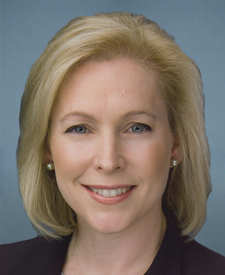
See how Kirsten E. Gillibrand actually votes — against your values.
DeepSyte scores Kirsten E. Gillibrand's record on the issues you care about — not party, not press releases. Take the 2-minute values quiz to see your personal alignment.
Sign in and take the values quiz to see how Kirsten E. Gillibrand's votes line up with your views.
Prediction track record
How often we called Kirsten E. Gillibrand's passage votes correctly, from their stated positions on each bill's tagged topics. Excludes “unclear” calls and abstentions.
100%
Accuracy
1
Correct
0
Incorrect
12
Pending
Right119-sjres-184
A joint resolution to direct the removal of United States Armed Forces from hostilities within or against the Islamic Republic of Iran that have not been authorized by Congress.
A joint resolution to direct the removal of United States Armed Forces from hostilities within or against the Islamic Republic of Iran that have not been authorized by Congress.
Providing for congressional disapproval under chapter 8 of title 5, United States Code, of the rule submitted by the Bureau of Consumer Financial Protection relating to the withdrawal of the rule relating to "Truth in Lending (Regulation Z); Consumer Protections for Home Sales Financed Under Contracts for Deed".
Based on 6 data points across public statements and recorded votes · AI analysis of public records
119-sjres-184·Consistent
A joint resolution to direct the removal of United States Armed Forces from hostilities within or against the Islamic Republic of Iran that have not been authorized by Congress.
92/100
What they said
Sep 9, 2026
Senator Gillibrand opposes the Trump administration's military operations in Iran, arguing they have caused rising oil and fuel prices, harmed U.S. service members, lack clear strategic objectives, and distract from addressing costs for American families.
Voted Yea on A joint resolution to direct the removal of United States Armed Forces from hostilities within or against the Islamic Republic of Iran that have not been authorized by Congress.
Senator Gillibrand's statement directly opposes Trump's military operations in Iran, citing harm to service members, rising oil prices, and lack of clear strategic objectives. The joint resolution directs removal of U.S. Armed Forces from unauthorized hostilities in Iran. Her yes vote on passage aligns precisely with her stated opposition to the war and support for ending it absent congressional authorization.
A joint resolution to direct the removal of United States Armed Forces from hostilities within or against the Islamic Republic of Iran that have not been authorized by Congress.
92/100
What they said
Sep 3, 2026
Senator Gillibrand opposes the extension of U.S. troop deployments in the Middle East, characterizing the ongoing military operation as a failed war that wastes taxpayer resources without a clear mission or exit strategy.
Voted Yea on A joint resolution to direct the removal of United States Armed Forces from hostilities within or against the Islamic Republic of Iran that have not been authorized by Congress.
Senator Gillibrand's statement opposes extending troop deployments in the Middle East, characterizing the operation as a failed war without clear mission or exit strategy. The joint resolution directs removal of U.S. Armed Forces from hostilities against Iran unless Congress authorizes military force, and Gillibrand voted yes for passage. The statement and vote are directly aligned on the specific question: both oppose continued military operations in Iran absent congressional authorization and clear strategic justification.
A joint resolution to direct the removal of United States Armed Forces from hostilities within or against the Islamic Republic of Iran that have not been authorized by Congress.
92/100
What they said
May 15, 2026
Senator Gillibrand opposes the Trump administration's military conflict with Iran, arguing it has driven up gas prices and harmed Central New York families and farmers. She calls for an immediate end to the conflict and has voted for war powers resolutions to reassert congressional authority over military action.
Voted Yea on A joint resolution to direct the removal of United States Armed Forces from hostilities within or against the Islamic Republic of Iran that have not been authorized by Congress.
Senator Gillibrand's statement explicitly opposes the Trump administration's military conflict with Iran and calls for its immediate end, citing harm to gas prices and Central New York families. The bill directs removal of U.S. Armed Forces from hostilities against Iran absent congressional authorization. Her YES vote on passage is directly consistent with her stated opposition to the war and her stated commitment to voting for war powers resolutions to reassert congressional authority over military action.
A joint resolution to direct the removal of United States Armed Forces from hostilities within or against the Islamic Republic of Iran that have not been authorized by Congress.
92/100
What they said
May 15, 2026
Senator Gillibrand opposes President Trump's military conflict with Iran, arguing it is directly responsible for elevated gas prices harming working families and small businesses. She calls for an immediate and permanent end to the conflict to provide economic relief.
Voted Yea on A joint resolution to direct the removal of United States Armed Forces from hostilities within or against the Islamic Republic of Iran that have not been authorized by Congress.
Senator Gillibrand's statement directly opposes Trump's military conflict with Iran and calls for its immediate end to provide economic relief to working families. The bill (S.J.Res. 184) directs removal of U.S. Armed Forces from hostilities against Iran absent Congressional authorization, invoking the War Powers Resolution. Her yes vote on passage aligns precisely with her stated position opposing the conflict and demanding its termination.
Providing for congressional disapproval under chapter 8 of title 5, United States Code, of the rule submitted by the Bureau of Alcohol, Tobacco, Firearms, and Explosives relating to "Factoring Criteria for Firearms with Attached 'Stabilizing Braces'".
85/100
What they said
Sep 9, 2026
Senator Gillibrand and colleagues oppose the Department of Justice's decision not to seek appellate relief from a district court ruling that struck down key regulatory requirements of the National Firearms Act of 1934, arguing that the NFA's nearly century-old protections against dangerous weapons should be vigorously defended in court.
Voted Nay on Providing for congressional disapproval under chapter 8 of title 5, United States Code, of the rule submitted by the Bureau of Alcohol, Tobacco, Firearms, and Explosives relating to "Factoring Criteria for Firearms with Attached 'Stabilizing Braces'".
Senator Gillibrand's statement opposes DOJ's failure to defend the National Firearms Act's regulatory requirements for dangerous weapons. The bill nullifies an ATF rule that implements NFA protections by classifying stabilizing-brace firearms as regulated rifles. Gillibrand's NO vote on the resolution aligns with her stated position: she opposes weakening NFA enforcement, and voting NO preserves the ATF rule that strengthens NFA implementation. The positions are directionally consistent on the shared question of NFA enforcement strength, though the statement focuses on DOJ's appellate strategy while the vote addresses a specific regulatory rule.
Senator Gillibrand and colleagues filed an amicus brief supporting a federal court ruling that the Trump administration's HUD unlawfully restricted funding to fair housing organizations that investigate and enforce housing discrimination laws, arguing the administration's redirection of $46 million lacks legal justification and would harm fair housing enforcement.
Senator Gillibrand's statement opposes the Trump administration's redirection of fair housing funding away from enforcement organizations. The bill is a FY2024 omnibus appropriations act that includes the Transportation, Housing and Urban Development appropriations division, which would fund HUD programs including fair housing initiatives. A YES vote on the appropriations bill is generally consistent with supporting congressional intent to fund fair housing enforcement, though the bill does not specifically address or reverse the Trump administration's funding restrictions that the statement criticizes. The vote reflects support for HUD appropriations broadly, but the statement targets a specific Trump-era reallocation that may or may not be addressed within this particular appropriations measure.
Pairs with ambiguous language and high uncertainty are withheld until more data is available. Procedural, cloture, and amendment votes are excluded — they don't cleanly signal substantive support or opposition.
Pro analysis
AI rep analysis — Pro
Get an AI-narrated read on Kirsten E. Gillibrand's full voting record against your stated values — aligned themes, conflicts, notable votes, and what to watch for.
We haven't extracted campaign positions for Kirsten E. Gillibrand yet. Once their campaign website or position pages are processed, this card will track what they said vs how they voted.
Crossing the aisle
No party-break passage votes recorded for Kirsten E. Gillibrand. Either they've voted with Democrats on every substantive passage vote in the corpus, or their tenure overlaps few high-threshold party-line votes so far.
Gillibrand, Duckworth, Schiff Press FDA On Plan To Mitigate Estrogen Patch Shortage - Kirsten Gillibrand | U.S. Senator for New York
Position: Senator Gillibrand, joined by Senators Duckworth and Schiff, is pressing the FDA for a clear plan and additional details on how it will use its statutory authority to address the estradiol transdermal patch shortage affecting menopause treatment.
U.S. Senator Kirsten Gillibrand (D-NY) pressed the Food and Drug Administration (FDA) on its plan to mitigate the estradiol transdermal patch shortage, which is making it harder for women to manage symptoms of menopause.
Estradiol transdermal patches are the clinically preferred, first-line treatment for managing menopause symptoms like hot flashes, night sweats, mood changes, and vaginal dryness. However, over the last year, the drug supply chain has failed to meet increased demand for estradiol patches, leaving thousands of women to navigate administrative chaos and, in some cases, ration or discontinue use of the patches.
In a letter to FDA—which was co-signed by Senators Tammy Duckworth (D-IL) and Adam Schiff (D-CA)—-Senator Gillibrand demanded additional details about how FDA is exercising its statutory authority to alleviate the estradiol patch shortage.
“Estradiol patches are a first-line, widely used, and highly effective treatment for managing menopause symptoms, and FDA should be doing everything in its power to make sure this therapy is available to all women who need it,” said Senator Gillibrand. “As the top Democrat on the Senate Aging Committee, I am demanding a clear plan from FDA to mitigate the estradiol patch shortage. This is an urgent women’s health priority, and I will not rest until we have answers.”
This letter builds on Senator Gillibrand’s work to improve menopause research, training, and care. Last month, in her capacity as ranking member of the Senate Aging Committee, Senator Gillibrand held the first ever congressional hearing on menopause. She also led a bipartisan letter to the Government Accountability Office (GAO) requesting a report on the federal government’s current role in menopause care and research. Gillibrand is also a cosponsor of the Advancing Menopause Care and Mid-Life Women’s Health Act, bipartisan legislation that would authorize $275 million over five years to strengthen and expand federal menopause research, healthcare workforce training, and education efforts related to mid-life women’s health.
The full text of the letter can be found here or below:
Dear Acting Commissioner Diamantas,
We write to express concern regarding the ongoing widespread shortage of transdermal estradiol patches. On September 16, 2026, the Senate Special Committee on Aging held a hearing highlighting the systemic menopause care gap in the United States. During the hearing, the Committee heard testimony from researchers, providers, and patients who detailed how unpredictable access to transdermal estradiol over the past year has disrupted care for hundreds of thousands of American women.
Estradiol transdermal patches represent the clinically preferred, first-line treatment for menopausal symptom management, and estrogen hormone therapy remains the single most effective intervention for severe vasomotor symptoms, including hot flashes and night sweats. The FDA’s November 2025 removal of boxed warnings on hormone replacement therapies (HRT) for menopause management was a positive step in increasing access to safe, effective care. However, this regulatory shift, coupled with increased awareness and research, surged demand for HRT among menopausal women, resulting in a dramatic year-over-year increase in prescriptions nationwide.
It has become clear that the pharmaceutical supply chain has failed to adequately respond to this surge in demand. Reports from the American Society of Health-System Pharmacists (ASHP) indicate that nearly 20 distinct estrogen patch formulations have been severely impacted by supply disruptions over the last calendar year. As a result, thousands of women are struggling to navigate administrative chaos—bouncing between competing pharmacy chains, transferring prescriptions between locations, switching formulation brands, or resorting to stretching doses or splitting patches. In some cases, patients have been forced to discontinue this effective therapy altogether.
While we acknowledge the FDA’s update on September 3, 2026 addressing the estradiol patch supply, the Committee remains concerned about the Agency’s delay in addressing this crisis and has additional questions regarding remedial steps to ensure patients can access effective therapies. Unfortunately, it took four months of inquiry for the FDA to issue basic advice telling patients to contact their pharmacist or speak with their healthcare provider. Passive monitoring and generic advice fail to adequately mitigate a nationwide manufacturing deficit.
To ensure the FDA is exercising its full statutory authority to alleviate this crisis, we request written responses to the following questions no later than November 16, 2026:
1. What criteria must the disruptions in estradiol patches meet for the FDA to declare an official estradiol patch shortage on the official Drug Shortage Database, unlocking emergency regulation tools?
2. What metrics is the FDA using to monitor manufacturer capacity for transdermal estradiol products, and when did the Agency’s staff first identify an imbalance between national demand and production volume?
3. The September 2026 update notes that the FDA is working closely with manufacturers to ensure supply of estradiol patches keeps pace with demand. What remedial steps has the FDA taken since the shortage was first identified to increase supply long-term?
a. What is the baseline volume of production from late 2025 compared to current capacity?
b. When do you anticipate that production will meet full market demand?
4. How many prior-approval submissions for new manufacturing lines, expanded batch sizes, site additions, specialized equipment, or other production expansion requests related to estradiol patches has the FDA received since November 2025?
a. What is the average review time for these expedited requests?
b. Did FDA drug shortage staff forecast market impacts following the removal of the black box warning on HRT to
prepare for the surge in demand?
5. Given that scaling transdermal delivery manufacturing involves complex machinery and long lead times, what interim regulatory tools is the FDA considering to address the immediate deficit?
a. Will this involve temporary allowance of supplies from countries not previously approved for import? If so, will
FDA perform expedited site inspections for previously unexamined overseas manufacturing facilities?
6. Why did the FDA require four months of formal inquiry to issue basic patient guidance, and what concrete steps is the Agency taking to improve real-time public messaging and inventory reporting during active drug shortages?
7. How many staff currently work on identifying and mitigating drug shortages at FDA? How many employees are specifically focused on remedying the estradiol patch shortage?
8. What policies is the FDA implementing to check major labeling updates, boxed warning removals, or updated clinical guidelines with national supply chain forecasting to prevent similar drug shortages following updated regulatory guidance?
a. Does the FDA’s Center for Drug Evaluation and Research (CDER) perform supply chain impact reviews prior to
issuing major safety labeling changes like removing boxed warnings?
Thank you for your prompt attention to this urgent women's health priority. We look forward to receiving your response and working together to investigate this issue.
Gillibrand, Colleagues Slam Attorney General Blanche For Illegally Allowing Sale Of Guns To Teenagers, Increasing Likelihood Of School Shootings - Kirsten Gillibrand | U.S. Senator for New York
Position: Senator Gillibrand and 19 colleagues oppose the Department of Justice's decision to stop enforcing the federal prohibition on handgun sales to people under 21, and they request information on the authority and research behind that decision.
U.S. Senator Kirsten Gillibrand (D-NY) joined 19 of her Senate colleagues in a letter to Attorney General Todd Blanche demanding answers on the Department of Justice’s (DOJ) decision to break with decades of precedent and unilaterally refuse to enforce a prohibition against the sale of handguns to people under the age of 21.
“The Trump administration should be doing more to keep guns out of the wrong hands – not less,” said Senator Gillibrand. “Refusing to enforce the law that bars dealers from selling handguns to teenagers makes our communities less safe and is a direct surrender to the gun lobby at the expense of American lives.”
In their letter, the senators highlighted the enormous risks to public safety if handguns are placed in teens’ hands, writing, “The public safety implications of this decision are clear. Numerous mass shootings have been committed by perpetrators between the ages of 18 and 20, including the shooting at Robb Elementary School in Uvalde, Texas, where an 18-year-old fatally shot 19 students and two teachers and injured 18 others, as well as the shootings at a supermarket in Buffalo, New York; an Indianapolis FedEx facility and Marjory Stoneman Douglas High School in Parkland, Florida. These tragic examples underscore the public safety considerations at stake and the serious risks Congress sought to address.”
“Congress enacted this prohibition as part of the Gun Control Act of 1968, clearly stating that ‘it shall be unlawful’ for an FFL to sell or transfer a handgun to a person under age 21. Nearly 60 years later, the Department’s decision to stop enforcing this provision comes not because Congress repealed or amended the law, but because the executive branch has independently concluded that these provisions are unconstitutional. This decision raises serious questions about the Department’s execution of federal law, its communications with members of the gun industry, and the implications for the enforcement of federal firearms laws nationwide,” the senators continued.
The senators concluded by requesting Blanche provide the following information on the authority and research supporting his decision:
In addition to Senator Gillibrand, the letter was signed by U.S. Senators Richard Blumenthal (D-CT), Lisa Blunt Rochester (D-DE), Cory Booker (D-NJ), Chris Coons (D-DE), Dick Durbin (D-IL), Mazie Hirono (D-HI), Tim Kaine (D-VA), Mark Kelly (D-AZ), Andy Kim (D-NJ), Amy Klobuchar (D-MN), Ed Markey (D-MA), Chris Murphy (D-CT), Alex Padilla (D-CA), Jack Reed (D-RI), Adam Schiff (D-CA), Chuck Schumer (D-NY), Elizabeth Warren (D-MA), Peter Welch (D-VT), and Sheldon Whitehouse (D-RI).
Senator Gillibrand has long fought for commonsense gun safety laws. She wrote the interstate gun trafficking ban that became law as part of the Bipartisan Safer Communities Act, which has helped take over 6,000 guns off the streets. When the Trump administration stopped providing updates on prosecutions under the ban, Gillibrand successfully demanded that DOJ restore transparency and resume the updates. She also introduced the Age 21 Act to raise the minimum age to buy assault weapons to 21. In July, she called out the Trump administration’s dangerous rollbacks of gun safety regulations, like those that hold lawbreaking gun dealers accountable and keep guns away from people with serious mental illness.
The full text of the letter is available below. A copy of the letter is available here.
Dear Attorney General Blanche:
We write regarding the U.S. Department of Justice’s (the Department) decision to cease enforcement of longstanding federal restrictions on the sale of handguns to individuals under the age of 21 by federally licensed firearms dealers (FFLs). This significant change in federal enforcement policy raises serious questions about the Department’s legal justification, and we request information regarding the analysis underlying its decision.
On September 18, 2026, the Department’s Office of Legal Counsel (OLC) published a legal opinion concluding that 18 U.S.C. § 922(b)(1) and (c)(1)—the federal prohibition on FFLs selling handguns to 18- to 20-year-olds—violate the Second Amendment, and that federal prosecutors may no longer prosecute FFLs that sell handguns to 18- to 20-year-olds who are not otherwise prohibited from gun possession.[1] Congress enacted this prohibition as part of the Gun Control Act of 1968, clearly stating that “it shall be unlawful” for an FFL to sell or transfer a handgun to a person under age 21.[2] Nearly 60 years later, the Department’s decision to stop enforcing this provision comes not because Congress repealed or amended the law, but because the Executive Branch has independently concluded that these provisions are unconstitutional. This decision raises serious questions about the Department’s execution of federal law, its communications with members of the gun industry, and the implications for the enforcement of federal firearms laws nationwide.
The Department’s OLC opinion acknowledges the constitutionality of age-based firearms restrictions has “deeply divided members of the federal bench.” Given the ongoing nature of this legal dispute, the Department’s decision that it may cease enforcement of federal law by executive fiat, rather than continue defending and enforcing the statute, represents an expansive and concerning assertion of executive authority.
The public safety implications of this decision are clear. Numerous mass shootings have been committed by perpetrators between the ages of 18 and 20, including the shooting at Robb Elementary School in Uvalde, Texas, where an 18-year-old fatally shot 19 students and two teachers and injured 18 others, as well as the shootings at a supermarket in Buffalo, New York; an Indianapolis FedEx facility and Marjory Stoneman Douglas High School in Parkland, Florida. These tragic examples underscore the public safety considerations at stake and the serious risks Congress sought to address. The Department’s decision to unilaterally cease enforcement of this provision of law raises serious questions and concerns. Thus, we request the Department provide:
Please provide the requested information and documents by November 16, 2026.
Gillibrand, Colleagues Demand Trump FCC Withdraw Proposal To Undermine E-Rate Program - Kirsten Gillibrand | U.S. Senator for New York
Position: The release opposes the FCC's proposed rulemaking to eliminate or limit the E-Rate program and urges the Commission to withdraw it, arguing E-Rate's broadband support for schools and libraries should be preserved and that cutting it is not an effective child-safety measure.
Lawmakers Argue That Dismantling E-Rate Will Widen The Digital Divide And Raise Costs For The Communities That Can Least Afford It
U.S. Senator Kirsten Gillibrand (D-NY) joined a bicameral group of colleagues in urging Federal Communications Commission (FCC) Chairman Brendan Carr to withdraw the Commission’s damaging proposal to eliminate or limit the E-Rate program. In June, the Carr FCC voted to open a rulemaking examining E-Rate, which helps schools and libraries across the country afford reliable internet access.
“Every school should have the resources it needs to provide our kids with a high-quality education,” said Senator Gillibrand. “Millions of children who lack reliable internet access are at risk of falling behind without the critical connectivity that the E-Rate program provides. I urge the FCC to immediately withdraw its harmful proposal, and I will continue fighting to protect E-Rate and keep investing in our schools, libraries, and future leaders.”
E-Rate helps over 96% of U.S. public schools access high-speed internet. In 2025, nearly $182 million in E-Rate funding was committed to school districts and libraries across New York State, helping them afford reliable internet.
On Long Island, E-Rate saved Suffolk County public libraries over $300,000 last year, covering roughly 60% of their broadband bills. At the same time, internet demand in Nassau County school districts jumped 31% over the past year, a spike that could put significant strain on district budgets without E-Rate discounts.
In the letter, the lawmakers wrote, “Schools and libraries help develop the next generation of engineers, scientists, and cybersecurity professionals, including in communities that have historically lacked access to those opportunities. Cutting E-Rate would narrow that talent pipeline. Maintaining connectivity in every school and library is therefore an investment in America’s technological leadership, economic competitiveness, and national security.”
“We strongly support measures to protect children online and address concerns around excessive screen time. But cutting E-Rate is not a child-safety measure. E-Rate funds broadband connectivity — not laptops, tablets, applications, or online content — and recipients must already comply with the Children’s Internet Protection Act, including by using filtering and blocking tools, adopting internet-safety policies, and educating students about appropriate online behavior. States and local communities, meanwhile, are developing targeted policies governing when and how students use devices in schools — an appropriate way to address screen-time concerns, rather than cutting broadband support. The Commission should not use child safety as a pretext to dismantle the secure, managed broadband infrastructure that schools and libraries need to educate students and help them navigate the digital world safely,” the lawmakers continued.
In addition to Senator Gillibrand, the letter was signed by U.S. Senators Angela Alsobrooks (D-MD), Tammy Baldwin (D-WI), Michael Bennet (D-CO), Richard Blumenthal (D-CT), Lisa Blunt Rochester (D-DE), Cory Booker (D-NJ), Maria Cantwell (D-WA), Chris Coons (D-DE), Catherine Cortez Masto (D-NV), Tammy Duckworth (D-IL), Dick Durbin (D-IL), John Fetterman (D-PA), Ruben Gallego (D-AZ), Maggie Hassan (D-NH), Martin Heinrich (D-NM), John Hickenlooper (D-CO), Mazie Hirono (D-HI), Tim Kaine (D-VA), Mark Kelly (D-AZ), Andy Kim (D-NJ), Angus King (I-ME), Amy Klobuchar (D-MN), Ben Ray Luján (D-NM), Edward Markey (D-MA), Jeff Merkley (D-OR), Chris Murphy (D-CT), Patty Murray (D-WA), Alex Padilla (D-CA), Gary Peters (D-MI), Jack Reed (D-RI), Jacky Rosen (D-NV), Bernie Sanders (I-VT), Brian Schatz (D-HI), Adam Schiff (D-CA), Chuck Schumer (D-NY), Jeanne Shaheen (D-NH), Elissa Slotkin (D-MI), Tina Smith (D-MN), Chris Van Hollen (D-MD), Mark Warner (D-VA), Raphael Warnock (D-GA), Elizabeth Warren (D-MA), Peter Welch (D-VT), Sheldon Whitehouse (D-RI), and Ron Wyden (D-OR).
It was also signed by U.S. Representatives Doris Matsui (CA-07), Rob Menendez (NJ-08), Grace Meng (NY-06), and more than 60 other members of the House Democratic Caucus.
Senator Gillibrand has long fought to hold the FCC accountable and expand internet access for students across New York. During the COVID-19 pandemic, she urged the FCC to immediately provide more E-Rate funding so students learning remotely could access reliable internet from home. She also demanded answers from the FCC about its decision to block states that had already invested in rural broadband from a new federal funding program for unserved communities. Last year, she led the New York delegation in pushing the Trump administration to protect more than $270 million in federal broadband funding that New York can use to make internet service more affordable.
The full text of the letter is available HERE.
Gillibrand Statement On Trump Exempting Russia From New Sanctions - Kirsten Gillibrand | U.S. Senator for New York
Position: Senator Gillibrand opposes President Trump's executive order exempting Russia from a newly enacted sanctions measure, arguing the exemption undermines national security and that the administration prioritizes spending over relief for American families.
Today, U.S. Senator Kirsten Gillibrand (D-NY), member of the Senate Armed Services and Intelligence committees issued the following statement after President Trump issued an executive order exempting Russia from a new sanctions measure that Congress with bipartisan majorities passed last month:
“Instead of offering economic relief from the high prices he has inflicted on the American people, President Trump is giving relief to murderous dictator Vladimir Putin.
“This exemption defies logic and compromises our national security. This action does nothing to lower costs for working families; it simply rewards Putin for the indiscriminate killing of innocent civilians.
“Once again, this administration has shown it has unlimited money for bombs, ballrooms, and billionaires, but nothing for the American people — for their healthcare, their food, their housing, and their lives.”
New Study: Families In New York Have Had To Spend $6,000+ More Under Trump - Kirsten Gillibrand | U.S. Senator for New York
Position: The release states that rising costs under the Trump administration have added more than $6,000 per year to New York household expenses, and criticizes cuts to Medicaid, Medicare, and ACA subsidies, tariffs, and the administration's military action as contributing to higher prices.
JEC Report: The Average Household In New York Has Had To Pay An Additional $6,000+ For Goods And Services Due To Rising Costs Under President Trump
This week, a new Joint Economic Committee (JEC) – Minority report found that as of September 2026, the average household in New York has had to pay an additional $6,000+ for goods and services due to rising costs under President Trump. When campaigning in 2024, candidate Trump promised, “Starting on day one of my new administration, we will end inflation, and we will make America affordable again.”
In response to the new report and Republicans’ broken promises, U.S. Senator Kirsten Gillibrand issued the following statement:
“President Trump and congressional Republicans promised to lower costs and end inflation. Instead, they’ve made life $6,000 more expensive for New Yorkers,” said Senator Gillibrand. “Look at what they have done: they gutted Medicaid and cut Medicare and healthcare subsidies to fund tax breaks for billionaires, launched a war that increased gas prices, and supported tariffs to make groceries and essentials more expensive. I will not stop fighting to lower New Yorkers’ costs and hold this administration accountable for hurting working families and small businesses across our state.”
The new report follows JEC’s September study that found that President Trump’s vanity projects – including construction of the new White House ballroom and the no-bid contract to paint the Lincoln Memorial Reflecting Pool, among others – are expected to cost more than $1.8 billion, highlighting the administration’s egregiously misplaced priorities and lack of interest in spending money to lower costs and help the American people.
Additional breakdowns of the JEC report:
Sources: Bureau of Labor Statistics Consumer Price Index and Average Price Data, Census Bureau’s American Community Survey, Joint Economic Committee – Republicans, Bureau of Economic Analysis, U.S. Department of Agriculture, Walmart.com, AAA.com, Federal Highway Administration, Energy Information Administration, Kaiser Family Foundation. Gas cost calculations are current through October 14, 2026, heating oil as of October 5th.
ICYMI: Gillibrand Op-Ed In The Hill: The System Failed Jane Doe. Congress Can Fix It. - Kirsten Gillibrand | U.S. Senator for New York
Position: Senator Gillibrand urges Congress to pass the bipartisan Campus Accountability and Safety Act (CASA) to hold colleges accountable for sexual assault, provide fair adjudication processes for students, and offer survivors trauma-informed advocates.
In case you missed it, U.S. Senator Kirsten Gillibrand published an opinion piece in The Hill demanding that Congress take action to support victims of sexual assault in the wake of allegations of a horrific gang rape at Cornell University.
Senator Gillibrand argues that Congress—after spending two weeks debating regulations for college sports—must find time to protect students on college campuses. She urges passage of her bipartisan legislation, the Campus Accountability and Safety Act (CASA), and describes how that legislation could have helped Jane Doe and stands to help other survivors in the future if passed.
The full text of the op-ed can be found here or below:
The System Failed Jane Doe. Congress Can Fix It.
By Senator Kirsten Gillibrand (D-NY)
In recent weeks, the horrific allegations of sexual assault at a Cornell University fraternity house have sparked public outrage.
But as debates about campus culture and law enforcement lapses permeated the public conscience, Congress made clear that it had a very different priority: debating regulations for college sports. Not a second was spent on campus safety at a time that one in four undergraduate women report being sexually assaulted at school. At Cornell, that figure is more than one in three.
There is no question: the system has failed Jane Doe.
This is not just a problem with one case, one fraternity, or one university. Jane Doe’s story echoes a heartbreaking reality on campuses across the country. Time and time again, victims experience the same story: they report, then watch their perpetrators get by with a slap on the wrist.
In 2016, America watched Stanford swimmer Brock Turner serve just three months in jail for raping an unconscious woman behind a campus dumpster. The survivor’s victim impact statement went viral. Over a million people signed petitions calling for the judge in Turner’s case to be removed. Lawmakers changed the state’s sentencing laws.
This should have been a turning point. It wasn’t.
In 2016, Baylor also came under fire after an investigation found administrators had discouraged students from reporting sexual assault. In 2021, USC announced it would pay millions to women who said the university ignored years of complaints about sexual abuse by its campus gynecologist. In the years since, dozens of institutions have come under federal investigation over alleged mishandling of Title IX sexual violence cases.
A system that fails survivors again and again is fundamentally broken. The price of a college education shouldn’t include a 25+% chance of being sexually assaulted.
Congress must do more to protect students.
We must pass the Campus Accountability and Safety Act (CASA).
CASA is commonsense, bipartisan legislation. It would hold institutions accountable, uphold a fair process for students, and give sexual assault survivors a trauma-informed advocate to help them through the adjudication process.
Cornell offers confidential resources for students, and we don’t know the extent to which Jane Doe knew about or used them. But not all universities offer those resources, and even if they do, many students don’t know they exist.
First, it would require a trained, confidential advocate to be available to survivors of sexual assault on every campus.
The trauma of sexual assault can impair memory and make bureaucracy feel impossible. Having an advocate who is trained in trauma-informed care ensures that survivors are not re-traumatized by the very system meant to protect them.
Such an advocate could have been life-changing for someone like Jane Doe.
They could have walked Doe through the complex disciplinary process that comes with reporting an assault. They could have talked her through her options, including the difference between Cornell’s disciplinary process and the criminal process. And when Doe chose to report, they could have acted as her liaison with the university and law enforcement, sparing her the trauma of reliving her experience every time she spoke with a different authority figure.
Crucially, CASA would require campus staff who receive reports of sexual assault and domestic violence – including the Cornell Health medical clinic employee Jane Doe saw – to provide those students with contact information for the on-campus advocate and an explanation of the services they offer.
Second, CASA would require uniform, rigorous training for all campus personnel involved in investigating and adjudicating sexual assault cases.
That training could have helped prevent critical errors in Doe’s case.
For example, Doe’s lawyer alleges that the Tompkins County District Attorney (DA) never contacted her after she made her initial statement to Cornell police. A New York Times investigation later showed that a key statement from Doe’s testimony—“I can say with 100 percent confidence I was raped”—was left out of the six-page statement that was sent to the DA.
Better-trained investigators are far less likely to make that mistake.
At the same time, a CASA advocate could have helped Doe review her testimony and caught the omission. Then, once the complaint was submitted to the DA, they could have helped follow up on her case and demanded that her complaint be taken seriously.
Advocates and training help survivors navigate the system—but that is only half the battle. CASA also fixes the system itself, making it more transparent and fair for all students.
The legislation would mandate a uniform process for conducting campus disciplinary proceedings surrounding sexual assault.
That means no separate track for athletes or students in fraternities.
CASA also protects students who come forward by encouraging the adoption of a practical amnesty policy in cases like Jane Doe’s where alcohol or drugs are involved. CASA would help shield students who report in good faith from campus disciplinary actions for drinking or illegal substance use.
And finally, CASA would require colleges and universities to disclose key data about the prevalence of sexual assault on their campuses and the outcomes of sexual assault investigations. Institutions that fail to comply would face financial penalties.
Transparency creates accountability. If students and families can see what is happening on campus, and how universities respond, institutions will finally be incentivized to put safety first.
Passing CASA will not end sexual violence on college campuses, nor will it undo the harm already inflicted on countless survivors. Changing the culture that allows campus sexual assault to persist will require sustained commitment at every level—from universities, students, families, law enforcement, and lawmakers. But establishing a fair process, giving survivors an advocate, and mandating real accountability is an essential start.
The system failed Jane Doe. It has failed too many survivors for too long. Congress can change that. We must pass the Campus Accountability and Safety Act.
Following Gillibrand Demands, Federal Government Releases Heat Assistance Funding To New York State - Kirsten Gillibrand | U.S. Senator for New York
Position: Senator Gillibrand welcomed the federal release of LIHEAP heating assistance funding to New York and urged continued work to ensure New Yorkers can afford to heat their homes this winter, citing rising fuel prices attributed to the conflict with Iran. She also criticized the Trump administration for delaying release of the appropriated funds.
Today, following the federal government’s release of funding for the Low-Income Home Energy Assistance Program (LIHEAP), U.S. Senator Kirsten Gillibrand (D-NY) issued the following statement:
“I am relieved that the federal government has released heating assistance funding, allowing New York State to make these funds available to help New Yorkers heat their homes,” said Senator Gillibrand. “New Yorkers need relief now more than ever as temperatures drop and fuel prices soar because of President Trump’s war with Iran. I was proud to fight for the swift release of these funds, and I will continue working to make sure that New Yorkers have the assistance they need to stay warm this winter.”
President Trump’s war with Iran has caused the price of oil to skyrocket, with prices currently hovering near $100 per barrel. That has driven the average cost of heating oil in New York up to $6.21 per gallon—a 67 percent increase from this time last year. As temperatures drop below freezing in New York, this cost increase is putting massive strain on New Yorkers’ budgets, making it hard for many to heat their homes.
LIHEAP is a federally funded program that helps low-income households pay utility bills, address energy crises, and lower costs by improving home energy efficiency through weatherization. Last year, over 1.1 million in New York households received LIHEAP assistance to help them stay warm.
Funding for LIHEAP was appropriated by Congress in the Continuing Appropriations and Extensions Act, 2027 in September. After the funding was appropriated, Senator Gillibrand demanded that the Trump administration immediately release it to states for distribution to Americans in need.
New York is slated to receive an estimated $356 million in LIHEAP funds.
Gillibrand, Schumer, Torres Urge Acceleration Of Federal Lithium-Ion Battery Regulation Amidst E-Bike Fatalities - Kirsten Gillibrand | U.S. Senator for New York
Position: Senator Gillibrand, Senator Schumer, and Representative Torres urge the Consumer Product Safety Commission to complete rulemaking on a mandatory federal safety standard for lithium-ion batteries in micromobility products such as e-bikes and e-scooters. They also reference support for the Setting Consumer Standards for Lithium-Ion Batteries Act, which awaits Senate passage.
Import of Faulty Lithium-Ion Battery Powered Micromobility Products Linked to Nationwide Deaths
Today, U.S. Senator Kirsten Gillibrand (D-NY), along with Senate Democratic Leader Chuck Schumer (D-NY) and Congressman Ritchie Torres (D-NY), called on Peter Feldman, Acting Chair of the U.S. Consumer Product Safety Commission (CPSC), to complete the rulemaking process to set a mandatory federal standard for lithium-ion batteries in micromobility products such as e-bikes and e-scooters. In their letter, the members underscored the concerning number of lithium-ion battery-related fatalities among micromobility products across the country, particularly in New York City.
They wrote, “To prevent further destruction to our communities and protect lives, we urge the Consumer Product Safety Commission…to immediately work through stakeholder comments and swiftly complete the rulemaking process for the proposed rule, ‘Safety Standard for Lithium-Ion Batteries Used in Micromobility Products and Electrical Systems of Micromobility Products Containing Such Batteries.’”
The members cited the CPSC staff’s pre-existing awareness of the dangers of these batteries, as a 2026 CPSC report acknowledged 367 lithium-ion battery-related fires resulting in 45 fatalities from 2017 through 2024 among all micromobility products. While this has become an issue all across the nation, the numbers are especially concerning in New York City. The members wrote that just this year, the Fire Department of the City of New York reported 362 fires and 5 deaths among users of e‑bikes, e-scooters, and similar single‑person devices.
Local communities have attempted to implement safety measures, from setting standards for retailers to banning the use of micromobility products in certain locations. However, the members emphasized the necessity of action on the federal level. They maintained, “While these rules attempt to achieve safety, the only way to effectively prevent future fires is by setting mandatory federal standards for lithium-ion batteries. […] By finalizing this rule and setting standards for these batteries, the Commission can ensure that cheap and defective batteries do not enter the U.S. market.”
Senator Gillibrand has long championed a push toward the enforcement of e-bike safety standards on the federal level. She is the lead Senate sponsor of the Setting Consumer Standards for Lithium-Ion Batteries Act, which passed the House of Representatives on April 28, 2025 and awaits passage in the Senate.
The full text of the letter is available HERE.
Gillibrand Statement On Trump Administration Withholding Iran School Bombing Report Until After Midterms - Kirsten Gillibrand | U.S. Senator for New York
Position: Calls on the Defense Department to release the results of its investigation into the February bombing of an Iranian school without delay, and criticizes the administration for withholding the report until after the midterm elections and for cutting civilian harm mitigation staff.
GILLIBRAND: “Withholding This Report Until After The Election Is Not Only Disgraceful, It Is Cowardly.”
Today, following reports that top Pentagon officials intend to withhold the results of the Defense Department’s “all-but-complete” investigation into the U.S.’ bombing of an Iranian elementary school in February – the worst civilian casualty incident caused by the U.S. military in decades – until after the midterm elections, U.S. Senator Kirsten Gillibrand, member of the Senate Armed Services and Intelligence Committees, released the following statement:
“Secretary Hegseth has decided that politics is more important than our national security and innocent children’s lives. Withholding this report until after the election is not only disgraceful, it is cowardly. We have waited months – release the report. Congress and the American people deserve full transparency and accountability around this attack, and I will not rest until we have it. If Secretary Hegseth and this administration put as much effort into protecting civilians as they do into dodging accountability, those children might still be alive, and we wouldn’t be in this reckless war with Iran.”
Despite ample reporting that Pentagon investigators have found that the U.S. was at fault for the Minab school bombing, Trump administration officials have not publicly taken responsibility for the strike or the resultant civilian deaths. President Trump himself has suggested multiple times that the strike was not the U.S.’ fault and has even blamed Iran. Additionally, Secretary Hegseth has spent his tenure deriding the rules of engagement and cutting DoD programs that aim to prevent harm to civilians during war, including slashing civilian harm mitigation and response staff at the U.S. combatant commands by over 90 percent.
Senator Gillibrand has repeatedly pressed the Trump administration for answers on the Minab school strike and pushed for the results of the Pentagon’s investigation to be made public. Some of these actions include:
Gillibrand Calls For Legislation To Improve Social Security Benefits Following Announcement Of 2027 COLA - Kirsten Gillibrand | U.S. Senator for New York
Position: Senator Gillibrand calls for passage of the Boosting Benefits and COLAs for Seniors Act, which would base Social Security cost-of-living adjustments on the CPI-E index rather than the CPI-W. She also urges the Bureau of Labor Statistics to improve CPI-E data collection.
80% of Social Security Recipients Say Similar COLA Would Not Adequately Compensate For Rising Cost Of Living
Washington, D.C. — Today, U.S. Senator Kirsten Gillibrand (D-NY) called for passage of her legislation to strengthen Social Security benefits following the release of the 2027 cost-of-living adjustment (COLA). The Social Security Administration (SSA) announced this morning that Social Security benefits will increase by 3.6% in 2027.
“Our seniors have spent a lifetime of hard work paying into Social Security, but their checks simply aren’t keeping up with rising costs,” said Senator Gillibrand. “This year’s cost-of-living adjustment is not enough to make up for skyrocketing costs for groceries, gas, heating, and healthcare in President Trump’s America. As the top Democrat on the Senate Aging Committee, I’m fighting to pass the Boosting Benefits and COLAs for Seniors Act to protect and expand Social Security benefits long-term by changing the formula used to calculate COLAs to better account for the expenses that seniors face.”
The 3.6% COLA comes as rising costs are making it harder for American seniors to make ends meet. Already, New Yorkers have paid over $5,500 more due to President Trump’s reckless policies. In September alone, inflation rose to 3.7%.
The 2027 COLA will amount to an increase of about $75 per month. 80 percent of current Social Security recipients say a similar increase would not adequately compensate for the rising cost of living.
Senator Gillibrand’s Boosting Benefits and COLAs for Seniors Act—which was introduced last year—would direct SSA to adjust benefits based on the Consumer Price Index for Americans aged 62 or older (CPI-E), rather than the Consumer Price Index for Urban Wage Earners (CPI-W). The CPI-E more accurately accounts for the actual costs incurred by older Americans, such as medical expenses and prescription drug costs—making it a more reflective index to use when calculating benefits.
Additionally, this week, Senator Gillibrand sent a letter to the U.S. Bureau of Labor Statistics urging the administration to improve data collection for the CPI-E. This letter follows the Trump administration’s attempt to cut funding to the Bureau of Labor Statistics (BLS) in Fiscal Year 2027, as well as reports that staffing cuts at BLS have already eroded the reliability of economic data.
The text of the Boosting Benefits and COLAs for Seniors Act can be found here. Senator Gillibrand’s letter to the Bureau of Labor Statistics can be found here.
In addition to the Boosting Benefits and COLAs for Seniors Act, Senator Gillibrand has proposed multiple pieces of legislation to help ensure that seniors can continue to get the full benefits they are owed and to reverse disastrous Trump administration cuts to SSA:
Source: GDELT 2.0 GKG, filtered to a curated list of national outlets. Inclusion is not endorsement; opinion pieces and reported news are mixed.
Recent stock activity
Periodic transaction reports filed under the STOCK Act — disclosed by the rep, sourced from public filings.
No disclosed trades on record.
Source: open-data mirrors of the Senate eFD and House Clerk financial-disclosure systems. Disclosure within 30 days of trade is required by law (45 for spouse/dependent trades).
Top PAC donors · 2026 cycle
Political action committees that gave the most to this rep's principal campaign committee this cycle. PAC giving is direct organizational support — industry, ideological, or leadership.
1.INTERNATIONAL BROTHERHOOD OF ELECTRICAL WORKERS PACLabor1 contributionTrade-union PAC for electrical workers — backs prevailing-wage protections, infrastructure investment, project labor agreements, and pro-union labor policies.AI$5,000
2.BAKER, DONELSON, BEARMAN, CALDWELL & BERKOWITZ, PC PAC1 contribution$5,000
3.AMERICAN ACADEMY OF AUDIOLOGY, INC. PAC1 contribution$5,000
4.ALLIANCE FOR RETIRED AMERICANS POLITICAL ACTION FUND1 contribution$5,000
5.MCKINSEY & COMPANY, INC. UNITED STATES POLITICAL ACTION COMMITTEE (MCKINSEY PAC)1 contribution$5,000
6.CITIGROUP, INC. PAC - FEDERAL (CITI PAC-FEDERAL)1 contribution$5,000
7.CAPITAL GROUP COMPANIES, INC. PAC1 contribution$5,000
8.THE REAL ESTATE ROUNDTABLE POLITICAL ACTION COMMITTEE (REALPAC)1 contribution$5,000
9.MOMS FED UPIdeological1 contributionGrassroots advocacy PAC focused on parental and family concerns — backs candidates aligned with school choice, parental rights, and education policy priorities.AI$5,000
10.LSEG US HOLDCO INC. PAC1 contribution$5,000
Source: OpenFEC (api.open.fec.gov) Schedule A receipts where contributor type is “committee.” Aggregated by contributing committee. Self-transfers from joint-fundraising / victory committees are excluded.
Top individual contributors · 2026 cycle
Itemized individual contributions over $200 to this rep's campaign committee, aggregated by donor employer. PAC giving is shown above; this section is people, not organizations.
1.CANTOR FITZGERALD$37,000
2.COINBASE$25,500
3.PARADIGM$23,000
4.WILLKIE FARR & GALLAGHER LLP$20,000
5.BOIES SCHILLER FLEXNER LLP$17,000
6.WILLKIE FARR & GALLAGHER$16,500
7.RIPPLE$16,000
8.CITI$15,000
9.M&A$14,000
10.ELECTRIC CAPITAL$14,000
Source: OpenFEC Schedule A receipts where contributor type is “individual,” aggregated by the donor's self-reported employer. This is a geographic / industry correlation, not a corporate endorsement.