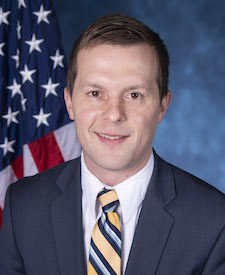
See how Jared F. Golden's votes line up with your values.
DeepSyte scores Jared F. Golden's record on the issues you care about — not party, not press releases. Take the 2-minute values quiz to see your personal alignment.
Sign in and take the values quiz to see how Jared F. Golden's votes line up with your views.
Prediction track record
How often we called Jared F. Golden's passage votes correctly, from their stated positions on each bill's tagged topics. Excludes “unclear” calls and abstentions.
A joint resolution to direct the removal of United States Armed Forces from hostilities within or against the Islamic Republic of Iran that have not been authorized by Congress.
To prohibit the disclosure of records by the Secretary of Housing and Urban Development of individuals for the purposes of immigration enforcement, and for other purposes.
No paired statements and votes yet for Jared F. Golden
We haven't yet found statement/vote pairs on the same topic for Jared F. Golden. This usually means either the rep hasn't taken public positions on bills that have come to a passage vote, or those bills haven't been tagged yet. The checker runs as new press releases and votes come in.
Pro analysis
AI rep analysis — Pro
Get an AI-narrated read on Jared F. Golden's full voting record against your stated values — aligned themes, conflicts, notable votes, and what to watch for.
We haven't extracted campaign positions for Jared F. Golden yet. Once their campaign website or position pages are processed, this card will track what they said vs how they voted.
Crossing the aisle
Passage votes where Jared F. Golden broke ranks with ≥75% of Democrats. Threshold catches substantively partisan splits; unanimous-ish or close votes are excluded.
Providing for consideration of the bill (H.R. 9576) to establish the National Fraud Enforcement Division of the Department of Justice; providing for consideration of the bill (H.R. 10326) to enhance information-sharing capabilities between Federal law enforcement and State agencies to detect, investigate, and prosecute fraud in certain Federal programs, and to protect individual privacy; providing for consideration of the joint resolution (H.J. Res. 210) providing for congressional disapproval under chapter 8 of title 5, United States Code, of the rule submitted by the Environmental Protection Agency relating to ''California State Nonroad Engine Pollution Control Standards; Ocean-Going Vessels At-Berth; Notice of Decision''; providing for consideration of the joint resolution (H.J. Res. 213) providing for congressional disapproval under chapter 8 of title 5, United States Code, of the rule issued by the Environmental Protection Agency relating to the ''California State Nonroad Engine Pollution Control Standards; Commercial Harbor Craft Regulations; Notice of Decision''; and providing for consideration of the Senate amendments to the bill (H.R. 5334) to amend the Internal Revenue Code of 1986 to allow early childhood educators to take the educator expense deduction, and for other purposes.
Golden presses leaders of Armed Services Committees to preserve NDAA language barring Trump from sending shipbuilding overseas
Position: Rep. Golden urges that the final NDAA retain his amendment prohibiting overseas construction of U.S. naval ships or ship parts, arguing that domestic shipbuilding should be supported and that offshoring creates uncertainty for the domestic industry. He opposes the Senate Armed Services Committee's language allowing certain naval support vessels to be built overseas.
WASHINGTON — Congressman Jared Golden (ME-02) today sent a letter to the chairmen and ranking members of the House and Senate Armed Services Committees, urging inclusion of his amendment to protect American shipbuilding as the chambers negotiate final legislative text of this year’s National Defense Authorization Act (NDAA).
“Wherever possible, American military spending should support Americans’ jobs,” Golden wrote in the letter. “Doing so is the best way to secure supply chains, ensure the United States reaps the innovation benefits of our manufacturing base and protect information critical to our national security. Sending a portion of our shipbuilding overseas also introduces uncertainty that could weaken our domestic shipbuilding industry and capacity at a time when the industry is already facing challenges as a result of fluctuations in federal demand.”
The annual NDAA sets policy and funding levels for the national defense. This year, the Pentagon has pushed plans to build ships in the naval fleet, or parts of ships, overseas. Golden — a member of the House Armed Services Committee and the Subcommittee on Seapower and Projection of Forces — fought successfully to amend the NDAA to prohibit any such offshoring.
The House passed the NDAA, with Golden’s amendment, in July. Since then, the Senate Armed Services Committee has crafted and advanced its own version of the NDAA, with language that would allow President Trump and Defense Secretary Hegseth to build certain naval support vessels overseas.
Golden urged the Armed Forces Committee leaders — House Chairman Mike Rogers (AL-03), House Ranking Member Adam Smith (WA-09), Senate Chairman Roger Wicker of Mississippi and Senate Ranking Member Jack Reed of Rhode Island — to retain his amendment in any negotiated final agreement on the NDAA.
Click here to read the full letter.
###
Golden, Blue Dog leaders introduce comprehensive reform package to fix broken budget process
Position: The release describes the introduction of the Congressional Budget Reform Act of 2026, which would alter the congressional budget and appropriations process, strengthen fiscal guardrails, and increase transparency on federal fiscal health. The sponsors cite concerns about national debt, interest rates, and government shutdowns.
WASHINGTON — U.S. Reps. Jared Golden (ME-02), Marie Gluesenkamp Perez (WA-03) and Adam Gray (CA-13) — leaders in the House Blue Dog Coalition — today introduced the Congressional Budget Reform Act of 2026.
The legislation would fix Congress’s broken budgeting process, strengthen fiscal guardrails and checks and balances, and provide greater transparency about the fiscal health of the United States.
“Washington has spent years cutting taxes while increasing spending, and the bill is catching up with us,” Golden said. “Debt payments have grown so large that they eclipse nearly every other line item in the budget. They are crowding out investments in education, national security and other priorities and threatening Social Security and Medicare. Now, our record-breaking $40 trillion debt is driving up interest rates, making it more expensive for Americans to own a home, buy a car or start a small business. Congress needs to get serious about the debt and start making responsible choices again.”
“Working people know what debt actually means — it’s the difference between whether you can afford your kid’s next season of sports or winter coat. Meanwhile, Congress has spent years treating hard-earned income like it’s monopoly money to throw around without a second thought,” said Gluesenkamp Perez, a member of the Appropriations Committee. “We’re introducing these reforms because we recognize that we have a job to do here, and the cost of not doing it is too high. Congress needs to show that there is a respect for the work it takes to earn money and for what it means to be a good steward of the economy. We want our kids to inherit an economy of stability, not one of flippant waste.”
“Passing a responsible budget is one of the most basic responsibilities Congress has, and the current system clearly isn’t working,” Gray said. “We shouldn’t accept shutdowns, trillion-dollar deficits and last-minute spending bills as business as usual. These reforms put some common sense back into the process, strengthen guardrails against runaway debt and make it easier for Congress to do what people expect us to do: pass a budget and make government work.”
The bill contains nine reforms to Congressional budgetmaking. These include:
Fixing a Broken Process:
Bundle the 12 Appropriations bills into four “minibus” bills: This will reduce procedural bottlenecks and encourage on-time enactment of appropriations.
Implement the Prevent Government Shutdowns Act: This would enact automatic 14-day Continuing Resolutions in the event of a lapse in government funding and require Congress to stay in session until Appropriations bills are completed.
End the fast-track for impoundment in the Senate: This would strengthen checks and balances by instituting the same 60-vote threshold on executive rescissions that is required to pass appropriations in the first place.
Clarify that so-called “pocket rescissions” are illegal: Close the door on presidents seeking to bypass congressional authority and unilaterally cancel funding by submitting a rescission request and withholding funding at the end of a budget cycle, when Congress does not have enough time to take up the request.
Strengthening Fiscal Guardrails:
Enforceable debt-to-GDP targets: Require Congress to set either debt-to-GDP or deficit-to-GDP targets in the annual budget resolution and create a special reconciliation process to enforce the target if it is exceeded.
Strengthen PAYGO: Require the House to take a recorded vote before exempting legislation from the PAYGO Scorecard or other actions that cook the books rather than meet statutory fiscal responsibility rules.
Deficit Reduction Accounts: Create new accounts in Appropriations bills to allow savings to go directly toward reducing the deficit.
Improving Information and Data Available to Congress:
Fiscal State of the Nation: Require an annual, nonpartisan briefing in a joint hearing of the House and Senate Budget committees from the Comptroller General.
Report on Fiscal Contingency Preparedness: Require the Treasury Department and OMB to conduct and publish an annual assessment of the government’s fiscal resilience to major emergencies, subject to independent Government Accountability Office review.
(For more information, click here to see full text of the bill and here to read a more detailed summary.)
The Budget Reform Act of 2026 is endorsed by the Blue Dog Coalition and supported by several independent, nonpartisan organizations dedicated to fiscal responsibility:
Maya MacGuineas, President, Committee for a Responsible Federal Budget: “We appreciate the Blue Dog Coalition putting forward the Congressional Budget Reform Act. The legislation includes multiple reforms to strengthen transparency and accountability in the federal budget process. Exploding deficits are an affordability issue, and reducing them can help temper inflation, lower everyday costs and boost incomes over time. Process reforms cannot substitute for the hard policy choices lawmakers will ultimately have to make. Still, this bill would be a step in the right direction by helping reduce the crisis-driven nature of the current budget process and enhancing the tools available to hold lawmakers accountable. We look forward to continuing to work with the Blue Dog Coalition to improve the nation’s fiscal outlook.”
Ben Ritz, VP of Policy Development, Progressive Policy Institute: “The Blue Dogs’ Congressional Budget Reform Act is a good first step to modernize the budget process and push Congress to manage federal finances more responsibly.”
Carolyn Bourdeax, Executive Director, Concord Action: “We appreciate the Blue Dog Coalition's leadership in proposing the Congressional Budget Reform Act of 2026. Restoring regular order, strengthening fiscal guardrails and improving transparency are good ways to begin righting the ship after being off course far too long. At the same time, Concord Action will continue to emphasize the urgent need for a concrete, enforceable plan to cut the deficit in half to ensure long-term fiscal sustainability and economic stability.”
Brett Loper, Executive Director, Peterson Solutions Fund: “Budgeting from one crisis to the next not only threatens our economy, but it contributes to our $40 trillion and rising national debt. We commend members of the Blue Dog Coalition for putting forward the Congressional Budget Reform Act of 2026, which includes commonsense proposals to strengthen fiscal guardrails, provide meaningful information to Congress and the public and better align budgeting with the goals of fiscal responsibility. In particular, setting a debt-to-GDP target is a commendable step to highlight our runaway long-term debt outlook and what is required to put our nation on a more sustainable path.”
###
Issues:
Good Government, Anti-Corruption & Clean Elections
Golden, bipartisan colleagues introduce SMILE for Veterans Act
Position: Supports expanding VA-covered dental care for rural veterans through a pilot program that reimburses existing community-based dental providers, rather than building a new federal system.
WASHINGTON — Congressmen Jared Golden (ME-02), Jack Bergman (MI-01), Don Davis (NC-01) and Jeff Van Drew (NJ-02) introduced the SMILE for Veterans Act, to expand affordable dental care for veterans in rural communities across the country.
“VA health care is an essential benefit for our nation’s veterans, but for too long a lack of dental coverage has been a massive gap in care. The mouth is part of the body, and our veterans shouldn’t have to jump through hoops to get basic dental care. I’m proud to work with Reps. Bergman, Davis and Van Drew on the SMILE for Veterans Act, which takes a smart first step toward more comprehensive coverage by focusing on rural areas where barriers to care are the highest and community providers that can help close the gap,” Golden said.
Under current law, only about 15 percent of the nearly nine million veterans enrolled in health care through the Department of Veterans Affairs (VA) are eligible for VA dental services. Eligibility is generally limited to veterans with a service-connected dental condition, a 100 percent disability rating or former prisoner-of-war status.
Efforts to broadly expand dental coverage through the VA have faced significant cost and capacity challenges, including the need for additional personnel, facilities, and community-care infrastructure.
The SMILE for Veterans Act takes a targeted approach by creating a pilot program to reimburse existing community-based dental providers to serve rural veterans. By leveraging providers and infrastructure already in place, the legislation would expand access to dental care in underserved communities without requiring the VA to build a new system from the ground up.
Research from the CareQuest Institute in 2024 found that more than one-third of veterans surveyed rated their oral health as only fair or poor, while more than 75 percent of respondents reported losing two or more teeth to decay or gum disease. Nearly four in 10 veterans reported having no dental insurance.
“For too many Veterans in rural communities, basic dental care is either too far away or simply out of reach,” Bergman said. “The SMILE for Veterans Act offers a practical solution by connecting Veterans with trusted dental providers already serving their communities. Rather than building an expensive new federal system from the ground up, this legislation uses existing local providers to deliver care efficiently and closer to home.”
“I spent 30 years as a dentist, and I can tell you that putting off dental care usually only makes things worse,” Van Drew said. “For veterans living in rural communities, sometimes the hardest part is simply finding a dentist close enough to get the care they need. That should not be the case. The SMILE for Veterans Act is a practical way to connect veterans with that care closer to home. To me, that is common sense.”
“Quality dental care is a critical part of keeping our veterans healthy, and too often, veterans in rural communities face significant challenges getting the care they need. The bipartisan SMILE for Veterans Act would give community providers across eastern North Carolina a way to deliver that care closer to home. Our veterans kept their promise to our nation, and we must always keep ours to them,” Davis said.
“The National Rural Health Association (NRHA) is grateful to see the introduction of the SMILE Act, led by Representative Bergman, Representative Davis, Representative Van Drew, and Representative Golden. This legislation would establish a pilot program to improve rural Veterans’ access to dental care, addressing a critical need in rural communities where Veterans often face significant barriers to accessing essential health services. With one in four Veterans living in a rural area, ensuring access to dental care is an important part of ensuring rural Veterans can receive the comprehensive care they deserve,” said Alan Morgan, CEO, National Rural Health Association.
Full text of the bill can be found here.
###
Golden pushes stronger anti-corruption rules on House earmarks
Position: Supports a House resolution to strengthen conflict-of-interest certification rules for Community Project Funding earmarks, requiring Members to certify that neither they, their spouse, immediate family, nor any entity in which they hold a material financial interest would directly or indirectly benefit financially from an earmark.
WASHINGTON — Congressman Jared Golden (ME-02) is co-leading an effort to strengthen guardrails against Members of Congress using taxpayer-funded earmarks to increase their own net worth.
Golden joined Reps. Young Kim (CA-40) and Brian Fitzpatrick (PA-01) to introduce a resolution seeking to change House rules regarding Community Project Funding (CPF), a process that allows Members to direct federal funds to projects undertaken by state, local or tribal governments or certain nonprofits.
“Americans deserve certainty that when a member of Congress secures funding for their district, it’s for the good of their constituents — not themselves, their families or any entity in which they have a financial interest,” Golden said. "This resolution will strengthen the anti-corruption guardrails around earmarks to ensure federal dollars are used responsibly. I’m proud to co-sponsor this commonsense change to preserve the integrity of the House.”
Under current rules, Members requesting CPF must certify that they and their spouses have no financial conflicts of interest in the request. However, current rules do not explicitly account for indirect financial interests — such as whether an earmark could increase the value of a business asset owned by a Member or their family because of its proximity to the CPF project.
The proposal closes this loophole by requiring Members of Congress to certify that neither they, their spouse, their immediate family members, nor any entity in which they hold a material financial interest would directly or indirectly benefit financially from an earmark.
“When politicians are busy lining their own pockets, how can they ever understand or focus on the pocketbook issues Americans face every single day? Californians are struggling to afford groceries, gas, healthcare, and housing while paying some of the highest taxes in the nation. The least they deserve is representation focused on making their lives better,” Kim said. “I’m proud to lead this commonsense resolution with Congressmen Jared Golden and Brian Fitzpatrick to hold Members of Congress to a stronger standard when bringing federal dollars back home. Members of Congress should be concerned with building a better future for Americans, not filling their own coffers.”
“Public service is a public trust, and there can be no ambiguity about whose interests we are here to serve,” Fitzpatrick said. “No Member of Congress should be able to use the power of public office to create a financial benefit for themselves, their family, or an entity in which they have a financial stake. I have spent years working across the aisle to strengthen accountability and eliminate conflicts of interest in Congress, and the principle here is just as clear: public decisions must be made in the public interest. Clear rules, meaningful transparency, and real accountability are essential to protecting the integrity of this institution and the trust of the people we serve.”
Text of the resolution is available here.
###
Golden statement in support of Russia sanctions bill
Position: The release expresses support for HR 5334, legislation imposing sanctions on Russia and authorizing tariffs on top importers of Russian energy and sanctions evaders, until Russia ends its war against Ukraine. The statement characterizes the bill as weakening Russia's ability to fund the war and as a signal of continued U.S. support for Ukraine.
WASHINGTON — Congressman Jared Golden (ME-02) released the following statement regarding his vote in favor of HR 5334, legislation to impose sanctions against Russia until it ends its war against Ukraine:
“Every barrel of Russian oil sold on the global market is funding for Vladimir Putin’s war of aggression against Ukraine. Russia is successfully evading the existing sanctions imposed by the U.S. and our Western partners. This bill provides new tools to cut off the oil revenue that’s greasing Russia’s war machine, including tariffs on the top buyers of Russian energy and those countries helping the federation evade existing sanctions.
“Under Putin’s rule, Russia has tested the boundaries of international order and safety at a scale not witnessed in generations. It is waging a war of territorial expansion against our democratic ally in Ukraine. It has made its hostile intent toward the United States and other western democracies clear in its words and actions, including its efforts to undermine U.S. elections.
“Passing this bill will weaken Putin’s hand, and will show the Ukrainians fighting to defend their homes that the United States will not abandon them. I’m proud to vote yes.”
The bill passed the House in a bipartisan vote of 262-159, having previously passed in the Senate 86-11. It now goes to the president to be signed into law.
BACKGROUND:
Russia has successfully evaded existing sanctions on its energy products with a “shadow fleet” of tankers conducting ship-to-ship transfers or rerouting to friendly buyers, often using false documents to hide ownership or cargo point-of-origin. According to one estimate, this shadow fleet transported roughly 3.7 billion barrels of oil in 2025.
In addition to direct sanctions on Russian officials, including President Vladimir Putin, the bill targets Russian financial institutions and defense and energy actors. It also sidesteps Russia’s evasion strategies by targeting the buyers of Russian energy products, authorizing the president to impose tariffs on the top five importers of Russian oil and gas and the top five facilitators of sanctions evasion.
Golden has been a consistent champion for the defense of Ukraine’s sovereignty, having voted in favor of every major military and financial aid for the besieged nation since 2022. To overcome partisan gridlock, in 2024 he co-sponsored the Defending Borders, Defending Democracies Act with Congressman Brian Fitzpatrick (PA-01), which paired aid for Ukraine, Israel and Taiwan with funding the restore order at America’s southern border. Elements of the bill were included in a successful bipartisan foreign aid and border security package enacted by the House that year.
###
Issues:
National Security and Servicemembers
Golden votes to extend government funding through December 11
Position: Golden voted in favor of a continuing resolution extending current government funding levels through December 11 to avoid a shutdown on October 1, arguing that shutdowns harm vulnerable people and that the extension gives Congress time to negotiate a full appropriations deal.
WASHINGTON — Congressman Jared Golden (ME-02) voted today in favor of a Continuing Resolution (CR) to keep the government funded until December 11, preventing the risk of a government shutdown on October 1.
The CR maintains current government funding levels until December 11, with limited policy changes. The bill passed the House of Representatives in a bipartisan 370-48 vote. It previously passed the Senate in a vote of 90-6 and now goes to President Donald Trump for his signature.
“As the November elections come into view, and we remain without a funding deal, the risk of political gamesmanship is high,” Golden said. “This resolution will remove the incentive for either party to hold the government hostage in an attempt to score political points — and give Congress the time needed to negotiate a sound appropriations deal.”
Golden has consistently voted to avoid government shutdowns because of the harm they cause, often to those less fortunate. This past winter, a lapse in appropriations triggered the longest shutdown in the nation’s history. As a result, food assistance benefits for needy families were disrupted, core public health and food safety programs were paused, millions of federal workers missed paychecks and travelers experienced long delays.
In Maine alone, a government shutdown would affect the more than 11,000 federal employees and could force Acadia National Park to close. Additionally, a shutdown would likely impact the 169,000 Mainers who rely on Supplemental Nutrition Assistance Program (SNAP) to put food on the table and the more than 45,000 Maine households that depend on Low Income Home Energy Assistance Program (LIHEP) to heat their homes.
###
Issues:
Good Government, Anti-Corruption & Clean Elections
Golden, Bipartisan Fiscal Forum React to Historic Debt Milestone
Position: Golden and the Bipartisan Fiscal Forum express concern about the national debt surpassing $40 trillion and call for bipartisan action on fiscal responsibility, including support for a bipartisan fiscal commission and the Fiscal Commission Act.
WASHINGTON — Congressman Jared Golden (ME-02) and members of the Bipartisan Fiscal Forum (BFF) released the following statements as our nation’s gross national debt recently surpassed $40 trillion.
Annual interest payments on the debt are already approaching $1 trillion, more than the United States is projected to spend this year on defense, Medicare or Medicaid. Absent meaningful action, the debt is only projected to increase, and this has real consequences for hard-working families.
The BFF is a group of House members committed to raising awareness of the nation's unsustainable debt and working across the aisle toward a more responsible fiscal future.
“Both parties talk a big game on fiscal responsibility — until they’re the ones who have to govern. Reducing our national debt shouldn’t be seen as a threat to one party’s agenda, but as a once-in-a-generation chance to work together for the good of all Americans,” Golden said. “It’s worth remembering: the last time we actually balanced the budget, Republicans controlled Congress and a Democrat sat in the White House. Absent bipartisan legislation, it's only a matter of time before one of the two parties is left holding the bag.”
“Our national debt threatens our economy, drives up interest rates, slows wage growth, and leaves us less prepared for the next emergency. We are in this together, regardless of party label. Addressing our looming fiscal challenges will take both parties, and a bipartisan fiscal commission is a practical step toward doing so.” said Congressman Bill Huizenga (MI-04), Co-Chair of the Bipartisan Fiscal Forum
“The national debt is now more than $40 trillion and we borrow nearly $2 trillion every year just to pay our expenses. As government borrowing grows, there is less money available in the system to help San Diegans afford homes, invest in their businesses, or take out loans. Congress must help working people keep up with the cost of living. The first step is to pass the Fiscal Commission Act.” said Congressman Scott Peters (CA-50), Co-Chair of the Bipartisan Fiscal Forum
Golden has led efforts on fiscal stability throughout his time in Congress, helping to introduce the bipartisan Fiscal Contingency Preparedness Act, which would require the federal government to conduct annual "fiscal stress tests" to measure the nation's financial resilience against major national emergencies. In addition to this legislation, Golden has cosponsored a series of bipartisan bills aimed at reducing the nation’s debt, including the Fiscal Commission Act, Budgeting for a Better America Act and a resolution that would encourage Congress to achieve and maintain deficits at 3% of GDP.
While the Bipartisan Fiscal Forum does not endorse legislation, members of the group are leading a range of proposals that would seek to improve the nation’s fiscal outlook.
###
Golden statement on Trump’s new push to offshore Navy shipbuilding
Position: Congressman Golden opposes the administration's effort to build or source Navy warships in foreign shipyards and to sell American shipyards to foreign corporations, and states that Congress should block this offshoring through legislative language in the NDAA.
WASHINGTON — Congressman Jared Golden (ME-02) released the following statement in response to President Donald Trump’s latest effort to build American warships in foreign shipyards:
“I don’t know how we’re supposed to take any soaring ‘America-first’ language from this administration seriously when it appears to be bound and determined to send American shipbuilding jobs overseas and, now, to sell American shipyards to foreign corporations. Luckily, the House has already given bipartisan support to my language to block this short-sighted offshoring scheme, and the Senate is poised to do the same. Congress must take seriously its job to protect national security and American jobs.”
BACKGROUND:
Golden successfully amended this year’s National Defense Authorization Act (NDAA) to explicitly prohibit the appropriation of federal funds to build American ships overseas. The House passed the NDAA, with Golden’s language to protect American shipbuilding, in July.
Golden’s amendment was in response to a Navy Shipbuilding Plan released by the Pentagon earlier this year, which called for offshoring the production of some warships, or parts of warships, in overseas yards.
Maine’s 2nd Congressional District is home to scores of shipbuilders employed at Bath Iron Works who build DDG-51 Destroyers, which Defense Secretary Pete Hegseth has called the “workhorse” of the US naval fleet.
###
Golden, Democratic veterans demand transparency on Iran war casualties
Position: The release calls on the Trump Administration to commit to timely, accurate, and transparent reporting of all U.S. servicemember casualties in the Iran war, and to explain any amended or delayed casualty reports.
WASHINGTON — Following reports that the Department of Defense removed the names of four American troops from the official Iran War death toll, Congressman Jared Golden (ME-02) and 14 fellow Democratic veterans are urging the Trump Administration to accurately and transparently account for U.S. servicemembers killed and wounded in the Iran war.
“As veterans of America’s wars, we have serious concerns about reports that the Department of War is delaying, removing or otherwise mischaracterizing the release of information about wounded and killed U.S. servicemembers,” the lawmakers wrote in a letter to President Trump.
“The U.S. government owes U.S. servicemembers, their families, and every American the truth about all U.S. casualties in the War with Iran. It is imperative that these reports are timely, accurate and adequately explain the reason for amended or delayed reports,” they continued. “We urge you to commit to releasing timely and accurate information on all injuries and deaths of U.S. servicemembers.”
The letter was led by Congressman Mike Thompson (CA-14). Golden was joined on the letter by Reps. Pat Ryan (NY-18), Seth Moulton (MA-06), Chris Deluzio (PA-17), Derek Tran (CA-45), Jimmy Panetta (CA-19), Ted Lieu (CA-36), Maggie Goodlander (NH-02), Eugene Vindman (VA-07), Chrissy Houlahan (PA-06), Jason Crow (CO-06), Bobby Scott (VA-03), Salud Carbajal (CA-24) and Gil Cisneros (CA-31).
The full text of the letter can be found here and below.
Dear President Trump,
As veterans of America’s wars, we have serious concerns about reports that the Department of War is delaying, removing or otherwise mischaracterizing the release of information about wounded and killed U.S. servicemembers.
The U.S. government owes U.S. servicemembers, their families, and every American the truth about all U.S. casualties in the War with Iran. It is imperative that these reports are timely, accurate and adequately explain the reason for amended or delayed reports. Inaccurate and delayed reports from the Department of War about U.S. casualties is bad for morale and undermines our U.S. servicemembers.
We urge you to commit to releasing timely and accurate information on all injuries and deaths of U.S. servicemembers.
Sincerely,
###
Issues:
National Security and Servicemembers
Golden announces support for ‘clean’ resolution to constrain military action in Iran
Position: Congressman Golden supports a clean war powers resolution to end U.S. military hostilities against Iran, arguing that the President's 60-day authority under the War Powers Act of 1973 has expired and Congressional approval is now required to continue military operations.
WASHINGTON — Congressman Jared Golden (ME-02) today announced he would vote in favor of a ‘clean’ war powers resolution to remove the United States from hostilities against Iran.
One such resolution, H.Con.Res.86, sponsored by Congressman Gregory Meeks (NY-05), will become eligible for a floor vote as early as next week.
“I have said since the start of this conflict that the War Powers Act of 1973 grants the president only 60 days to conduct military operations without an explicit authorization from Congress,” Golden said. “President Trump, like all his predecessors, has refused to recognize the limitations of the War Powers Act, but to me the law is clear. His window for unilateral military engagement has closed. Hostilities, including the use of the U.S. fleet to impose a blockade of Iranian ports, cannot legally continue unless the president seeks, and wins, Congressional approval.”
H.Con.Res.86 will be the first clean war powers resolution eligible for a vote since the 60-day deadline for the president to seek Congressional authorization was surpassed on May 1. Golden has opposed prior resolutions in recognition that the administration had, to that point, met its obligations under the War Powers Act.
Golden also announced that he will oppose a separate resolution, offered by Congressman Josh Gottheimer (NJ-05), that has been widely reported to be coming to the floor for a vote this week. That measure, H.Con.Res.75, was originally submitted on March 4 and would have reduced the deadline for Congressional authorization from 60 days to 30 days. This resolution was rendered moot one day after the 30-day deadline it sought to impose on the president.
“I supported this resolution when it was introduced, but unfortunately its proposed 30-day deadline lacks any real meaning now that we are more than 70 days into this conflict,” Golden said. “It no longer passes the straight-face test. I look forward to voting for a clean, relevant resolution as soon as possible.”
###
Issues:
National Security and Servicemembers
Articles from a curated list of national outlets that mention Jared F. Golden.
No recent news mentions yet.
Source: GDELT 2.0 GKG, filtered to a curated list of national outlets. Inclusion is not endorsement; opinion pieces and reported news are mixed.
Recent stock activity
Periodic transaction reports filed under the STOCK Act — disclosed by the rep, sourced from public filings.
No disclosed trades on record.
Source: open-data mirrors of the Senate eFD and House Clerk financial-disclosure systems. Disclosure within 30 days of trade is required by law (45 for spouse/dependent trades).
Top PAC donors · 2026 cycle
Political action committees that gave the most to this rep's principal campaign committee this cycle. PAC giving is direct organizational support — industry, ideological, or leadership.
1.SAVE DEMOCRACY PAC2 contributions$10,000
2.FAIR SHOT PACIdeological2 contributionsProgressive-aligned PAC — backs candidates and causes focused on economic opportunity and reducing inequality.AI$10,000
3.AMERIPAC: THE FUND FOR A GREATER AMERICAIdeological2 contributionsIdeological PAC with a nationalist or patriotic framing — specific policy positions not clearly signaled by the name.AI · low$10,000
5.BEYOND THOUGHTS AND PRAYERS PAC2 contributions$10,000
6.VOTEVETS FEDERAL PAC3 contributions$7,500
7.ENGINEERS POLITICAL EDUCATION COMMITTEE (EPEC)/INTERNATIONAL UNION OF OPERATING ENGINEERSLabor1 contributionTrade-union PAC for the International Union of Operating Engineers — backs candidates supporting prevailing-wage standards, infrastructure investment, and project labor agreements.AI$5,000
8.AMERICAN CRYSTAL SUGAR COMPANY POLITICAL ACTION COMMITTEEAgriculture1 contributionAgricultural processing PAC for American Crystal Sugar — backs candidates supporting farm subsidies, sugar price supports, and agricultural trade policies.AI$5,000
9.AMERICAN FEDERATION OF GOVERNMENT EMPLOYEES, AFL-CIO1 contribution$5,000
10.WELCOMEPAC1 contribution$5,000
Source: OpenFEC (api.open.fec.gov) Schedule A receipts where contributor type is “committee.” Aggregated by contributing committee. Self-transfers from joint-fundraising / victory committees are excluded.
Top individual contributors · 2026 cycle
Itemized individual contributions over $200 to this rep's campaign committee, aggregated by donor employer. PAC giving is shown above; this section is people, not organizations.
1.APOLLO GLOBAL MANAGEMENT$8,500
2.CHARLESBANK CAPITAL PARTNERS$8,000
3.MADISON DEARBORN PARTNERS$7,000
4.AGINS INTERIOR$7,000
5.MONTGOMERY CAPITAL, INC.$7,000
6.FORTRESS INVESTMENT GROUP$7,000
7.CARMEL PARTNERS MANAGEMENT, LLC$7,000
8.SAGEVIEW CAPITAL$7,000
9.MEDLEY PARTNERS LLC$7,000
10.LEE AUTO MALLS$7,000
Source: OpenFEC Schedule A receipts where contributor type is “individual,” aggregated by the donor's self-reported employer. This is a geographic / industry correlation, not a corporate endorsement.