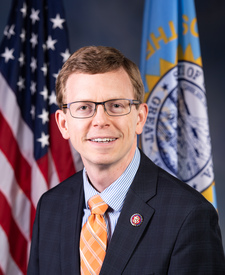
See how Dusty Johnson actually votes — against your values.
DeepSyte scores Dusty Johnson's record on the issues you care about — not party, not press releases. Take the 2-minute values quiz to see your personal alignment.
Sign in and take the values quiz to see how Dusty Johnson's votes line up with your views.
Prediction track record
We haven't made any vote predictions for Dusty Johnson yet. Predictions are generated for bills with tagged effects; they show up here as soon as the predict-votes job covers this rep's upcoming docket.
Consistency insights
No paired statements and votes yet for Dusty Johnson
We haven't yet found statement/vote pairs on the same topic for Dusty Johnson. This usually means either the rep hasn't taken public positions on bills that have come to a passage vote, or those bills haven't been tagged yet. The checker runs as new press releases and votes come in.
Pro analysis
AI rep analysis — Pro
Get an AI-narrated read on Dusty Johnson's full voting record against your stated values — aligned themes, conflicts, notable votes, and what to watch for.
We haven't extracted campaign positions for Dusty Johnson yet. Once their campaign website or position pages are processed, this card will track what they said vs how they voted.
Crossing the aisle
No party-break passage votes recorded for Dusty Johnson. Either they've voted with Republicans on every substantive passage vote in the corpus, or their tenure overlaps few high-threshold party-line votes so far.
U.S. House Passes Farm Bill with Johnson’s Support
Position: Representative Johnson supported passage of the Farm Bill, which he states invests in rural America, secures supply chains, and prioritizes producers. The bill includes multiple provisions Johnson authored or championed addressing agricultural trade, livestock processing, rural water systems, conservation, broadband, and workforce development.
Washington, D.C. – Today, the House of Representatives passed the Farm, Food, and National Security Act, also known as the Farm Bill, with a bipartisan 224-200 vote. U.S. Representative Dusty Johnson (R-S.D.) voted to pass the Farm Bill which contains dozens of Johnson’s priorities that support farmers and ranchers in South Dakota and across America.
“Farmers and ranchers have made it clear – we need a completed Farm Bill,” said Johnson. “I worked hard to ensure this Farm Bill invests in rural America, secures our supply chains, and puts producers first. I’m glad it has passed the House, and I hope the Senate considers it soon to provide certainty for our hardworking producers.”
After the Farm Bill passed the House Agriculture Committee in March, Johnson successfully worked to remove the Greyhound Protection Act to protect the use of and training of hunting dogs.
Johnson’s bills included in the Farm Bill:
The SAFETY Act to safeguard American exports from unfair trade practices.
The Butcher Block Act to assist with new and expanding livestock and meat processors.
The Assistance for Rural Water Systems Act to provide funding and technical support for water infrastructure in rural communities.
The Healthy Dog Importation Act to ensure dogs imported into the U.S. are in good health and have received proper vaccines and medical treatment.
The A-Plus Act to increase investments in small meat packers.
The ACES Act to add agricultural cooperatives with fewer than 2,500 employees as qualified entities under the Rural Energy for America Program.
The Increased TSP (Technical Service Providers) Access Act to improve and expand the certification and participation process for Technical Service Providers under United States Department of Agriculture (USDA) conservation programs.
Transfer Food for Peace from United States Agency for International Development (USAID) to USDA, as seen in H.R. 1207.
The Dairy Nutrition Incentive Program Act to improve nutrition and increase access to dairy products for low-income populations.
The CAREERS Act to strengthen workforce development and career education programs.
The Save Our Bacon Act to block California’s Proposition 12 requirements on producers.
Johnson’s crop and conservation priorities included in the Farm Bill:
Provides long-term investments in working lands conservation programs, such as the Environmental Quality Incentives Program (EQIP) and Conservation Stewardship Program (CSP).
Johnson’s amendment to clarify that tech-neutral modernization is eligible for fencing repair or replacement under the Emergency Conservation Program (ECP).
Johnson’s rural development priorities included in the Farm Bill:
Updates and modernizes USDA broadband programs, providing faster buildout speeds and strengthening connectivity to rural communities.
Codifies the Circuit Rider Program, which provides technical assistance for rural water systems.
Broadens the Business and Industry Guaranteed Loan Program to support new investments in food infrastructure for a more resilient and diverse U.S. food supply chain.
Reauthorizes the Rural Economic Development Loan and Grant Program and permits awardees to provide other forms of collateral to secure loans.
Johnson’s other agricultural priorities included in the Farm Bill:
Johnson’s amendment to strengthen Tribal 1994 Land Grant Institutions by expanding their ability to acquire land, modernize facilities, and invest in equipment to support ag research and extension.
Reauthorizes the New Beginnings for Tribal Students Program and removes the cap on funding each state can receive.
Reauthorizes the Sun Grant Program, expands the scope to include bioproducts, and allows universities to better utilize grant funding.
Reauthorizes the Wood Innovation Grant Program, reduces the non-Federal match, and authorizes grants for hauling materials to locations that can utilize it.
Directs additional resources toward livestock and poultry disease preparedness, including the National Animal Health Laboratory Network, National Animal Disease Preparedness and Response Program, and the National Animal Vaccine and Veterinary Countermeasures Bank.
More than doubles authorization funding for the Market Access Program (MAP) and Foreign Market Development (FMD) Program, enabling better market access and trade promotion.
Reforms reporting requirements under the Agricultural Foreign Investment Disclosure Act to ensure accuracy and transparency of data on farmland owned by foreign persons.
Allows the Secretary to enter into self-determination contracts with Tribes to operate SNAP, consistent with the SNAP Tribal Food Sovereignty Act.
The Farm Bill has the support of more than 500 agricultural organizations from across the country, including seven from South Dakota: South Dakota Agri-Business Association, South Dakota Association of Conservation Districts, South Dakota Corn Growers Association, South Dakota Farm Bureau, South Dakota Soybean Association, South Dakota State University, and South Dakota Wheat Growers Association.
Issues:Agriculture
Johnson Testifies in Support of His Eastern South Dakota Rural Water Bills
Position: Johnson supports federal authorization of feasibility studies for two regional water supply projects in eastern South Dakota that would draw from the Missouri River to serve rural communities across multiple states.
Washington, D.C. – Today, the House Committee on Natural Resources Subcommittee on Water, Wildlife and Fisheries held a hearing on U.S. Representative Dusty Johnson’s (R-S.D.) bills to conduct feasibility studies on supplying Missouri River water to communities in eastern South Dakota.
“As South Dakota continues to grow, investments in water supply are critical for the future of our state,” said Johnson. “I’m proud to support the Lewis and Clark and Dakota Mainstem projects to ensure safe and ample water resources for generations to come.”
Click here for Johnson’s remarks
“The Lewis & Clark Regional Water System is grateful for the support of Congressman Johnson and the tri-state delegation for the planning for water needs of our region decades into the future, planning that can occur with this feasibility study,” said Troy Larson, Executive Director of Lewis & Clark Regional Water System. “Whether it is economic development or the ongoing needs of communities big and small, access to safe reliable water is a necessary element to future growth.”
“On behalf of Dakota Mainstem, I want to thank Congressman Dusty Johnson and the members of the House Subcommittee for the opportunity to testify and discuss the importance of this project,” said Ryan Johnson, President of Dakota Mainstem Regional Water System. “Reliable water infrastructure is a shared responsibly, essential to the future growth, economic stability, and long-term drought resilience of our region. This feasibility study authorization is an important step toward ensuring communities, rural water systems, and future generations have access to a dependable water supply.”
The Lewis and Clark Regional Water System Expansion Feasibility Study Act authorizes the Bureau of Reclamation to carry out a feasibility study for a proposed drinking water project drawing from the Missouri River. This project would support Lewis and Clark Regional Water System’s efforts to supply drinking water to 350,000 people in southeast South Dakota, northwest Iowa, and southwest Minnesota. Click here for bill text.
The Dakota Mainstem Water Supply Project Feasibility Study Act authorizes the Bureau of Reclamation to carry out a feasibility study for a proposed water project drawing from the Missouri River to supplement local supplies and address long-term water scarcity and quality challenges. This project will help Dakota Mainstem support more than 50 water providers in South Dakota, Iowa, Minnesota, and Nebraska. Click here for bill text.
Johnson testified in support of his Western South Dakota Water Supply Project Feasibility Study Act on April 16, 2026.
Issues:Transportation & Infrastructure
Johnson Testifies in Support of His Western South Dakota Rural Water Bill
Position: Johnson supports a feasibility study for the Western Dakota Regional Water System project to supply Missouri River water to western South Dakota, characterizing it as an important step to meet growing regional water demand.
Washington, D.C. – Today, the House Committee on Natural Resources held a hearing on U.S. Representative Dusty Johnson’s (R-S.D.) bill to conduct a feasibility study on supplying Missouri River water to the Western Dakota Regional Water System (WDRWS).
“It’s hard to overstate the importance of water,” said Johnson. “If we want a vibrant and healthy West River, we have to have the Western Dakota Regional Water System project, and I’m proud to support this important step forward.”
Click here for Johnson’s remarks.
“Western Dakota Regional Water System has completed five years of foundational work, including demand projections, intake evaluations, and regional system planning. The State of South Dakota has invested more than $12 million, alongside strong local support from our 49 members. The project is ready for the next step: a Bureau of Reclamation feasibility study,” said Kristin Conzet, Executive Director of WDRWS. “We are grateful to Rep. Johnson and his team for their professionalism and assistance throughout the federal process.”
As western South Dakota grows, the demand for water continues to increase. WDRWS seeks to meet that growing demand. The Western South Dakota Water Supply Project Feasibility Study Act allocates $10 million to the Bureau of Reclamation to carry out a feasibility study for a proposed rural water supply project that would deliver municipal, rural, and industrial water from the Missouri River to western South Dakota. The purpose of a feasibility study is to ensure that a water resources project is technically, environmentally, and economically sound.
Click here for bill text.
Issues:Transportation & Infrastructure
Johnson Announces $65 Million for Platte-Winner Bridge
Washington, D.C. – Today, U.S. Representative Dusty Johnson (R-S.D.) announced $65 million of federal funding for the Platte-Winner bridge along Highway 44. This bridge replacement restores a vital transportation link for not only Gregory and Charles Mix Counties, but the entire region.
“This is huge news for South Dakota. Our hard-fought advocacy efforts to secure $65 million for this bridge were successful,” said Johnson. “This is a great investment in South Dakota’s infrastructure and I’m grateful the Administration awarded our state this funding.”
The Highway 44 Platte-Winner bridge crosses the Missouri River. Without this bridge, the nearest crossings of the Missouri River would require a detour of over 50 miles.
Issues:Transportation & Infrastructure
Johnson Legislation Gives Producers Fertilizer Price Transparency
Position: Representative Johnson introduced the Fertilizer Transparency Act to require the USDA to establish a mandatory weekly reporting program for fertilizer prices and quantities sold, replacing the current voluntary annual reporting system, to provide farmers with better market information and reduce input cost uncertainty.
Washington, D.C. – Today, U.S. Representative Dusty Johnson (R-S.D.) introduced the bipartisan Fertilizer Transparency Act to increase transparency in fertilizer markets and provide farmers with better information on the price of key crop inputs. The bill would require the United States Department of Agriculture (USDA) to establish a mandatory reporting program for fertilizer prices and quantities sold in the United States. The data would be published weekly to give farmers clearer insight into fertilizer markets. Currently, USDA publishes the data annually, on a voluntary basis.
“On top of market uncertainty, low commodity prices, and severe weather, high input costs have increased the financial strain for our producers,” said Johnson. “The Fertilizer Transparency Act would alleviate some of the uncertainty that producers face every day and help them plan best for the seasons ahead.”
“We appreciate Representative Johnson’s introduction in the House of Representatives of the Fertilizer Transparency Act of 2026,” said Trent Kubik, President of the South Dakota Corn Growers Association. “The continued high cost of fertilizer negatively impacts corn farmers’ bottom line. Since 2022, we have seen record-setting spikes in the price of fertilizer that have not decreased in a consequential way. This bill will help to improve market signals by providing public access to meaningful pricing data.”
The Fertilizer Transparency Act is cosponsored by U.S. Representatives Angie Craig (D-MN), Brad Finstad (R-MN), Sharice Davids (D-KS), Randy Feenstra (R-IA), Nikki Budzinski (D-IL), Zach Nunn (R-IA), Jimmy Panetta (D-CA), Ashley Hinson (R-IA), Josh Riley (D-NY), Mariannette Miller-Meeks (R-IA), and Eric Sorensen (D-IL).
U.S. Senator John Thune (R-S.D.) introduced this legislation in the Senate.
Click here for bill text.
Issues:Agriculture
Johnson Joins 71 Lawmakers Urging Treasury, USTR on Curbing Import of Dangerous Chinese Vapes
Position: The release urges the Trump Administration to require China to curb illegal e-cigarette exports as part of trade negotiations, citing national security and public health threats including smuggling near military bases and schools, and cybersecurity risks from smart vapes.
Washington, D.C. – U.S. Representative Dusty Johnson (R-S.D.) joined 71 House lawmakers in a letter to U.S. Department of Treasury (Treasury) Secretary Scott Bessent and U.S. Trade Representative (USTR) Ambassador Jamieson Greer urging them to combat the flow of illicit Chinese e-cigarettes and vapes from flooding into American markets without approval from the U.S. Food and Drug Administration (FDA).
The lawmakers asked the Trump Administration to consider the national security and public health threats these vapes pose in any future trade negotiations with the Chinese government.
“These [Chinese vapes] are a threat to national security. The Department of Justice has reported that unauthorized vapes are frequently smuggled from China and sold near schools and military bases, putting minors and service members at risk. The Drug Enforcement Administration has investigated vape shops in proximity to military installations and found that many are owned or operated by foreign nationals suspected of deliberately targeting military personnel,” the lawmakers wrote.
Full text of the letter can be found here or below:
Dear Secretary Bessent and Ambassador Greer:
As trade discussions with the People’s Republic of China (PRC) advance, it is critical that the United States Trade Representative (USTR) and the Department of the Treasury confront the ongoing exploitation of our trade system. Any new trade agreement with China should require the Chinese government, through its oversight of e-cigarette exports, to take decisive action to curb the influx of illegal, youth-oriented e-cigarettes that openly flout U.S. and Chinese law.
The Administration has made clear that stopping the flow of dangerous and plainly illegal Chinese e-cigarettes is a national priority. We commend the important work of U.S. Customs and Border Protection officers, who continue to intercept illicit, often misdeclared, shipments. Despite these efforts, Chinese e-cigarette exports to the United States continued to rise during the final quarter of 2025, surpassing $10 billion in that year.
These devices are a threat to national security. The Department of Justice has reported that unauthorized vapes are frequently smuggled from China and sold near schools and military bases, putting minors and service members at risk. The Drug Enforcement Administration has investigated vape shops in proximity to military installations and found that many are owned or operated by foreign nationals suspected of deliberately targeting military personnel. One joint operation led to 20 arrests, including three Chinese nationals.
The emergence of Chinese “smart vapes”—which connect to smartphones—poses an additional cybersecurity threat. These devices may enable unauthorized access to personal data, cameras, microphones, geolocations, and networks. If used by military personnel, sensitive information could flow directly to the Chinese Communist Party under China’s 2017 National Intelligence Law, which requires companies to cooperate with state intelligence services.
Given the threat these devices pose, the U.S. government should aggressively counter the source of these products. It is far more efficient to prevent these products from entering the United States from China than it is to intercept such products once they have entered the U.S. domestic supply chain. Chinese law bans manufacturers from shipping e-cigarettes to a country where those products are illegal. Although the State Tobacco Monopoly Administration (STMA) exerts extensive control over the e-cigarette- industry in China, including the export of such products, the STMA has allowed massive quantities of illegal e-cigarettes shipments to the United States. This is not an administrative lapse; it appears to be a deliberate strategy on the part of the STMA that capitalizes on gaps in U.S. enforcement. Any forthcoming agreement with the PRC must ensure that the STMA enforces its existing rules on these illegal exports.
The need for action is urgent. Illicit Chinese e-cigarette makers and their U.S. distributors intentionally design and market products to appeal to young people—using candy flavored cartridges, toy-like designs, and packaging styled after fashion accessories. They rely on influencer marketing on youth-heavy platforms such as TikTok and Instagram. These illegal products often contain carcinogens, toxic additives, and high levels of heavy metals like lead, along with other unknown substances.
Moreover, the illicit e-cigarette- trade has become an attractive revenue stream for Mexican drug cartels. Associated Press reporting indicates that cartels have secured a dominant share of the illegal market in Mexico and are continuing to expand their operations in the United States. E-cigarette sales are illegal in Mexico, but demand for these products still exists which has likely led to the rise of cartel involvement in the sale of these devices. The Financial Crimes Enforcement Network (a bureau of the Department of the Treasury) has identified these products as a vehicle for trade-based money laundering schemes tied to fentanyl proceeds, and the U.S. Bureau of Alcohol, Tobacco, and Firearms has similarly traced funds from illicit Chinese e-cigarette sales to foreign adversaries and cartel operations inside the United States.
For these reasons, we strongly urge the USTR to elevate this matter in ongoing trade negotiations with China and to pursue a binding commitment requiring the Chinese government to stop all e-cigarette exports that fail to comply with U.S. and Chinese law. U.S. national security and public health require nothing less.
Issues:China
Johnson, Vasquez Bill Ensures Tribal Children Have Fair Shot at High-Quality Education
Position: Representatives Johnson and Vasquez introduced legislation to provide teachers at tribally controlled schools with the same federal retirement benefits available to Bureau of Indian Education school teachers, addressing teacher recruitment and retention disparities in tribal education.
Washington, D.C. – U.S. Representatives Dusty Johnson (R-S.D.) and Gabe Vasquez (D-N.M.) introduced the Parity for Tribal Educators Act to address teacher shortages in Indian country. The legislation would provide teachers at tribally controlled schools the same federal retirement benefits that teachers at Bureau of Indian Education (BIE) schools receive, ensuring tribal students have equal access to educational opportunity.
“Tribal educators are doing the same work as their Bureau of Indian Affairs counterparts. They should have access to the same retirement programs. The Parity for Tribal Educators Act fixes that disparity and would help recruit and retain tribal educators,” said Johnson. “I’m grateful for Rep. Vasquez’s partnership on this issue to improve the quality of education tribal schools across America.”
“This bill is about doing right by our Tribal communities, overcoming recruitment and retention issues, and making sure every child in New Mexico has a fair shot at success,” said Vasquez. “Giving Tribal teachers the benefits they deserve helps keep Tribal schools staffed with quality educators – the type of quality educators who help Tribal students unlock their brightest futures possible.”
The Parity for Tribal Educators Act is endorsed by National Indian Education Association and the National Congress of American Indians.
“We appreciate Congressman Johnson’s leadership in supporting this legislation. For too long, tribal schools have faced inequities in retirement benefits. This bill will help tribally controlled schools in South Dakota recruit and retain the talented teachers our students deserve,” said Cecilia Firethunder, President of the Oglala Lakota Nation Education Coalition.
“The National Indian Education Association supports the Parity for Tribal Educators Act. We appreciate the leadership of Representatives Gabe Vasquez and Dusty Johnson in advancing legislation that strengthens teacher retention in tribally controlled schools and helps ensure educators receive equitable, high-quality employment benefits,” saidJason Dropik, Executive Director of the National Indian Education Association.
“Parity for tribal educators is a matter of basic fairness. The National Congress of American Indians (NCAI) is proud to endorse the Parity for Tribal Educators Act, a bipartisan effort to ensure our teachers are no longer left behind when it comes to their retirement and well-being. By strengthening recruitment and retention in Indian Country, this legislation represents a meaningful investment in Tribal schools and the students they serve,” saidLarry Wright, Jr., Executive Director of the National Congress of American Indians.
Issues:Tribal AffairsEducation
Farm Bill Passes Ag Committee with Johnson’s Support
Position: Representative Johnson supported passage of the Farm Bill in the House Agriculture Committee, citing its investments in rural America, agricultural producers, food supply security, and inclusion of multiple bills addressing farmer priorities including trade protections, livestock processing, rural water infrastructure, and conservation programs.
Washington, D.C. – Today, the House Agriculture Committee passed the Farm, Food, and National Security Act, also known as the Farm Bill, with a bipartisan 34-17 vote. U.S. Representative Dusty Johnson (R-S.D.) voted to pass the Farm Bill which contains dozens of Johnson’s priorities that support farmers and ranchers in South Dakota and across America.
“I’ve met with ag producers across South Dakota and they all agree – we need a Farm Bill. I agree, and that’s why I’m proud to have worked with Chairman Thompson to finalize this legislation,” said Johnson. “This Farm Bill invests in rural America and provides needed certainty for producers by building on the work completed in the Working Families Tax Cuts. These investments in American agriculture strengthen communities, secure our food supply chains, and put our producers first.”
Click here or the image above for Johnson’s opening remarks.
Johnson’s bills included in the Farm Bill:
The SAFETY Act to safeguard American exports from unfair trade practices.
The Butcher Block Act to assist with new and expanding livestock and meat processors.
The Assistance for Rural Water Systems Act to provide funding and technical support for water infrastructure in rural communities.
The Healthy Dog Importation Act to ensure dogs imported into the U.S. are in good health and have received proper vaccines and medical treatment.
The A-Plus Act to increase investments in small meat packers.
The ACES Act to add agricultural cooperatives with fewer than 2,500 employees as qualified entities under the Rural Energy for America Program.
The Increased TSP (Technical Service Providers) Access Act to improve and expand the certification and participation process for Technical Service Providers under United States Department of Agriculture (USDA) conservation programs.
Transfer Food for Peace from United States Agency for International Development (USAID) to USDA, as seen in H.R. 1207.
The Dairy Nutrition Incentive Program Act to improve nutrition and increase access to dairy products for low-income populations.
The CAREERS Act to strengthen workforce development and career education programs.
The Save Our Bacon Act to block California’s Proposition 12 requirements on producers.
Johnson’s crop and conservation priorities included in the Farm Bill:
Provides long-term investments in working lands conservation programs, such as the Environmental Quality Incentives Program (EQIP) and Conservation Stewardship Program (CSP).
Johnson’s amendment to clarify that tech-neutral modernization is eligible for fencing repair or replacement under the Emergency Conservation Program (ECP).
Johnson’s rural development priorities included in the Farm Bill:
Updates and modernizes USDA broadband programs, providing faster buildout speeds and strengthening connectivity to rural communities.
Codifies the Circuit Rider Program, which provides technical assistance for rural water systems.
Broadens the Business and Industry Guaranteed Loan Program to support new investments in food infrastructure for a more resilient and diverse U.S. food supply chain.
Reauthorizes the Rural Economic Development Loan and Grant Program and permits awardees to provide other forms of collateral to secure loans.
Johnson’s other agricultural priorities included in the Farm Bill:
Johnson’s amendment to strengthen Tribal 1994 Land Grant Institutions by expanding their ability to acquire land, modernize facilities, and invest in equipment to support ag research and extension.
Reauthorizes the New Beginnings for Tribal Students Program and removes the cap on funding each state can receive.
Reauthorizes the Sun Grant Program, expands the scope to include bioproducts, and allows universities to better utilize grant funding.
Reauthorizes the Wood Innovation Grant Program, reduces the non-Federal match, and authorizes grants for hauling materials to locations that can utilize it.
Directs additional resources toward livestock and poultry disease preparedness, including the National Animal Health Laboratory Network, National Animal Disease Preparedness and Response Program, and the National Animal Vaccine and Veterinary Countermeasures Bank.
More than doubles authorization funding for the Market Access Program (MAP) and Foreign Market Development (FMD) Program, enabling better market access and trade promotion.
Reforms reporting requirements under the Agricultural Foreign Investment Disclosure Act to ensure accuracy and transparency of data on farmland owned by foreign persons.
Allows the Secretary to enter into self-determination contracts with Tribes to operate SNAP, consistent with the SNAP Tribal Food Sovereignty Act.
Issues:Agriculture
Articles from a curated list of national outlets that mention Dusty Johnson.
No recent news mentions yet.
Source: GDELT 2.0 GKG, filtered to a curated list of national outlets. Inclusion is not endorsement; opinion pieces and reported news are mixed.
Recent stock activity
Periodic transaction reports filed under the STOCK Act — disclosed by the rep, sourced from public filings.
No disclosed trades on record.
Source: open-data mirrors of the Senate eFD and House Clerk financial-disclosure systems. Disclosure within 30 days of trade is required by law (45 for spouse/dependent trades).
Top PAC donors · 2026 cycle
Political action committees that gave the most to this rep's principal campaign committee this cycle. PAC giving is direct organizational support — industry, ideological, or leadership.
1.POET PACAgriculture5 contributionsAgribusiness PAC affiliated with the Renewable Fuels Association — backs ethanol production, renewable fuel mandates, and agricultural commodity support.AI$25,000
2.HUCK PACLeadership3 contributionsMember-of-Congress leadership PAC — directs contributions to allied candidates, likely associated with a member using the nickname or surname Huck.AI$15,000
3.THE EYE OF THE TIGER POLITICAL ACTION COMMITTEEOther3 contributionsPAC with a motivational slogan name — specific policy positions and affiliations not inferable from the name alone.AI · low$15,000
4.AMERICAN ISRAEL PUBLIC AFFAIRS COMMITTEE POLITICAL ACTION COMMITTEEIdeological3 contributionsPAC arm of the American Israel Public Affairs Committee, federalized in 2021. Backs candidates of both parties who support U.S.-Israel security and economic ties.AI$15,000
5.NATIONAL CATTLEMEN'S BEEF ASSOCIATION POLITICAL ACTION COMMITTEE (NCBA-PAC)Agriculture3 contributionsAgribusiness PAC representing U.S. cattle ranchers and beef producers — backs policies supporting livestock production, trade, and agricultural infrastructure.AI$15,000
6.UBS AMERICAS INC. POLITICAL ACTION COMMITTEE (UBS PAC)Finance3 contributionsFinancial-services PAC for UBS Americas — backs candidates and policies supporting banking, investment, and capital-markets regulation.AI$15,000
7.ROUNDS FOR SENATE1 contribution$11,304
8.NATIONAL ASSOCIATION OF REALTORSReal Estate2 contributionsReal-estate industry PAC — backs candidates supporting property-rights protections, mortgage-interest deductions, and policies favorable to home sales and residential transactions.AI$10,000
9.INDEPENDENT INSURANCE AGENTS & BROKERS OF AMERICA, INC. POLITICAL ACTION COMMITTEE (INSURP2 contributions$10,000
10.KOCH INDUSTRIES, INC. POLITICAL ACTION COMMITTEE (KOCHPAC)Business2 contributionsCorporate PAC of Koch Industries, a diversified conglomerate with operations in energy, chemicals, manufacturing, and consumer products. Backs candidates supporting business-friendly regulatory and tax policy.AI$10,000
Source: OpenFEC (api.open.fec.gov) Schedule A receipts where contributor type is “committee.” Aggregated by contributing committee. Self-transfers from joint-fundraising / victory committees are excluded.
Top individual contributors · 2026 cycle
Itemized individual contributions over $200 to this rep's campaign committee, aggregated by donor employer. PAC giving is shown above; this section is people, not organizations.
1.SANFORD HEALTH$18,200
2.SELF$16,350
3.WINKLEVOSS CAPITAL MANAGEMENT$14,000
4.REEDE CONSTRUCTION$10,500
5.AVERA$10,000
6.VANTAGE POINT$9,500
7.COINBASE$9,100
8.AVERA HEALTH$9,000
9.MUTH ELECTRIC$8,000
10.FIRST DAKOTA NATIONAL BANK$7,800
Source: OpenFEC Schedule A receipts where contributor type is “individual,” aggregated by the donor's self-reported employer. This is a geographic / industry correlation, not a corporate endorsement.