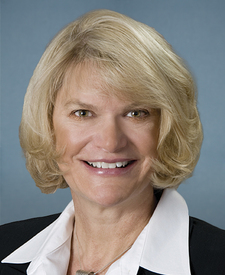
See how Cynthia M. Lummis actually votes — against your values.
DeepSyte scores Cynthia M. Lummis's record on the issues you care about — not party, not press releases. Take the 2-minute values quiz to see your personal alignment.
Sign in and take the values quiz to see how Cynthia M. Lummis's votes line up with your views.
Prediction track record
How often we called Cynthia M. Lummis's passage votes correctly, from their stated positions on each bill's tagged topics. Excludes “unclear” calls and abstentions.
23 predictions on record · none have been resolved by a passage vote yet. Check back as bills move.
Pending vote119-hr-5123
Indoor Air Quality and Healthy Schools Act of 2025
To amend the Internal Revenue Code of 1986 to temporarily suspend certain fuel excise taxes for fuel separated during periods in which the national average price of gasoline exceeds $3.99 per gallon, and to prohibit certain credits or deductions for oil and gas companies during such periods.
No paired statements and votes yet for Cynthia M. Lummis
We haven't yet found statement/vote pairs on the same topic for Cynthia M. Lummis. This usually means either the rep hasn't taken public positions on bills that have come to a passage vote, or those bills haven't been tagged yet. The checker runs as new press releases and votes come in.
Pro analysis
AI rep analysis — Pro
Get an AI-narrated read on Cynthia M. Lummis's full voting record against your stated values — aligned themes, conflicts, notable votes, and what to watch for.
We haven't extracted campaign positions for Cynthia M. Lummis yet. Once their campaign website or position pages are processed, this card will track what they said vs how they voted.
Crossing the aisle
Passage votes where Cynthia M. Lummis broke ranks with ≥75% of Republicans. Threshold catches substantively partisan splits; unanimous-ish or close votes are excluded.
2
Cross-aisle votes
118-hr-2670·Dec 14, 2023·91% of R voted YES
National Defense Authorization Act for Fiscal Year 2024
Lummis-Led FENCES Act Clears U.S. House » Senator Cynthia Lummis
Position: Senator Lummis supports the FENCES Act, which clarifies that states should be able to exclude foreign emissions—both natural and human-caused—when determining compliance with federal air quality standards and during facility permitting reviews.
Washington, D.C. — U.S. Senator Cynthia Lummis (R-WY) today applauded the bipartisan passage of the Foreign Emissions and Nonattainment Clarification for Economic Stability(FENCES) Act in the U.S. House of Representatives. This legislation protects producers from unnecessary compliance burdens caused by events beyond their control, such as foreign wildfires or dust storms, ensuring fair air quality designations. Representative August Pfluger (TX-11) introduced the companion legislation in the House.
“I’m thrilled to see the FENCES Act move one step closer to becoming law,” said Lummis.“This legislation will help drive innovation and economic growth across Wyoming by cutting unnecessary red tape. At the same time, the FENCES Act preserves strong Clean Air Act standards while implementing commonsense policies that account for pollution beyond a state’s control. I look forward to seeing this legislation make its way to the Senate.”
States throughout America are being unfairly penalized for pollution originating outside U.S. borders, including from natural events such as Canadian wildfires. While current law allows states to adjust their air quality plans when foreign emissions interfere with compliance, EPA guidance under the Biden administration narrowed those adjustments to human-caused emissions only. This change has created unnecessary regulatory hurdles for states and industries already working to meet Clean Air Act requirements.
The FENCES Act restores clarity by confirming that all foreign emissions, whether natural or man-made, are excluded when determining compliance with national air quality standards and during new facility permitting reviews. The bill also allows states to account for foreign emissions earlier in the regulatory process, providing greater certainty and efficiency.
Lummis, Cruz File Amicus Brief Backing Trump Administration's Push to Repeal Endangerment Finding » Senator Cynthia Lummis
Position: Senators Lummis and Cruz support the Trump administration's repeal of the EPA's greenhouse gas endangerment finding, arguing that the EPA lacks congressional authorization to enforce greenhouse gas regulations and that courts should apply the major questions doctrine to limit executive agency authority.
Washington, D.C. — Senator Cynthia Lummis (R-WY) and Senator Ted Cruz (R-TX) have filed an amicus brief in support of the Trump administration's repeal of the greenhouse gas endangerment finding, arguing that the Environmental Protection Agency is operating without the congressional authorization needed to enforce these types of regulations.
Senator Lummis currently serves as Chairman of the Subcommittee on Clean Air, Climate, and Nuclear Innovation and Safety for the Senate Committee on Environment and Public Works. Senator Cruz serves as Chairman of the Subcommittee on Federal Courts, Oversight, Agency Action and Federal Rights for the Senate Committee on the Judiciary.
Excerpts from the amicus brief are included below; the full text can be reviewed here.
Senators Ted Cruz and Cynthia Lummis respectfully move this Court for leave to file the attached proposed brief as amici curiae in this matter. In support of their Motion, amici state as follows:
1. Amici Curiae are Senators Ted Cruz and Cynthia Lummis, who represent the States of Texas and Wyoming, respectively, in the United States Senate. Senator Cruz serves as Chairman of the Subcommittee on Federal Courts, Oversight, Agency Action and Federal Rights for the Senate Committee on the Judiciary. Senator Lummis serves as Chairman of the Subcommittee on Clean Air, Climate, and Nuclear Innovation and Safety for the Senate Committee on Environment & Public Works. Amici’s respective interests overlap perfectly here.
2. Namely, both have a strong interest in judicial interpretations that preserve the legislative powers that Article I of the Constitution vests exclusively in Congress. Amici share an interest in ensuring that the judiciary serves as an appropriate check on the executive branch and vigilantly safeguards the Constitution’s separation of powers. In addition, amici have an interest in ensuring that executive agencies–– like the EPA––exercise only the authority Congress delegated to them, meaning that Congress retains all federal legislative power. When an executive agency issues regulations with vast economic and political significance, the courts must invoke the major questions doctrine to protect the Constitution’s separation of powers.
3. As members of the U.S. Senate, amici possess a unique interest in, and perspective on, the EPA’s reliance on the major question doctrine to repeal its 2009 Endangerment Finding and corresponding regulations concerning greenhouse gas emissions standards for vehicles and engines. Amici respectfully submit this amici curiae brief pursuant to these interests and their unique perspective as U.S. Senators.
4. Counsel for amici contacted counsel for the parties in No. 26- 1037 on April 6, 2026, to obtain their positions on the Motion. Counsel for amici contacted counsel for the parties in the consolidated cases on April 8, 2026, to obtain their positions on the Motion. Respondents consent to the Motion. Petitioners in No. 26-1037 consent to the Motion provided that the brief complies with Rule 29. Petitioners in No. 26-1043, Missouri Coalition for the Environment and Metropolitan Congregations United, take no position. Petitioner in No. 26-1051, Service Employees International Union, takes no position. The State and local government Petitioners in No. 26-1061 take no position on the Motion. The remaining Petitioners provided no position before the filing of this Motion.
5. The proposed brief is desirable and relevant to the disposition of the case. The brief describes how the major questions doctrine plays a central role in preserving separation of powers by ensuring that questions of economic and political significance are resolved by Congress, not administrative agencies. And it explains how the EPA’s invocation of the major questions doctrine in repealing the 2009 Endangerment Finding and greenhouse gas vehicle standards preserves Congress’s lawmaking authority. The Court must uphold that necessary conclusion to ensure that Congress maintains its role as supreme lawmaker in the face of Executive overreach.
6. Pursuant to Circuit Rule 29(d), counsel for amici state that one amicus brief was lodged on March 13, 2026, and again on March 31, 2026, by a party that is also appearing as an intervenor (John Worthington). Another amicus brief was lodged on March 19, 2026, by Government Accountability & Oversight and Government Oversight & Education. Amici were not notified of either brief, which were filed nearly a month before amici are seeking leave, and therefore did not have an opportunity to contribute to them. Additionally, neither brief analyzes the major questions doctrine and its applicability to the EPA’s 2009 Endangerment Finding and greenhouse gas vehicle emission standards. Amici’s unique perspective as members of Congress on the applicability of the major questions doctrine to this case further renders a separate brief necessary and desirable.
7. Accordingly, amici respectfully request that the Court grant them leave to file the proposed brief as amici curiae.
Lummis Hosts Crypto Roundtable with Comptroller Gould and Governor Gordon » Senator Cynthia Lummis
CHEYENNE, WY— U.S. Senator Cynthia Lummis (R-WY), Senate Banking Subcommittee on Digital Assets Chair, hosted a roundtable at the Wyoming State Capitol with Comptroller of the Currency Jonathan V. Gould and Governor Mark Gordon to discuss the state’s regulatory landscape for digital assets, the importance of the dual banking system, and how bank supervision can support responsible financial innovation. The Comptroller of the Currency is a Senate-confirmed position that charters, regulates, and supervises all national banks and federal savings associations in the United States.
“Wyoming has always led from the front on digital assets, and the work we did in Wyoming nearly a decade ago is the foundation for what we are doing now on the federal level,” said Lummis. “Wyoming has built the most thoughtful regulatory framework in the country for digital assets, and bringing Comptroller Gould here to see what we have accomplished firsthand is how we ensure federal policy reflects what is actually working on the ground.”
“As the business of banking continues to evolve, it is critical that we engage with leaders at every level of government to ensure the safe and sound operation of our financial system—including the important role of digital asset technology,” said Gould. “I appreciate Senator Lummis and Governor Gordon for facilitating this thoughtful discussion and for their strong commitment to the long-term vibrancy and competitiveness of our nation’s economy.”
“Wyoming has worked deliberately to create a policy environment that supports innovation while maintaining high standards for safety, soundness, and consumer protection,” said Gordon. “Today’s discussion reflects the importance of continued coordination among policymakers, regulators and industry leaders as digital assets become an increasingly important part of U.S. monetary policy and the global financial landscape.”
ICYMI: Lummis Op-ed in Washington Post: A broken system is costing America trillions. I see it in Wyoming. » Senator Cynthia Lummis
Position: Senator Lummis advocates for streamlined federal environmental permitting and regulatory certainty for energy and infrastructure projects, arguing that the current system causes excessive delays and economic harm. She calls on Congress to codify permitting reforms into law to prevent administrative reversals between administrations.
Cheyenne, WY.— Senate Western Caucus Chair Cynthia Lummis (R-WY) today published an op-ed in the Washington Post highlighting the critical need for permitting reform and permitting certainty in the U.S. and making the case for why Congress must act this year.
Read the full op-ed here and below:
A broken system is costing America trillions. I see it in Wyoming.
Twenty-nine years to open a mine? Here’s what that tells me.
Cynthia Lummis, a Republican, represents Wyoming in the U.S. Senate.
Natural resources are one of America’s greatest strengths. Gas, coal, rare earth elements, liquid natural gas and crude oil exports have powered the nation’s economy, helped put food on the table for generations of families, and aided allies in times of great need. So, it’s maddening to watch a broken permitting system stand between the United States and so much more.
I see it constantly in Wyoming. Companies willing to invest billions sit in regulatory limbo for years, sometimes decades. The average time to bring a new mine online in America is almost 29 years; the permitting process consumes most of that time. Only three mines have come online in the United States since 2002. Meanwhile, China has built entire industries.
Uncertainty and regulatory whiplash keep people up at night. For example, when a project gets approved, jobs and investments get planned, and then a new administration comes in and stops it.
The last two Democratic presidents slow-walked and killed traditional energy projects while green-lighting questionable renewable energy deals. President Joe Biden canceled already approved oil and gas leases in Alaska and revoked two federal mineral leases for a mine in Minnesota. In the final months of his presidency, Biden stopped federal coal leasing in the Powder River Basin of Wyoming and Montana, a region providing about 40 percent of the country’s coal. Reversing this unpopular decision required an act of Congress. These administrative policy moves were wrong and costly.
President Donald Trump has started to change that, and I’m glad for it. But executive action isn’t enough. Congress should codify project certainty into law.
Look at what occurred with TerraPower’s proposed nuclear reactor in Kemmerer, Wyoming. Regulatory changes under the Trump administration cut Nuclear Regulatory Commission review time from 26 months to 19. This was done safely, without compromising standards. The result? New jobs in western Wyoming on a reasonable timeline.
But these projects take years to build. The next Democratic administration could decide it isn’t a fan of a project, just like when Biden inexplicably killed the Keystone XL pipeline on Day 1 of his administration. President Barack Obama had also summarily rejected the Keystone project in 2015. Congress should lock in the positive changes under Trump that give projects the certainty they need to move forward and invest in communities.
Environmental reviews that stretch five, seven or 10 years aren’t thorough; they’re broken. Two years for major environmental reviews is enough. One year for smaller projects. An analysis by the Business Roundtable, an association of more than 200 chief executives, puts the economic cost of permitting delays for projects now in federal review as high as $2.4 trillion.
The longer reviews drag on, the worse the damage. Costs pile up, then workforce plans collapse.
A company can do everything right: work with state regulators, get input from local groups, and then an environmental organization at the last minute sues to stop it. That’s not environmental protection. That’s obstruction.
Another permitting issue is the Endangered Species Act. It was meant to protect wildlife but is often wielded as a wedge to stop projects. When a species recovers, it should be delisted and management returned to the states. Federal conservation dollars should go toward species that truly need help.
I don’t want corners cut. Weak projects damage the environment and destroy public trust. What the nation needs is a permitting system that’s clear, consistent, vetted and works.
The National Environmental Policy Act (NEPA), which requires the federal government to evaluate impacts of projects, produces reams of paperwork that are not focused on the law’s core objectives. The mandated reviews make projects slower, more expensive and drain revenue from the communities that could use the investment the most.
I encourage Sens. Shelley Moore Capito (R-West Virginia), Mike Lee (R-Utah), Sheldon Whitehouse (D-Rhode Island) and Martin Heinrich (D-New Mexico), who lead the Senate’s key energy, natural resources and environment committees, to carry that momentum forward and deliver a strong, bipartisan bill that meets the permitting needs of our time.
Fixing permitting isn’t a choice between the environment and the economy. America can protect both. The current system protects neither and hurts everyone. The opportunity to get something done is this year. Congress should not squander it.
Lummis Introduces Legislation to Codify Trump's Nuclear Baseload Energy Executive Orders » Senator Cynthia Lummis
Position: Senator Lummis supports legislation to codify Trump administration executive orders on nuclear energy, including reforms to nuclear reactor testing, accelerated deployment of advanced reactors, streamlined Nuclear Regulatory Commission approvals, and revitalization of the domestic nuclear industrial base.
Washington, D.C. — Senator Cynthia Lummis (R-WY) today introduced the Strengthening American Nuclear Energy Act of 2026, legislation that codifies four of President Trump's executive orders on nuclear energy into law, locking in the Trump administration's pro-nuclear agenda and ensuring it cannot be undone by a future administration.
"Our country's energy demands are only increasing, and meeting them requires every baseload source available," said Senator Lummis. "Next generation nuclear is reliable, clean, cost effective, and powerful, and it is exactly what America, and our allies need more of. President Trump prioritized nuclear from day one, and this legislation makes that work permanent. America is moving forward toward energy dominance and next generation nuclear will help lead the way."
“I am grateful to Senator Lummis for leading the Senate companion to this critical legislation, said Congressman Donalds. “As President Trump continues to secure national energy dominance, it’s up to Congress to hold up our end of the bargain. Energy security is national security, and it is imperative that we support the administration’s effort to revitalize the nuclear industry.”
"The Uranium Producers of America (UPA) strongly supports Senator Cynthia Lummis’ legislation to codify President Trump’s executive orders (EOs) advancing nuclear energy,” said Scott Melbye, President of the UPA and Executive Vice President of Uranium Energy Corp. "This effort represents a critical step toward achieving the United States’ goal of quadrupling U.S. nuclear energy production by 2050. Meeting this target will require a robust and reliable domestic nuclear fuel supply chain that UPA and its member companies are actively expanding. Codifying the EOs will enhance energy and national security and ensure the United States can meet growing electricity demand with reliable, baseload nuclear power.”
This legislation codifies four executive orders signed by President Trump on May 23, 2025, giving them the full force of law. Those executive orders directed the reform of nuclear reactor testing at the Department of Energy, accelerated the deployment of advanced nuclear reactor technologies for national security, ordered meaningful reform of the Nuclear Regulatory Commission to cut red tape and speed up approvals, and directed a reinvigoration of the American nuclear industrial base.
The Trump administration has worked aggressively to cut bureaucratic delays at the Nuclear Regulatory Commission and rebuild America's nuclear industrial base after years of neglect under the Biden administration. Senator Lummis's legislation ensures those reforms are codified into law and protected from future political interference.
Nuclear energy is one of the most reliable baseload power sources available, producing energy around the clock regardless of weather conditions. As America's energy demands continue to grow, driven by data centers, AI, and a expanding economy, nuclear must be a central part of the solution.
Wyoming is already home to TerraPower's Natrium reactor project in Kemmerer, a next-generation nuclear facility that is putting Wyoming workers on the cutting edge of America's energy future.
Read the full legislative text here.
Senator Tom Cotton (R-AR) is a cosponsor. Rep. Byron Donalds (R-FL) introduced the House companion.
Read Senator Lummis’ recent op-ed on nuclear energy here.
Source: GDELT 2.0 GKG, filtered to a curated list of national outlets. Inclusion is not endorsement; opinion pieces and reported news are mixed.
Recent stock activity
Periodic transaction reports filed under the STOCK Act — disclosed by the rep, sourced from public filings.
No disclosed trades on record.
Source: open-data mirrors of the Senate eFD and House Clerk financial-disclosure systems. Disclosure within 30 days of trade is required by law (45 for spouse/dependent trades).
Top PAC donors · 2026 cycle
Political action committees that gave the most to this rep's principal campaign committee this cycle. PAC giving is direct organizational support — industry, ideological, or leadership.
1.2025 SENATORS CLASSIC COMMITTEELeadership2 contributionsMember-of-Congress leadership PAC — likely affiliated with a Senate Republican or Democratic leader or caucus, directs contributions to allied candidates.AI$21,162
2.GOP WINNING WOMEN 2026Leadership2 contributionsRepublican party-aligned PAC focused on supporting female GOP candidates and women's engagement in Republican politics.AI$15,691
3.BADLANDS PAC3 contributions$15,000
4.ONE TEAM SENATE MAJORITY1 contribution$12,642
5.FUND FOR AMERICA'S FUTURE2 contributions$10,000
6.CHEVRON EMPLOYEES PAC2 contributions$10,000
7.SENATE EAGLE PAC2 contributions$10,000
8.CONTINUING AMERICA'S STRENGTH AND SECURITY PAC2 contributions$10,000
9.WATERPAC - NATIONAL RURAL WATER ASSOCIATION POLITICAL COMMITTEE2 contributions$10,000
10.J.R. SIMPLOT CO. PAC2 contributions$10,000
Source: OpenFEC (api.open.fec.gov) Schedule A receipts where contributor type is “committee.” Aggregated by contributing committee. Self-transfers from joint-fundraising / victory committees are excluded.
Top individual contributors · 2026 cycle
Itemized individual contributions over $200 to this rep's campaign committee, aggregated by donor employer. PAC giving is shown above; this section is people, not organizations.
1.SELF$21,750
2.CARVER CREEK RANCH$12,000
3.KALSHI$10,000
4.CLEANSPARK$7,500
5.COINBASE$7,000
6.RESEARCH AFFILIATES LLC$7,000
7.HOROWITZ FOUNDATION$7,000
8.50T FUNDS$7,000
9.AUDAX GROUP$7,000
10.RGAS REFRIGERANTS$7,000
Source: OpenFEC Schedule A receipts where contributor type is “individual,” aggregated by the donor's self-reported employer. This is a geographic / industry correlation, not a corporate endorsement.