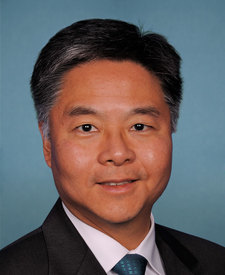
See how Ted Lieu's votes line up with your values.
DeepSyte scores Ted Lieu's record on the issues you care about — not party, not press releases. Take the 2-minute values quiz to see your personal alignment.
Sign in and take the values quiz to see how Ted Lieu's votes line up with your views.
Prediction track record
How often we called Ted Lieu's passage votes correctly, from their stated positions on each bill's tagged topics. Excludes “unclear” calls and abstentions.
A joint resolution to direct the removal of United States Armed Forces from hostilities within or against the Islamic Republic of Iran that have not been authorized by Congress.
Based on 3 data points across public statements and recorded votes · AI analysis of public records
118-hr-4365·Consistent
Department of Defense Appropriations Act, 2024
85/100
What they said
Apr 7, 2026
House Democratic leaders call for an immediate end to U.S. military operations in the Middle East, characterizing the current military engagement as a reckless war of choice that has resulted in casualties and is driving up costs for American families.
The statement calls for an immediate end to U.S. military operations in the Middle East, characterizing current engagement as a reckless war of choice. The rep voted NO on the FY2024 DOD appropriations bill, which funds military personnel, operations, maintenance, and procurement. The NO vote is directionally consistent with the stated opposition to the Middle East military engagement, as voting against DOD appropriations reflects opposition to funding that military activity. However, the DOD appropriations bill funds the entire defense budget across multiple programs and regions, not solely Middle East operations, creating some ambiguity about whether the NO vote was driven specifically by opposition to Middle East policy or broader defense spending concerns.
Israel Security Supplemental Appropriations Act, 2024
85/100
What they said
Apr 7, 2026
House Democratic leaders call for an immediate end to U.S. military operations in the Middle East, characterizing the current military engagement as a reckless war of choice that has resulted in casualties and is driving up costs for American families.
The statement calls for an immediate end to U.S. military operations in the Middle East and characterizes current engagement as a reckless war of choice. The bill provides supplemental appropriations for DOD and State Department activities in response to attacks in Israel, including funding for defense articles, systems, and military financing. The rep's NO vote on passage is consistent with the stated opposition to military engagement in the region, though the bill's specific focus on Israel defense support rather than broader Middle East operations creates some granularity difference.
House Democratic leaders call for an immediate end to U.S. military operations in the Middle East, characterizing the current military engagement as a reckless war of choice that has resulted in casualties and is driving up costs for American families.
The statement calls for ending U.S. military operations in the Middle East and characterizes current engagement as a reckless war of choice. The bill mandates continued defense assistance to Israel. The rep's NO vote aligns with the statement's opposition to Middle East military involvement, though the bill addresses a specific mechanism (defense aid to Israel) rather than the broader military operations the statement emphasizes. The alignment is directional but the specific policy questions differ in scope.
Pairs with ambiguous language and high uncertainty are withheld until more data is available. Procedural, cloture, and amendment votes are excluded — they don't cleanly signal substantive support or opposition.
Pro analysis
AI rep analysis — Pro
Get an AI-narrated read on Ted Lieu's full voting record against your stated values — aligned themes, conflicts, notable votes, and what to watch for.
We haven't extracted campaign positions for Ted Lieu yet. Once their campaign website or position pages are processed, this card will track what they said vs how they voted.
Crossing the aisle
Passage votes where Ted Lieu broke ranks with ≥75% of Democrats. Threshold catches substantively partisan splits; unanimous-ish or close votes are excluded.
2
Cross-aisle votes
118-hr-5947·Apr 17, 2024·77% of D voted NO
To provide for the rescission of certain waivers and licenses relating to Iran, and for other purposes.
REP LIEU STATEMENT ON THREE-YEAR ANNIVERSARY OF OCTOBER 7 ATTACK
Position: The statement mourns victims of the October 7, 2023 Hamas attacks in Israel, describes the attacks as the worst mass murder of Jews since the Holocaust, and expresses a desire for peace in the region with safety for Israeli and Palestinian civilians.
WASHINGTON – Today, Congressman Ted W. Lieu (D-Los Angeles County) issued the following statement on the three-year anniversary of the October 7th terrorist attacks in Israel.
“Three years have passed since the horrific terrorist attacks in Israel but the pain remains fresh for so many in my district and around the world. The heart-wrenching statistic we must never forget about that day: it was the worst mass murder of Jews since the Holocaust. I share in the sorrow of the victims of Hamas’ brutality and every person who has lost a loved one during this devastating war.
“The impacts of that day have reverberated in ways that have fundamentally changed our world, and not for the better. I want desperately to see peace in the region. Israeli and Palestinian civilians deserve to live safely.”
Issues:
National Security and Foreign Affairs
REP LIEU JOINS REP. FRIEDMAN, LOS ANGELES DELEGATION, AND ENTERTAINMENT UNIONS IN PUSH FOR NATIONAL FILM & TV TAX CREDIT
Position: The release supports the Motion Picture, Television, and Entertainment Revitalization Act, which would create a federal film and television tax credit on American labor expenses to bring production jobs back to the United States.
GLENDALE, CA – Today, October 6, 2026, Congressman Ted Lieu (D-Los Angeles County) joined U.S. Congresswoman Laura Friedman (D-Los Angeles County), Members of the Los Angeles congressional delegation, and the major unions representing film and television workers at the Alex Theatre in a new push for the Motion Picture, Television, and Entertainment Revitalization Act. This bipartisan legislation creates a national film tax credit on qualified labor expenses to bring production jobs back home.
For decades, the United States has offered no national filming incentive, leaving American crews to compete against roughly 65 countries that do. The result has been hundreds of thousands of lost jobs for the drivers, grips, electricians, carpenters, caterers, and crew members.
WHAT THE BILL DOES:
A 20% credit on American labor expenses. Feature films, television pilots, and television seasons that cost more than $1 million qualify if at least 75% of their principal photography days happen in the United States.
Bonus credits that reward hiring where it is needed most. Productions can earn an additional 5% each, up to a 30% total credit, for shooting at least 30% of their days in a rural opportunity zone or a federally declared disaster area, for independent productions, for spending at least $10 million in qualified wages across 10 or more states, and for increasing domestic production relative to what a company shoots abroad.
Includes post-production and visual effects work. Domestic post-production and VFX qualify as long as at least 75% of those costs are incurred in the United States, with the same 5% bonuses available.
Usable by independent producers, not just major studios. The credit is transferable, meaning a producer who doesn't owe enough in federal taxes to use it can sell it to a company that does and get the cash up front.
REP LIEU AND SEN MARKEY URGE TRUMP TO GET CHINA TO COMMIT TO ENSURING ARTIFICIAL INTELLIGENCE CANNOT LAUNCH NUKES WITHOUT HUMAN ENGAGEMENT
Position: Representative Lieu and Senator Markey urge President Trump to seek a commitment from China to maintain a human-in-the-loop principle for nuclear launch decisions and to ensure artificial intelligence does not compromise nuclear safeguards, citing a U.S. policy established in the FY2025 NDAA.
WASHINGTON – Today, Congressman Ted W. Lieu (D-Los Angeles County) and Senator Ed Markey (D-MA) urged President Trump to raise the principle of maintaining a “human-in-the-loop” in nuclear launch decisions during his meeting with General Secretary Xi Jinping next week. The United States already has the policy of ensuring humans are the decision-makers in the employment of nuclear weapons thanks to a provision authored by Rep. Lieu and Sen. Markey in the 2025 National Defense Authorization Act.
In the letter, Congressman Lieu and Senator Markey write:
Dear President Trump:
As you prepare to meet with General Secretary Xi Jinping next week, we respectfully ask you to raise the issue of artificial intelligence (AI) and its use in nuclear weapons launch systems. The United States already requires that the use of AI should not compromise the integrity of nuclear safeguards or compromise the principle of maintaining a “human-in-the-loop” in the employment of nuclear weapons. We urge you to get General Secretary Xi to commit the People’s Republic of China (PRC) to the same principle that the United States already follows.
Sec. 1638 of the Fiscal Year 2025 National Defense Authorization Act declared that it is the policy of the United States that AI should not compromise the integrity of nuclear safeguards. A human must be kept “in the loop” for all nuclear launch decisions. AI should never launch a nuclear weapon by itself. Since the United States follows this basic principle, so should the PRC.
Your direct engagement on this matter is critical to ensuring AI doesn’t accidentally or intentionally cause a preventable nuclear disaster. Thank you for your consideration.
Sincerely,
READ THE LETTER HERE
Issues:
Committee Work
National Security and Foreign Affairs
REP LIEU’S BILL TO PREVENT FENTANYL OVERDOSES PASSES THE HOUSE
Position: The release supports Tyler's Law, a bipartisan bill requiring HHS to study how often hospitals test for fentanyl in suspected overdose cases and to issue guidance on adding fentanyl testing to emergency room drug screenings.
WASHINGTON D.C. — Today, the House of Representatives passed Tyler’s Law, a bipartisan bill designed to prevent fentanyl overdoses in the United States.
Introduced by Congressman Ted Lieu (D-Los Angeles County, Congressman Bob Latta (R-OH), and Congresswoman Sydney Kamlager-Dove (D-CA), Tyler’s Law requires the Department of Health and Human Services (HHS) to complete a study on how frequently hospitals test for fentanyl when a patient is experiencing an overdose. Based on these results, the bill instructs the HHS to issue guidance to hospitals on implementing fentanyl testing in emergency rooms.
To this day, many emergency rooms do not include fentanyl in their drug screenings. Fentanyl is a synthetic opioid that does not show up on most rapid drug testing, which typically only includes marijuana, cocaine, amphetamines, opiates, and phencyclidine (PCP). According to the HHS, fentanyl-related deaths have skyrocketed 103-fold in the United States from 1999–2023. Adding fentanyl testing to emergency room drug screenings could save countless lives.
Tyler’s Law is named in memory of Tyler Shamash, a 19-year-old boy who died following a fentanyl ingestion in 2018. He was not tested for fentanyl after being brought to the hospital with a suspected overdose. His mother, Juli, is an advocate for this legislation and is sharing Tyler’s story to prevent others from experiencing the same tragedy.
“I am so pleased that Tyler’s Law passed the House,” said Congressman Lieu. “No family should have to endure the devastating loss that Tyler’s family experienced, especially when a simple fentanyl test could save a life. It is a privilege to work alongside Juli, Rep. Latta, and Rep. Kamlager-Dove to honor Tyler’s memory and advance this important legislation.”
"Today is an incredibly momentous day for my family and me. After losing my son Tyler, I never could have imagined that his story would one day help bring important change to emergency rooms across the country. Tyler’s Law is about giving doctors critical information and giving families a chance we didn’t have. I am deeply grateful to Congressman Ted Lieu, Congressman Bob Latta, and Congresswoman Sydney Kamlager-Dove for their leadership and commitment to this legislation, to their dedicated staff, and to the advocates and organizations who have worked tirelessly to help move Tyler’s Law forward. My greatest hope is that Tyler’s legacy will be measured in lives saved and families spared the heartbreak that ours has endured,” said Tyler’s mother, Juli.
Tyler’s Law is supported by American College of Emergency Physicians, Emergency Nurses Association, AIDS United, The National Drug & Alcohol Screening Association, The Partnership for a Healthy Iowa, Facing Fentanyl, Voices for Awareness, Project Eli, Song for Charlie, End Overdose, High Truths on Drugs and Addiction, Sun Shine on You Foundation, Drug Awareness Foundation, VOID, Crime Stoppers of Houston, Victoria’s Voice, and Stop Drug Homicide.
READ THE FULL BILL TEXT HERE
REPS LIEU, SUBRAMANYAM, AND NEGUSE INTRODUCE THE NO PARDON PAYDAYS ACT
Position: The release supports the No Pardon Paydays Act, which would require the Pardon Attorney to submit reviews of pardon recipients' criminal histories to Congress and would bar pardon recipients from making high-dollar contributions to political committees associated with the granting President.
WASHINGTON, D.C. — Yesterday, Representatives Suhas Subramanyam (D-VA), Ted Lieu (D-Los Angeles County), and Joe Neguse (D-CO) introduced the No Pardon Paydays Act.
Trump has handed out blanket pardons to January 6th insurrectionists and those who padded his pockets – including those who engaged in acts of violence. Many of the January 6th insurrectionists who received pardons have since committed new crimes.
The No Pardon Paydays Act would prevent corruption in the pardon process by requiring the Pardon Attorney to submit a review to Congress of any criminal history of the pardon recipient. It would also prohibit pardon recipients from making high dollar contributions to political committees associated with the President who granted the pardon.
“Time and time again, trump uses pardons as favors for his pals and donors. This blatant corruption is dangerous to our democracy and our communities,” said Congressman Lieu. “I am pleased to partner with Rep. Subramanyam on the No Pardon Paydays Act, which would mitigate the perverse practice of paying for Presidential pardons. You should not be able to buy your way out of justice, no matter how much money you donate to the President.”
“This administration is the most corrupt in modern American history. Every American is paying the price while this administration lines their pockets and dishes out favors to their friends. We refuse to stand by and watch this unfold. There must be consequences for this corruption while we work to restore the American people’s trust,”
said Congressman Subramanyam.
“Donald Trump has repeatedly abused the presidential pardon power to give get out of jail free cards to violent, convicted felons who assaulted Capitol Police officers on January 6th, and benefit close political allies and the members of his inner circle. This cannot stand. That’s why I’m proud to join Rep. Subramanyam’s effort to put a commonsense check on presidential pardons, ensuring regardless of who’s in the White House, the power is used fairly and responsibly,” said Congressman Neguse.
Issues:
Government Oversight & Ethics
Position: The release describes a panel discussion on Los Angeles transportation readiness for the 2028 Olympic and Paralympic Games and states that the representatives want to secure federal funding for the region's transportation and security needs.
WEST HOLLYWOOD, CA — On August 26, 2026, Congresswoman Laura Friedman (D-Los Angeles) convened a panel of the region’s top transportation officials alongside U.S. Representatives Ted Lieu (D-Los Angeles), Maxine Waters (D-Los Angeles), Judy Chu (D-Los Angeles), and Sydney Kamlager-Dove (D-Los Angeles) to examine what the 2026 FIFA World Cup revealed about Los Angeles County’s readiness to move millions of people during the 2028 Olympic and Paralympic Games. The panel came just weeks before Congress decides how much federal funding Los Angeles gets for the Games.
The panel brought together the agencies that run public transit across the region:
LA Metro Chief Customer Experience Officer Jennifer Vides, who spoke to what the agency needs to move visitors across dozens of venues over sixteen days, including the buses, operators, and storage capacity a Games-scale operation requires and the capital projects Metro is working to finish before 2028.
Los Angeles Department of Transportation General Manager Laura Rubio-Cornejo, who runs the second largest municipal transportation department in the country and is delivering street and transit improvements before 2028, including an additional zero-emissions bus maintenance facility.
City of Santa Monica Department of Transportation Director Anuj Gupta, who oversees the Big Blue Bus and a department of more than 470 employees in a city that will host no Olympic venues but will be the site of at least a dozen nation houses.
LA Metro Chief of Police and Emergency Management Bill Scott, who led Metro's security coordination during the World Cup and is standing up the agency's new in-house Transit Community Public Safety Department while preparing for the 2027 Super Bowl and 2028 Games.
“I am honored to represent California’s 36th Congressional District, which will host the Olympic Athletes Village at UCLA and the first LA 28 medal event, the Women’s Triathlon in Venice Beach. Ahead of the Olympics, we must ensure that athletes are able to get to and from their events safely and efficiently. Just as importantly, we must make sure the millions of Angelenos and visitors from around the world attending the Games can reliably travel to the venues while minimizing traffic impacts on Los Angeles County residents,” said Congressman Lieu. “I look forward to working with my colleagues to secure the federal funding needed to address Los Angeles’ critical transportation and security needs.”
“The World Cup proved that Los Angeles can deliver, but eight matches at one stadium over five weeks is not the same as sixteen days of events at dozens of venues across the region,” said Congresswoman Laura Friedman. “The agencies responsible for moving those visitors have never had to work at that scale together. So, we brought them into one room to tell Congress what they need to pull this off, and when they need it because the window for that closes in weeks, not years. I am going to keep fighting to bring our tax dollars home, and to make sure what this region builds for 2028 is still serving Angelenos long after the Games leave town.”
"The American Decade of Sports is an opportunity for Los Angeles to shine bright on the world stage while leaving our region better than fans found it," said Congresswoman Kamlager-Dove. “Hosting successful games and delivering lasting benefits for our community starts with investing in our transportation infrastructure. The 2026 World Cup was the ultimate test run for the 2028 Olympics, and convenings like today help us learn from the past so we can build a safer, more accessible, and better-connected LA long after the Olympic flame is extinguished."
WHAT THE WORLD CUP SHOWED:
More than 212,000 rides were taken on Metro’s enhanced bus service to and from SoFi Stadium at $1.75 each way.
Enhanced service included direct shuttles connecting the stadium to 15 transit hubs across Southern California.
June system ridership was 2 million riders higher than last June, with Metro recording its highest single-day ridership of the month on June 18.
Metro CEO Stephanie Wiggins has said there were zero major security incidents during the tournament.
WHAT THE 2028 GAMES REQUIRE:
Metro has requested approximately $2 billion for its Games mobility plan. Congress approved only $94.3 million earlier this year.
The House Appropriations Committee approved $875 million for the request in its FY27 Transportation, Housing and Urban Development bill. This has not been signed into law and falls short of what Los Angeles will need to make the games safe and secure.
The President’s FY27 budget request did not include funding.
Metro needs approximately 1,700 additional buses against a current fleet of roughly 2,100, and has secured roughly half of that total to date.
The Infrastructure Investment and Jobs Act expires September 30, 2026.
Metro has publicly stated that without the full request, the complete scope of the Games Enhanced Transit System would not be feasible.
In February 2026, Rep. Kamlager-Dove led 36 members of the California delegation, including Senators Alex Padilla and Adam Schiff, in a letter to Transportation Secretary Sean Duffy urging the Administration to include Metro’s request in the President’s FY27 budget request. The letter warned that FY27 was likely the region’s final opportunity to get the investments in place in time for the Games.
REPS LIEU AND MCCLAIN DELANEY INTRODUCE THE CONGRESSIONAL AUTHORIZATION FOR FEDERAL BUILDING NAMES ACT
Position: The release supports requiring Congress to expressly authorize any renaming of federal property and proposes criminal penalties for officials who rename federal property or display incorrect names without statutory authorization.
WASHINGTON D.C. — Today, Congressman Ted W. Lieu (D-Los Angeles County) and Congresswoman April McClain Delaney (D-MD) introduced the Congressional Authorization for Federal Building Names Act that would require Congress to expressly authorize the renaming of federal property.
In September 2025, Trump ordered the Department of Defense to be renamed the “Department of War.” However, FY27 appropriations requests and bills continue to refer to the agency as the Department of Defense because the change has not been enacted in statute. This renaming attempt could cost taxpayers up to $125 million. Later in December, Trump ordered the John F. Kennedy Center to be renamed the “Donald J. Trump and John F. Kennedy Memorial Center for the Performing Arts,” and directed the U.S. Institute of Peace to be renamed the “Donald J. Trump Institute of Peace.” The Administration has physically changed the names of these buildings, effectively defacing them.
“Presidents should not be able to unilaterally put their own name on federal property,” said Congressman Lieu. “Not only is this practice self-centered, it also carries a large price tag for the American people. Renaming federal property should respect the history, spirit, and purpose of the property as opposed to catering to the ego of the president.”
“The names on our federal buildings are not any President’s to give away. They belong to the American people, and only Congress can change them. This bill puts that in statute — with real penalties for appointees who ignore it,” said Congresswoman McClain Delaney.
The Congressional Authorization for Federal Building Names Act would:
Require Congress to expressly authorize the renaming of federal property – any feature, building, or property administered by a federal agency or designated by statute.
Impose criminal penalties on any officer or employee of the federal government who
(1) willfully displays an incorrect name of a unit of federal property, or
(2) renames a unit of federal property without prior statutory authorization
Defines "officer or employee" as any political appointee, including those appointed to or acting in a position that requires Senate confirmation.
Consistent with federal law, impose penalties based on the amount of damage caused or attempted:
If the damage or attempted damage does not exceed $1000: up to 1 year imprisonment, a fine of up to $100,000, or both.
If the damage or attempted damage exceeds $1000: up to 10 years imprisonment, a fine of up to $250,000, or both.
Increase the statute of limitations from 5 to 10 years.
READ THE FULL BILL TEXT HERE
REP LIEU’S BILL TO PREVENT FENTANYL OVERDOSES MOVES TO HOUSE FLOOR
Position: Supports Tyler's Law, bipartisan legislation requiring HHS to study hospital fentanyl testing practices during overdose cases and to issue guidance on implementing fentanyl testing in emergency rooms.
WASHINGTON D.C. — On July 21st, the House Energy and Commerce Committee voted to favorably report Tyler’s Law out of committee with a vote of 46-0. Tyler’s Law is a piece of bipartisan legislation designed to prevent fentanyl overdoses in the United States.
Introduced by Congressman Ted Lieu (D-Los Angeles County, Congressman Bob Latta (R-OH), and Congresswoman Sydney Kamlager-Dove (D-CA), Tyler’s Law requires the Department of Health and Human Services (HHS) to complete a study on how frequently hospitals test for fentanyl when a patient is experiencing an overdose. Based on these results, the bill instructs the HHS to issue guidance to hospitals on implementing fentanyl testing in emergency rooms.
Still to this day, many emergency rooms do not include fentanyl in their drug screenings. Fentanyl is a synthetic opioid that does not show up on most rapid drug testing, which typically only includes marijuana, cocaine, amphetamines, opiates, and phencyclidine (PCP). According to the HHS, fentanyl-related deaths have skyrocketed 103-fold in the United States from 1999–2023. Adding fentanyl testing to emergency room drug screenings could save countless lives.
Tyler’s Law is named in memory of Tyler Shamash, a 19-year-old boy who died following a fentanyl ingestion in 2018. He was not tested for fentanyl after being brought to the hospital with a suspected overdose. His mother, Juli, is an advocate for this legislation and is sharing Tyler’s story to prevent others from experiencing the same tragedy.
“A simple drug test can mean the difference between life and death,” said Congressman Lieu. “Tyler’s Law is a bipartisan and commonsense piece of legislation. It is a privilege to work with Tyler’s mom, Juli, to honor Tyler’s memory and fight so no other family is forced to undergo such devastating loss.”
Tyler’s Law is supported by American College of Emergency Physicians, Emergency Nurses Association, AIDS United, The National Drug & Alcohol Screening Association, The Partnership for a Healthy Iowa, Facing Fentanyl, Voices for Awareness, Project Eli, Song for Charlie, End Overdose, High Truths on Drugs and Addiction, Sun Shine on You Foundation, Drug Awareness Foundation, VOID, Crime Stoppers of Houston, Victoria’s Voice, and Stop Drug Homicide.
READ THE FULL BILL TEXT HERE
###
REPS LIEU AND OBERNOLTE INTRODUCE BIPARTISAN BILL TO ADVANCE AMERICAN LEADERSHIP IN AI
Position: The release introduces bipartisan legislation to strengthen U.S. AI leadership through improved standards, expanded research infrastructure, modernized federal AI adoption, worker and small-business support, crime prevention, and AI education and workforce development.
WASHINGTON - Today, Congressman Ted W. Lieu (D-Los Angeles County) and Congressman Jay Obernolte (R-CA), former heads of the Bipartisan Artificial Intelligence Task Force, introduced The American Leadership in AI Act, which brings together over 20 bipartisan legislative proposals that seek to act on many of the recommendations from the report issued last Congress by the Bipartisan Task Force on Artificial Intelligence.
This legislation will strengthen U.S. leadership in AI by improving AI standards and evaluation, expanding research infrastructure and R&D, modernizing federal AI adoption and risk management, supporting workers and small businesses, addressing AI-enabled crimes, and expanding AI education and workforce opportunities.
“Last Congress, the Bipartisan Task Force on Artificial Intelligence brought together 24 Members of Congress from across 20 House committees to examine a wide range of policy challenges and opportunities presented by artificial intelligence,” Reps. Lieu and Obernolte said. “The Task Force conducted numerous stakeholder discussions and roundtables, engaging with more than 100 experts from industry, academia, government, and civil society to develop a broad set of recommendations. As the Task Force’s Republican and Democratic leaders, we are pleased to introduce a legislative package grounded in that work. The American Leadership in AI Act builds on the strong bipartisan foundation already laid by our colleagues, incorporating and advancing bipartisan legislation previously introduced by Members across the House. By unifying these efforts, this package reflects the thoughtful, consensus-driven work already underway and translates it into a cohesive strategy to strengthen U.S. leadership in AI. At a time of deep political division, this package demonstrates that serious, forward-looking policymaking is still possible. We look forward to continuing to work with our former Task Force colleagues and others to advance these bipartisan solutions.”
READ THE FULL TEXT HERE
Background on The American Leadership in AI Act
The American Leadership in AI Act brings together more than 20 bipartisan proposals to implement key recommendations from the Bipartisan Task Force on Artificial Intelligence report issued last Congress. The bill is designed to strengthen U.S. leadership in AI while promoting responsible innovation and safeguarding the public.
Key Objectives
Strengthen our capacity to measure and evaluate AI
Advances voluntary standards, testing frameworks, and evaluation tools
Increases U.S. leadership in international standards-setting to help shape global AI standards and specifications
Directs the National Institute of Standards & Technology (NIST) to identify and promote best practices for transparency, safety, security, and performance
Build research infrastructure and drive innovation
Expands access to shared research resources
Supports collaboration across academia, industry, and government
Promotes ambitious, mission-driven research through competitive initiatives across critical sectors
Modernize federal AI governance, procurement, and security
Enhances government’s ability to track and respond to AI-related vulnerabilities
Updates how federal agencies govern and deploy AI
Promotes consistent adoption of risk-management frameworks
Expand AI education and protect the workforce
Invests in education and training programs to develop AI talent
Supports ongoing research on AI’s impact on the labor market
Strengthens the talent pipeline and promotes key sectors like manufacturing, agriculture, and cybersecurity
Safeguard Americans and deter harmful deepfakes
Strengthens safeguards to deter AI-enabled crime
Enhances legal remedies to deepfake victims and increases penalties for AI-enabled fraud and impersonation
Supports whistleblowers who expose AI-related risks and misconduct
More on the 118th Congress's AI Task Force
In February 2024, Speaker Mike Johnson and Democratic Leader Hakeem Jeffries established a bipartisan Task Force on Artificial Intelligence (AI) to explore how Congress can ensure America continues to lead the world in AI innovation while considering guardrails that may be appropriate to safeguard the nation against current and emerging threats.
Membership:
Rep. Ted Lieu (CA-36), Co-Chair
Rep. Anna Eshoo (CA-16)
Rep. Yvette Clarke (NY-09)
Rep. Bill Foster (IL-11)
Rep. Suzanne Bonamici (OR-01)
Rep. Ami Bera (CA-06)
Rep. Don Beyer (VA-08)
Rep. Alexandria Ocasio-Cortez (NY-14)
Rep. Haley Stevens (MI-11)
Rep. Sara Jacobs (CA-51)
Rep. Valerie Foushee (NC-04)
Rep. Brittany Pettersen (CO-07)
Rep. Jay Obernolte (CA-23), Chair
Rep. Darrell Issa (CA-48)
Rep. French Hill (AR-02)
Rep. Michael Cloud (TX-27)
Rep. Neal Dunn (FL-02)
Rep. Ben Cline (VA-06)
Rep. Kat Cammack (FL-03)
Rep. Scott Franklin (FL-18)
Rep. Michelle Steel (CA-45)
Rep. Eric Burlison (MO-07)
Rep. Laurel Lee (FL-15)
Rep. Rich McCormick (GA-06)
Issues:
Artificial Intelligence
REP LIEU STATEMENT ON TRUMP'S RACIST POST AGAINST INDIAN AND CHINESE IMMIGRANTS
Position: Rep. Lieu opposes President Trump's statements characterizing Indian and Chinese immigrants as disloyal and lacking assimilation capacity. He argues that immigrants strengthen the country and rejects the framing that certain ethnic groups pose a threat to American society.
WASHINGTON – Today, Congressman Ted W. Lieu (D-Los Angeles County) condemned President trump's racist post against Indian and Chinese immigrants.
“During WWII, over 100,000 Americans were torn from their homes and forcibly incarcerated in U.S. internment camps because they were deemed disloyal. The message was clear: Japanese Americans could never truly belong. Their very presence was a threat.
That logic didn’t begin or end there. For much of U.S. history, Asian Americans have been cast as forever foreigners – regardless of whether they were born here or have spent decades building their lives in this country.
Now, as trump attempts to strip citizenship away from thousands of naturalized Americans, he posts a racist rant on social media – claiming there is “no loyalty” among today’s immigrants, singling out Indian and Chinese communities specifically. Meanwhile, the rant claims European immigrants are the only example of successful assimilation. Also, trump uses racial stereotypes to describe a Chinese American attorney as “very smart, very evil, and very devious.”
I came to this country with my family at three years old. With the support of hard-working parents and a country that provided limitless opportunity, we went from going to flea markets to having a successful small business. I served my country on active duty for four years before joining the Air Force Reserves for 21 years. I have dedicated my career to serving my neighbors and my country.
Immigrants make our country great. Nothing trump says will change that.
trump is also the worst President ever. He dodged the draft, called our veterans suckers and losers, increased inflation with his unconstitutional tariffs and unconstitutional war, constantly seeks to divide Americans, and falls asleep at public events. He should resign in shame.”
Issues:
Civil Rights and Social Justice
Source: GDELT 2.0 GKG, filtered to a curated list of national outlets. Inclusion is not endorsement; opinion pieces and reported news are mixed.
Recent stock activity
Periodic transaction reports filed under the STOCK Act — disclosed by the rep, sourced from public filings.
No disclosed trades on record.
Source: open-data mirrors of the Senate eFD and House Clerk financial-disclosure systems. Disclosure within 30 days of trade is required by law (45 for spouse/dependent trades).
Top PAC donors · 2026 cycle
Political action committees that gave the most to this rep's principal campaign committee this cycle. PAC giving is direct organizational support — industry, ideological, or leadership.
1.AMERICAN CRYSTAL SUGAR COMPANY PACAgriculture3 contributionsAgricultural company PAC for a major sugar producer — backs candidates supporting farm subsidies, tariff protections, and agricultural trade policies.AI$11,000
2.ERNST & YOUNG POLITICAL ACTION COMMITTEEFinance2 contributionsAccounting and professional-services PAC — supports candidates aligned with business-friendly tax policy, regulatory efficiency, and professional-services industry interests.AI$10,000
3.AMERICAN FEDERATION OF TEACHERS, AFL-CIO COMMITTEE ON POLITICAL EDUCATIONLabor2 contributionsTrade-union PAC for teachers — backs candidates supporting public education funding, collective bargaining rights, and worker protections.AI$10,000
4.EMPLOYEES OF NORTHROP GRUMMAN CORPORATION PAC (ENGPAC)2 contributions$10,000
5.EDISON INTERNATIONAL PAC4 contributions$10,000
6.BANK OF AMERICA CORPORATION FEDERAL PAC3 contributions$10,000
7.AMAZON.COM SERVICES LLC SEPARATE SEGREGATED FUND (AMAZON PAC)3 contributions$10,000
8.GOOGLE LLC NETPAC7 contributions$10,000
9.VOTEVETSIdeological4 contributionsMilitary-veteran advocacy PAC — supports candidates backing veterans' benefits, healthcare access, and foreign policy positions aligned with veteran community priorities.AI$10,000
10.AMERICAN FEDERATION OF STATE, COUNTY AND MUNICIPAL EMPLOYEES P E O P L E4 contributions$10,000
Source: OpenFEC (api.open.fec.gov) Schedule A receipts where contributor type is “committee.” Aggregated by contributing committee. Self-transfers from joint-fundraising / victory committees are excluded.
Top individual contributors · 2026 cycle
Itemized individual contributions over $200 to this rep's campaign committee, aggregated by donor employer. PAC giving is shown above; this section is people, not organizations.
1.NOT-EMPLOYED$187,754
2.ANTHROPIC$30,000
3.GOOGLE$21,000
4.CONCORD USA$14,000
5.ROBINSON HELICOPTER COMPANY$10,500
6.NETFLIX$10,500
7.ANDREESSEEN HOROWITZ$10,000
8.THEGROUP$10,000
9.CAPITAL GROUP$9,000
10.SEVILLE CLASSICS$8,654
Source: OpenFEC Schedule A receipts where contributor type is “individual,” aggregated by the donor's self-reported employer. This is a geographic / industry correlation, not a corporate endorsement.