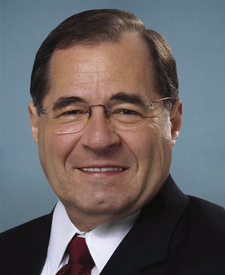
See how Jerrold Nadler's votes line up with your values.
DeepSyte scores Jerrold Nadler's record on the issues you care about — not party, not press releases. Take the 2-minute values quiz to see your personal alignment.
Sign in and take the values quiz to see how Jerrold Nadler's votes line up with your views.
Prediction track record
How often we called Jerrold Nadler's passage votes correctly, from their stated positions on each bill's tagged topics. Excludes “unclear” calls and abstentions.
77 predictions on record · none have been resolved by a passage vote yet. Check back as bills move.
To prohibit the disclosure of records by the Secretary of Housing and Urban Development of individuals for the purposes of immigration enforcement, and for other purposes.
Based on 6 data points across public statements and recorded votes · AI analysis of public records
118-hr-6918·Consistent
Supporting Pregnant and Parenting Women and Families Act
92/100
What they said
May 6, 2026
The lawmakers urge the Supreme Court to overturn a Fifth Circuit decision restricting mifepristone access, arguing that the medication has undergone rigorous FDA approval, is safe and effective, and that court intervention undermines the evidence-based FDA regulatory process and limits access to reproductive healthcare.
The statement advocates for protecting mifepristone access and FDA authority over medication approval, opposing court restrictions on the drug. The bill restricts federal oversight of state TANF funding for pregnancy centers that discourage abortion and promote childbirth—a policy that directly undermines access to abortion medication by redirecting public funds away from comprehensive reproductive healthcare toward pregnancy-continuation services. The rep's NO vote on the bill aligns with the statement's position protecting reproductive healthcare access and opposing restrictions on abortion-related services.
Detain and Deport Illegal Aliens Who Assault Cops Act
85/100
What they said
Feb 26, 2026
The representatives oppose ICE enforcement actions that involve entering residential buildings without judicial warrants and misrepresenting identity to detain individuals, characterizing such tactics as harmful to community trust and safety.
Nadler's statement opposes ICE enforcement tactics that lack judicial warrants and involve misrepresentation to enter residences. HR 7343 mandates DHS custody of non-citizens arrested for assaulting law enforcement, a detention provision without addressing warrant requirements or residential entry tactics. His 'no' vote on passage aligns with his stated opposition to expansive ICE enforcement authority, though the bill's specific focus on assault-related detentions rather than residential entry methods creates some directional ambiguity.
The representatives oppose ICE enforcement actions that involve entering residential buildings without judicial warrants and misrepresenting identity to detain individuals, characterizing such tactics as harmful to community trust and safety.
The statement opposes ICE enforcement tactics that involve deception and warrantless residential entry, characterizing such actions as harmful to community trust. The Secure the Border Act expands border enforcement infrastructure and employer verification systems—provisions that reflect a broader enforcement-focused immigration approach. The rep's NO vote on a bill that substantially expands enforcement capacity is generally consistent with the stated opposition to aggressive ICE tactics, though the bill addresses border construction and employment verification rather than the specific residential-entry and identity-misrepresentation practices criticized in the statement.
The representatives oppose ICE enforcement actions that involve entering residential buildings without judicial warrants and misrepresenting identity to detain individuals, characterizing such tactics as harmful to community trust and safety.
The statement opposes ICE enforcement tactics that involve misrepresenting identity and entering residences without judicial warrants, characterizing such actions as harmful to community trust. The Laken Riley Act mandates detention of non-U.S. nationals arrested for certain property crimes and authorizes state litigation over immigration enforcement decisions. The rep's NO vote aligns with the statement's opposition to aggressive ICE enforcement practices—the bill would expand mandatory detention authority and litigation mechanisms that could facilitate more aggressive enforcement actions. However, the statement focuses specifically on deceptive entry tactics and residential intrusions, while the bill addresses detention mandates and state litigation authority, which are related but distinct mechanisms of enforcement.
Department of Homeland Security Appropriations Act, 2024
75/100
What they said
Feb 26, 2026
The representatives oppose ICE enforcement actions that involve entering residential buildings without judicial warrants and misrepresenting identity to detain individuals, characterizing such tactics as harmful to community trust and safety.
The statement opposes ICE enforcement tactics that lack judicial warrants and involve misrepresentation to enter residences. The bill is a broad DHS appropriations measure that funds ICE operations among many other agencies and programs. The representative's NO vote on the appropriations bill is generally consistent with opposition to ICE's enforcement approach, as voting against DHS funding could reflect objection to ICE's operational practices. However, the bill funds multiple DHS agencies and programs beyond ICE, and the statement addresses specific tactical concerns (warrant requirements, identity misrepresentation) rather than ICE's overall funding level. The vote does not directly address the particular enforcement practices criticized in the statement.
Continuing Appropriations and Border Security Enhancement Act, 2024
75/100
What they said
Feb 26, 2026
The representatives oppose ICE enforcement actions that involve entering residential buildings without judicial warrants and misrepresenting identity to detain individuals, characterizing such tactics as harmful to community trust and safety.
The statement opposes ICE enforcement tactics involving misrepresentation and warrantless residential entry. The bill is a broad continuing appropriations measure that includes provisions prohibiting DHS from using CR funds for certain immigration-related purposes, though the specific scope of those prohibitions is not detailed in the summary. The rep's NO vote is generally consistent with opposition to ICE enforcement expansion, but the bill bundles appropriations for multiple agencies and programs; the vote reflects a position on the overall package rather than a direct statement on ICE residential enforcement tactics specifically.
Pairs with ambiguous language and high uncertainty are withheld until more data is available. Procedural, cloture, and amendment votes are excluded — they don't cleanly signal substantive support or opposition.
Pro analysis
AI rep analysis — Pro
Get an AI-narrated read on Jerrold Nadler's full voting record against your stated values — aligned themes, conflicts, notable votes, and what to watch for.
We haven't extracted campaign positions for Jerrold Nadler yet. Once their campaign website or position pages are processed, this card will track what they said vs how they voted.
Crossing the aisle
Passage votes where Jerrold Nadler broke ranks with ≥75% of Democrats. Threshold catches substantively partisan splits; unanimous-ish or close votes are excluded.
Ranking Members Nadler, Raskin, Johnson Urge Court to Reject DOJ’s Arguments for Giving AI Companies Unlimited, Free Use of Copyrighted New York Times Journalism to Train AI Models
Position: The lawmakers oppose the Department of Justice's argument that a national security exception to copyright law permits AI companies to train models on copyrighted works, including New York Times journalism, without compensation. They urge the court to reject that argument and uphold copyright protections for content creators.
Washington, D.C. – Today, Rep. Jerrold Nadler, Ranking Member of the Subcommittee on the Administrative State, Regulatory Reform, and Antitrust, Rep. Jamie Raskin, Ranking Member of the House Judiciary Committee, and Rep. Hank Johnson, Ranking Member of the Subcommittee on Courts, Intellectual Property, Artificial Intelligence, and the Internet, submitted an amicus brief opposing the Department of Justice’s (DOJ) bizarre argument that there is some sort of national security exception to current copyright law that allows AI companies to train their models on copyrighted work, including New York Times journalism, without compensation.
The brief, filed in the Southern District of New York in In re OpenAI, Inc. Copyright Infringement Litigation, reminds the court that the arguments in DOJ’s brief violate the plain text of the Copyright Act, which does not contain any national security exception to allow private companies free and unfettered use of copyrighted materials.
“National security is not a fair use factor under the Copyright Act. […] To treat it as a fair use consideration would be to add to the Copyright Act a national security exception that Congress did not enact,” the lawmakers wrote.
The dispute stems from allegations that OpenAI and Microsoft used New York Times journalism without permission to build AI products that compete with the newspaper. On September 1, DOJ intervened to support AI companies, arguing that restricting their use of copyrighted texts would threaten American AI development and national security. DOJ’s filing reportedly surprised even the government’s own copyright and patent experts.
Copyright law allows some uses of copyrighted work without permission, under a set of rules known as “fair use.” But before “fair use” doctrine applies, the courts must consider the circumstances—including how the work was used, how much was copied and whether the copying harms the market for the original work. Instead, DOJ is inviting the court to jettison federal statutes and case law and rule that AI companies have special rights based on specious national security claims.
The lawmakers urge the court to reject DOJ’s arguments and uphold legal protections that ensure fair compensation to millions of American content creators including writers, journalists, and artists.
The full brief is available here.
Nadler, Pappas, Goodlander Lead House in Urging HUD to Expedite Release of Critical Housing Grant Funding to Prevent Homelessness, Service Cuts
Position: The release urges HUD to promptly issue the Notice of Funding Opportunity and expedite renewal awards for the HOPWA program, which provides housing assistance to people living with HIV/AIDS, to avoid funding gaps. It also opposes the proposal to eliminate HOPWA funding.
For decades, Congressman Nadler has been the leading advocate in Congress for fully funding and effectively administering HOPWA. Each year, he has worked to secure robust HOPWA funding in the appropriations process and has pushed back against efforts to cut, withhold, or otherwise undermine the program’s resources. In April 2026, Congressman Nadler took to the House floor to oppose President Trump’s budget request to eliminate HOPWA funding entirely, a proposal that would have jeopardized critical housing assistance for people living with HIV/AIDS across the country.
In the letter to Secretary Turner, the lawmakers wrote, “We write to express our grave concerns regarding the delayed Notice of Funding Opportunity (NOFO) for the Housing Opportunities for Persons with AIDS (HOPWA) program. For many organizations in our communities, this program is vital to ensuring individuals with HIV/AIDS have access to safe and stable housing. We urge you to release the NOFO immediately and expedite the awards so communities can continue to provide support and housing to those who need it.”
They continued: “Unfortunately, many competitive HOPWA awards will expire tomorrow on September 30, 2026. Your department still has not released a NOFO, and grantees have received no information regarding the renewal of their awards. HOPWA is the only Federal program dedicated to the housing needs of people living with HIV/AIDS, making any gap in funding detrimental for the organizations providing support and the individuals and communities that depend on this program.”
The lawmakers concluded: “We understand that the awarding process takes careful review, but because these applicants are all seeking renewals, they have already been vetted and approved by your department. We urge you to expedite this process immediately and release awards as soon as possible. Without these critical funds, individuals with HIV/AIDS will face the risk of homelessness, and the organizations that help them may have to close their doors.”
Over 30 percent of those with HIV are living below the poverty line, and 20 percent have experienced homelessness in recent years. As the only HUD program dedicated to housing support for those with HIV/AIDS, expiration of previous awards and a delayed grant process by HUD could lead to staff layoffs and cuts to health care and housing services—exacerbating homelessness for some of the country’s most vulnerable communities.
The full letter can be read here.
Members of the House signing the letter are Representatives Jasmine Crockett (TX-30), Betty McCollum (MN-04), Adriano Espaillat (NY-13), Mark Pocan (WI-02), Eleanor Holmes Norton (DC-AL), Kevin Mullin (CA-15), Dan Goldman (NY-10), Jonathan Jackson (IL-01), Rashida Tlaib (MI-12), Wesley Bell (MO-01), Gwen Moore (WI-04), Danny Davis (IL-07), Joyce Beatty (OH-03), Ro Khanna (CA-17), Bennie Thompson (MS-02), Yassamin Ansari (AZ-03), Mark DeSaulnier (CA-10), Robert Garcia (CA-42), Bonnie Watson Coleman (NJ-12), Haley Stevens (MI-11), Everton Blair (GA-13), Seth Moulton (MA-06), Judy Chu (CA-28), Julie Johnson (TX-32), Pramila Jayapal (WA-07), Mike Quigley (IL-05), Nancy Pelosi (CA-11), Troy Carter (LA-02), Adelita Grijalva (AZ-07), Lateefah Simon (CA-12), Frederica Wilson (FL-24), Delia Ramirez (IL-03), Nydia Velázquez (NY-07), Sean Casten (IL-06), Raja Krishnamoorthi (IL-08), Gabe Vasquez (NM-02), Joe Courtney (CT-02), Paul Tonko (NY-20), Bill Foster (IL-11), Diana DeGette (CO-01), Stephen Lynch (MA-08), Robin Kelly (IL-02), Nikema Williams (GA-05), Josh Gottheimer (NJ-05), William Keating (MA-09), Val Hoyle (OR-04), Maxwell Frost (FL-10), Terri Sewell (AL-07), Angie Craig (MN-02) and Juan Vargas (CA-52).
Congressional Jewish Caucus Urges Secretary Rubio To Preserve The Office Of The Special Envoy For Holocaust Issues As A Permanent And Distinct Entity
Position: The Congressional Jewish Caucus urges the Secretary of State to keep the Office of the Special Envoy for Holocaust Issues as a permanent, distinct entity rather than consolidating it under the Special Envoy to Monitor and Combat Antisemitism, and to appoint a senior career official to lead it full-time.
Washington, D.C. – Today, Co-Chairs Congressman Jerrold Nadler (NY-12) and Congressman Brad Schneider (IL-10) led the Congressional Jewish Caucus in calling on Secretary of State Marco Rubio to preserve the office of the Special Envoy for Holocaust Issues (SEHI) as a permanent and distinct entity within the Department of State and not for SEHI to be absorbed under the Special Envoy to Monitor and Combat Antisemitism (SEAS). This letter highlights that SEHI is the only office in the federal government solely devoted to pursuing justice for Holocaust survivors and advocating on their behalf, and the need to appoint a career official as the next SEHI, with the seniority, diplomatic experience, and specialized expertise necessary to negotiate complex restitution and compensation matters.
“Since its establishment in 1999, the Office of the Special Envoy for Holocaust Issues has been the only office in the federal government solely devoted to pursuing justice for Holocaust survivors and advocating on their behalf,” the members wrote. “The office has also been supported on a bipartisan basis in Congress and administrations of both parties have actively affirmed its importance. For decades, SEHI has worked with foreign governments, international institutions, and Jewish organizations to pursue restitution and compensation for survivors and their families, recover Nazi-looted property, preserve Holocaust memory, and address unresolved Holocaust-era obligations. As the number of living Holocaust survivors continues to decline, this work is only becoming more urgent.”
“That is why we oppose any effort to consolidate or eliminate SEHI and are troubled by the reported plan for the Office of the Special Envoy to Monitor and Combat Antisemitism (SEAS) to absorb the SEHI office. SEHI and SEAS have clearly distinct mandates and responsibilities,” the members continued. “Both are full-time responsibilities that require full-time principals with unique areas of focus and full-time staff with unique expertise. Combining them would not streamline efficiency or eliminate any meaningful duplication; it would risk diminishing the focus, experience, and institutional capacity necessary for each.”
“The SEHI portfolio requires deep institutional knowledge, advanced diplomatic acumen, and sustained relationships with governments and international organizations,” the members added. “We ask that you appoint, as soon as possible, a senior career State Department official whose sole and full-time responsibility is serving as Special Envoy for Holocaust Issues. That official should have the seniority, diplomatic experience, and specialized expertise necessary to negotiate complex restitution and compensation matters and to maintain the relationships that SEHI has built over decades.”
Signers of the letter include Reps. Jake Auchincloss, Becca Balint, Suzanne Bonamici, Steve Cohen, Lois Frankel, Laura Friedman, Dan Goldman, Josh Gottheimer, Sara Jacobs, Greg Landsman, Mike Levin, Jared Moskowitz, Jerrold Nadler, Jamie Raskin, Jan Schakowsky, Brad Schneider, Kim Schrier, Eugene Vindman, and Debbie Wasserman Schultz.
View the full letter here and below.
As members of the Congressional Jewish Caucus, we write to urge you to immediately appoint a new Special Envoy for Holocaust Issues (SEHI) and to preserve SEHI as a distinct, permanent office led by a dedicated career State Department official.
Since its establishment in 1999, the Office of the Special Envoy for Holocaust Issues has been the only office in the federal government solely devoted to pursuing justice for Holocaust survivors and advocating on their behalf. The office has also been supported on a bipartisan basis in Congress and administrations of both parties have actively affirmed its importance. For decades, SEHI has worked with foreign governments, international institutions, and Jewish organizations to pursue restitution and compensation for survivors and their families, recover Nazi-looted property, preserve Holocaust memory, and address unresolved Holocaust-era obligations. As the number of living Holocaust survivors continues to decline, this work is only becoming more urgent.
That is why we oppose any effort to consolidate or eliminate SEHI and are troubled by the reported plan for the Office of the Special Envoy to Monitor and Combat Antisemitism (SEAS) to absorb the SEHI office.
SEHI and SEAS have clearly distinct mandates and responsibilities. SEAS is responsible for confronting contemporary antisemitism around the world, while SEHI focuses on Holocaust-era restitution, historical justice, remembrance, and accountability. These missions are complementary, but they are not interchangeable. Both are full-time responsibilities that require full-time principals with unique areas of focus and full-time staff with unique expertise. Combining them would not streamline efficiency or eliminate any meaningful duplication; it would risk diminishing the focus, experience, and institutional capacity necessary for each.
The effort is also especially troubling given the highly specialized nature of SEHI’s work and the longstanding success of having it led by a career diplomat with the expertise and continuity necessary to conduct sensitive restitution negotiations. The SEHI portfolio requires deep institutional knowledge, advanced diplomatic acumen, and sustained relationships with governments and international organizations. This unique mandate needs an independent office, fully integrated within the Bureau of European and Eurasian Affairs, and without additional or perhaps superseding agenda items both with external interlocutors and internal stakeholders.
Strong institutions must outlast individual officeholders and administrations. We are troubled by the suggestion that the plan to merge these offices may be motivated, at least in part, by a desire to expand the influence of certain personnel within the State Department.
Jewish organizations across the ideological and institutional spectrum have recognized the importance of maintaining a dedicated SEHI. In their letter to you, leading organizations including the Conference on Jewish Material Claims Against Germany, World Jewish Restitution Organization, American Jewish Committee, Anti-Defamation League, B’nai B’rith International, and more urged you to appoint a senior diplomat promptly and preserve the uniqueness of this important office. Their concern is shared by former SEAS and Holocaust experts who understand that preserving the distinct mission of SEHI is not bureaucratic duplication—it is an essential part of the United States’ commitment to Holocaust survivors and their families.
We urge you to heed their call and to reject any effort to eliminate, consolidate, or dual-hat the SEHI position. Instead, we ask that you appoint, as soon as possible, a senior career State Department official whose sole and full-time responsibility is serving as Special Envoy for Holocaust Issues. That official should have the seniority, diplomatic experience, and specialized expertise necessary to negotiate complex restitution and compensation matters and to maintain the relationships that SEHI has built over decades.
This appointment should be made with urgency. The recent departure of Special Envoy Germain creates a vacancy at precisely the moment when continuity is most important. There are fewer Holocaust survivors with each passing year. Every delay risks losing opportunities for restitution, accountability, and historical preservation that may never return.
The United States created SEHI because Holocaust survivors and their families require a dedicated advocate within our government. That need has not diminished. It has become more urgent. We urge you to put an end to the effort to consolidate these offices and to appoint a new, dedicated, career Special Envoy for Holocaust Issues without delay.
Amid NYFW, Nadler & Gillibrand Reintroduce FABRIC Act To Support Garment Workers And Revitalize The US Fashion Industry
Position: Congressman Nadler and Senator Gillibrand support reintroducing the FABRIC Act to improve garment worker safety and working conditions, reform piece-rate pay, curb wage theft, and expand domestic apparel manufacturing.
Washington, D.C. – Today, Congressman Jerry Nadler (NY-12) and U.S. Senator Kirsten Gillibrand (D-NY) announced the reintroduction of their Fashioning Accountability and Building Real Institutional Change (FABRIC) Act.
In New York State, there are approximately 130,000 people employed by the fashion industry, including thousands working in apparel manufacturing. Garment workers are a cornerstone of the American economy, and for far too long, they have faced unsafe working conditions, wage theft, and piecework pay, which often prioritizes fast fashion over the safety of workers. Nadler and Gillibrand's FABRIC Act would protect over 75,000 American garment workers and help revitalize the garment manufacturing industry in the United States by improving working conditions and reforming the piece-rate pay scale.
“America's garment workers have been undervalued and subjected to unfair labor practices for far too long, due to weak regulations across the fashion industry and the rise of fast fashion. With more than 100,000 New Yorkers contributing their labor to a billion-dollar garment industry, it is time to protect these workers and others across our nation and make historic investments in domestic manufacturing by passing the FABRIC Act,” said Congressman Jerrold Nadler. “I’m proud to work with Senator Gillibrand to protect workers’ rights, bring jobs back from overseas, and revitalize the American fashion industry.”
“Garment workers are the backbone of a multibillion-dollar industry, yet for far too long, their labor has been undervalued and exploited,” said Senator Gillibrand. “We cannot champion American innovation while turning a blind eye to abusive labor practices in our own backyard. It’s time to take bold action at the federal level to change the fabric of the American garment industry. The United States was once home to a booming apparel manufacturing industry, and it’s time to reexamine how this industry has evolved over the past 50 years and change how we treat our workers. With the FABRIC Act, we can curb wage theft, protect our workers, and revitalize domestic manufacturing so that 'Made in America' also means ethically made.”
The FABRIC Act proposes to address these issues by:
In addition to Nadler and Gillibrand, the bill is cosponsored by Reps. Deborah Ross (D-NC), Don Beyer (D-VA), Maxwell Frost (D-FL), Robert Garcia (D-CA), Dan Goldman (D-NY), Eleanor Holmes Norton (D-DC), Stephen Lynch (D-MA), and Rashida Tlaib (D-MI), as well as Senators Bernie Sanders (I-VT), Elizabeth Warren (D-MA), and Tammy Duckworth (D-IL). The bill is also endorsed by AFL-CIO, UNITE HERE, Workers United, and RWDSU.
The full text of the FABRIC Act can be found here.
Nadler Statement Ahead Of Vote On H.R. 4795, The “Protect Economic And Academic Freedom Act Of 2026”
Position: The release opposes H.R. 4795, which would bar universities from engaging in non-expressive commercial boycotts and require certification that they are not boycotting Israel to access certain federal funds, arguing it violates First Amendment protections and undermines a two-state solution.
Washington, D.C. – Today, Congressman Jerrold Nadler (NY-12) released the following statement ahead of House consideration of H.R. 4795:
“When the House votes on H.R. 4795, I will vote no.
“H.R. 4795, the so-called Protect Economic and Academic Freedom Act, prohibits universities from engaging in “non-expressive commercial boycotts,” and requires institutions of higher education to certify they are not boycotting Israel in order to access certain federal funds.
“I strongly oppose the global Boycott, Divestment, and Sanctions (BDS) movement and I ardently oppose BDS as a strategy to secure change in the Middle East. I also recognize that those who advocate for BDS can veer into antisemitism if they should use antisemitic tropes or stereotypes, hold Jews collectively responsible for Israel’s actions, target or exclude Jews because they are Jewish, use opposition to Israel or Zionism as a proxy for hostility toward Jews, or advance an eliminationist vision that denies Jews in Israel equal rights, physical safety, or the ability to remain in the country as equals.
“But no matter how strongly I oppose the BDS movement, I also believe that those who engage in BDS have a First Amendment right to do so. The First Amendment right to free speech does not apply only to agreeable speech. No matter how much I may disagree with BDS, and find it strategically stupid and morally repugnant, I will always fight to protect Americans’ right to speech with which I disagree. It is the only way to ensure speech I do agree with is equally protected.
“In my view, H.R. 4795 is a direct and gross violation of the First Amendment. The proponents of this bill hide behind an inadequately defined term of “non-expressive commercial boycotts,” but, as the ACLU wrote in a letter to Congress, “Many of those engaged in boycotts of Israel do so not for commercial reasons, but because they wish to express their political opposition to the policies of the Israeli government – matters of overwhelming public concern and debate in the present moment. HR 4795’s labeling such boycotts as “non-expressive” does nothing to change this reality.” Moreover, as the Supreme Court has noted in Chiles v. Salazar, “the First Amendment is no word game. And the rights it protects cannot be renamed away or their protections nullified by ‘mere labels.’”
“Additionally, the language in H.R. 4795 treats the entire West Bank as part of Israel, erasing the Green Line and undermining efforts to promote a two-state solution. The United States and Congress must recognize the difference between the State of Israel and the territory it occupies beyond the Green Line. Imposing penalties on institutions of higher education for opposing activities that advance annexation, blur that crucially important distinction, and undermine prospects for a two-state solution would establish a deeply troubling precedent.
“H.R. 4795 is the latest assault by the Trump Administration and Congressional Republicans on American colleges and universities. Supporting this bill does nothing to support students on campus, prevent hate, or improve the reality in the Middle East. Instead, it feeds the political arson being committed by the Trump Administration against institutions of higher education and endeavors to limit Americans’ First Amendment freedoms in service of Republicans’ partisan political agenda.
“I urge my colleagues not to take the bait and to join me in voting no on H.R. 4795.”
###
Nadler, Frost Demand Antitrust Investigation Into Sysco’s $29.1 Billion Acquisition of Restaurant Depot Over Threats of Higher Costs for Restaurants
Position: The release calls on the DOJ and FTC to closely scrutinize Sysco's proposed $29.1 billion acquisition of Restaurant Depot, arguing the deal could reduce competition and raise food costs for independent restaurants and consumers.
Washington, D.C. – Today, Congressman Jerrold Nadler (NY-12) and Congressman Maxwell Alejandro Frost (FL-10) are calling on the Department of Justice (DOJ) and the Federal Trade Commission (FTC) to closely scrutinize Sysco's proposed $29.1 billion acquisition of Restaurant Depot and investigate its potential anticompetitive effects. In the letter sent to the DOJ and FTC, the Congressmen warn that the deal could reduce competition, drive up costs for independent restaurants, and ultimately make dining out more expensive for consumers:
Restaurant Depot currently operates 166 locations across 35 states and serves more than 700,000 restaurants and food service operators. As a direct competitor to Sysco, Restaurant Depot provides independent restaurants with an important alternative when purchasing food and negotiating prices.
“Soaring food prices are forcing Americans to struggle to put food on the table for their families. The last thing our districts need is another bloated corporation using their unfair market power to raise food prices further. The Department of Justice must take its job seriously by fairly and carefully examining this proposed transaction to ensure that American consumers are protected,” said Congressman Jerry Nadler (NY-12), Ranking Member of the Subcommittee on the Administrative State, Regulatory Reform, and Antitrust Committee on the Judiciary.
“Restaurants are already struggling with rising costs, and eliminating competition in food distribution could make the problem worse. If this merger drives up the cost of food for small restaurants, those costs will ultimately be passed on to consumers. Families can’t afford another hit to their wallets, and that’s why the DOJ and FTC need to closely scrutinize this deal,” said Congressman Maxwell Frost (FL-10).
"Independent restaurants operate on razor-thin margins, and Restaurant Depot gives them an essential alternative to large distributors like Sysco and a critical price benchmark when negotiating with suppliers. If Sysco is allowed to acquire a major competitor, independent restaurants will lose that leverage, face higher food costs, and ultimately have little choice but to pass those costs on to diners. We thank Representatives Frost and Nadler for urging federal regulators to thoroughly investigate this deal before it does lasting harm to independent restaurants and the communities they serve,” said Erika Polmar, Executive Director Independent Restaurant Coalition.
The proposed acquisition would eliminate a major competitor to Sysco, the nation’s largest food distributor, and could give the company greater leverage over the prices restaurants pay for ingredients and supplies. For independent restaurants operating on already-thin margins, even modest increases in food costs can have significant consequences, including higher prices for customers.
Nadler and Frost warned that the impact of the merger could extend beyond restaurant owners to consumers and workers. If restaurants face higher costs, they may have little choice but to pass those costs on to customers at a time when families are already cutting back on dining out because of rising prices.
The proposed acquisition could also have implications for independent farmers and growers. Sysco has touted the increased purchasing power that would result from the acquisition, raising concerns about how greater market concentration could affect the prices paid to producers.
Nadler and Frost are calling on the Department of Justice and Federal Trade Commission to closely examine the proposed acquisition and launch an antitrust investigation into its potential effects on competition, independent restaurants, farmers, workers, and consumers.
Nadler Statement On "Murder Against Civilians" In The Eastern Pacific Ocean
Position: The release condemns recent U.S. military boat strikes in the eastern Pacific as unauthorized and lethal, asserts they lack due process or a declaration of war, and calls for an immediate halt to the strikes.
Washington, D.C. – Today, Congressman Jerrold Nadler (NY-12) released the following statement on the latest U.S. military strikes against a boat in the eastern Pacific:
“With Pete Hegseth at the helm, the U.S. military has conducted at least 67 unauthorized, lethal boat strikes, killing at least 223 people without any due process for perceived criminal wrongdoing or a declaration of war. This conduct amounts to nothing short of the U.S. military committing murder against civilians.
"I am appalled by this level of abject wrongdoing and demand an immediate halt to these extrajudicial strikes.”
Representatives Nadler and Hinson Introduce Bipartisan Legislation to Support New Parents
Position: Representatives Nadler and Hinson reintroduced the No Surprise Bills for New Moms Act, which would require health insurers to automatically cover newborns for 30 days after birth, establish a uniform 60-day newborn enrollment period, and notify parents of bills for uncovered newborns.
Washington, DC – Today, Representatives Jerrold Nadler (NY-12) and Ashley Hinson (IA-02) reintroduced No Surprise Bills for New Moms Act, bipartisan legislation that would ensure parents do not receive unexpected medical bills for their newborns. This bill is co-led by Nanette Barrágan (CA-44) and Brian Fitzpatrick (PA-01).
No Surprise Bills for New Moms Act would require health insurers to automatically provide coverage to newborns for 30 days after birth, establish a uniform 60-day enrollment period for newborns after those first 30 days, and notify parents if they receive a bill for an uncovered newborn.
“When a child is born, parents should only have to worry about them being happy and healthy,” said Congressman Jerrold Nadler. “Families deserve the peace of mind that their newborns will automatically have health insurance for the first month of their life and that they will know when the next medical bill is. I urge my colleagues to support the No Surprise Bills for New Moms Act to help prevent new parents from being hit with potentially devastating bills.”
“Parents shouldn’t be hit with surprise medical bills for their newborn because big health insurance companies prioritize their bottom line over working families,” said Congresswoman Ashley Hinson. "This bipartisan bill holds insurance companies accountable, ensures newborns have seamless coverage, and gives new parents one less thing to worry about so they can focus on keeping their babies healthy and happy.”
“Coverage for a newborn should not depend on the fine print of an insurance policy or the speed of an enrollment form,” said Congressman Brian Fitzpatrick. “The first weeks of life are medically consequential, and our laws should reflect that reality. Our initiative establishes a clear national standard: automatic coverage from birth, sufficient time for parents to enroll their child, and timely notice before a family is exposed to an unexpected bill. It is a practical, bipartisan reform that replaces needless uncertainty with clarity and common sense.”
“Welcoming a baby should be a time of joy, not a time for families to worry about unexpected medical bills or complicated insurance requirements,” said Congresswoman Nanette Barragán. “That is why I joined Representatives Nadler, Hinson, and Fitzpatrick to reintroduce the bipartisan No Surprise Bills for New Moms Act, which would ensure parents have a clear and simple enrollment period for their newborn’s health insurance, and that they are notified if their insurer is billed for a newborn who isn’t covered. No family should face high out-of-pocket costs because paperwork stood between their child and health coverage.”
The No Surprise Bills for New Moms Act is endorsed by the Society for Maternal Fetal Medicine, the American Hospital Association, the American College of Obstetricians and Gynecologists, and America’s Essential Hospitals. The No Surprise Bills for New Moms Act was endorsed by the Association of Maternal and Child Health Programs, Families USA, March of Dimes, 1,000 Days, and the Society for Maternal-Fetal Medicine when introduced during the 118th Congress.
Representatives Nadler, Scott, and Senator Murray Introduce Legislation to Protect Workers’ Rights by Ending Forced Arbitration in the Workplace
Position: The release announces bicameral legislation, the Restoring Justice for Workers Act, to end forced arbitration clauses in employment contracts, protect workers' ability to pursue work-related claims in court, and allow collective legal action, and it would override the 2018 Supreme Court decision in Epic Systems v. Lewis.
Washington, D.C. – Today, U.S. Representatives Jerrold Nadler (D-NY-12), Member of the House Judiciary Committee, Robert C. “Bobby” Scott (D-VA-03), Ranking Member of the House Committee on Education and Workforce, and U.S. Senator Patty Murray (D-WA), a senior member and former Chair of the Senate Health, Education, Labor and Pensions (HELP) Committee, reintroduced their bicameral Restoring Justice for Workers Act, legislation to end forced arbitration clauses, protect workers’ ability to pursue work-related claims in court, and allow workers to band together to vindicate their rights. Nadler, Scott, and Murray first introduced the bill in 2018.
The bill would override the 2018 Supreme Court decision, Epic Systems v. Lewis, which allowed employers to continue to enforce forced arbitration clauses against workers. These arbitration clauses prevent workers from banding together to enforce their legal rights and are often buried in the fine print of employment contracts, meaning many workers are not aware they’ve waived their rights. The use of forced arbitration clauses that block workers’ access to the courts has led to widespread non-enforcement of workers’ rights, including their right to minimum wage, overtime, and to a workplace free of discrimination.
“Mandatory arbitration clauses hurt workers by blocking them from pursuing justice for wage theft, discrimination, harassment, and other forms of corporate abuse and misconduct. These clauses are often hidden in the fine-print of employment contracts for the purpose of protecting corporations from facing consequences of violating their workers' rights” said Congressman Jerrold Nadler (NY-12). "Every worker deserves a workplace that honors their contributions with fair treatment, respect, and dignity. This bill protects employees' fundamental rights to access justice and empowers them to do so without unnecessary barriers. I urge my colleagues to support the Restoring Justice for Workers Act to protect and support American workers.”
“Workers should not be coerced into signing away their rights as a condition of their employment. Unfortunately, that is the reality for millions of workers across the country,” said Congressman Robert C. “Bobby” Scott (VA-03). “Employers are increasingly using mandatory arbitration agreements to deny employees a fair venue to seek recourse for wage theft, discrimination, or harassment. The Supreme Court’s decision in Epic Systems v. Lewis went further by undermining workers’ rights to file joint, class, or collective legal actions. The Restoring Justice for Workers Act would help restore employees’ fundamental rights to have their day in court and join with their co-workers to hold employers accountable for unlawful conduct.”
“If an employer does something illegal, workers should be able to hold them accountable in a court of law. But far too often, big corporations will cynically leverage long and complicated employment contracts to stack the deck against their workers. It’s manipulative and wrong. This means that—for instance—if workers are victims of wage theft, they can’t join together and go to court because they signed those rights away when they started the job. Workers shouldn’t have to choose between waiving the ability to enforce their rights and earning a living,” said Senator Murray. “That’s why it’s far past time we put an end to the practice of forced arbitration—and this bill can do just that. I’ll keep fighting until the rights of every worker are protected.”
“Binding arbitration clauses are one of the worst forms of control employers have over workers. While forced arbitration in cases of sexual harassment was thankfully finally banned a few years ago, it's long past time we did away with this practice for all other types of violations of rights on the job as well,” said Samantha Sanders, Director of Government Affairs and Advocacy at the Economic Policy Institute. “Workers can still be forced to sign away their right to a day in court over wage theft, unsafe working conditions, racial discrimination, and more in a secretive, biased process that is tilted towards bosses. This bill would go a long way towards empowering workers – even those who don’t have the protection of a union – to have full access to the courts and the opportunity to hold their employers accountable for breaking the law."
The Restoring Justice for Workers Act would:
This bill is cosponsored by Representatives Suzanne Bonamici (OR-01), Eleanor Holmes Norton (DC-At large), Hank Johnson (GA-04), Julia Brownley (CA-26), and Jan Schakowsky (IL-09).
In the Senate, the bill is also cosponsored by Senators Richard Blumenthal (D-CT), Dick Durbin (D-IL), Angus King (I-ME), Amy Klobuchar (D-MN), Jeff Merkley (D-OR), Chris Murphy (D-CT), Alex Padilla (D-CA), Jack Reed (D-RI), Bernie Sanders (I-VT), Jeanne Shaheen (D-NH), Mazie Hirono (D-HI), and Elizabeth Warren (D-MA).
This bill is also endorsed by the American Association for Justice, the American Federation of Labor and Congress of Industrial Organizations, and the Economic Policy Institute.
A one pager on the Restoring Justice for Workers Act can be found HERE
Full text of the legislation is available HERE.
Nadler, Schumer, Gillibrand Call on USPS to Immediately Cancel Planned Closure of the Bryant Park Post Office, One of Midtown Manhattan's Busiest Retail Postal Facilities
Position: The representatives call on the U.S. Postal Service to cancel the planned closure of the Bryant Park Post Office and to provide a full accounting of how the decision was made, arguing that the Postal Service did not adequately inform or engage the public.
New York, N.Y. – Congressman Jerrold Nadler (NY-12), Senate Democratic Leader Chuck Schumer, and Senator Kirsten Gillibrand today sent a letter to Postmaster General David Steiner calling for the immediate cancellation of the planned closure of the Bryant Park Post Office, located at 23 West 43rd Street in Midtown Manhattan, and demanded a full accounting of how and when the U.S. Postal Service made that decision. The Postal Service is planning to close the facility on August 8th. Nadler, Schumer, and Gillibrand wrote that the Postal Service has not made a serious effort to properly inform and engage the public with full transparency or to adequately solicit public input.
“USPS’s unilateral decision to shutter the Bryant Park USPS Station will hurt thousands of New Yorkers, workers, visitors, and small businesses. Every day, the Bryant Park station provides necessary postal services in one of the most prominent economic, cultural, and financial hubs in America, and ripping these services away without any participation from the Bryant Park community is a clear violation of federal regulations,” said Congressman Nadler. “I am glad to be working with Leader Schumer and Senator Gillibrand to hold USPS accountable and protect NY-12’s access to public services.”
"The Bryant Park Post Office is staffed by dedicated postal workers and is a lifeline for Midtown businesses, non-profits and residents, and the Postal Service wants to slam the doors shut without regard for how the closure will impact New Yorkers and without having made a serious attempt to inform and engage the community," said Senator Schumer. "Federal rules require the Postal Service to fully satisfy a public review process, which I don’t feel they executed adequately. I am telling Postmaster General Steiner to cancel this closure now, come clean about how this decision was made, and let New Yorkers be heard."
“USPS must immediately reverse its decision to close the Bryant Park Post Office, which will harm the families, workers, and small businesses who rely on the branch’s critical services every day,” said Senator Gillibrand. “By failing to provide the Bryant Park community with public notice or adequate opportunity to give feedback on the closure, the Postal Service violated federal standards and stifled the voices of New Yorkers who deserve a say in their community. I will work with my colleagues to cancel this closure and restore New Yorkers’ access to the public services they need to thrive.”
The representatives said: “The Bryant Park Post Office is a pillar of USPS's postal services in Midtown Manhattan and beyond, and is one of Midtown Manhattan's busiest retail post offices, serving millions of New Yorkers, workers, visitors, and small businesses every day.”
Nadler, Schumer, and Gillibrand wrote that closing the facility would mean millions of New Yorkers and visitors see reduced access to retail postal services and increased wait times at nearby post offices, and that small businesses that rely on daily postal services will see services disrupted, leaving lasting harm to the community and the local economy.
Under federal regulations, the Postal Service is required to provide public notice, solicit community input, evaluate local impacts, and consider alternatives before permanently discontinuing a retail facility. Schumer, Gillibrand and Nadler raised concerns that their constituents were not properly informed by the Postal Service of the planned closure and the opportunity for public comment, and that the Postal Service cannot proceed until the mandatory public review process has been fully satisfied and has seriously engaged the community on its plans.
Nadler, Schumer, and Gillibrand demanded answers to a series of questions, including the Postal Service's full justification for the closure, for how long has USPS known about the potential expiration of the current lease, whether an extension or renewal of the current lease was pursued, what alternatives to closing the Bryant Park Post Office were considered, when the decision was made, when the public was notified and whether the opportunity for public comment was provided, what analysis USPS has conducted regarding impacts the closure may have on the community and employees at the facility, what plans are in place to ensure that the quality and availability of postal services will not be impacted should the closure proceed, and whether and when the Bryant Park Post Office will be relocated.
The letter to Postmaster General Steiner can be found below:
We write with serious concern regarding the planned closure of the Bryant Park Post Office, located at 23 West 43rd Street, New York, NY 10036. It has come to our attention that the Postal Service is planning to close the Bryant Park Post Office on August 8th and that in making this determination, the Postal Service has not made a serious effort to properly inform and engage the public with full transparency or to adequately solicit public input. Therefore, we urge you to immediately cancel the planned closure of the Bryant Park Post Office.
The Bryant Park Post Office is a pillar of USPS’s postal services in Midtown Manhattan and beyond. As one of Midtown Manhattan’s busiest retail post offices, the Bryant Park Post Office serves many thousands of New Yorkers, workers, visitors, and small businesses every day. Located in the center of the world’s greatest business, cultural, and financial hub, the Bryant Park Post Office serves to keep the essential public infrastructure of postal services running for Midtown Manhattan. Closing this postal facility would mean that the millions of New Yorkers and visitors will see reduced access to retail postal services and see increased wait times at nearby post offices. Small businesses which rely on daily postal services will see their services disrupted and without reliable postal access. The harm to the community and local economy is clear and negative.
Under federal regulations, the Postal Service is required to provide public notice, solicit community input, evaluate local impacts, and consider alternatives before permanently discontinuing a retail facility. Specifically, pursuant to 39 C.F.R. § 241.3, the public must be given a 60 days’ notice of a proposed closure of a postal facility and be provided an opportunity for public comments.[1] Regrettably, we are hearing from our constituents that the Postal Service did not properly inform the residents of its plans to close the Bryant Park Post Office and furthermore, failed to seriously engage the community regarding its decision to close this postal facility. This is unacceptable. The Postal Service cannot proceed with its plans to close the Bryant Park Post Office until the public review process under 39 C.F.R. § 241.3 has been fully satisfied.
We request that you provide written responses to the following questions no later than July 31, 2026:
i. Is it due to the landlord’s decision to not provide an option to the Postal Service with a lease renewal, or is the Postal Service choosing not to renew the existing lease?
ii. Was an extension of the current lease pursued by the Postal Service?
i. If yes, please provide a specific date of this notice to the public and include documentation of this invitation for public comment.
ii. If yes, did the Postal Service provide clear, transparent instructions to the public on how the public can submit input on the proposed closure?
iii. If yes, was this notice to the public list a clear deadline for the public to submit input?
Thank you for your attention to this important matter. We look forward to hearing your response.
Source: GDELT 2.0 GKG, filtered to a curated list of national outlets. Inclusion is not endorsement; opinion pieces and reported news are mixed.
Recent stock activity
Periodic transaction reports filed under the STOCK Act — disclosed by the rep, sourced from public filings.
No disclosed trades on record.
Source: open-data mirrors of the Senate eFD and House Clerk financial-disclosure systems. Disclosure within 30 days of trade is required by law (45 for spouse/dependent trades).
Top PAC donors · 2026 cycle
Political action committees that gave the most to this rep's principal campaign committee this cycle. PAC giving is direct organizational support — industry, ideological, or leadership.
1.TEVA PHARMACEUTICALS USA INC. POLITICAL ACTION COMMITTEE (TEVA PAC)1 contribution$5,000
2.ORGANIZATION OF STAFF ANALYSTS PAC1 contribution$5,000
3.MACHINISTS NON-PARTISAN POLITICAL LEAGUELabor1 contributionTrade-union PAC of the International Association of Machinists and Aerospace Workers — backs candidates supporting union organizing, prevailing wages, and aerospace/manufacturing jobs.AI$5,000
4.INTERNATIONAL ASSOCIATION OF SHEET METAL, AIR, RAIL AND TRANSPORTATION WORKERS POLITICAL ACTION LEAGUELabor1 contributionTrade-union PAC for sheet metal, air, rail, and transportation workers — backs candidates supporting union organizing, prevailing wages, and infrastructure investment.AI$5,000
5.BROADCAST MUSIC INC LEGISLATIVE FUND FOR AUTHORS COMPOSERS & PUBLISHERS1 contribution$5,000
6.NORFOLK SOUTHERN CORPORATION GOOD GOVERNMENT FUND2 contributions$4,500
7.BNSF RAILWAY COMPANY RAILPAC (BNSF RAILPAC)2 contributions$3,000
8.INTERNATIONAL ALLIANCE OF THEATRICAL STAGE EMPLOYEES1 contribution$2,500
9.AMALGAMATED TRANSIT UNION - COPELabor1 contributionTrade-union PAC for transit workers — backs candidates supporting public transportation funding, worker protections, and collective bargaining rights.AI$2,500
10.NATIONAL APARTMENT ASSOCIATION POLITICAL ACTION COMMITTEEReal Estate1 contributionTrade association PAC for apartment owners and operators — backs candidates supporting property-rights protections, favorable tax treatment of rental housing, and reduced regulatory burdens on multifamily housing.AI$2,500
Source: OpenFEC (api.open.fec.gov) Schedule A receipts where contributor type is “committee.” Aggregated by contributing committee. Self-transfers from joint-fundraising / victory committees are excluded.
Top individual contributors · 2026 cycle
Itemized individual contributions over $200 to this rep's campaign committee, aggregated by donor employer. PAC giving is shown above; this section is people, not organizations.
1.SELF$20,976
2.CREDIT RENAISSANCE PARTNERS$6,000
3.PROSKAUER ROSE LLP$3,500
4.ALLEN & CO$3,500
5.HERITAGE CAPITAL CORPORATION$3,500
6.KREINDLER & KREINDER$3,500
7.STANDARD MOTOR PRODUCTS$3,500
8.PROSKAUER$3,500
9.GOURMET EXPRESS LTD$3,500
10.THE ELEEMOSYNARY GROUP$3,500
Source: OpenFEC Schedule A receipts where contributor type is “individual,” aggregated by the donor's self-reported employer. This is a geographic / industry correlation, not a corporate endorsement.