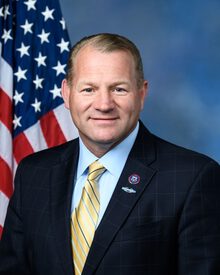
See how Troy E. Nehls actually votes — against your values.
DeepSyte scores Troy E. Nehls's record on the issues you care about — not party, not press releases. Take the 2-minute values quiz to see your personal alignment.
Sign in and take the values quiz to see how Troy E. Nehls's votes line up with your views.
Prediction track record
How often we called Troy E. Nehls's passage votes correctly, from their stated positions on each bill's tagged topics. Excludes “unclear” calls and abstentions.
Based on 1 data point across public statements and recorded votes · AI analysis of public records
118-hr-288·Notable gap
Separation of Powers Restoration Act of 2023
25/100
What they said
Mar 19, 2026
Rep. Nehls advocates for streamlining the FAA's aircraft type certification process for Advanced Air Mobility vehicles through H.R. 7553, arguing that the current five-to-nine-year process lacks transparency and predictability, hindering U.S. competitiveness against China while maintaining safety standards.
Rep. Nehls's statement advocates for streamlining FAA certification processes through transparent, predictable regulatory procedures that maintain safety standards. The Separation of Powers Restoration Act removes judicial deference to agency interpretations across all regulatory domains, which would fundamentally alter how courts review FAA decisions. His procedural 'no' vote is inconsistent with his stated position favoring a modernized but functional FAA certification framework; SOPRA would subject FAA expertise to de novo judicial review, undermining the agency's regulatory authority rather than reforming its internal processes as Nehls proposes.
Pairs with ambiguous language and high uncertainty are withheld until more data is available. Procedural, cloture, and amendment votes are excluded — they don't cleanly signal substantive support or opposition.
Pro analysis
AI rep analysis — Pro
Get an AI-narrated read on Troy E. Nehls's full voting record against your stated values — aligned themes, conflicts, notable votes, and what to watch for.
We haven't extracted campaign positions for Troy E. Nehls yet. Once their campaign website or position pages are processed, this card will track what they said vs how they voted.
Crossing the aisle
Passage votes where Troy E. Nehls broke ranks with ≥75% of Republicans. Threshold catches substantively partisan splits; unanimous-ish or close votes are excluded.
A bill to designate the facility of the United States Postal Service located at 180 Steuart Street in San Francisco, California, as the "Dianne Feinstein Post Office".
Reps. Nehls, Deluzio, and Sens. Coons and Hawley Introduce the Railroad Retirement Fairness Act
Position: The release advocates for eliminating a federal provision that reduces railroad retirement benefits for retirees and spouses who continue working for their pre-retirement non-railroad employer, arguing the current rule unfairly penalizes workers who wish to remain employed.
WASHINGTON, D.C. —Today, Congressman Troy E. Nehls (R-TX-22), Congressman Chris Deluzio (D-PA-17), alongside Senator Josh Hawley (R-MO) and Senator Chris Coons (D-DE), introduced the Railroad Retirement Fairness Act. This bipartisan, bicameral legislation would eliminate an outdated provision in federal law, which unfairly reduces railroad retirement payments for certain retirees and spouses who continue working in non-railroad jobs after retirement.
Under current law, railroad retirees and their spouses face a reduction in their retirement benefits if they continue working for their last prior non-railroad employer before retirement. That current rule can force retirees and spouses to leave jobs they want to keep or switch employers, simply to avoid losing benefits they earned.
“Retired railroad employees shouldn’t be penalized for continuing to work after their retirement to supplement their income or to stay active in their communities,” said Congressman Nehls. “I’m proud to join my colleagues in the House and Senate to eliminate the current provision that punishes hardworking railroad workers for continuing to work after their retirement, and ensure these men and women keep their rightfully earned retirement benefits.”
“People shouldn’t be locked out of their earned benefits if they want or need to keep working after retirement,” said Congressman Deluzio. “Unfortunately, that is what is happening now to thousands of American railroad workers. The Railroad Retirement Fairness Act is a bipartisan effort to level the playing field and make it so railroad retirees and their spouses can work non-railroad jobs without sacrificing their earned retirement benefits.”
“Railroad workers are losing out on their hard-earned retirement benefits due to outdated laws that penalize work,” said Senator Hawley. “Congress must act now to protect retirees and ensure they receive the pensions they were promised for their service to our nation’s rail system.”
“When I heard from Delawareans that their retirement benefits were being reduced simply because they or their spouses continued working after retiring from a long railroad career, I knew we had to do something in Washington,” said Senator Coons. “Too often our outdated systems are stacked against workers, that’s why I’m fighting for Delaware’s workers every day to make our economy fairer through bills like this one.”
The railroad retirement system provides benefits to rail employees through a two-tier structure. Tier I benefits are similar to Social Security, while Tier II benefits function like a private pension. Current law reduces some Tier II benefits based solely on whether a retiree or spouse continues working for the same non-railroad employer they had before retirement, even though a retiree who takes a different job after retiring would not face the same penalty.
The Railroad Retirement Fairness Act would:
Eliminate the arbitrary “last prior employer” deduction;
Allow railroad retirees and their spouses to continue working in non-railroad jobs without losing earned retirement benefits; and
Ensure more equal treatment for retirees regardless of where they choose to work in retirement.
This legislation is endorsed by the Transportation Trades Department (TTD) of the AFL-CIO,the Brotherhood of Maintenance of Way Employees Division (BMWED) of the Teamsters, the International Association of Machinists and Aerospace Workers (IAM), and the Transportation Communications Union (TCU).
“For far too long, outdated LPE rules have unfairly penalized railroad retirees who simply want to remain active, support their families, or contribute to their communities,” said IAM Union International President Brian Bryant. “The common-sense, bipartisan Railroad Retirement Fairness Act is about restoring dignity, fairness, and economic opportunity for retired railroad workers who have already earned their benefits.”
“LPE work restrictions punish railroad retirees for working, caring for family, or staying productive long after they’ve earned their benefits,” said IAM Rail Division member Dave Tackett. “The policy is outdated, inconsistent, and unfair, and it treats railroad workers worse than every other American retiree. It’s time to remove it. I want to thank our bipartisan, bicameral group of officials for championing the removal of this unfair deduction.”
“We are grateful to Senators Coons and Hawley as well as Congressmen DeLuzio and Nehls for introducing the Railroad Retirement Fairness Act to address this outdated policy,” said Josh Hartford, IAM Special Assistant to the International President for the IAM Rail Division. “Their work brings long overdue attention to an issue that affects retired railroad workers and their families. Their bipartisan effort represents an important step toward restoring fairness and modernizing the Railroad Retirement system.”
“Railroad retirees should not be discouraged from working or supporting their families after a lifetime of service,” said Transportation Communications Union (TCU/IAM) National President Matt Hollis. “Fixing the LPE rule is a long-overdue and commonsense step toward fairness and ensures these workers are treated with the same respect as every other American retiree.”
"As America's largest transportation labor federation, representing the entirety of rail labor, we are grateful to Senators Coons and Hawley as well as Congressmen DeLuzio and Nehls for introducing this common-sense legislation that will give railroad retirees the full value of their benefits,” said Greg Regan, President of the Transportation Trades Department, AFL-CIOD. "Railroaders and their spouses should not be penalized with benefits deductions simply for continuing to support their families after retirement. This legislation is long overdue, and puts hard-earned money back into the pockets of rail retirees."
Read the Railroad Retirement Fairness Act here.
Issues:Transportation And Infrastructure
House Passes Nehls’ Bill to Allow for Supersonic Flight Over the United States
Position: Congressman Nehls advocates for passage of the Supersonic Aviation Modernization Act, which would direct the FAA to revise regulations within one year to permit civil supersonic flight over the United States provided no sonic boom reaches the ground, arguing this removes outdated restrictions and positions the U.S. as a leader in aerospace innovation.
WASHINGTON, D.C. —Today, Congressman Troy E. Nehls (R-TX-22) announced that his bill, H.R. 3410, the Supersonic Aviation Modernization (SAM) Act, passed the United States House of Representatives.
“Today, the House passed my bill, which ensures the United States doesn’t fall behind our foreign adversaries in aviation innovation,” said Congressman Nehls. “For decades, FAA regulations have held back American innovation and supersonic flight. My legislation, the Supersonic Aviation Modernization Act, puts a stop to that and safely unleashes the next era of aerospace innovation. The Senate must act and swiftly pass my legislation to codify President Trump’s executive order and ensure the U.S. is the world’s leader in supersonic aviation.”
Background
Congressman Nehls and Senator Ted Budd (R-NC) introduced the SAM Act on May 14, 2025. This bipartisan, bicameral legislation directs the Federal Aviation Administration (FAA) to issue or revise regulations, within one year of enactment, to allow for the operation of civil aviation aircraft at speeds of Mach 1 or higher, so long as no sonic boom reaches the ground, maintaining the highest public safety standards while allowing innovation to move forward.
Enacted in 1973, 14 CFR § 91.817 dictates that no person may operate a civil aircraft in the United States at a speed of Mach 1 or higher, thereby prohibiting non-military-related supersonic flight over the United States. American companies have developed quiet supersonic technologies, and these companies have demonstrated that their aircraft can operate above Mach 1. Despite these innovations, 14 CFR § 91.817 continues to restrict supersonic operations.
The SAM Act, if enacted, would require the FAA to revise existing regulations to allow for the operation of supersonic civil aircraft. Operators would be permitted to fly their aircraft at supersonic speeds within the National Airspace System as long as no sonic boom reaches the ground.
On June 6, 2025, President Donald J. Trump signed an executive order entitled “Leading the World in Supersonic Flight,” which directs the FAA to lift the ban on supersonic flight by repealing outdated FAA regulations and establishing updated noise-based standards. The SAM Act, which codifies President Trump’s executive order, passed the House Transportation and Infrastructure Committee on December 18, 2025.
Rep. Troy E. Nehls in Flying Magazine: Clearing America’s Runway for the Future of Aviation
Position: Rep. Nehls advocates for streamlining the FAA's aircraft type certification process for Advanced Air Mobility vehicles through H.R. 7553, arguing that the current five-to-nine-year process lacks transparency and predictability, hindering U.S. competitiveness against China while maintaining safety standards.
WASHINGTON, D.C. —Congressman Troy E. Nehls (R-TX-22), Chairman of the House Aviation Subcommittee, penned an op-ed in FLYING magazine highlighting his bipartisan, bicameral legislation, H.R. 7553, the Aviation Innovation and Global Competitiveness Act. Congressman Nehls’ legislation would enhance transparency, predictability, and accountability during the Federal Aviation Administration (FAA) type certification process for Advanced Air Mobility (AAM) aircraft, helping American companies succeed and cement the United States' role as the global leader in aviation.
Read the op-ed HERE or below:
"The American aviation industry is at a crossroads. We can either choose to embrace the future and unleash American innovation, or we can maintain the status quo and allow other nations, including our foreign adversaries, to surpass us as the world’s leader in aviation.
Advanced air mobility (AAM) has the potential to redefine how we transport passengers and cargo in ways that traditional aviation cannot. While electric vertical takeoff and landing (eVTOL) powered-lift aircraft can reshape America’s aviation industry, not a single eVTOL aircraft has received full FAA type certification yet, despite many key industry leaders attempting to do so.
You might be wondering why.
The current FAA certification process for new AAM aircraft is a multiyear evaluation process that can take between five and nine years, with little transparency on the aircraft’s status in the process. The current process is hindering America’s ability to grow and potentially lead the world in advanced aviation. It’s long past time to bring this process into the 21st century to allow new aircraft to enter our skies safely and responsibly.
On the other hand, China has moved aggressively in the AAM sector, launching early commercial passenger services and achieving regulatory milestones that position it at the forefront of deployment. Companies like EHang have already conducted autonomous passenger flights and advanced toward commercial operations.
To the FAA’s credit, the U.S. has recently taken meaningful steps forward. The Department of Transportation and the FAA’s Electric Vertical Takeoff and Landing Integration Pilot Program (eIPP) represents a critical bridge between innovation and real-world deployment. By partnering with state and local governments, industry leaders, and communities, eIPP is doing what Washington often struggles to do: turning policy into practice.
While I am pleased with the rollout of eIPP, we must also clearly address the certification process that is jeopardizing America’s role as the world’s leader in aviation. Today’s certification process, while grounded in a vital commitment to safety, is not built for the speed or complexity of emerging technologies. For innovators, that uncertainty can be as challenging as the timeline itself. For the United States, it risks ceding leadership in a sector we helped create.
In order to ensure America remains the world’s gold standard in aviation, I’m championing the bipartisan Aviation Innovation and Global Competitiveness Act in the United States House of Representatives. My legislation would enhance transparency, predictability, and accountability during the FAA’s type certification process for AAM aircraft, helping American companies succeed and cement the United States’ role as the global leader in aviation.
The United States has always been a leader in flight and cutting-edge aviation technology, but we’re at risk of losing that edge. With global events like the 2026 FIFA World Cup and the 2028 Summer Olympics on the horizon, the world will be watching how the United States moves people at scale. We should be showcasing the future of flight and not be explaining why it’s still stuck in the certification process. The United States has always led the world in aviation. Not by chance, but by choice. We led because we were willing to innovate, to adapt, and build systems that matched the ambition of our engineers and entrepreneurs.
Now we face that choice again.
We can either clear the runway by modernizing the certification process, scaling integration through programs like eIPP and empowering American companies to lead, or we can remain grounded while others take flight."
Rep. Troy E. Nehls Introduces CODIS Access Modernization Act
Position: Rep. Nehls advocates for legislation that would allow privately-owned forensic DNA laboratories meeting federal quality standards to directly upload DNA profiles to the National DNA Index System (CODIS), eliminating current restrictions that require redundant reviews by public laboratories.
WASHINGTON, D.C. —Today, Congressman Troy E. Nehls (R-TX-22) introduced the CODIS Access Modernization Act, which would allow privately-owned and operated forensic evidence DNA testing laboratories to directly upload qualifying DNA profiles to the National DNA Index System (NDIS), so long as they meet certain requirements.
Currently, accredited private forensic DNA laboratories, meeting the same Federal Bureau of Investigation (FBI) Quality Assurance Standards and ISO/IEC 1025 requirements as public laboratories, are barred from directly uploading DNA profiles to the Combined DNA Index System (CODIS), resulting in redundant reviews that delay investigations and impose significant costs on public agencies.
“By limiting CODIS access to public laboratories, glaring national security and public safety bottlenecks have been created,” said Congressman Nehls. “My bill would grant CODIS access to eligible private laboratories and accelerate case resolutions, increase DNA matches and arrests, reduce the burden on public laboratories, and prevent additional offenses, resulting in getting more violent offenders off our streets and put behind bars.”
Supporting organizations of the CODIS Access Modernization Act include the International Homicide Investigators Association, National Center for Missing and Exploited Children, Federal Law Enforcement Officers Foundation, Southeastern Homicide Investigators Association, Miami-Dade County Association of Chiefs of Police, North Aurora Police, Pasco Police Department, Louisville Metro Police Department, Beverly Hills Police Department, Project Cold Case, Season of Justice, Joyful Heart Foundation, H-E-A-R-T (Hope Exists After Rape Trauma), Project Beloved, Not Just Me Foundation, Lavinia Masters, Bode Technology, DNA Labs International, Signature Science, Pure Gold Forensics, Serological Research Institute, DNA Solutions, and Forensic Analytical Crime Lab.
“A CODIS hit is a vital piece of information in a criminal investigation,” said Tracy Matheson, President and Founder of Project Beloved. “They may identify an unknown perpetrator or they may reveal the serial nature of a known perpetrator. It is absolutely essential that the CODIS hits are uploaded in a timely and efficient manner so that justice may be served. Giving private labs access to upload CODIS hits directly is a much needed step to streamline this process and protect future victims.”
“Justice delayed is justice denied. By leveraging the high-throughput workflows and innovative technologies of private labs, together we can expedite the identification of criminals before they strike again,” said Kameran Wong, Communications Director for the Forensic Criminal Justice Alliance. "I would like to thank Rep. Nehls for introducing this important legislation."
Read Congressman Nehls’ bill HERE.
Issues:CongressJudiciaryLaw Enforcement And Crime Updates
Rep. Troy E. Nehls’ Save Our Shrimpers Act Passes House Financial Services Committee
Position: Rep. Nehls advocates for legislation that would direct the U.S. to oppose international financial institution funding for foreign shrimp farming and operations, citing harm to American shrimpers from foreign market competition.
WASHINGTON, D.C. —Today, Congressman Troy E. Nehls (R-TX-22) announced his bill, H.R. 2071, the Save Our Shrimpers Act, passed the House Financial Services Committee.
“After pushing this America First legislation for nearly two years, I’m proud that my bill, the Save Our Shrimpers Act, passed the House Financial Services Committee,” said Congressman Nehls. “Shrimpers across the country, including shrimpers in my district, are struggling to stay afloat due to an excess of foreign shrimp flooding our markets. Sadly, our tax dollars have been used to bankroll foreign shrimp operations, which are driving American shrimpers out of business. My legislation directs the United States to oppose projects that use hardworking Americans' tax dollars to fund foreign shrimp farms and operations and puts American shrimpers first. Thank you to my colleagues on both sides of the aisle who supported my legislation.”
BACKGROUND
Congressman Nehls first introduced the Save Our Shrimpers Act in the 118th Congress. Congressman Nehls reintroduced this legislation in the 119th Congress on March 11, 2025. The bipartisan Save Our Shrimpers Act would require the Secretary of State to instruct the United States Executive Directors at International Financial Institutions (IFIs) to use their voice and always vote against any financial assistance by such institution to support shrimp farming, shrimp processing, or the export of shrimp in a foreign country.
In April 2025, for the first time in history, the U.S. voted against funding a shrimp aquaculture project at an IFI.
Rep. Troy E. Nehls and Congressman Seth Moulton Introduce Legislation to Enhance Rail Safety
Position: The release introduces bipartisan legislation to enhance railroad safety through mandatory enrollment in a confidential reporting system, improved hazardous materials information access for first responders, and funding for connectivity improvements in remote rail areas.
WASHINGTON, D.C. —Today, Congressman Troy E. Nehls (R-TX-22) and Congressman Seth Moulton (D-MA-06) introduced the Railroad Safety Enhancement Act of 2026. This legislation incorporates components of the Railway Safety Act of 2024, which was introduced by then Senator JD Vance (R-OH).
“As a member of the Railroads, Pipelines, and Hazardous Materials subcommittee, I am proud to work with Congressman Seth Moulton to introduce the Railroad Safety Enhancement Act of 2026,” said Congressman Nehls. "This bipartisan legislation enhances safety programs and modernizes critical protections to ensure our rail infrastructure operates safely and efficiently. I appreciate Congressman Moulton’s partnership on this bipartisan effort, and I look forward to working with my colleagues on both sides of the aisle to move this legislation forward.”
"Every community that a freight train passes through—such as East Palestine, Ohio—deserves to know that strong safety standards are in place, especially when hazardous materials are onboard,” said Congressman Moulton. “Our bipartisan legislation will strengthen inspections, improve emergency preparedness, and modernize safety requirements so that we can better protect families, workers, and communities across the country. This industry is the lifeblood of American commerce and a major source of jobs, but it can and must be better."
The Railroad Safety Enhancement Act of 2026 consists of:
C3RS Requirement:
Requires all Class 1 railroads and Amtrak to enroll in the Confidential Close Call Reporting System (“C3RS”) for two years.
This program is run by an independent third party, the National Aeronautics and Space Administration (NASA), and allows railroads and their employees to report close calls, unsafe incidents, and share information industry-wide on best practices without fear of reprisal from management. It also prevents the Federal Railroad Administration (FRA) enforcement for events reported.
ASKRAIL:
The ASKRAIL app is a mobile application used by first responders in collaboration with Class 1 railroads. It allows first responders to access accurate data about which hazardous materials a railcar is carrying so they can make informed decisions on how to respond to incidents. First responders must have accurate information about what they expect they will be fighting when reaching a scene.
Requires the State Department of Transportations’ eligible for specific grants to notify first responders in their state about the existence of the app and to certify to the FRA that they have completed this requirement. Because derailments often occur in remote and isolated areas, service for the application can be unreliable.
Creates the ASKRAIL Connectivity Pilot Program and authorizes $25 million per year. The pilot program creates a competitive bidding process to provide service in areas along the national rail network in most need of connectivity.
Railroad Crossing Elimination Grant Program:
Authorizes an additional $1 billion on top of the Infrastructure Investment and Jobs Act (IIJA) advanced appropriations funding.
According to the National Transportation Safety Board (NTSB), during Congressional Testimony, rail crossings are the most dangerous part of America’s rail network, in part because this is where our nation’s highway and rail systems meet. Removing as many rail crossings as possible will help reduce deaths and relieve congestion in the rail network.
Read the entire bill HERE.
Issues:CongressTransportation And Infrastructure
Rep. Troy E. Nehls Responds to President Trump’s State of the Union
WASHINGTON, D.C. —Congressman Troy E. Nehls (R-TX-22) issued the following statement after President Donald J. Trump’s State of the Union address:
“Tonight, President Trump clearly outlined the wins he and his administration, along with Republicans in Congress, have delivered for the American people,” said Congressman Nehls. "For nine consecutive months, zero illegal aliens have been released into our homeland, gas prices are at a four-year low, and this year, thanks to the Working Families Tax Cuts, average tax refunds are 11% higher, resulting in the largest tax refund season in history. Remarkably, violent crime and homicide rates have dropped to their lowest levels in at least 20 years. President Trump continues to deliver on the promises he made on the campaign trail.
“One thing is clear: The state of our union is stronger than ever before under the leadership of President Trump.”
Issues:Congress
Reps. Troy E. Nehls, Obernolte, Panetta, Carson, and Sens. Peter Welch, Budd, Luján, Curtis, Padilla, and Moran Introduce Bill to Streamline FAA Certification Process for AAM Aircraft
Position: The release advocates for streamlining the FAA's aircraft type certification process for Advanced Air Mobility (AAM) aircraft by improving transparency, predictability, and staffing capacity, while maintaining safety standards, to help U.S. companies compete globally.
WASHINGTON, D.C. —Congressman Troy E. Nehls (R-TX-22) joined by Congressman Jay Obernolte (R-CA-23), Congressman Jimmy Panetta (D-CA-19), Congressman André Carson (D-IN-07), Senator Peter Welch (D-VT), Senator Ted Budd (R-NC), Senator Ben Ray Luján (D-NM), Senator John Curtis (R-Utah), Senator Alex Padilla (D-CA), and Jerry Moran (R-KS) introduced the Aviation Innovation and Global Competitiveness Act, which would enhance transparency, predictability, and accountability during the Federal Aviation Administration (FAA) type certification process for Advanced Air Mobility (AAM) aircraft, helping American companies succeed and cement the United States' role as the global leader in aviation. Additionally, this bicameral, bipartisan legislation would support FAA staffing capacity and prevent gridlock in the certification process for AAM aircraft by providing more clarity and transparency for industry applicants.
The current FAA type certification process is a rigorous, multi-year evaluation that approves a new aircraft design and ensures it complies with airworthiness, noise, and safety standards. The amended type certifications typically take between 3 and 5 years to complete. In contrast, the certification of a new aircraft type, such as AAM aircraft, can take between 5 and 9 years, with little transparency on where they are in the process.
"Our current process for certifying new aircraft, specifically AAM aircraft, has caused America to fall behind as the leader in AAM aircraft development and production," said Congressman Nehls. "We cannot afford for our foreign adversaries, like China, to become the global leader in AAM. We must responsibly speed up the certification process for AAM so we can cement the United States' position as the world leader in aviation."
“The United States must remain the global leader in aviation innovation, and that means ensuring our regulatory framework keeps pace with emerging technologies,” said Congressman Obernolte. “The Aviation Innovation and Global Competitiveness Act modernizes the FAA’s certification process by improving transparency, predictability, and accountability while maintaining the highest safety standards so American companies can bring next generation aircraft to market more quickly and safely."
"America has always been a leader in flight and cutting-edge aviation technology, but we're at risk of losing that edge because of bureaucratic red tape," said Congressman Panetta. "The Aviation Innovation and Global Competitiveness Act fixes this by giving the FAA clear timelines, better staffing, and updated rules that can actually keep pace with these new technologies. We must clear the runway for American companies to innovate quickly and safely, keeping us ahead of the competition while never compromising on safety."
“I am deeply committed to advancing American aviation innovation to ensure safety, our global competitiveness, and grow America’s aviation workforce," said Congressman Carson. "I’m eager to work with Subcommittee Chairman Nehls and our Senate colleagues as we build on the strong bipartisan foundation in the 2024 FAA Reauthorization law. Our new bill directs the FAA to improve their work to support advanced air mobility, better engage with key stakeholders, and ultimately foster the development and safe deployment of new and novel aviation technologies in the U.S.”
“Building on generations of leadership in aviation, American companies are spearheading electric aircraft innovation," said Senator Welch. "That includes companies like Vermont’s Beta Technologies, which completed its historic, first-ever electric flight last year in South Burlington. Streamlining FAA certification processes and creating more transparency for emerging AAM companies like Beta is critical to chipping away at gridlock to keep up with our allies. I’m proud to join my colleagues on this bipartisan legislation that will bolster the United States’ storied legacy of global leadership in aviation—and support American and ingenuity and American jobs.”
“Innovative aircraft like eVTOLs promise to revolutionize America’s aviation system, but the certification process for new entrants to our airspace lacks clarity and efficiency, delaying next-generation advanced air mobility development," said Senator Budd. "I am pleased to join Rep. Nehls, Sen. Welch, and our colleagues to introduce legislation that will ensure the FAA prioritizes timely certification of novel aircraft, allowing manufacturers to focus their efforts on developing their groundbreaking technology, not bureaucratic hurdles.”
“American innovators are shaping the future of flight, and Congress must ensure our regulatory framework keeps pace with that innovation,” said Senator John Curtis. “This bipartisan bill brings greater clarity and accountability to the FAA certification process, helping Advanced Air Mobility companies compete, grow, and keep the United States at the forefront of the next generation of flight. I’m proud to work with my colleagues on this bipartisan effort to help American companies compete and succeed.”
Senator Cynthia Lummis (R-WY), Senator Tim Sheehy (R-MT), and Senator Todd Young (R-IN) are original cosponsors of the Senate version of Congressman Nehls' legislation.
Specifically, the Aviation Innovation and Global Competitiveness Act would:
-Streamline FAA certification review standards by directing the agency to set transparent and reliable timelines for consideration of type certification proposals, and to develop means of compliance for aircraft outside of the existing types of AAM aircraft.
-Update delegation guidance for type certification to cover new and novel technologies, including AAM aircraft.
-Direct the FAA to establish specific criteria to be used to support innovation in aviation and the development of new and novel technologies, and ensure continued U.S. global leadership in aviation.
-Direct the FAA to report to the relevant congressional committees on the status of implementing the certification regulations.
Supporting organizations of the Aviation Innovation and Global Competitiveness Act include the Aerospace Industries Association (AIA), Airports Council International-North America (ACI-NA), Archer Aviation, the Association for Uncrewed Vehicle Systems International (AUVSI), BETA Technologies, Boeing, the General Aviation Manufacturers Association (GAMA), the National Business Aviation Association (NBAA), Joby Aviation, Professional Aviation Safety Specialists, AFL, CIO (PASS), Vertical Aviation International (VIA), Wisk Aero, and the National Air Transportation Association (NATA).
"Wisk appreciates the bipartisan leadership of Chairman Nehls, Ranking Member Carson, Representative Obernolte, and Representative Panetta for introducing the Aviation Innovation and Global Competitiveness Act," said Cindy Comer, Wisk's Vice President of SMS, Certifications, & Quality. "This legislation is a vital step towards strengthening the certification process for modern aviation technologies and will provide the regulatory clarity needed to bring safe, autonomous, electric flight to communities across the country."
Rep. Troy E. Nehls Introduces the PROTECT Act of 2026
Position: Rep. Nehls introduced legislation to prohibit U.S. universities from selling intellectual property rights of research to hostile foreign governments, and to authorize the Department of Justice to seize funds received in such transactions.
WASHINGTON, D.C. —Congressman Troy E. Nehls (R-TX-22) introduced the Preventing Research Ownership Transfer to External Competitive Threats (PROTECT) Act of 2026, which would prohibit U.S. universities from selling the intellectual property (IP) rights of research conducted by the university, their staff, or students to the government of a hostile nation, like China, Russia, or Iran.
Currently, U.S. universities receive millions annually in gifts and contracts from foreign companies and governments. Among these foreign governments is China. Reporting revealed that some universities entered into contracts with foreign governments, namely the Chinese Communist Party (CCP), to sell the intellectual property rights of their research, directly jeopardizing U.S. national security. Evidence shows that much of the research provided to these foreign governments has focused on critical energy and weapons development. Certain universities are even under investigation for allegedly receiving funding from Chinese universities and the associated smuggling of biological material.
Congressman Nehls’ PROTECT Act of 2026 would establish civil penalties for U.S. universities who sell their intellectual property rights of research conducted by their institutions, staff, or students to the government of a hostile nation, and authorizes the U.S. Department of Justice (DOJ), in conjunction with the U.S. Department of State (DOS), to seize any funds a university receives in exchange for covered research from a university.
“Under no circumstance should U.S. universities be selling the intellectual property rights of their research to foreign, hostile nations,” said Congressman Nehls. “Our country’s universities should be focused on advancing American students’ education rather than jeopardizing the national security of the United States and spoon-feeding our adversaries a technological edge. My legislation ensures that U.S. universities aren't compromising the security of our nation by prohibiting them from selling the IP rights of their research to nations that hate us."
The PROTECT Act of 2026 is cosponsored by Congressman Brandon Gill (R-TX-26).
Read the bill text HERE.
Read the exclusive in The Daily Caller HERE.
Issues:CongressEducationNational Security
Rep. Troy E. Nehls Introduces Bill to Support Replacement, Rehabilitation, Preservation, Protection, and Construction of Bridges in States Across the U.S.
Position: Rep. Nehls introduced legislation to reform the federal bridge funding formula, shifting from a needs-based approach to one primarily based on total bridge deck area (75%) with a secondary focus on condition (25%), and repealing two climate-related IIJA provisions to give states greater flexibility in managing bridge assets.
WASHINGTON, D.C.— Today, Congressman Troy E. Nehls (R-TX-22) introduced the National Bridge Program Reform Act of 2026, which would distribute federal bridge infrastructure funds to states primarily based on total bridge deck area, with a focus on both overall infrastructure and bridges in poor condition.
The Infrastructure Investment and Jobs Act's (IIJA) Bridge Formula Program distributes funds to states based on their share of the nationwide bridge repair needs. Specifically, IIJA's Bridge Formula Program distributes funds to a state based on the state's total cost of replacing all bridges in poor condition and rehabilitating all bridges in fair condition, compared to the combined costs for all such bridges across every state in the country.
The proposed legislation would distribute funds to states based on total deck area so that states' Department of Transportation agencies can manage all bridge assets as needed. By repealing two climate-related provisions of the IIJA, Congressman Nehls' legislation would distribute funds to states based primarily on total bridge deck area (75 percent), with a focus on overall infrastructure and bridges in poor condition (25 percent).
Unlike IIJA, Congressman Nehls' new proposed formula would allow states across the United States to take proactive actions on bridges in good condition, as well as address those in fair and poor conditions, while also allowing states to prioritize more preservation and rehabilitation along high-traffic corridors, rural connectors, and aging infrastructure more flexibly.
"My legislation supports the replacement, rehabilitation, preservation, protection, and construction of bridges across our nation, " said Congressman Nehls. "By rewriting the formula, this reform creates fairness among states with a large number of bridges on Federal-aid highways, like Texas, and allows states to improve their overall infrastructure capacity."
Original cosponsors of the National Bridge Program Reform Act of 2026 include Congressman Randy Weber (R-TX-14), Congressman Roger Williams (R-TX-25), and Congressman Brandon Gill (R-TX-26).
This legislation is supported by the Texas Department of Transportation (TxDOT).
"TxDOT is grateful for Congressman Nehls' foresight in recognizing our state’s need of federal bridge funding," said Marc Williams, TxDOT Executive Director. "His introduction of the National Bridge Program Reform Act of 2026 will ensure Texas is fairly recognized for having the largest bridge deck area of any state and provide commensurate funding."
Read Congressman Nehls' legislation HERE.
Issues:Transportation And Infrastructure
Source: GDELT 2.0 GKG, filtered to a curated list of national outlets. Inclusion is not endorsement; opinion pieces and reported news are mixed.
Recent stock activity
Periodic transaction reports filed under the STOCK Act — disclosed by the rep, sourced from public filings.
No disclosed trades on record.
Source: open-data mirrors of the Senate eFD and House Clerk financial-disclosure systems. Disclosure within 30 days of trade is required by law (45 for spouse/dependent trades).
Top PAC donors · 2026 cycle
Political action committees that gave the most to this rep's principal campaign committee this cycle. PAC giving is direct organizational support — industry, ideological, or leadership.
1.TAKE BACK THE HOUSE 2022Leadership5 contributionsMember-of-Congress leadership PAC — supports Republican candidates aligned with the party's House agenda.AI$53,313
2.NATIONAL AUTOMOBILE DEALERS ASSOCIATION POLITICAL ACTION COMMITTEEBusiness5 contributionsTrade association PAC for new-car dealers — backs candidates supporting dealer franchise protections, vehicle sales regulations, and automotive retail interests.AI$25,000
3.TEXAS FARM BUREAU AGFUNDAgriculture5 contributionsAgricultural advocacy PAC affiliated with the Texas Farm Bureau — supports candidates backing farm-friendly policies, commodity protections, and rural economic interests.AI$24,000
4.TAKE BACK THE HOUSE TEXAS 2022Leadership2 contributionsLeadership or party-aligned PAC — supports Republican candidates in Texas House races and coordinates campaign funding.AI$21,819
5.HUCK PACLeadership3 contributionsMember-of-Congress leadership PAC — directs contributions to allied candidates, likely associated with a member using the nickname or surname Huck.AI$15,000
6.THE EYE OF THE TIGER POLITICAL ACTION COMMITTEEOther3 contributionsPAC with a motivational slogan name — specific policy positions and affiliations not inferable from the name alone.AI · low$15,000
7.PHILLIPS 66 PACEnergy3 contributionsEnergy company PAC for Phillips 66 — backs candidates supporting oil refining, petrochemicals, pipeline infrastructure, and energy independence policies.AI$15,000
8.ALLEGIANT TRAVEL COMPANY PAC2 contributions$13,000
9.HOUSE FREEDOM FUNDLeadership2 contributionsMember-of-Congress leadership PAC — supports conservative House candidates and Republican priorities aligned with fiscal and social conservative principles.AI$10,800
10.AMERICAN ISRAEL PUBLIC AFFAIRS COMMITTEE POLITICAL ACTION COMMITTEEIdeological2 contributionsPAC arm of the American Israel Public Affairs Committee, federalized in 2021. Backs candidates of both parties who support U.S.-Israel security and economic ties.AI$10,000
Source: OpenFEC (api.open.fec.gov) Schedule A receipts where contributor type is “committee.” Aggregated by contributing committee. Self-transfers from joint-fundraising / victory committees are excluded.
Top individual contributors · 2026 cycle
Itemized individual contributions over $200 to this rep's campaign committee, aggregated by donor employer. PAC giving is shown above; this section is people, not organizations.
1.LEIDOS$17,100
2.WINKLEVOSS CAPITAL MANAGEMENT$13,200
3.SPARROW GROUP$7,000
4.TOLUNAY-WONG$7,000
5.ORC THE BRAZOS$6,831
6.ESSC$5,165
7.TRAVIS KISNER$5,165
8.HIF GLOBAL$4,000
9.MADDOX INDUSTRIES$3,500
10.THE ORCHARD RECOVERY$3,500
Source: OpenFEC Schedule A receipts where contributor type is “individual,” aggregated by the donor's self-reported employer. This is a geographic / industry correlation, not a corporate endorsement.