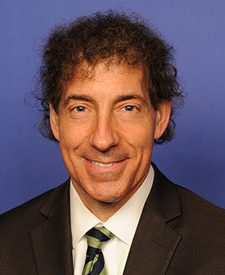
See how Jamie Raskin's votes line up with your values.
DeepSyte scores Jamie Raskin's record on the issues you care about — not party, not press releases. Take the 2-minute values quiz to see your personal alignment.
Sign in and take the values quiz to see how Jamie Raskin's votes line up with your views.
Prediction track record
How often we called Jamie Raskin's passage votes correctly, from their stated positions on each bill's tagged topics. Excludes “unclear” calls and abstentions.
36 predictions on record · none have been resolved by a passage vote yet. Check back as bills move.
Pending vote119-hr-5340
To prohibit the disclosure of records by the Secretary of Housing and Urban Development of individuals for the purposes of immigration enforcement, and for other purposes.
No paired statements and votes yet for Jamie Raskin
We haven't yet found statement/vote pairs on the same topic for Jamie Raskin. This usually means either the rep hasn't taken public positions on bills that have come to a passage vote, or those bills haven't been tagged yet. The checker runs as new press releases and votes come in.
Pro analysis
AI rep analysis — Pro
Get an AI-narrated read on Jamie Raskin's full voting record against your stated values — aligned themes, conflicts, notable votes, and what to watch for.
We haven't extracted campaign positions for Jamie Raskin yet. Once their campaign website or position pages are processed, this card will track what they said vs how they voted.
Crossing the aisle
Passage votes where Jamie Raskin broke ranks with ≥75% of Democrats. Threshold catches substantively partisan splits; unanimous-ish or close votes are excluded.
Raskin Introduces Legislation to Preserve and Document Trump Propaganda and Educate Future Generations on Resistance to Corruption and Authoritarianism
Position: Introduces legislation directing the Smithsonian Institution to collect and preserve artifacts related to governmental propaganda, corruption, and authoritarianism during the Trump presidencies for a permanent exhibition, and directing the National Park Service to remove signage placed near the National Museum of American History without congressional consent.
WASHINGTON, D.C.— As the Trump Administration prepares propaganda signage to adorn the Smithsonian's National Museum of American History, Representative Jamie Raskin (MD-08) introduced legislation to ensure future generations learn about President Donald Trump's commitment to censoring, whitewashing and fictionalizing American history. The Preserving and Remembering the History of Trump and other Tyrants Act directs officials from the Smithsonian Institution to collect and preserve artifacts reflecting the rise of governmental propaganda, corruption, and authoritarianism during the Trump presidencies as the basis for a permanent exhibition in the National Museum of American History.
Last month, the Department of the Interior—under orders from President Trump—created propaganda signage to place outside of the National Museum of American History, warning visitors of curators' "personal, radical ideologies." Preserving these signs will educate Americans on how authoritarians attempt to control media, government and culture.
"Unlike President Trump's project of censoring, whitewashing and fictionalizing American history, my legislation will forever preserve his manifestations of authoritarian narcissism and his propagandistic assault on American history and American democracy," said Rep. Raskin. "To avoid repeating this descent into authoritarianism, we must study this corrupt President's actions and allow the public to learn about the numerous tools he deployed while attempting to remake American history in his own image and according to his own autocratic and white nationalist beliefs."
The legislation directs officials from the Smithsonian Institution to preserve the banners bearing President Trump's face that are currently displayed outside of certain federal agencies; still images and videos from the media; personal narratives of American citizens who resisted and opposed the rise in authoritarianism in the United States; and other artifacts that the Secretary of the Smithsonian Institution determines to have historical significance. The legislation also directs officials from the National Park Service to remove any signage that was erected near the National Museum of American History without the consent of Congress.
Rep. Raskin has drawn on his expertise as an American constitutional scholar as he speaks out against the Trump Administration's authoritarian tactics. This month, he introduced a Resolution condemning President Trump and MAGA's campaign of book bans and censorship and advocating for the American freedom to read and think freely.
Read the full text of the legislation here.
Permalink: https://raskin.house.gov/2026/10/raskin-introduces-legislation-to-preserve-and-document-trump-propaganda-and-educate-future-generations-on-resistance-to-corruption-and-authoritarianism
Raskin and Schatz Fight Back Against MAGA Book Bans and Attacks on First Amendment Rights of the Free Press and of Citizens in Schools, Libraries and Museums
Position: The release announces a resolution condemning book bans in school libraries and federal and state censorship of books and materials at the Smithsonian and other public institutions, and affirms freedom to read, write, and learn under the First Amendment.
WASHINGTON, D.C.— Representative Jamie Raskin (MD-08) and Senator Brian Schatz (D-HI) introduced a resolution standing strong for the American freedom to read, write and learn. The lawmakers' resolution condemns MAGA's escalating campaign of book bans in school libraries and censorship targeting the Smithsonian Institution and other public museums, parks and facilities.
The lawmakers' resolution specifically cites book bans issued by the Trump Administration, MAGA state legislatures, local libraries and schools across America. This year, federal officials, at the direction of President Trump, censored books and educational materials at the Smithsonian Institution and Department of Defense Education Activity schools.
"The freedom to read, write and think independently are all rights enshrined in the First Amendment to our Constitution," said Rep. Raskin. "MAGA's book bans and censorship campaigns seek to control the freedom of thought in schools, libraries and government, but we are fighting back against this authoritarian assault on free expression and American democracy."
"Any attempt to ban books because someone has an ideological disagreement or doesn't believe in capturing the full scope of history is un-American," said Senator Schatz. "Freedom of expression is a founding principle of our country, and it's up to all of us to stand up against these attacks on this fundamental right."
More than 12,000 individual books were banned in America between July 2025 and June 2026, according to a report by PEN America. This includes books like "The Bluest Eye" by Toni Morrison and "MARCH" by former Congressman and Civil Rights Movement hero John Lewis, Andrew Aydin and Nate Powell.
PEN America's report captures the proliferation of MAGA book bans that specifically target books written by and about outsiders and individuals from marginalized backgrounds. Books with LGBTQ+ characters or themes face a disproportionate risk of being banned.
According to PEN America, from July 2025 to June 2026, 24 States across the country limited access to certain books, including—
The resolution is endorsed by PEN America and the American Library Association (ALA); Authors Against Banned Books; Banned Books Week Coalition; Center for American Progress; EdTrust; EveryLibrary; Freedom to Learn Foundation; Florida Freedom to Read Project; Freedom to Read Project; Hatchette Book Group; Interfaith Alliance; JCRC of Greater Washington; Jewish Community Relations Council of Portland; Jewish Council for Public Affairs; Jewish Federation of Greater Rochester; Lee & Low Books ; Let Utah Read; Macmillan Publishing; National Coalition Against Censorship; National Council for Jewish Women; National Council of Teachers of English; National Education Association; Penguin Random House; PFLAG National; Red Wine and Blue Education Fund; Simon & Schuster; Texas Freedom to Read Project; and the Tucson Jewish Museum & Holocaust Center.
The resolution is cosponsored in the House by Representatives Joyce Beatty (OH-03), Suzanne Bonamici (OR-01), Shontel Brown (OH-11), Julia Brownley (CA-26), Andre Carson (IN-07), Joaquin Castro (TX-20), Judy Chu (CA-28), Yvette Clarke (NY-09), Emmanuel Cleaver (MO-5), Jim Costa (CA-21), Jasmine Crockett (TX-30), Danny Davis (IL-07), Madeleine Dean (PA-04), Suzan DelBene (WA-01), Mark DeSaulnier (CA-10), Maxine Dexter (OR-03), Sarah Elfreth (MD-03), Veronica Escobar (TX-16), Adriano Espaillat (NY-13), Dwight Evans (PA-03), Valerie Foushee (NC-04), Maxwell Frost (FL-10), Robert Garcia (CA-42), Adelita Grijalva (AZ-07), Jahana Hayes (CT-05), Jared Huffman (CA-02), Glenn Ivey (MD-04), Jonathan Jackson (IL-01), Julie Johnson (TX-32), Hank Johnson (GA-04), Sydney Kamlager-Dove (CA-37), Tim Kennedy (NY-26), Raja Krishnamoorthi (IL-08), Summer Lee (PA-12), Teresa Leger Fernández (NM-03), Ted Lieu (CA-36), Stephen Lynch (MA-08), LaMonica McIver (NJ-10), Betty McCollum (MN-04), April McClain Delaney (MD-06), Grace Meng (NY-06), Kweisi Mfume (MD-07), Seth Moulton (MA-06), Kevin Mullin (CA-15), Eleanor Holmes Norton (DC), Scott Peters (CA-50), Brittany Pettersen (CO-07), Chellie Pingree (ME-01), Mark Pocan (WI-02), Delia Ramirez (IL-03), Andrea Salinas (OR-06), Mary Gay Scanlon (PA-05), Jan Schakowsky (IL-09), Melanie Stansbury (NM-01), Terri Sewell (AL-07), Lateefah Simon (CA-12), Mark Takano (CA-39), Shri Thanedar (MI-13), Rashida Tlaib (MI-12), Jill Tokuda (HI-02), Marc Veasey (TX-33), Bonnie Watson Coleman (NJ-12), Nikema Williams (GA-05) and Frederica Wilson (FL-24).
The resolution is cosponsored in the Senate by Senators Alex Padilla (D-CA), Jack Reed (D-RI), Chris Van Hollen (D-MD), Bernie Sanders (I-VT), Ron Wyden (D-OR), Angus King (I-ME), Jeff Merkley (D-OR), Mazie Hirono (D-HI), Angela Alsobrooks (D-MD), Dick Durbin (D-IL), Chris Murphy (D-CT), Cory Booker (D-NJ), Richard Blumenthal (D-CT), Ed Markey (D-MA), Sheldon Whitehouse (D-RI), Raphael Warnock (D-GA), John Fetterman (D-PA) and Ben Ray Luján (D-NM).
Read the full text of the resolution here.
Permalink: https://raskin.house.gov/2026/10/raskin-and-schatz-fight-back-against-maga-book-bans-and-attacks-on-first-amendment-rights-of-the-free-press-and-of-citizens-in-schools-libraries-and-museums
Ahead of U.S.-China Summit, Raskin, Meeks, McGovern Urge Trump to Condemn CCP Law Designed to Repress Religious Minorities and Attack Critics Around the World
Position: The lawmakers urge the President to publicly oppose China's Ethnic Unity and Progress Law, which they say enables prosecution of ethnic and religious minorities and overseas dissidents, and to press this concern during the U.S.-China summit.
WASHINGTON, D.C.—Today, Representative Jamie Raskin (MD-08), House Foreign Affairs Committee Ranking Member Gregory Meeks (NY-05) and Representative Jim McGovern (MA-02) called on President Donald Trump to express the United States' opposition to China's sweeping new law to repress ethnic minorities and silence critics around the world, including U.S. citizens, during his meetings with President Xi Jinping at this week's U.S-China summit. The Ethnic Unity and Progress Law grants Chinese officials broad authority to prosecute transnational dissidents as well as Tibetans, Uyghurs and other ethnic and religious minority groups that it classifies as detrimental to "national unity and Communist Party ideology."
Xi's visit to the U.S. is scheduled to begin on September 24. The State Department has previously expressed opposition to China's Ethnic Unity and Progress Law.
"During your meeting with Xi Jinping, it is imperative that you continue to voice your administration's disapproval of this affront to the fundamental freedoms of minority communities, human rights advocates and U.S. citizens," the lawmakers wrote to President Trump.
Enacted in March, the Ethnic Unity and Progress Law furthers the Chinese government's efforts to systematically persecute ethnic and religious minorities and attack critics under the guise of protecting 'social harmony.'
The law allows China to target dissidents around the world, including U.S. citizens living outside of China. In recent years, China has sought to silence pro-democracy voices through monetary bounties on Hong Kong advocates, cyberhacking campaigns and other intimidation tactics. Absent a repeal of the Ethnic Unity and Progress Law, the use of such tactics will only become more frequent.
"We greatly appreciated the State Department's earlier statement expressing concerns about the Ethnic Unity and Progress Law," the lawmakers continued. "A president's personal advocacy, however, has unparalleled power to elicit meaningful change."
The lawmakers specifically cited the case of Min Zin, a U.S. citizen detained in June while visiting China for an academic conference, to illustrate the government's repressive practices. Min was an active voice for democracy in Southeast Asia. He remains in Chinese custody.
The Chinese government has a long and troubling history of subordinating and forcefully assimilating religious and ethnic groups that it deems a threat to state security. As the lawmakers noted, Chinese authorities have sought "to destroy the shrines of Uyghur Muslims, remove Tibetan Buddhist statues from monasteries, censor the holy texts read in Christian churches and otherwise purge houses of worship…"
Raskin, Meeks and McGovern are among the most vocal advocates in Congress for human rights around the world. They have sought and obtained the release numerous of prisoners of conscience, including through the Tom Lantos Commission's Defending Freedoms Project, an effort to bring attention to international human rights abuses. Tibetan writer Kunchok Tsephel and Vietnamese climate activist Dang Dinh Bach—two political prisoners sponsored by Raskin—were later released from prison.
The letter is also signed by Speaker Emerita Nancy Pelosi (CA-11) and Representatives Jake Auchincloss (MA-04), Ami Bera (CA-06), André Carson (IN-07), Kathy Castor (FL-14), Steve Cohen (TN-09), Jasmine Crockett (TX-30), Madeleine Dean (PA-04), Mark DeSaulnier (CA-10), Lloyd Doggett (TX-10), Veronica Escobar (TX-16), Sylvia Garcia (TX-29), Al Green (TX-09), Pramila Jayapal (WA-07), Sydney Kamlager-Dove (CA-37), Ro Khanna (CA-17), Raja Krishnamoorthi (IL-08), George Latimer (NY-16), Stephen Lynch (MA-08), Grace Meng (NY-06), Jerry Nadler (NY-12), Richard Neal (MA-01), Eleanor Norton (DC-AL), Ilhan Omar (MN-05), Mark Pocan (WI-02), Jan Schakowsky (IL-09), Brad Schneider (IL-10), Brad Sherman (CA-32), Tom Suozzi (NY-03), Shri Thanedar (MI-13), Dina Titus (NV-01), James Walkinshaw (VA-11) , Debbie Wasserman Schultz (FL-25) and Maxine Waters (CA-43).
The letter is endorsed by the International Campaign for Tibet, Uyghur Human Rights Project and Committee for Freedom in Hong Kong Foundation.
Read the full letter here and below.
As you engage with President Xi Jinping this month, we urge you to express profound opposition to the Ethnic Unity and Progress Law recently implemented by the Chinese government.
This law grants Chinese authorities sweeping authority to prosecute Tibetans, Uyghurs and other ethnic and religious minority groups that it broadly accuses of undermining national unity and Communist Party ideology.
Moreover, the extraterritorial scope of the law means that it will dramatically accelerate China's transnational repression of critics living in the U.S. The State Department has itself recognized these ramifications in a statement calling the Ethnic Unity and Progress Law "problematic." During your meeting with Xi Jinping, it is imperative that you continue to voice your administration's disapproval of this affront to the fundamental freedoms of minority communities, human rights advocates and U.S. citizens.
Enacted under the guise of promoting "social harmony" on March 12, 2026, the Ethnic Unity and Progress Law is in fact an insidious declaration of China's intent to further repress religious freedom and the freedom of group association. One of the most troubling provisions of the law would require religious activities to undergo "Sinicization," a process championed by Xi Jinping and used in reference to the complete subordination and assimilation of religious and ethnic groups to the political ideology of the Chinese Communist Party (CCP). Well before the Ethnic Unity and Progress Law came into effect on July 1, 2026, China had already embarked upon a concerted campaign to destroy the shrines of Uyghur Muslims, remove Tibetan Buddhist statues from monasteries, censor the holy texts read in Christian churches and otherwise purge houses of worship in the name of "Sinicization." With the additional legal cover provided by their new law, Chinese authorities are escalating their systemic persecution of minority faith communities.
Elsewhere in the text of the law, the Chinese government asserts the alarming power to extend its repressive tactics into U.S. borders and against U.S. citizens. Article 63 plainly states that organizations and individuals outside China will be held legally accountable for activities that China deems are undertaken in opposition to national unity and progress. In codifying this language, China thus purports to exercise jurisdiction over people who are neither Chinese citizens nor residents of the country and who are merely exercising their freedom of expression. For dissidents who fled China in pursuit of the rights and freedoms we enjoy in America, the clause amounts to a promise that they will continue to be pursued by an oppressive state adamant about suppressing their speech and beliefs.
To grasp the consequences of such a promise, one need only examine the tactics China has increasingly deployed against its U.S.-based critics, including U.S. citizens. In the last couple of years alone, the federal government determined conclusively that Chinese officials intimidated student activists who spoke out against its rule, imposed monetary bounties on Hong Kong activists, launched a cyber-hacking campaign targeting dissidents and employed other sophisticated strategies to silence pro-democracy voices in the U.S. Just this summer, Chinese authorities detained Min Zin, a U.S. citizen and doctoral candidate, upon his arrival in the country for an academic conference. Today, Min Zin, who actively promoted democratization in Southeast Asia, remains in Chinese custody. Absent robust efforts to contest the Ethnic Unity and Progress Law, he will be just one of many more targeted U.S. citizens.
Min Zin's story, along with the broader trends indicating an intensification of China's crackdown on religious minorities and dissent abroad, should serve as a warning to us all. If left in place, the Ethnic Unity and Progress Law will expedite ongoing transnational repression, religiously motivated and identity-based persecution and other anti-democratic maneuvers of the Chinese government. In fact, emerging evidence suggests that China has actively begun to leverage the measure against the communities it has historically sought to marginalize. Uyghur-language signs are reportedly being removed from city streets, and during a recent tour of Tibet, a top CCP leader pressed authorities to "adapt" Tibetan Buddhism in accordance with the Ethnic Unity and Progress Law.
We greatly appreciated the State Department's earlier statement expressing concerns about the Ethnic Unity and Progress Law. However, a president's personal advocacy has unparalleled power to elicit meaningful change. During your upcoming meeting with Xi Jinping, we therefore urge you to ask for the repeal of the Ethnic Unity and Progress Law.
At stake are our national security, sovereignty and basic human rights all over the world.
Permalink: https://raskin.house.gov/2026/9/ahead-of-u-s-china-summit-raskin-meeks-mcgovern-urge-trump-to-condemn-ccp-law-designed-to-repress-religious-minorities-and-attack-critics-around-the-world
Raskin, Panetta, McGovern Proposal Providing Tax Relief for Scam, Disaster Victims Passes House
Position: The release announces that a bill providing tax relief for scam and disaster victims, sponsored by Representatives Raskin, Panetta, and McGovern, has passed the House.
Raskin, Beyer, DeGette Led 68 Colleagues Demanding AHRQ Reverse Cancellation of More Than $200 Million in Health Care Research Grants
Position: Representatives Raskin, Beyer, and DeGette and 68 House Democrats urge the Agency for Healthcare Research and Quality to withdraw its cancellation of more than 150 health care research grants, restore funding, and provide Congress with a list of affected awards and grant-specific information. The lawmakers argue the cancellations may be an illegal impoundment of appropriated funds and may not comply with federal termination regulations.
WASHINGTON, D.C.– Representatives Jamie Raskin (MD-08), Don Beyer (D-VA) and Diana DeGette (D-CO) led 68 House Democrats in demanding that the Agency for Healthcare Research and Quality (AHRQ) immediately reverse the cancellation of more than 150 grants supporting over $200 million in critical health care research. Among the research projects affected by the cancellations are efforts to integrate behavioral health services into routine pediatric care; use telehealth to expand access to care and reduce costs, including in rural communities; improve postpartum care for patients with chronic medical conditions; and reduce the overuse of antibiotics following hospital discharge to combat antimicrobial resistance.
In a letter to AHRQ Director Roger Klein, the lawmakers noted that Congress provided AHRQ with $345.38 million in funding as part of the Fiscal Year 2026 Consolidated Appropriations Act, reflecting bipartisan support for the agency's work to improve health care access, affordability, and quality. The lawmakers warned that the mass cancellation of grants may constitute an illegal impoundment of Congressionally authorized and appropriated funding and raised concerns that the agency failed to follow federal regulations governing the termination of awards.
"Given the disastrous impact of these notices, the potential procedural defects in issuing them, and our concerns surrounding AHRQ's use of Congressionally-appropriated funds, we ask that you immediately withdraw these notices and fully fund the grantees that have waited for committed funds for over a year," the lawmakers wrote. "Additionally, we ask that you provide Congress with a comprehensive list of all awards for which notices referenced above have been issued and, for each of the canceled grants, list grant-specific information regarding the grantee's progress, management practices, and other factors considered before issuing the notice."
The letter is also signed by Representatives Jake Auchincloss (MA-4), Nanette Barragán (CA-44), Joyce Beatty (OH-03), Wesley Bell (MO-01), Suzanne Bonamici (OR-01), Julia Brownley (CA-26), Troy Carter (LA-02), Kathy Castor (FL-14), Yvette Clarke (NY-09), Steve Cohen (TN-09), Herb Conaway (NJ-03), Angie Craig (MN-02), Jasmine Crockett (TX-30), Jacon Crow (CO-06), Danny Davis (IL-07), Madeleine Dean (PA-04), Suzan DelBene (WA-01), Chris Deluzio (PA-17), Mark DeSaulnier (CA-10), Maxine Dexter (OR-03), Debbie Dingell (MI-06), Dwight Evans (PA-03), Maxwell Frost (FL-10), John Garamendi (CA-08), Jesús "Chuy" García (IL-04), Dan Goldman (NY-10), Maggie Goodlander (NH-02), Josh Gottheimer (NJ-05), Adelita Grijalva (AZ-07), Van Hoyle (OR-04), Jonathan Jackson (IL-01), Hank Johnson (GA-04), Robin Kelly (IL-02), Raja Krishnamoorthi (IL-08), Greg Landsman (OH-01), Summer Lee (PA-12), Ted Lieu (CA-36), Stephen Lynch (MA-08), John Mannion (NY-22), Doris Matsui (CA-07), April McClain Delaney (MD-06), LaMonica McIver (NJ-10), Grace Meng (NY-06), Gwen Moore (WI-04), Kelly Morrison (MN-03), Seth Moulton (MA-06), Kevin Mullin (CA-15), Jerry Nadler (NJ-12), Richard Neal (MA-01), Brittany Pettersen (CO-07), Mike Quigley (IL-05), Delia Ramirez (IL-03), Andrea Salinas (OR-06), Mary Gay Scanlon (PA-05), Kim Schrier (WA-08), Terri Sewell (AL-07), Lateefah Simon (CA-12), Haley Stevens (MI-11), Tom Suozzi (NY-03), Mark Takano (CA-39), Bennie Thompson (MS-02), Dina Titus (NV-01), Rashida Tlaib (MI-12), Ritchie Torres (NY-15), James Walkinshaw (VA-11), Bonnie Watson Coleman (NJ-12), Frederica Wilson (FL-24) and Congresswoman Eleanor Holmes Norton (DC-AL).
Full text of the letter follows below, and a signed copy is available here.
We write to request the Agency for Healthcare Research and Quality (AHRQ) Grants Management Office immediately reverse the mass cancellation of grants issued July 15, 2026. AHRQ has a statutory responsibility to support research to improve the quality and effectiveness of health services for the American people. The cancellation of more than 150 meritorious grants violates this duty and is likely an illegal impoundment of Congressionally-authorized and appropriated funds. The Grants Management Office also failed to follow federal regulations governing the termination of awards. We urge you to realign your Agency with federal law and the best interests of the American people and reverse these grant cancellations.
On July 15, 2026, AHRQ reportedly sent an estimated 150 cancellation notices to grant recipients. This action is expected to eliminate more than $200 million in lifesaving healthcare research that AHRQ funds as the lead federal agency directing studies into delivering care efficiently, effectively, and safely. At a time when the United States spends $5.3 trillion on healthcare annually, accounting for 18% of national gross domestic product, it is shocking that AHRQ would choose to end its support of that critical research.
Congress consistently authorizes and appropriates federal dollars to AHRQ, and most recently received $345.38 million in the FY26 Consolidated Appropriations Act, demonstrating bipartisan support for improving healthcare access, affordability, and quality, including in areas of priority for AHRQ like rural healthcare, artificial intelligence, and the prevention of healthcare associated infections. Examples of canceled research grants include programs to:
The above list is a small sample of the myriad topics addressed through canceled AHRQ grants that would improve healthcare quality, safety, and cost for the American people.
Withholding federal dollars from grant recipients across nearly 30 states without seeking Congressional approval under the Impoundment Control Act of 1974 is likely illegal and continues what is now a multi-year violation of federal law. The cancellation notices issued on July 15 fail to meet basic standards for grant cancellation notices. The notices cite 42 C.F.R. § 67.17(d) and 42 C.F.R. § 67.17(e), styling the notices as "non-awards" of future funding, rather than cancellations of ongoing research. However, the notices then assign recipients specific obligations under 2 C.F.R. § 200.344, which only applies when grants are canceled. The authorities to cancel ongoing grants provided under 42 C.F.R. § 67.17 require that specific factors are taken into account to cancel individual awards, including "the grantee's progress and management practices and the availability of funds." Applying blanket language across up to 150 grants covering more than $200 million in awards is not consistent with careful consideration of individual grantees' progress or performance.
Given the disastrous impact of these notices, the potential procedural defects in issuing them, and our concerns surrounding AHRQ's use of Congressionally-appropriated funds, we ask that you immediately withdraw these notices and fully fund the grantees that have waited for committed funds for over a year. Additionally, we ask that you provide Congress with a comprehensive list of all awards for which notices referenced above have been issued and, for each of the canceled grants, list grant-specific information regarding the grantee's progress, management practices, and other factors considered before issuing the notice. We request an update on AHRQ's plans to withdraw these notices, as well as the full list of requested grantee information, no later than August 21, 2026.
Permalink: https://raskin.house.gov/2026/8/raskin-beyer-degette-led-68-colleagues-demanding-ahrq-reverse-cancellation-of-more-than-200-million-in-health-care-research-grants
Raskin, DeLauro, Casten, Jacobs and 111 Colleagues Demand Netanyahu Remove Barbed-Wire Fence Blocking Students’ Path from West Bank Village Umm Al-Kheir to School
Position: Members of Congress urge Israeli Prime Minister Netanyahu to remove a barbed-wire fence that blocks students' access from the West Bank village of Umm Al-Kheir to their school.
Raskin, Beyer, Norton, Ivey Oppose Trump Administration’s Rushed “Redevelopment” of Historic East Potomac Park
Position: The lawmakers oppose the administration's rushed redevelopment of East Potomac Park and call for disclosure of costs, effects on bike and walking paths, golf course pricing, and financing, as well as compliance with environmental and historic preservation laws and public consultation.
WASHINGTON, D.C. — Today, Representatives Jamie Raskin (MD-08), Eleanor Holmes Norton (DC-AL), Don Beyer (VA-08) and Glenn Ivey (MD-04), along with 43 of their colleagues, demanded transparency about the Trump Administration's new vanity project, the proposed redevelopment of East Potomac Park designed by President Trump's handpicked architect, Tom Fazio. The letter, written to Secretary of the Interior Doug Burgum and Acting Director of the National Park Service Jessica Bowron, called on the Administration to preserve the park's historical features and affordability.
In this latest letter, the lawmakers are demanding the administration disclose the cost of the golf course's redevelopment and how any changes would affect bike and walking paths. They also demanded the administration comply with historic preservation laws and disclose how the golf course's pricing may change.
"We write with strong objections to your rushed 'redevelopment' of East Potomac Park, as well as the lack of clear public communication as to the changes planned for a beloved historic and recreation site," the lawmakers wrote. "Any significant construction… requires compliance with bedrock environmental and historic preservation laws, robust public consultation and review, and protection of the existing uses of the site."
East Potomac Park, which includes East Potomac Golf Links, lies on federal land in Washington, D.C. The existing golf courses are well-used and popular, and hosted 130,000 rounds of golf in 2025. The courses are known for both their affordability—a tee time costs as little as $17—and their rich history and accessibility for players of all skill levels. In addition to the golf courses, East Potomac Park is also a beloved recreation site for thousands of residents in D.C., Maryland and Virginia who use the park's biking and walking paths and picnic on scenic Hains Point. In the spring, the park hosts visitors who travel to see D.C.'s oldest stand of cherry blossoms.
The courses became a core part of the nation's civil rights history in 1941 when three Black golf players insisted on playing a round of golf, making East Potomac Golf Links one of the first desegregated public golf courses in the country.
In addition to public access considerations, the lawmakers raised transparency concerns surrounding the redevelopment project's financing.
"A private entity called the National Garden of American Heroes Foundation has sent brochures of the redesign to prospective donors and advertised the option for these donors to remain anonymous," the lawmakers wrote. "The only information available about this shadowy foundation is that interested donors can contact President Trump's 2024 presidential campaign finance director if they have any questions."
The lawmakers first sounded the alarm on threats to East Potomac Park in response to the 35,000 cubic yards of toxic debris that the Trump Administration dumped on the golf courses following the illegal demolition of the White House's East Wing. The proposed East Potomac Park redevelopment follows the Trump Administration's pattern of unauthorized demolition and construction projects. Following the personal involvement of President Trump, the Administration has defaced other cultural and recreational spaces in the Nation's Capital, including the East Wing of the White House, the Kennedy Center and the Lincoln Memorial Reflecting Pool.
The letter is also signed by Reps. Yassamin Ansari (AZ-03), Joyce Beatty (OH-03), André Carson (IN-07), Sean Casten (IL-06), Emanuel Cleaver (MO-05), Steve Cohen (TN-09), Jasmine Crockett (TX-30), Danny Davis (IL-07), Lloyd Doggett (TX-37), Sarah Elfreth (MD-03), Veronica Escobar (TX-16), Dwight Evans (PA-03), John Garamendi (CA-08), Jesús "Chuy" García (IL-04), Robert Garcia (CA-42), Sylvia Garcia (TX-29), Adelita Grijalva (AZ-07), Steny Hoyer (MD-05), Jared Huffman (CA-02), Jonathan Jackson (IL-01), Pramila Jayapal (WA-07), Henry "Hank" Johnson (GA-04), Raja Krishnamoorthi (IL-08), Zoe Lofgren (CA-18), Stephen Lynch (MA-08), April McClain Delaney (MD-06), Betty McCollum (MN-04), James McGovern (MA-02), Kweisi Mfume (MD-07), Dave Min (CA-04), Jerry Nadler (NY-17), Johnny Olszewski (MD-02), Chellie Pingree (ME-01), Emily Randall (WA-06), Mary Gay Scanlon (PA-05), Robert "Bobby" Scott (VA-03), Mark Takano (CA-39), Shri Thanedar (MI-13), Bennie Thompson (MI-02), Paul Tonko (NY-20), Nydia Velázquez (NY-07), James Walkinshaw (VA-11) and Bonnie Watson Coleman (NJ-12).
Read the full text of the letter here and below:
Dear Secretary Burgum and Acting Director Bowron:
We write with strong objections to your rushed "redevelopment" of East Potomac Park, as well as the lack of clear public communication as to the changes planned for a beloved historic and recreation site. Any significant construction at East Potomac Park, which was expressly created by Congress in 1897 to be "forever held and used as a park for the recreation and pleasure of the people," requires compliance with bedrock environmental and historic preservation laws, robust public consultation and review, and protection of the existing uses of the site. Removing or diminishing any of those uses, including the existing affordable public golf course, the biking and running trails around the course, and the historic grove of cherry trees along Hains Point, is unacceptable and potentially illegal. We urge you to immediately abandon those efforts and protect this essential site for generations present and future.
East Potomac Golf Links has been an indispensable public asset since 1921. The National Park Service (NPS) responded to popular demand that year to create one of the country's first public golf courses. The three courses—Red, White and Blue—were designed or inspired by the designs of Walter Travis, who rejected Victorian-style designs favored by the rich and powerful to create links-style courses that all players could enjoy. The courses opened with rounds of golf priced at just 25 cents. This legacy of inclusive pricing continues to this day. Visitors can book a child's tee time for just $9 and enjoy a hamburger at the Potomac Grille for under $10—an enjoyable afternoon that won't break the bank. The courses became a core part of our national civil rights history in 1941 when three Black golf players insisted on playing a round of golf, making East Potomac Golf Links one of the first desegregated golf courses in the country. For 85 years, residents of all backgrounds in the District of Columbia and the surrounding area have enjoyed the golf course and the biking and running trails that surround it.
This all changed on August 1, 2025, when you met with President Trump to discuss destroying the Red, White, and Blue courses and replacing them with a single "championship- style" layout designed to host professional tournaments. This recently released "Washington National Plan," credited to Tom Fazio—who has previously designed golf courses for President Trump—would be a wholesale redevelopment of a property that has been on the National Register of Historic Places since 1973. To make this design a reality, the existing 36 holes, split across the Red, White and Blue courses, would need to be destroyed, trees would be cut down, and an entirely new clubhouse would likely be constructed. All of this would yield just one large course, an 18-hole course designed for professionals, and one 9-hole pitch and putt course, leaving little room for the cycling, running and picnicking activities that are equally important to the park's character.
On June 28, this already expansive redesign became catastrophic when President Trump toured East Potomac Golf Links and examined new renderings of a far more expansive redesign proposal than what you disclosed on social media. If the high-resolution photos of the plan clutched by the President during the tour reflect the Administration's real intentions, the redesign would create just one 18-hole course for professionals, provide no 9-hole pitch and putt course, and completely eliminate Hains Point and the walking and biking trails surrounding the park. The Administration has not publicly released cost projections for this massive undertaking. The limited information shared about public access after the redesign includes estimates that the weekend price for local golfers could nearly double as a result of this complete transformation, even as the number of available courses to play on is cut by a third. This undermines the longstanding principles of affordability and public access which have driven East Potomac Golf Links since its founding.
While the courses are certainly in need of significant maintenance and repair following decades of underinvestment, this work must be accomplished in compliance with the law and with respect for the historic nature of this beloved public resource. NPS itself has performed a Cultural Landscape Report on East Potomac Golf Links, determining in 2019 that the Red, White and Blue courses are "essential" to the "design integrity at East Potomac" and that the historic design reflects "an egalitarian institution within the city of Washington, D.C., as originally intended." Furthermore, the biking and running trails circumnavigating East Potomac Park—in addition to providing crucial public access to the waterfront—are core components of the park. Hains Point is a beloved and scenic picnic area that is also critical to residents and visitors alike, who come each spring to enjoy Washington, D.C.'s cherry blossom season.
To raise funds for the Washington National Plan, a private entity called the National Garden of American Heroes Foundation has sent brochures of the redesign to prospective donors and advertised the option for these donors to remain anonymous. The only information available about this shadowy foundation is that interested donors can contact President Trump's 2024 presidential campaign finance director if they have any questions. We have seen this hollow promise before. Previous construction efforts that President Trump has touted as privately funded have both ballooned in cost and in fact been paid for by taxpayers.
Section 106 of the National Historic Preservation Act (NHPA) requires federal agencies to assess the effects of any proposed project on "historic federal properties." It also requires federal agencies to publicly release development plans of this level of significance and incorporate sufficient time for public comment. Instead of engaging with the public about this design as required by law, the Administration began setting plans in motion to close the existing golf courses and clear stands of trees within them in May 2026. The trees have only been spared and the course only remains open due to pending litigation.
To learn more about your plans to redevelop the park, and how you will address our concerns about the redevelopment and its negative impact on multi-purpose recreation access, we request written answers to the following questions by no later than August 14, 2026:
What is the cost of redeveloping East Potomac Golf Links?
Will the beloved and heavily-used walking and biking paths and lanes through the Park be preserved? If so, will any changes be made to those paths and lanes?
Will the similarly beloved and heavily-visited cherry trees within the Park be preserved? If so, are there anticipated impacts on health or access to those trees?
How much more will it cost for the public to play golf at East Potomac Golf Links under the "Washington National Plan"? The similar courses that you have cited as cost models in your redesign proposal feature prices that are as much as double the current East Potomac Golf Links prices. What justifies this increase?
What is the relationship between the National Garden of American Heroes Foundation and members of the Trump Administration and specifically President Trump?
What are the Department's plans to assess project compliance under Section 106 of the National Historic Preservation Act for the wholesale redevelopment of East Potomac Golf Links?
We appreciate your consideration and look forward to your prompt response.
Permalink: https://raskin.house.gov/2026/7/raskin-beyer-norton-ivey-oppose-trump-administration-s-rushed-redevelopment-of-historic-east-potomac-park
Raskin, Bacon, Dexter Celebrate House Passage of Bipartisan Legislation Protecting Pension Payments for NOAA Corps, U.S. Public Health Service Commissioned Corps
Position: The release supports legislation (the Pensions for Retired Uniformed Servicemembers Act) that would ensure retired NOAA and USPHS Commissioned Corps officers continue receiving pension payments during a government shutdown, on parity with other federal retirees. It celebrates the bill's House passage and calls for Senate passage.
WASHINGTON, D.C. – Representatives Jamie Raskin (MD-08), Don Bacon (NE-02) and Maxine Dexter (OR-03) celebrated the House passage of their bipartisan legislation safeguarding pension payments for an estimated 8,000 retired uniformed servicemembers.
The Pensions for Retired Uniformed Servicemembers Act would secure parity between retired members of the National Oceanic and Atmospheric Administration (NOAA) Commissioned Officer Corps and the U.S. Public Health Service (USPHS) Commissioned Corps and all other federal retirees, ensuring they continue receiving pension payments during a government shutdown. The bill's passage was also supported by Representatives Don Davis (NC-01), Nick LaLota (NY-01) and August Pfluger (TX-11).
"A government shutdown shouldn't prevent retired NOAA and USPHS officers from paying rent or putting food on the table," said Rep. Raskin. "Our bipartisan bill honors their years of public service defending the health and safety of our people. Once the Senate passes this legislation and it becomes law, these patriots will always receive the benefits they earned on time, even if government funding lapses."
"Legislating in a Republican-controlled House has not stopped me from getting things done," said Rep. Dexter. "I'm proud to secure this win for every retired public servant who has endured the struggle of going without a paycheck during a government shutdown and for the constituent who reached out to my office and made us aware of this egregious gap in our system. I am honored to have the opportunity to definitively address concerns my community elevates and help thousands of Americans in the process."
"NOAA Corps and U.S. Public Health Service Commissioned Corps officers serve our nation in moments of crisis, from hurricane response and environmental disasters to disease outbreaks at home and overseas," said Rep. Bacon. "These uniformed officers have answered the call in national emergencies and times of war, and they deserve a retirement structure that recognizes that service. I'm pleased the House passed this bipartisan legislation, and I look forward to working with my colleagues in the Senate to get it across the finish line and to the President's desk."
"The Commissioned Officers Association of the U.S. Public Health Service applauds the effort to place the U.S. Public Health Service Commissioned Corps and the NOAA Commissioned Officer Corps in the Military Retirement Fund. This bipartisan achievement will ensure that retired officers of both uniformed services continue to receive the retirement benefits they have earned without interruption during a government shutdown," said CAPT. Jacqueline Rychnovsky, USPHS (Ret.), Executive Director of the Commissioned Officers Association of the U.S. Public Health Service. "The Association congratulates Representatives Jamie Raskin, Don Bacon, Maxine Dexter, Donald Davis, Nick LaLota, and August Pfluger for their bipartisan leadership in advancing this important amendment and helping safeguard the retirement security of those who have dedicated their careers to serving our nation."
"USPHS and NOAA Corps retirees served and sacrificed during a career in uniform. They stepped up for our nation and its citizens in times of crisis. They earned the benefit of knowing their retirement checks will always arrive and always arrive on time," said Lt. Gen. Brian T. Kelly, USAF (Ret), president and CEO of the Military Officers Association of America (MOAA). "MOAA thanks Reps. Raskin, Bacon, and Dexter for their work on this issue, and we look forward to solidifying this important step toward retirement pay parity across all services."
Currently, USPHS Commissioned Officer Corps and NOAA Corps retirees are paid out of funds held in the Coast Guard Pay & Personnel Center. This Center shuts down during shutdowns. As a result, retirees did not receive their pension payments for more than 43 days during the October shutdown. Rep. Raskin learned about this problem by listening to concerns from his constituents in Maryland's Eighth Congressional District who depend on their pension payments and feared for their ability to make ends meet during last year's government shutdown. This legislation, now one step closer to becoming law, would protect the pensions of more than 1,166 Maryland residents and more than 7,500 people across the country.
Established upon the outbreak of World War I, NOAA Corps Officers command ships and aircraft and support emergency response efforts, including hurricane response and oil spill mitigation. They lead a fleet of vessels and aircraft used for everything from deep ocean research to flying into hurricanes, and they can be brought into the armed services whenever the President requires their expertise.
The U.S. Public Health Service Commissioned Corps was established in 1889 to root out smallpox and yellow fever and is now the largest public health program in the world. Driven by a passion for public service, the Commissioned Corps officers respond to public health crises and national emergencies such as natural disasters, disease outbreaks, and terrorist attacks, both at home and overseas.
The lawmakers introduced their bipartisan legislation in May 2026. It was referred to the House Committee on Armed Services.
The Pensions for Retired?Uniformed Servicemembers Act is endorsed by the Commissioned Officers Association of the United States Public Health Service, Military Officers Association of America, Navy League, National Military Family Association, AMVETS, Blinded Veterans Association, Blue Star Families, Fleet Reserve Association, Iraq and Afghanistan Veterans of America, Jewish War Veterans, Military Chaplains Association, Military Family Advisory Network, National Defense Committee, Non-Commissioned Officers Association, Reserve Organization of America, Service Women's Action Network, Tragedy Assistance Program for Survivors, United States Army Warrant Officers Association, USCG Chief Petty Officers Association, Vietnam Veterans of America and With Honor Action.
Permalink: https://raskin.house.gov/2026/7/raskin-bacon-dexter-celebrate-house-passage-of-bipartisan-legislation-protecting-pension-payments-for-noaa-corps-u-s-public-health-service-commissioned-corps
Raskin, Van Hollen and Alsobrooks to Trump Administration: Save the World’s Largest Workplace Giving Program
Today, Representative Jamie Raskin (MD-08) and Senators Chris Van Hollen (D-MD) and Angela Alsobrooks (D-MD) are rallying 40 of their colleagues to save the Combined Federal Campaign (CFC), the world's largest workplace giving program. The CFC, which was formally established by President Reagan in 1982, connects federal public-spirited employees with charities in need of donations.
In a letter to Office of Personnel Management (OPM) Director Scott Kupor, the lawmakers called on him to preserve the CFC as its sudden termination would have disastrous consequences for the hospitals, disaster relief providers, food banks and other charitable organizations it serves across the country.
"For decades, the CFC has provided tremendous value to our nation's charities and vulnerable populations ranging from sick children to families on the brink of poverty," the lawmakers wrote. "By supporting the needs of such populations through voluntary employee contributions as opposed to traditional federal spending, the program has also saved taxpayers hundreds of millions of dollars."
The CFC supports more than 4,400 charitable organizations and has saved the federal government an estimated $400 million over the past five years. Since its inception under the Reagan Administration, the CFC has raised more than $9 billion for thousands of nonprofits. Notably, participating charitable organizations are charged fees for participating in the CFC, passing no operational burden onto American taxpayers. The CFC has in fact saved the federal government hundreds of millions of dollars by directing voluntary contributions to community needs that might typically require federal spending. In August, OPM issued a stop-work order halting all preparations for the CFC's 2025 funding cycle, alarming organizations that depend on charitable giving from federal workers. In the months since, OPM has decommissioned the program's charity portal and issued a warning that the program's website 'may be taken offline at any moment.'
"By harnessing the generosity of federal employees, the Combined Federal Campaign has strengthened charities' capacity to address local, regional and national needs that might have otherwise necessitated the use of taxpayer resources," the lawmakers wrote. "...Ending the program will disrupt and destabilize the valuable work of charitable organizations — and cause substantial harm to students with disabilities, hungry families and other populations that depend on their work."
Charitable organizations that benefit from the CFC include some of the nation's largest nonprofits such as the Ronald McDonald House, St. Jude Children's Research Hospital and the Red Cross. Local and regional charities, such as the North Texas Food Bank and United Way of the National Capital Area, also receive critical support through the CFC.
The letter was also signed by Senators Mark Warner (D-VA), Chris Coons (D-DE) and Tim Kaine (D-VA) and Representatives Eleanor Holmes Norton (D-D.C.), Stephen Lynch (MA-08), Ritchie Torres (NY-15), Don Beyer (VA-08), Robin Kelly (IL-02), Kweisi Mfume (MD-07), Adelita Grijalva (AZ-07), Lateefah Simon (CA-12), Johnny Olszewski (MD-02), Jonathan Jackson (IL-01), Suhas Subramanyam (VA-10), Yassamin Ansari (AZ-03), Steny Hoyer (MD-05), Gwen Moore (WI-04), Glenn Ivey (MD-04), Adam Smith (WA-09), Eugene Vindman (VA-07), Timothy Kennedy (NY-26), Sarah Elfreth (MD-03), Andriano Epsaillat (NY-13), Seth Magaziner (RI-02), Mark Pocan (WI-02), April McClain Delaney (MD-06), Nikki Budzinski (IL-13), Analilia Mejia (NJ-11) James Walkinshaw (VA-11), Danny Davis (IL-07), Jennifer McClellan (VA-04), Bobby Scott (VA-03), Gabe Amo (RI-01), Ed Case (HI-01), Lloyd Doggett (TX-35), Teresa Leger Fernandez (NM-03), Jim McGovern (MA-02), Andre Carson (IN-07), Gabe Evans (CO-08) and Pramila Jayapal (WA-07).
The lawmakers' letter is endorsed by the Nonprofit Alliance, a national coalition of nonprofits that has played a leading role in advocacy on behalf of the CFC.
Read the full letter to Director Kupor here and below.
Office of Personnel Management
We write with grave concern about the potential termination of the Combined Federal Campaign (CFC), the largest workplace giving program in the world. For decades, the CFC has provided tremendous value to our nation's charities and vulnerable populations ranging from sick children to families on the brink of poverty. By supporting the needs of such populations through voluntary employee contributions as opposed to traditional federal spending, the program has also saved taxpayers hundreds of millions of dollars. Yet the Office of Personnel Management (OPM) has taken several actions to undermine the CFC. The recent decommissioning of online portals for participating charities and donors represents a significant threat to their work, and we are concerned that the program now faces imminent closure. In light of the strong return on investments delivered by the CFC and the lifeline it represents for charities across the nation, we urge you to preserve this vital program.
In 1982, President Ronald Reagan issued an executive order establishing the modern-day CFC. Writing to federal agencies, he reaffirmed the program's role in upholding American traditions of social responsibility and in his own words, "individual giving for good causes." Today, over 4,400 charitable organizations participate in the CFC, and to date, the program has raised nearly $9 billion for food banks, veteran support, disaster relief and other important causes. The CFC has also saved the federal government an estimated $400 million over the past five years. Such savings are the result of empowering federal workers to donate to community needs that would otherwise require taxpayer dollars.
Given the wide reach of the CFC, we are worried that its sudden termination would impose broad human costs. The program benefits rural nonprofits, faith-based charities, and other service-oriented organizations in regions across the country. Ronald McDonald House, for example, serves critically ill children in states as diverse as California, Alabama, and Maine. At Ronald McDonald Houses, children and their families benefit from home-cooked meals, supportive staff and crucially, proximity to the hospitals where they can access the lifesaving care they need. Donations generated through the CFC contribute to these services, enabling children to undergo vital medical treatment and ensuring they can remain with their families as they do so. CFC contributions benefit nonprofit hospitals directly as well. In one story shared by a children's cancer research hospital, a Marine Corps staff sergeant in Florida had been a consistent donor through the CFC. Little did he know that one day, his five-year-old daughter would be diagnosed with a kidney tumor and in need of care at the same hospital to which he had been donating for years.
According to the North Texas Food Bank, which fills kitchen pantries throughout the region, every dollar it receives through the CFC enables it to provide access to three nutritious meals. For families who do not know where their next meal may come from, this food assistance represents a critical form of relief. The Maryland Food Bank, a major supplier for hundreds of the state's soup kitchens, shelters and faith-based organizations, has similarly highlighted the significance of the funding it receives from the CFC. Especially in the face of recent cuts to federal grants, the organization has warned that the termination of the CFC may introduce new budgetary challenges.
Despite the CFC's proven track record of success, OPM issued a stop-work order halting all preparations for the launch of the 2025 cycle on August 26, 2025. The directive came mere days before the website for the 2025 CFC was set to be activated on September 2, 2025, and charities participating in the drive had already paid the requisite application and listing fees. In the midst of the uncertainty, organizations across the country mobilized and obtained assurances that OPM would proceed with the 2025 CFC. Yet in a memo issued to federal agencies on September 10, 2025, you clarified that OPM continued to assess the future of the CFC, including a possible end to the program altogether. Not to be discouraged by this looming threat, charities displayed remarkable resilience throughout the 2025 CFC cycle, overcoming federal layoffs and a government shutdown to raise an estimated $40 million for disaster survivors, people facing housing insecurity and other individuals in need of assistance.
On February 20, 2026, OPM notified participating charities that the website portal they used to apply for the CFC and track donations would be decommissioned on March 4, 2026. A similar message was posted on the public-facing CFC website, with language indicating that the portal for federal employee donors would also be decommissioned in March. At present, only the charity portal appears to have been taken offline, but the public-facing website now warns donors to download their tax receipts since their portal — and the website itself — "may be taken offline at any moment." Additionally, the website specifies that "the decommissioning process began on March 4."
According to your September 2025 memo, your concerns about the value of the CFC are due to "excessive administrative costs." This statement, however, omits crucial facts about the structure and long-term benefits of the CFC. For one, charities are charged various fees throughout their participation in the program. The funds collected are then used for operating costs, and taxpayers are left unburdened. Moreover, far from requiring a significant infusion of taxpayer resources, the CFC has saved the federal government hundreds of millions of dollars by directing voluntary contributions to community needs that might typically require federal spending.
If there are changes OPM can make to further increase the efficiency of the CFC, we encourage you to explore them in consultation with longstanding charity partners. But a unilateral decision to dismantle the program altogether is not the solution. Many charities rely upon the funds they raise through the CFC to operate. The loss of such resources would force them to scale back their programming, making it exceedingly difficult for them to meet the needs of the disadvantaged communities they serve. As a result, the federal government would likely have to devote additional resources toward addressing the needs of these communities.
By harnessing the generosity of federal employees, the Combined Federal Campaign has strengthened charities' capacity to address local, regional and national needs that might have otherwise necessitated the use of taxpayer resources. In addition to considering the taxpayer savings associated with the CFC, we urge you to take seriously the human toll of moving forward with its termination. Ending the program will disrupt and destabilize the valuable work of charitable organizations — and cause substantial harm to students with disabilities, hungry families and other populations that depend on their work. For the sake of the charitable community and the vulnerable populations they serve, we urge you to preserve the CFC.
Thank you for your attention to this matter, and we look forward to your response.
Permalink: https://raskin.house.gov/2026/5/raskin-van-hollen-and-alsobrooks-to-trump-administration-save-the-world-s-largest-workplace-giving-program
Source: GDELT 2.0 GKG, filtered to a curated list of national outlets. Inclusion is not endorsement; opinion pieces and reported news are mixed.
Recent stock activity
Periodic transaction reports filed under the STOCK Act — disclosed by the rep, sourced from public filings.
No disclosed trades on record.
Source: open-data mirrors of the Senate eFD and House Clerk financial-disclosure systems. Disclosure within 30 days of trade is required by law (45 for spouse/dependent trades).
Top PAC donors · 2026 cycle
Political action committees that gave the most to this rep's principal campaign committee this cycle. PAC giving is direct organizational support — industry, ideological, or leadership.
1.UNIVERSAL MUSIC GROUP POLITICAL ACTION COMMITTEE2 contributions$10,000
2.BMI POLITICAL ACTION COMMITTEE (BMI PAC)3 contributions$10,000
3.DELOITTE POLITICAL ACTION COMMITTEE2 contributions$10,000
4.AMERICAN ASSOCIATION FOR JUSTICE POLITICAL ACTION COMMITTEE (AAJ PAC)3 contributions$10,000
5.PSYCHOLOGY PAC OF AMERICAN PSYCHOLOGICAL ASSOCIATION SERVICES INC.3 contributions$10,000
6.AMERICAN FEDERATION OF STATE COUNTY & MUNICIPAL EMPLOYEES - PEOPLE4 contributions$10,000
7.AMERICAN INSTITUTE OF CERTIFIED PUBLIC ACCOUNTANTS PACFinance4 contributionsProfessional accounting association PAC — supports candidates and policies favoring tax simplification, accounting standards, and financial regulation aligned with CPA interests.AI$8,500
8.AMAZON CORPORATE LLC SEPARATE SEGREGATED FUND (AMAZON PAC)3 contributions$8,000
9.NATIONAL RURAL LETTER CARRIERS' ASSOCIATION PAC2 contributions$7,500
10.THE ASCAP LEGISLATIVE FUND FOR THE ARTS3 contributions$7,500
Source: OpenFEC (api.open.fec.gov) Schedule A receipts where contributor type is “committee.” Aggregated by contributing committee. Self-transfers from joint-fundraising / victory committees are excluded.
Top individual contributors · 2026 cycle
Itemized individual contributions over $200 to this rep's campaign committee, aggregated by donor employer. PAC giving is shown above; this section is people, not organizations.
1.AMERICAN UNIVERSITY$17,775
2.ROM-RYMER AND ASSOCIATES$11,000
3.GEORGETOWN UNIVERSITY$8,249
4.ALSOP LOUIE PARTNERS$7,000
5.LONE PINE CAPITAL$7,000
6.WARBURG PINCUS$7,000
7.ANALYSIS GROUP$7,000
8.WEINMAN COMPANY$7,000
9.PARSONS & WHITTEMORE INC.$7,000
10.ARNOLD VENTURES$7,000
Source: OpenFEC Schedule A receipts where contributor type is “individual,” aggregated by the donor's self-reported employer. This is a geographic / industry correlation, not a corporate endorsement.