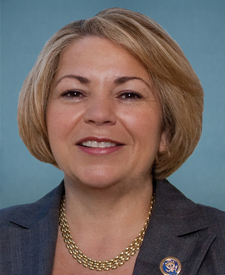
See how Linda T. Sánchez actually votes — against your values.
DeepSyte scores Linda T. Sánchez's record on the issues you care about — not party, not press releases. Take the 2-minute values quiz to see your personal alignment.
Sign in and take the values quiz to see how Linda T. Sánchez's votes line up with your views.
Prediction track record
How often we called Linda T. Sánchez's passage votes correctly, from their stated positions on each bill's tagged topics. Excludes “unclear” calls and abstentions.
A joint resolution to direct the removal of United States Armed Forces from hostilities within or against the Islamic Republic of Iran that have not been authorized by Congress.
To prohibit the disclosure of records by the Secretary of Housing and Urban Development of individuals for the purposes of immigration enforcement, and for other purposes.
A joint resolution to direct the removal of United States Armed Forces from hostilities within or against the Islamic Republic of Iran that have not been authorized by Congress.
Based on 3 data points across public statements and recorded votes · AI analysis of public records
119-hr-5587·Notable gap
HEATS Act
5/100
What they said
Apr 30, 2026
Congresswoman Sánchez introduced legislation that would impose a 45 percent tax on PFAS manufacturers, with revenue funding tax credits for water agencies to remove PFAS contamination from drinking water supplies. The bill aims to shift cleanup costs from taxpayers to the companies that produce these chemicals.
Congresswoman Sánchez's statement advocates for environmental protection and holding polluters financially responsible for cleanup costs. The HEATS Act exempts geothermal activities from environmental review requirements under NEPA, the Endangered Species Act, and the National Historic Preservation Act. Her no vote on this bill is strongly consistent with her stated environmental protection priorities, as the bill would weaken environmental safeguards rather than strengthen them.
Rep. Sánchez welcomes the DHS funding agreement that excludes ICE and CBP, but opposes additional funding for those agencies pending resolution of what she characterizes as abuses in immigrant communities.
Rep. Sánchez's statement opposes additional funding for ICE and CBP pending resolution of what she characterizes as abuses in immigrant communities. The Stop Illegal Entry Act increases criminal penalties for unauthorized entry and reentry, which aligns with enforcement-focused immigration policy that she has indicated concern about. Her NO vote on this amendment is consistent with her stated opposition to expanding ICE/CBP resources and enforcement authority without addressing alleged abuses. The amendment vote is procedural rather than a direct passage vote, which introduces some uncertainty about her specific intent, but the directional alignment between her stated position (opposing expanded enforcement pending abuse resolution) and her vote against a bill that expands enforcement penalties is clear.
To direct the removal of United States Armed Forces from hostilities within or against Venezuela that have not been authorized by Congress.
72/100
What they said
Feb 28, 2026
Congresswoman Sánchez opposes President Trump's airstrikes on Iranian nuclear sites, arguing they violate the Constitution by occurring without congressional approval and risk escalating conflict without clear strategic justification or evidence of imminent threat.
Voted Yea on To direct the removal of United States Armed Forces from hostilities within or against Venezuela that have not been authorized by Congress.
Sánchez's statement opposes military action without congressional authorization, arguing the President violated the Constitution by acting unilaterally. Her yes vote on H.Con.Res. 64—which directs removal of armed forces from unauthorized hostilities—aligns with that constitutional principle. However, the vote is procedural rather than on final passage, and the bill addresses Venezuela while her statement addressed Iran, creating some distance between the specific contexts even though the underlying constitutional principle is consistent.
Pairs with ambiguous language and high uncertainty are withheld until more data is available. Procedural, cloture, and amendment votes are excluded — they don't cleanly signal substantive support or opposition.
Pro analysis
AI rep analysis — Pro
Get an AI-narrated read on Linda T. Sánchez's full voting record against your stated values — aligned themes, conflicts, notable votes, and what to watch for.
We haven't extracted campaign positions for Linda T. Sánchez yet. Once their campaign website or position pages are processed, this card will track what they said vs how they voted.
Crossing the aisle
Passage votes where Linda T. Sánchez broke ranks with ≥75% of Democrats. Threshold catches substantively partisan splits; unanimous-ish or close votes are excluded.
1
Cross-aisle vote
118-hr-7024·Feb 1, 2024·89% of D voted YES
Tax Relief for American Families and Workers Act of 2024
Bipartisan bill would tackle rental housing shortage, lower costs for families
Position: The bill modernizes the federal tax code to accelerate cost recovery for rental housing developers, reducing upfront construction costs and creating tax incentives to increase the supply of affordable rental housing.
WASHINGTON – Ways and Means Committee members Linda T. Sánchez (D-Calif.), Claudia Tenney (R-N.Y.), Jimmy Panetta (D-Calif.) and Darin LaHood (R-Ill.) today introduced the Rental Housing Investment Act, a bipartisan bill that would modernize the tax code, lower construction costs and create stronger incentives to build affordable rental housing.
“Southern California families are being priced out of their own communities,” said Congresswoman Sánchez. “Rents are climbing and there simply are not enough homes to meet demand. Our bill removes a real barrier to building more housing to give working families a shot at finding a home they can afford.”
“Families across New York and across the country are struggling under the weight of rising housing costs and a severe shortage of available rental housing,” said Congresswoman Tenney. “The federal tax code should encourage the construction of more housing, not stand in the way. This bipartisan legislation takes a practical, market-driven approach to expanding housing supply, reducing development costs, and helping make housing more affordable for hardworking Americans.”
“Although many people work in California’s 19th Congressional District, contributing so much to our economy and communities, many people can't afford to live in our district due to the lack of affordable rental housing,” said Congressman Panetta. “That’s why I’m joining my colleagues to introduce the bipartisan Rental Housing Investment Act as a way to incentivize the development of new multifamily rental housing with deductions for upfront costs, which often prevent contractors from getting projects off the ground. This type of bipartisan legislation is a way in which the federal government can play its part to ensure more affordable housing for working families in our communities.”
“The shortage of affordable housing is a rural, urban, and suburban issue, impacting communities throughout central and northwestern Illinois,” said Congressman LaHood. “To address this growing crisis across the country, Congress must continue to advance legislation that drives investment into new affordable housing and expands housing options for hardworking Americans nationwide. I am proud to join my colleagues to introduce the bipartisan Rental Housing Investment Act to encourage the development of new affordable housing and lower costs for families.”
The United States is facing a persistent shortage of rental housing, particularly multifamily apartments. Construction has not kept pace with population growth, driving up rents and deepening the affordability crisis. A key barrier to new construction is the high upfront costs for building rental housing. Under current tax law, developers must recover those costs over 27.5 years, making many otherwise viable projects financially difficult, especially in a high-interest-rate environment.
The bill addresses this by modernizing cost recovery in the tax code and encouraging greater private investment in rental housing.
The Rental Housing Investment Act would:
Allow builders to immediately deduct up to $150,000 per unit in construction costs, rather than depreciating those costs over 27.5 years.
Provide an enhanced deduction of up to $250,000 per unit for projects that include income-restricted units reserved for working families. Projects receiving the enhanced benefit would be required to maintain attainability commitments for at least 15 years.
Apply only to newly constructed multifamily rental housing, ensuring the incentive creates new supply.
Senator Lisa Blunt Rochester (D-Del.) previously introduced companion legislation in the Senate.
###
Issues:Housing and Homelessness
Ways and Means Democrats lay out priorities in upcoming USMCA review
Position: House Democrats call on the Trump administration to prioritize worker protections, environmental standards, and economic security in the upcoming USMCA review, urging the administration to address offshoring, worker rights, and enforcement while maintaining the trilateral structure of the agreement.
WASHINGTON – Ways and Means Trade Subcommittee Ranking Member Linda T. Sánchez (D-Calif.), along with all Ways and Means Committee Democrats, today called on the Trump administration to prioritize American workers, stronger environmental protections and economic security in the upcoming review of the U.S.-Mexico-Canada Agreement.
The members urged the administration to update the agreement to address offshoring, worker rights, environmental protections, economic security and enforcement of existing commitments.
“The USMCA Review is a crucial opportunity to fortify the North American economic relationship and the resiliency of the U.S. economy at a time when our most important economic and security relationships have been thrown into disarray and persistent economic uncertainty has raised costs for American families,” the members wrote. “We urge you, moving forward, to forgo the kind of combative rhetoric and coercive behavior that has defined the past year. House Democrats stand ready to work with your office, but USTR must make clear that the United States remains committed to the trilateral structure of USMCA, the defining feature of the North American economic relationship, and to a durable, mutually beneficial relationship with our partners that ensures the gains from trade are shared broadly both within and across our North American markets.”
In addition to Sánchez, the letter was signed by Ranking Member Richard Neal (D-Mass.) and Representatives Lloyd Doggett (D-Texas), Mike Thompson (D-Calif.), John Larson (D-Conn.), Danny Davis (D-Ill.), Terri Sewell (D-Ala.), Suzan DelBene (D-Wash.), Judy Chu (D-Calif.), Gwen Moore (D-Wisc.), Brendan Boyle (D-Pa.), Don Beyer (D-Va.), Dwight Evans (D-Pa.), Brad Schneider (D-Ill.), Jimmy Panetta (D-Calif.), Jimmy Gomez (D-Calif.), Steven Horsford (D-Nev.), Stacey Plaskett (D-Virgin Islands) and Tom Suozzi (D-N.Y.).
The full text of the letter is available HERE and follows:
May 18, 2026
The Honorable Jamieson Greer
Ambassador
United States Trade Representative
600 17th Street, NW
Washington, DC 20508
Dear Ambassador Greer:
As we prepare for the July 2026 Review of the U.S.-Mexico-Canada Agreement (USMCA), we write to express our views regarding aspects of the agreement that require updates and improvement. Our assessment reflects both public feedback and the considerable economic and geopolitical uncertainty facing the United States today.
The USMCA remains vitally important to the United States' economic security and prosperity. We are proud of our contributions to USMCA, including the bipartisan work by House Democrats and members of the first Trump Administration to secure major reforms and address shortcomings of the North American Free Trade Agreement (NAFTA). Many of the reforms we sought and won remain some of the most groundbreaking provisions in the history of trade. In other cases, the provisions negotiated in 2019 remain broadly fit for purpose.
However, the last five years have also made clear that adjustments are needed. New challenges have emerged and some reforms require updates to ensure the agreement delivers for American families, workers, and businesses. In particular, we urge you to negotiate provisions targeting offshoring and threats to economic security; adopt new environmental protections; secure new commitments to strengthen worker rights; and ensure fair and effective enforcement of commitments already made.
Additionally, the USMCA Review is a crucial opportunity to fortify the North American economic relationship and the resiliency of the U.S. economy at a time when our most important economic and security relationships have been thrown into disarray and persistent economic uncertainty has raised costs for American families. We urge you, moving forward, to forgo the kind of combative rhetoric and coercive behavior that has defined the past year. House Democrats stand ready to work with your office, but USTR must make clear that the United States remains committed to the trilateral structure of USMCA, the defining feature of the North American economic relationship, and to a durable, mutually beneficial relationship with our partners that ensures the gains from trade are shared broadly both within and across our North American markets.
Offshoring
Of central importance in our efforts to renegotiate NAFTA was the need to combat the continued offshoring of jobs and production. The global shocks since NAFTA renegotiation have also made clear the value of creating secure supply chains by strengthening North American manufacturing. However, manufacturing continues to leave the United States in pursuit of lower wages and less regulation, undermining the American workforce and jeopardizing our industrial capabilities.
A combination of low wages, weak worker protections, and less environmental and business regulation in Mexico has proven a powerful incentive for investors to offshore jobs across the economy. As Democrats, we stand firmly for the proposition that our trade policy must support opportunities for a willing and able U.S. workforce and provide secure supply chains for American businesses and workers. We urge you to identify and implement new tools to ensure that existing and future U.S. enterprises have the appropriate incentives to support a large and growing U.S. workforce, along with concomitant disincentives for corporations that offshore existing jobs as part of a strategy of regulatory or wage arbitrage.
USMCA's rules of origin (ROO) are one of the tools that have proven useful in ensuring that more of the benefits of trade accrue to the region and are not unduly captured by third parties. However, we have heard from both industry and labor that certain provisions are overly complex, poorly enforced, or already overtaken by the pace of technological change. In strategic industries, like autos or steel and aluminum, we encourage you to evaluate the ROO regime for its effectiveness in supporting North American manufacturing, and to consider updates that may be appropriate as new technologies have matured. At minimum, it is necessary to clarify the rules around regional value content (RVC) provisions for core parts and ensure that the category of core parts is reviewed and updated.
North American Economic Security
The USMCA review is also an opportunity to address some of the economic and national security risks arising from U.S. and North American trade and investment with countries of concern. The United States and Canada both maintain investment screening mechanisms for national security purposes, but Mexico has yet to establish a comparable framework. The USMCA joint review provides an opportunity to strengthen cooperation between the U.S. and Canadian regimes, to support the development of a similar regime in Mexico, and to establish clear guidelines that facilitate the sharing of information regarding sensitive investments. This would be an important step toward reducing vulnerabilities in North American supply chains.
Similarly, as the United States continues to seek out ready and reliable access to critical minerals, the upcoming USMCA review represents an extraordinary opportunity to work with our allies to enhance economic and national security for the region. An integrated North American market based on high social and environmental standards holds immense promise to ensure supply chain security and can help demonstrate to trusted trading partners the value of robust coordinated policies to ensure transparency and predictability.
The review should also discuss coordination on national security tariffs, such as those imposed under Section 232 of the Trade Expansion Act of 1962. When Canada and Mexico are willing to coordinate trade and investment policies with the United States and able to implement well-functioning import monitoring systems to protect the North American economy from predatory trading practices that threaten our national economic security, USMCA should reflect a high level of coordination and alignment. The imposition by the United States of national security tariffs on our closest trading partners, without congressional oversight, procedural safeguards, or efforts to coordinate trade responses with Canada and Mexico, undermines not just USMCA, but the credibility of the United States as a trustworthy trading partner and our own constitutional delegation of powers.
Environment
We believe it is critical to establish an enforcement mechanism that can quickly address point source pollution in covered facilities that violate environmental standards. House Democrats were proud to have designed a Rapid Response Mechanism for Labor in the 2019 USMCA negotiations, but there is still no comparable mechanism to challenge enterprises that pollute our shared environment for profit.
The list of covered multilateral environmental agreements (MEA) should be updated and we urge you, after many years of debate, to finally remove the phrases "sustained and recurring" and "in a manner affecting trade" from the text of the environment and labor chapters. These phrases have served only to offer confusion and ambiguity for labor and environmental advocates.
Finally, we note the positive example of transparency and accountability offered in the labor chapter by the Independent Mexican Labor Experts Board (IMLEB). Standing up a similar body of environmental experts would help build public trust in the ability of the agreement to call attention to environmental harms and could help guide the Parties' enforcement efforts.
Labor
A defining innovation of the 2019 USMCA agreement was the inclusion of the Rapid Response Mechanism (RRM) for labor violations. While the RRM continues to represent a singular advance in the enforcement of trade agreements, a number of procedural and evidentiary concerns have undermined the effectiveness of the mechanism. For instance, procedural delays by employers and the Mexican government threaten nascent organizing campaigns and prolong the threat of violence and intimidation when workers are at their most exposed. We urge you to ensure that panels formed under the RRM operate under strict time limits to complete investigations and issue reports and recommendations. Additionally, labor advocates have pointed to the difficulty of proving that facilities are "covered" under the Agreement when workers themselves lack access to the requisite business records, which remain in the possession and control of the businesses themselves. Mexican workers also note that violations of fundamental associational rights are regularly resolved through negotiations between Mexican officials and business owners without any consultations with the affected workers. We trust that these and other procedural challenges can be addressed through the six-year review to ensure that the RRM can effectively protect workers' rights.
Apart from the procedural adjustments needed to strengthen the RRM, labor officials lack the necessary tools to combat practices like union "blacklisting," importation of goods made with forced labor, and the refusal to negotiate in good faith with a duly recognized trade union. Mexican labor officials should be given clear authority and sanctioning powers to combat these insidious practices.
In addition, a persistent and widening wage gap between the Mexican and American workforces and the relative weakness of regulatory enforcement in Mexico continues to fuel the offshoring of jobs and manufacturing. We strongly urge the adoption, in these strategic industries, of sectoral collective bargaining agreements. Such agreements can be designed, with the input of the Parties, to close the wage gap by removing the ability of corrupt protection unions and vested business interests to artificially suppress wages for Mexican workers.
Upon passage of USMCA six years ago, Mexico committed to providing minimum levels of funding to ensure the effective implementation of critical labor reforms. Mexico lived up to its budgetary commitments, but many of the most critical labor reforms remain incomplete. The Mexican government must again commit to minimum levels of funding and staff to ensure effective monitoring and enforcement of labor rights and environmental protections.
Finally, while Mexico and Canada have the most work to do, the U.S. government also has a role to play. The Department of Labor's Bureau of International Labor Affairs (ILAB) funding for USMCA technical assistance was decimated last year through self-defeating funding cuts. Providing full funding for ILAB to provide technical assistance to Mexican labor institutions and civil society is in the best interests of both U.S. and Mexican workers.
Effective Enforcement
USMCA made strides in creating fair, predictable, and mutually beneficial trade conditions across key sectors of the North American economy. While the agreement has delivered important gains, persistent challenges in the implementation and enforcement of the agreement continue to undermine U.S. workers, farmers, and manufacturers. A glaring example has been Mexico's failure to implement the important intellectual property reforms it made following the last USMCA negotiations. We also note with concern both Mexico and Canada's failure to enforce their respective forced labor import bans as required under the agreement.
Agricultural trade through USMCA also provides economic opportunities for U.S. farmers, ranchers, and food manufacturers, and any updates to the agreement should consider the stability needed to support U.S. agriculture. We encourage you to use this review to reinforce existing terms and ensure the fair and effective enforcement of measures to reduce barriers impacting U.S. agriculture. This includes addressing Canada's long-standing allocation of dairy tariff rate quotas, which serve to unfairly deny U.S. dairy producers of the meaningful access to the Canadian market. Canada must also end the regional bans on U.S. wines and spirits and work with your office to resolve existing non-tariff barriers. With respect to widespread consumer boycotts in Canada and Mexico, it will take time to recover the trust and goodwill of foreign consumers; the successful conclusion of the USMCA review without more unnecessary provocations is a critical first step. We urge you to consider that exporters invest heavily in developing foreign markets and earning the business of discerning consumers. Reckless and offensive comments about our neighbors by the President and senior U.S. officials can squander hard-won market share faster, and just as surely, as any formal trade barrier.
Finally, USMCA must provide a predictable framework for the digital economy and foster a competitive environment for North American industries while allowing for regulation to meet evolving challenges. The USMCA has helped deliver key benefits to the digital economy. It is critical that an integrated North American market continue to facilitate electronic commerce, reduce barriers for small businesses, and prohibit duties on digital products.
We thank you for your efforts to secure these critical changes to the USMCA and look forward to working with you to ensure that the agreement remains the global gold standard for many years to come.
###
Issues:Labor and Trade
Position: Rep. Sánchez criticizes President Trump's visit to China, arguing that Trump failed to hold China accountable for unfair trade practices, did not secure commitments to protect Taiwan, and prioritized corporate interests over national security.
WASHINGTON – Ways and Means Trade Subcommittee Ranking Member Linda T. Sánchez (D-Calif.) released the following statement on President Trump’s visit to China:
“President Trump continues to treat one of America’s adversaries like a reality show, and America is paying the price.
“President Trump let China hold the upper hand from start to finish. He did nothing to hold China accountable for its unfair trade practices, nothing to improve or restore global security, and nothing to protect American workers and manufacturers. Instead, he surrounded himself with CEOs, flew to Beijing to strike business deals and then came back with virtually nothing to show for it.
“But perhaps most alarming, Trump refused to commit to protecting Taiwan – a major gift to Beijing. He has once again showed his willingness to trade U.S. national security for corporate interests.
“China is playing chess while Trump is playing checkers. Competing with the world’s largest authoritarian government requires seriousness and a long-term strategy – none of which we saw from the Trump administration during this visit.”
###
Issues:Labor and TradeNational Security and Foreign Policy
Congressional delegation demands answers on Taiwan's exclusion from WTO conference
Position: The members express concern that Taiwan was effectively excluded from the WTO Ministerial Conference by being forced to choose between using a designation implying it is not a sovereign WTO member or not participating, and call on the WTO Director-General to prevent this from setting a precedent for future conferences.
WASHINGTON – Ways and Means Trade Subcommittee Ranking Member Linda T. Sánchez (D-Calif.), Trade Subcommittee Chairman Adrian Smith (R-Neb.), Congresswoman Judy Chu (D-Calif.), chair emerita of the Congressional Asian Pacific American Caucus, and 23 colleagues today called on World Trade Organization Director-General Okonjo-Iweala to ensure that Taiwan’s effective exclusion from the 14th WTO Ministerial Conference in Cameroon will not set a precedent for future Ministerial Conferences.
Taiwan was effectively forced to choose between participating under the designation “Taiwan, Province of China” on official visas or sitting out entirely. The issue wasn’t resolved even after WTO Members, including the United States, raised serious concerns about undue pressure from China. It marks the first time Taiwan has been excluded from a Ministerial Conference since joining the WTO in 2002.
“It is an improper infringement of Taiwan’s right as a full WTO Member to force its delegates to choose between entering Cameroon for the Ministerial Conference on visas using the nomenclature 'Taiwan, Province of China' — which implies that Taiwan is not a WTO Member in its own right — or missing the Ministerial Conference altogether,” the members wrote.
In addition to Representatives Sánchez, Smith and Chu, the letter was signed by Representatives Ami Bera (D-Calif.), Donald Beyer (D-Va.), Gus Bilirakis (R-Fla.), Brendan Boyle (D-Pa.), Danny Davis (D-Ill.), Suzan DelBene (D-Wash.), Jimmy Gomez (D-Calif.), Steven Horsford (D-Nev.), Raja Krishnamoorthi (D-Ill.), John Larson (D-Conn.), Michael Lawler (R-N.Y.), Ted Lieu (D-Calif.), Carol Miller (R-W.Va.), Dave Min (D-Calif.), Gwen Moore (D-Wis.), Nathaniel Moran (R-Texas), Jimmy Panetta (D-Calif.), Bradley Schneider (D-Ill.), Terri Sewell (D-Ala.), Brad Sherman (D-Calif.), Thomas Suozzi (D-N.Y.), Claudia Tenney (R-N.Y.) and Rudy Yakym (R-Ind.).
Full text of the bipartisan letter is available HERE and follows:
May 14, 2026
Director-General Okonjo-Iweala
World Trade Organization
Centre William Rappard
Rue de Lausanne 154
1211 Geneva 2
Switzerland
Dear Director-General Okonjo-Iweala:
We write to express our serious concern regarding Taiwan’s effective exclusion from the 14th Ministerial Conference in Cameroon.
Taiwan acceded to the WTO as its 144th Member in 2002 as “The Separate Customs Territory of Taiwan, Penghu, Kinmen and Matsu” (or “Chinese Taipei”). Since that time, other WTO Members and the WTO Secretariat have respected Taiwan’s status as a “Separate Customs Territory” with the same status as all other economies that have joined the WTO. This includes full and equal participation of its delegation at Ministerial Conferences. It is an improper infringement of Taiwan’s right as a full WTO Member to force its delegates to choose between entering Cameroon for the Ministerial Conference on visas using the nomenclature “Taiwan, Province of China”— which implies that Taiwan is not a WTO Member in its own right — or missing the Ministerial Conference altogether.
In light of this, we urge you to answer the following questions:
How will the WTO Secretariat ensure that this incident does not set a precedent for future Ministerial Conferences?
Is the WTO Secretariat putting in place written guidelines to provide assurances that similar incidents undermining the rights of Members will not occur at future Ministerial Conferences?
We look forward to receiving your response by June 3, 2026, and welcome an opportunity to discuss this issue in more detail. We thank you for your efforts to lead the WTO through these consequential times and for your willingness to engage directly with the U.S. Congress on a range of important issues.
###
Issues:Labor and TradeNational Security and Foreign Policy
Sánchez on trade court’s tariffs ruling: Trump never gets tired of losing
Position: Opposes President Trump's 10 percent global tariffs under Section 122, characterizing them as unlawful, economically harmful to families and businesses, and failed policy. Calls for Republicans to join Democrats in ending the tariffs.
WASHINGTON – Ways and Means Trade Subcommittee Ranking Member Linda T. Sánchez released the following statement in response to the U.S. Court of International Trade ruling that President Trump’s 10 percent Section 122 global tariffs were an unlawful abuse of executive authority:
“President Trump never gets tired of losing in court.
“While American families are drowning due to record-high prices, and farmers and small businesses are struggling to make ends meet because of his tariffs, he keeps doubling down on the same failed, illegal and reckless trade policies.
“Democrats are ready to end this chaos. It’s time for Republicans to join us and put their constituents first, not Donald Trump.”
Background:
Ranking Member Sánchez and Representatives Jimmy Panetta (D-Calif) and Don Bacon (R-Neb.) introduced the bipartisan Stop Global Tariffs Act to terminate the 10 percent tariffs issued by President Trump under Section 122 of the Trade Act of 1974.
###
Issues:Labor and Trade
Sánchez introduces bill to require PFAS manufactures to pay for clean up
Position: Congresswoman Sánchez introduced legislation that would impose a 45 percent tax on PFAS manufacturers, with revenue funding tax credits for water agencies to remove PFAS contamination from drinking water supplies. The bill aims to shift cleanup costs from taxpayers to the companies that produce these chemicals.
WASHINGTON – Congresswoman Linda T. Sánchez (D-Calif.) today introduced the PFAS Cleanup Act, a bill that would require manufacturers of PFAS chemicals to help fund the cleanup of contamination from these forever chemicals in our nation's water supply.
The bill would establish a 45 percent tax on the manufacturing of PFAS, with the revenue used to fund a tax credit of up to 25 percent for public and private water agencies to remove PFAS contamination from their water supplies.
“PFAS contamination is a serious public health issue affecting communities throughout Southern California and across the country,” said Congresswoman Sánchez. “The companies that manufacture these chemicals should help pay to clean them up. My bill ensures that the cost of addressing this public health problem does not fall entirely on taxpayers and the water agencies.”
PFAS contamination is a growing public health crisis. These chemicals have been linked to cancer, child developmental issues, fertility problems, and other serious health concerns.
In California, PFAS have been detected in water systems serving nearly 26 million people, according to a recent report by the Natural Resources Defense Council (NRDC). The problem disproportionally impacts disadvantaged communities, where up to 9 million people are exposed to forever chemicals in their water.
However, that number is expected to rise, as California expands monitoring of drinking water sources for PFAS near landfills, airports, oil and gas facilities, and other potential contamination sites.
The PFAS Cleanup Act has been endorsed by the NRDC, the Environmental Working Group and the Waterkeepers Alliance.
###
Issues:Health CareTax Policy
Position: Rep. Sánchez welcomes the DHS funding agreement that excludes ICE and CBP, but opposes additional funding for those agencies pending resolution of what she characterizes as abuses in immigrant communities.
WASHINGTON – Congresswoman Linda T. Sánchez (D-Calif.) today released the following statement after House Republican leadership agreed to pass the bipartisan Senate bill to fund all Department of Homeland Security agencies except Customs and Border Protection and Immigration and Customs Enforcement:
“Speaker Johnson held DHS employees' paychecks hostage for more than a month to satisfy the unreasonable demands of far-right Republicans. It was wrong, and it did not have to happen.
“A bipartisan agreement to fund every DHS agency except ICE and CBP has been on the table since before the Easter recess. It passed the Senate unanimously and would have passed the House weeks ago if Republican leadership had simply allowed a vote.
“I’m glad that Coast Guard, TSA, FEMA and other critical employees will get paid. But Republicans now want to reward ICE and CBP with another $140 billion through reconciliation. I will continue to fight to block their funding until the abuses we are seeing in our communities come to an end.”
###
Issues:Immigration
Position: Congresswoman Sánchez argues that Medicare hospice fraud is a nationwide problem affecting all states, not unique to Democratic-led states, and advocates for passage of the Hospice CARE Act to comprehensively reform the hospice benefit, modernize it for patients and caregivers, and address documented fraud while protecting the Medicare Trust Fund.
WASHINGTON – Congresswoman Linda T. Sánchez (D-Calif.) today called out President Trump and Republicans during a Ways and Means Committee hearing, dismantling their claim that Medicare fraud is a problem unique to Democratic-led states.
Sánchez put the question directly to the witnesses, asking whether Medicare fraud occurred only in “blue states” or in every state. Every single witness, including those invited by the Republican majority, agreed by a show of hands that it happens in every state.
Witnesses agreeing that Medicare fraud occurs in every state, not just Democratic-led states.
“By a quick show of hands, very quickly, how many of you think that Medicare fraud only happens in blue states?” said Congresswoman Sanchez.
“Let the record reflect that nobody raised their hands.
“And how many you, by a show of hands, think that it happens in every state.
“Let the record reflect that everybody agrees it happens in all states.
“There are many unscrupulous actors all over the United States. Texas is one example. The HHS [inspector general] found a hospice executive was guilty of falsely enrolling Alzheimer’s and dementia patients, telling them they had mere months to live. End-of life care is very personal to me because I was a caregiver for both my father and mother who died from Alzheimer’s. It’s unfortunately one of the most common diagnoses for patients who have elected the hospice benefit. And I can tell you that the hospice benefit is a critical support not just for the patient, but for their caregivers who have a huge burden. But that benefit needs to be updated because over the past 10 years, public trust in that benefit has eroded.”
Video of the congresswoman’s full remarks is available HERE.
Sheila Clark, president and CEO of California Hospice and Palliative Care Association, and a witness invited by Chairman Jason Smith, supported Sánchez’ bill, the Hospice CARE Act. The bill is the only comprehensive federal legislation that would reform the hospice benefit, and address rampant hospice fraud in Medicare, while modernizing the benefit for patients and caregivers.
Medicare’s hospice benefit has remained largely unchanged since its inception in 1982. However, the hospice industry has changed dramatically both in terms of the types of providers delivering and patients receiving end-of-life services. At the same time, documented and burgeoning fraud and abuse have raised questions about how to ensure the benefit continues to promote patient access while safeguarding the Medicare Trust Fund.
###
Issues:Health Care
Sánchez grills Health Secretary Kennedy on spike in measles cases, anti-vaccine rhetoric
Position: Congresswoman Sánchez opposes the Trump administration's decision to cut federal pro-vaccination messaging campaigns and criticizes Health Secretary Kennedy for removing CDC universal vaccine recommendations for children, citing a spike in measles cases and a measles-related death of an unvaccinated child.
WASHINGTON – Congresswoman Linda T. Sánchez (D-Calif.) during a Ways and Means Committee hearing today questioned Health Secretary Robert F. Kennedy Jr. for the dramatic rise in U.S. measles cases after the Trump administration cut public health messaging campaigns promoting vaccinations.
In response to her question, Secretary Kennedy refused to answer whether President Trump authorized cutting the pro-vaccination campaigns.
“I think you don’t want to answer the question, because I think you know these are terrible, terrible decisions that impact very, very real lives, especially the lives of children,” said Congresswoman Sanchez in response. “Now, one thing that I find incredible is that you suspended this pro-vaccine messaging campaign, but somehow you’re spending taxpayer dollars to drink milk shirtless in a hot tub with Kid Rock, and somehow you think that’s a better public health message than informing the public about the importance of vaccines.”
Under Secretary Kennedy, measle cases in the United States spiked from 285 cases in 2024 to 2,286 in the first year of the Trump administration, a record high since the development of the lifesaving measles vaccine. This year, the United States is on track to shatter that record with 1,671 cases already reported in the first 3.5 months.
Video of the full exchange is available HERE and the text follows:
Sánchez: Thank you, Secretary Kennedy. We appreciate your appearance here today. To win the support of skeptical senators during your confirmation hearings, you claimed, and I’m quoting here, “I support vaccines. I support the childhood vaccine schedule.” I was skeptical about those comments, because prior to your nomination, you espoused numerous disproven theories that childhood vaccines, including the measles vaccines, were linked to autism, death, and other adverse effects. Not surprisingly, we were right to be skeptical of your promise to support the childhood vaccine schedule, because at your direction, the CDC removed its universal vaccine recommendations for children, covering seven immunizations, including things like flu, covid, hepatitis A, hepatitis B, and rotavirus. On Fox News last year, you stated, and I’m quoting you again here, “There are adverse effects from the vaccine. It does cause deaths every year. It causes all the illnesses that measles itself causes.” A deadly measles outbreak in Texas killed an unvaccinated six-year-old, the first such death in a decade. So, simple yes or no question. It’s not that we don’t want to let you answer, it’s that we all have limited time, and you have plenty of time to answer questions, and you had plenty of time to give testimony at the beginning. So a simple yes or no answer will do here. Do you agree with the majority of doctors that the measles vaccine could have saved that child’s life in Texas?
Kennedy: It’s possible. Certainly.
Sánchez: Okay. Thank you. I want to look at some very important data. In 2024, under the Biden administration, which apparently seems to be responsible for every ill in the world, in 2024 under the Biden administration, there were 285 cases of measles. And in 2025, under your leadership at HHS, it ballooned to over 2,000. That’s a 675 percent increase. And we are now on track to surpass that this year, with over 1,600 confirmed cases in just three and a half months. If we project those numbers out for all of 2026, we can expect a whopping 6,400 cases of measles. That’s a 2,380 percent increase in a preventable disease. CDC data also shows that about 80 percent of children who died from flu this season were not vaccinated. The anti-vaccine rhetoric you ran on and the anti-vaccine actions you have taken over the last year clearly correlates with the dramatic increases, again, in preventable diseases. As a mother, this horrifies me. Stopping the spread of communicable diseases is one of HHS’s primary responsibilities, and a strong public health messaging campaign on the importance of vaccines could have stopped this surge of measles cases, as it had in past outbreaks. But I was appalled to learn that the CDC suspended public health messaging on vaccines last February. It ended a successful flu vaccine campaign as well. My question is, did President Trump approve your decision to end the CDC pro-vaccine public messaging campaign?
Kennedy: You got a lot of misinformation there. First of all…
Sánchez: No, I’m asking you a question. I’d appreciate a response to the question.
Kennedy: ...to the misstatements that you’ve made.
Sánchez: No, you have other opportunities. I have limited time. I only have your answer.
Kennedy: You are my only opportunity. I have to respond…
Sánchez: Did President Trump approve your decision to end the CDC pro-vaccine public messaging campaign?
Kennedy: Let me, allow me to answer to respond to a lot of the misinformation.
Sánchez: No, answer my question. Please, sir. I have limited time.
Kennedy: There’s a global measles epidemic. We’ve done better than any country in the world.
Sánchez: There is no country that has seen a bigger percentage increase.
Kennedy: That’s not true. Mexico has three times our measles and one-eighth of our population.
Sánchez: Did President Trump approve your decision to end the CDC pro-vaccine public messaging campaign?
Kennedy: Canada has double the measles and they have one-eighth of our population.
Sánchez: Was that a decision that was made by Trump? Did he approve that?
Kennedy: We’ve done better preventing measles than any country in the world.
Sánchez: Did President Trump approve your decision to end the CDC pro-vaccine public messaging campaign?
Kennedy: We’ve done better at preventing…
Sánchez: That’s not answering my question, and I think you don’t want to answer the question, because I think you know these are terrible, terrible decisions that impact very, very real lives, especially the lives of children. Now, one thing that I find incredible is that you suspended this pro-vaccine messaging campaign, but somehow you’re spending taxpayer dollars to drink milk shirtless in a hot tub with Kid Rock, and somehow you think that’s a better public health message than informing the public about the importance of vaccines, really?
###
Issues:Health Care
Sánchez, Miller introduce bipartisan child care affordability legislation
Position: The release introduces bipartisan legislation creating a tax credit for child care facilities to help offset employee wages, with the goal of improving staff retention and reducing costs passed on to parents.
WASHINGTON – Congresswomen Linda T. Sánchez (D-Calif.) and Carol Miller (R-W.V.), members of the Ways and Means Committee, today introduced the Child Care Supply Tax Credit Act, a bipartisan bill to address the nationwide child care shortage by creating a tax credit to help providers attract and retain qualified staff.
As child care costs continue to rise faster than inflation, parents in California now pay nearly $22,000 annually for infant care and $13,000 for a 4-year-old. In West Virginia, the cost is nearly $10,000 for both.
“It’s ridiculous that it can be cheaper to send a child to college than to preschool,” said Congresswoman Sánchez. “If we’re serious about supporting working families, we need to make child care more affordable and accessible. Our bill will help providers hire and retain qualified staff, so parents have reliable options for their young children without paying higher prices.”
“Parents across the country continue to struggle with the rising costs of childcare due to the industry’s workforce shortage. Attractive wages attract employees, and a large part of the cost of retaining the staff needed to adequately and safely care for the children is often passed on from the provider to the parents,” said Congresswoman Miller. “Building on the increased Child Tax Credit and expansion of the Child and Dependent Care Tax Credit that were secured by the passage of the Working Families Tax Cuts last summer, I am happy to join my colleagues Rep. Sánchez and Senators Justice and Warner in introducing the Child Care Supply Tax Credit Act to go one step further in addressing rising childcare costs. By providing a tax credit to assist our providers in paying their staff, we can limit the costs being passed on to parents.”
In the United States, child care workers earn less than the average worker despite a high level of responsibility and demanding training requirements. These low wages lead to high turnover and difficulty in recruitment, ultimately resulting in fewer available classroom slots and higher costs for families.
The bipartisan Child Care Supply Tax Credit Act would create a new tax credit for eligible child care facilities to help offset the cost of employee wages, incentivizing higher pay for workers who directly care for children, while preventing the benefit from going toward administrative overhead.
Senators Mark R. Warner (D-Va.) and Jim Justice (R-W.V.) previously introduced companion legislation in the Senate.
“From health care premiums to groceries to utility bills, life is only getting more and more expensive for American families, and for many, the math simply doesn’t work without affordable child care,” said Senator Warner. “Child care is the foundation that allows parents to earn a living while providing kids with the head start they deserve. I’m proud to introduce this bipartisan legislation to address the workforce challenges contributing to our nation’s child care crisis.”
“Childcare providers simply can’t afford to pay their workers enough without passing those high costs on to parents. Families in West Virginia and across the country are spending thousands of dollars just to secure reliable childcare – it must be addressed. By creating a targeted tax credit tied directly to caregiver wages, we can pay the people who take care of our kids what they deserve while giving our hard-working families some breathing room,” said Senator Justice.
###
Issues:Working Families
Articles from a curated list of national outlets that mention Linda T. Sánchez.
No recent news mentions yet.
Source: GDELT 2.0 GKG, filtered to a curated list of national outlets. Inclusion is not endorsement; opinion pieces and reported news are mixed.
Recent stock activity
Periodic transaction reports filed under the STOCK Act — disclosed by the rep, sourced from public filings.
No disclosed trades on record.
Source: open-data mirrors of the Senate eFD and House Clerk financial-disclosure systems. Disclosure within 30 days of trade is required by law (45 for spouse/dependent trades).
Top PAC donors · 2026 cycle
Political action committees that gave the most to this rep's principal campaign committee this cycle. PAC giving is direct organizational support — industry, ideological, or leadership.
1.CARPENTERS LEG IMPROVEMENT COMMITTEE PAC5 contributions$25,000
2.NATIONAL ASSOCIATION OF REALTORS POLITICAL ACTION COMMITTEEReal Estate4 contributionsTrade association PAC for U.S. real estate agents and brokers — backs candidates supporting property-rights protections, mortgage-lending access, and tax incentives for homeownership.AI$20,000
3.AMERICAN CRYSTAL SUGAR COMPANY POLITICAL ACTION COMMITTEEAgriculture4 contributionsAgricultural processing PAC for American Crystal Sugar — backs candidates supporting farm subsidies, sugar price supports, and agricultural trade policies.AI$20,000
4.MACHINISTS NON PARTISAN POLITICAL LEAGUE OF THE INTERNATIONAL ASSOCIATION OF MACHINISTS & AEROSPACE WORKERSLabor4 contributionsTrade-union PAC of the International Association of Machinists & Aerospace Workers — backs candidates supporting union organizing, prevailing wages, and aerospace manufacturing jobs.AI$20,000
5.BLUE WAVE CALIFORNIA2 contributions$16,883
6.UNITED ASSOCIATION POLITICAL EDUCATION COMMITTEE3 contributions$15,000
7.SISTER-ACT COMMITTEE1 contribution$10,460
8.NATIONAL RURAL LETTER CARRIERS' ASSOCIATION POLITICAL ACTION COMMITTEEPublic Sector2 contributionsPublic-sector employee union PAC representing U.S. Postal Service letter carriers — backs candidates supporting postal worker wages, benefits, and job protections.AI$10,000
9.COMMITTEE ON LETTER CARRIERS POLITICAL EDUCATION (LETTER CARRIERS POLITICAL ACTION FUND)Public Sector2 contributionsPublic-sector union PAC for U.S. Postal Service letter carriers — backs candidates supporting postal worker wages, benefits, job security, and USPS funding.AI$10,000
10.AMERICAN COUNCIL OF LIFE INSURERS POLITICAL ACTION COMMITTEEFinance2 contributionsLife-insurance industry PAC — backs candidates and policies supporting insurance regulation, tax treatment of life-insurance products, and industry business interests.AI$10,000
Source: OpenFEC (api.open.fec.gov) Schedule A receipts where contributor type is “committee.” Aggregated by contributing committee. Self-transfers from joint-fundraising / victory committees are excluded.
Top individual contributors · 2026 cycle
Itemized individual contributions over $200 to this rep's campaign committee, aggregated by donor employer. PAC giving is shown above; this section is people, not organizations.
1.INVARIANT$14,000
2.RESOLUTION PUBLIC AFFAIRS$7,500
3.COMCAST$7,000
4.HACKMAN CAPITAL PARTNERS$7,000
5.CASSIDY & ASSOC$7,000
6.MILLER BARONDESS$7,000
7.S-3 GROUP$6,000
8.RIDGELINE ADVOCACY GROUP$6,000
9.NFP$6,000
10.ROCK CREEK COUNSEL$6,000
Source: OpenFEC Schedule A receipts where contributor type is “individual,” aggregated by the donor's self-reported employer. This is a geographic / industry correlation, not a corporate endorsement.