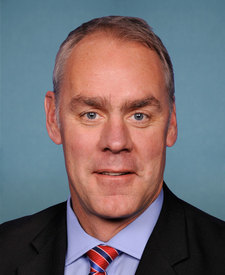
See how Ryan K. Zinke actually votes — against your values.
DeepSyte scores Ryan K. Zinke's record on the issues you care about — not party, not press releases. Take the 2-minute values quiz to see your personal alignment.
Sign in and take the values quiz to see how Ryan K. Zinke's votes line up with your views.
Prediction track record
How often we called Ryan K. Zinke's passage votes correctly, from their stated positions on each bill's tagged topics. Excludes “unclear” calls and abstentions.
A joint resolution to direct the removal of United States Armed Forces from hostilities within or against the Islamic Republic of Iran that have not been authorized by Congress.
A joint resolution to direct the removal of United States Armed Forces from hostilities within or against the Islamic Republic of Iran that have not been authorized by Congress.
A joint resolution to direct the removal of United States Armed Forces from hostilities within or against the Islamic Republic of Iran that have not been authorized by Congress.
A joint resolution to direct the removal of United States Armed Forces from hostilities within or against the Islamic Republic of Iran that have not been authorized by Congress.
No paired statements and votes yet for Ryan K. Zinke
We haven't yet found statement/vote pairs on the same topic for Ryan K. Zinke. This usually means either the rep hasn't taken public positions on bills that have come to a passage vote, or those bills haven't been tagged yet. The checker runs as new press releases and votes come in.
Pro analysis
AI rep analysis — Pro
Get an AI-narrated read on Ryan K. Zinke's full voting record against your stated values — aligned themes, conflicts, notable votes, and what to watch for.
We haven't extracted campaign positions for Ryan K. Zinke yet. Once their campaign website or position pages are processed, this card will track what they said vs how they voted.
Crossing the aisle
Passage votes where Ryan K. Zinke broke ranks with ≥75% of Republicans. Threshold catches substantively partisan splits; unanimous-ish or close votes are excluded.
3
Cross-aisle votes
119-hr-4058·Nov 20, 2025·78% of R voted YES
Enhancing Stakeholder Support and Outreach for Preparedness Grants Act
Zinke Introduces Allied Defense Sales Act to Boost U.S. Manufacturing and Strengthen Alliances
Position: The release advocates for legislation that would streamline the process for allied nations to jointly purchase U.S. defense equipment, with the stated goals of strengthening U.S. manufacturing, improving interoperability among allies, and deepening strategic partnerships.
Washington, D.C. – Today, Western Montana Congressman and Foreign Military Sales Task Force Chairman Ryan Zinke and Rep. Ami Bera (D-CA-06), members of the House Foreign Affairs Committee, introduced the Allied Defense Sales Act, legislation aimed at strengthening U.S. manufacturing by making it easier for allies to jointly purchase American-made defense equipment, while deepening strategic partnerships abroad.
The bill is modeled after successful multinational cooperation efforts and focuses on helping groups of allied countries that share similar defense needs coordinate joint purchases. By aligning demand across multiple partners, the legislation would help stabilize production and accelerate delivery timelines for U.S. manufacturers.
"Our allies should be fighting adversaries, not red tape,” said Zinke. “This bipartisan bill helps keep production lines hot, improves our allies’ ability to work together, and ensures the United States remains the security partner of choice for nations in the fight for freedom.”
“Strengthening our partnerships abroad is critical to advancing our national security interests and maintaining a competitive edge in an increasingly complex world,” said Representative Ami Bera, M.D. “This bipartisan legislation will help trusted allies and partners coordinate purchases of U.S. defense equipment, improve interoperability, and deliver capabilities more efficiently. By encouraging these kinds of ‘group buys,’ we can support smaller partners, bolster our domestic industrial base, strengthen our defense relationships, and better meet shared security challenges around the world.”
Under current systems, many smaller countries face steep barriers when trying to buy U.S. equipment due to the scale and complexity of the process. These hurdles can slow down orders and create uncertainty for American manufacturers. The Allied Defense Sales Act addresses these challenges by creating a more flexible, coordinated approach, especially for partners in regions like Eastern Europe, Southeast Asia, and the Caribbean, helping generate more consistent demand for U.S.-made systems.
The legislation directs the Department of State to assess interest among allied nations, identify potential lead coordinator countries for joint purchases, recommend ways to streamline approvals and licensing, and increase the exportability of defense articles and services. It also explores ways to expand access to financing tools and speed up sales outside traditional programs, ensuring American defense companies can respond more quickly to allied demand.
The bill now heads to committee for further consideration.
Read the full text of the bill HERE.
###
Issues:Congress
Farm Bill Passes House: Zinke Secures Huge Wins to Repeal Cottonwood, Support Farmers & Ranchers, Improve Wildlife Conservation
Washington, D.C. – Today, Congressman Ryan Zinke announced the House passage of the Farm, Food, and National Security Act of 2026, commonly known as the Farm Bill. A comprehensive piece of legislation designed to strengthen American agriculture, support rural communities, and improve forest and land management. The bill includes six provisions sponsored or co-sponsored by Zinke, notably codifying a permanent fix to the disastrous Cottonwood Decision that has strangled forest management in Montana for over a decade.
“The Farm Bill gives farmers and ranchers the certainty they need to keep doing what they do best and keeps the communities around them strong and stable,” said Zinke. “It preserves food assistance for those who truly need it while cutting waste and fraud and making sure families have access to nutritious food. It supports rural economies, strengthens basic infrastructure so it actually works for the people who live there, and helps folks get access to the health services they rely on without having to leave their towns. It also pushes smarter forest management to reduce wildfire risk and keep our lands healthier for the long haul. At the end of the day, this bill is about keeping American agriculture and small towns strong and built to last.”
The Farm Bill, typically reauthorized every five years, has been operating under an extension since 2023. This legislation reauthorizes and modernizes key USDA programs through 2031, providing long-term stability for producers.
Key provisions of the Farm Bill include:
Expands access to credit and risk management tools for farmers and ranchers facing tough economic conditions
Improves SNAP with stronger accountability and a greater focus on healthier outcomes, without increasing federal spending
Bolsters support for specialty crop producers and domestic fruit and vegetable production
Streamlines conservation programs and strengthens management of working lands and federal forests
Enhances export promotion efforts to help address the agricultural trade deficit
Modernizes rural development and energy programs and increases investment in research
Protects interstate livestock commerce and maintains access to critical crop protection tools
The legislation is supported by more than 500 agricultural and stakeholder organizations and maintains budget neutrality while preserving savings achieved through the One Big Beautiful Bill.
Zinke provisions included in the bill
Habitat Connectivity on Working Lands Act
The bill directs USDA to provide more resources and incentives for farmers and ranchers to improve habitat connectivity and wildlife movement on working lands, prioritizing wildlife corridors within critical conservation areas under the Regional Conservation Partnership Program and building on efforts like Wyoming’s Big Game Conservation Partnership. It encourages practices like virtual fencing to better manage livestock and expand USDA research and guidance on connectivity tools. Congressman Zinke has long led on this issue, including as Secretary of the Interior when he signed Secretarial Order 3362 in 2018 to work with western states on improving big-game winter range and migration corridors on federal lands while respecting state authority and private property rights, a framework that helped states like Wyoming protect key mule deer migration corridors in southwest Wyoming.
FIR Act (Cottonwood Fix)
The bill provides a permanent legislative fix to the Cottonwood court decision by limiting when the U.S. Forest Service must reinitiate consultation with the U.S. Fish and Wildlife Service to cases involving substantial new developments or changes to forest management plans. It will reduce delays that have stalled logging and forest management projects, address backlogs, and improve wildfire response and habitat management across Montana and the West. Zinke has previously introduced similar legislation in 2016 and 2023, both of which drew bipartisan and conservation support.
The Cottonwood decision stems from a 2015 ruling by Obama-appointed U.S. District Judge Dana Christensen in Cottonwood Environmental Law Center v. U.S. Forest Service, after a lawsuit brought by the Bozeman-based environmental group the Cottonwood Environmental Law Center. The ruling forced the Forest Service to reopen Endangered Species Act consultations on already approved forest plans, giving activist groups a pathway to repeatedly relitigate projects and tie them up in court. Since then, Montana has become the most litigated states in the country for timber harvesting, with projects delayed or halted, closing mills and leaving loggers and rural counties left in limbo. The decision has blocked common-sense forest management like thinning and fuels reduction, increasing wildfire risk while undercutting a key part of Montana’s economy.
Legislation cosponsored by Zinke included in the Bill
H.R. 4713 Rural Hospital Technical Assistance Program Act – Provides resources and guidance to help rural hospitals remain operational and expand access to care
H.R. 3361 Collaborative Forest Landscape Restoration Program Reauthorization Act of 2025 – Extends successful forest restoration efforts that reduce wildfire risk and improve forest health
H.R.178 - To require the Secretary of Agriculture to carry out activities to suppress wildfires, and for other purposes – Strengthens the Forest Service’s ability to carry out wildfire suppression and prevention activities
H.R. 179 Proven Forest Management Act of 2025 – Promotes active forest management to reduce forest fuels (dead and dying timber, etc.) and prevent catastrophic wildfires.
The bill now heads to the Senate for a vote.
###
Issues:CongressEnergy
Zinke, Daines, Sheehy, Downing Send Letter to Bureau of Reclamation Requesting Funds to Repair St. Mary Diversion Dam and Canal
WASHINGTON, D.C. – Congressmen Ryan Zinke and Troy Downing (MT-02), as well as U.S. Senators Steve Daines and Tim Sheehy today sent a letter to the U.S. Bureau of Reclamation requesting funding to repair the St. Mary Diversion Dam and Canal.
“We write to urge full and fair consideration of the St. Mary Diversion Dam and Canal of the Milk River Project (Project) in northwestern Montana to be an authorized recipient of funding as appropriated in the One Big Beautiful Bill Act, titled under “Water Conveyance and Surface Water Storage Enhancement.”
When the Canal was originally constructed in 1915, it had the capacity to divert up to 850 cubic feet per second (cfs). However, due to its age, capacity has declined to only 600 cfs. This reduction in capacity is leading to a loss of more than 100-million-acre feet that’s flowing across the border into Canada every day…
…While two out of the five Drops have been successfully replaced, failure of the remaining three is imminent. As you may know, Drop 5 failed in 2020 and the Siphon failed in 2025, leading to the complete loss of the irrigation season for local and regional producers, resulting in hundreds of millions of dollars lost. The failure of any three remaining Drops could once again lead to catastrophic failure and severe economic loss.
Funding under “Water Conveyance and Surface Water Storage Enhancement” was designated specifically for “construction and associated activities that restore or increase the capacity or use of existing conveyance facilities constructed by the Bureau of Reclamation.” The current fragility of the system speaks to the dire need to restore this key infrastructure to protect our precious water resources,” they wrote in the letter.
Read the full letter HERE.
###
Issues:Congress
Over $10 million in Secure Rural Schools funding headed to Montana counties
Washington, D.C. - Yesterday, the U.S. Forest Service announced it will distribute $248 million in Secure Rural Schools (SRS) payments for Fiscal Year 2025, including more than $10 million for Montana’s First Congressional District. The payments support critical infrastructure, rural schools and fund essential local services in communities surrounded by federally managed lands.
“Secure Rural Schools is a commitment to communities like ours that live with the reality of federal land ownership every day,” said Zinke. “When Washington controls the land, it has a responsibility to help keep our roads maintained, our schools open, and our first responders supported. Timber communities have been hit especially hard with radical environmental organizations and activist judges stalling timber sales and cutting off reliable sources of revenue. After the lapse in 2023, counties were left in limbo. This funding provides needed relief and restores a measure of certainty.”
The announcement follows passage of the Secure Rural Schools Reauthorization Act of 2025, which Congressman Zinke sponsored to ensure continued payments through FY2026 and restore lapsed funding. Zinke has consistently pushed for long-term certainty for timber-dependent and forested communities, arguing that counties with large amounts of federal land should not be left at a disadvantage.
Montana county funding breakdown (MT-01)
Beaverhead County — $923,911.02
Deer Lodge County — $178,409.30
Flathead County — $973,971.32
Gallatin County — $188,457.00
Glacier County — $34,690.56
Granite County — $594,901.75
Lake County — $57,833.79
Lincoln County — $3,609,891.82
Madison County — $314,327.84
Mineral County — $857,047.13
Missoula County — $523,289.83
Pondera County — $72,007.32
Powell County — $630,469.84
Ravalli County — $611,524.64
Sanders County — $1,436,653.22
Silver Bow County — $124,603.93
Total (MT-01): $10,131,989.25
Background
The Secure Rural Schools program was originally enacted in 2000 to offset declining revenues from timber harvests and other federal land uses. These funds are primarily directed toward schools, infrastructure, and public safety services in counties with significant federal land holdings.
After lapsing in 2023, the program was reauthorized through bipartisan legislation signed into law in December 2025. The reauthorization ensured retroactive payments and restored stability for rural communities that rely on these funds.
Congressman Zinke has been a consistent voice in advocating for responsible forest management, increased timber production, and long-term certainty for programs like SRS that directly support Montana communities.
###
Issues:Congress
Source: GDELT 2.0 GKG, filtered to a curated list of national outlets. Inclusion is not endorsement; opinion pieces and reported news are mixed.
Recent stock activity
Periodic transaction reports filed under the STOCK Act — disclosed by the rep, sourced from public filings.
No disclosed trades on record.
Source: open-data mirrors of the Senate eFD and House Clerk financial-disclosure systems. Disclosure within 30 days of trade is required by law (45 for spouse/dependent trades).
Top PAC donors · 2026 cycle
Political action committees that gave the most to this rep's principal campaign committee this cycle. PAC giving is direct organizational support — industry, ideological, or leadership.
No PAC contributions ranked for the 2026 cycle yet.
Source: OpenFEC (api.open.fec.gov) Schedule A receipts where contributor type is “committee.” Aggregated by contributing committee. Self-transfers from joint-fundraising / victory committees are excluded.
Top individual contributors · 2026 cycle
Itemized individual contributions over $200 to this rep's campaign committee, aggregated by donor employer. PAC giving is shown above; this section is people, not organizations.
No itemized contributions ranked for the 2026 cycle yet.
Source: OpenFEC Schedule A receipts where contributor type is “individual,” aggregated by the donor's self-reported employer. This is a geographic / industry correlation, not a corporate endorsement.