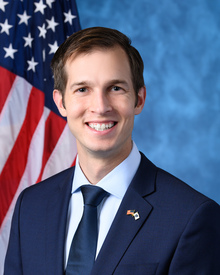
See how Jake Auchincloss actually votes — against your values.
DeepSyte scores Jake Auchincloss's record on the issues you care about — not party, not press releases. Take the 2-minute values quiz to see your personal alignment.
Sign in and take the values quiz to see how Jake Auchincloss's votes line up with your views.
Prediction track record
How often we called Jake Auchincloss's passage votes correctly, from their stated positions on each bill's tagged topics. Excludes “unclear” calls and abstentions.
To prohibit the disclosure of records by the Secretary of Housing and Urban Development of individuals for the purposes of immigration enforcement, and for other purposes.
No paired statements and votes yet for Jake Auchincloss
We haven't yet found statement/vote pairs on the same topic for Jake Auchincloss. This usually means either the rep hasn't taken public positions on bills that have come to a passage vote, or those bills haven't been tagged yet. The checker runs as new press releases and votes come in.
Pro analysis
AI rep analysis — Pro
Get an AI-narrated read on Jake Auchincloss's full voting record against your stated values — aligned themes, conflicts, notable votes, and what to watch for.
Positions Jake Auchincloss took during their campaign, scored against their subsequent record — public statements cross-checked with related votes. “Kept” means 80%+ of those statement-vs-vote pairs aligned; “Broken” means 30% or fewer.
0 kept0 broken0 mixed2 no action yet
Jake Auchincloss has 2 tracked positions but no scored statement-vs-vote pairs touching them yet. Verdicts will appear here as related statements and votes accumulate.
No action yetSupports
Medicare should be allowed to negotiate lower prescription drug prices.
“fighting special interests to lower drug prices for seniors and the middle class”
Passage votes where Jake Auchincloss broke ranks with ≥75% of Democrats. Threshold catches substantively partisan splits; unanimous-ish or close votes are excluded.
Providing for congressional disapproval under chapter 8 of title 5, United States Code, of the rule submitted by the Securities and Exchange Commission relating to "Staff Accounting Bulletin No. 121".
RELEASE: Auchincloss, Warren, Harshbarger, Hawley Reintroduce Bipartisan Legislation to Rein in Pharmacy Benefit Managers (PBMs), Cut Drug Costs | U.S. Congressman Jake Auchincloss Of Massachusetts 4th District
Position: The release advocates for legislation that prohibits pharmacy benefit managers and their parent companies from owning pharmacy chains, requires divestment of conflicting pharmacy businesses, and strengthens federal antitrust enforcement against PBM consolidation to reduce drug costs and protect independent pharmacies.
Contact: Georgina.Burros@mail.house.gov (Auchincloss)
RELEASE: Auchincloss, Warren, Harshbarger, Hawley Reintroduce Bipartisan Legislation to Rein in Pharmacy Benefit Managers (PBMs), Cut Drug Costs
WASHINGTON, D.C. – Representatives Jake Auchincloss (D-MA) and Diana Harshbarger (R-TN), alongside Senators Elizabeth Warren (D-MA) and Josh Hawley (R-MO), reintroduced the Patients Before Monopolies (PBM) Act with expanded bipartisan support to rein in drug pricing middlemen, known as pharmacy benefit managers (PBMs), from enriching themselves and crushing competition at the expense of patients and independent pharmacies.
In the 119th Congress, new original cosponsors include Senators John Fetterman (D-PA) and Roger Marshall (R-KS), alongside Representatives Greg Landsman (D-OH) and Buddy Carter (R-GA) of the Committee on Energy and Commerce, and Jerry Nadler (D-NY) and Troy Nehls (R-TX) of the Judiciary Committee.
Since the PBM Act was first introduced in 2024, states across the country have sought to break up these giant conglomerates. In early 2025, Arkansas passed a law to prevent the joint ownership of PBMs and pharmacies. Later that year, 39 state attorneys general wrote a letter urging Congress to “pass[] an act prohibiting PBMs, their parent companies, or affiliates from owning or operating pharmacies.” In April, Tennessee lawmakers passed a law to ban joint ownership of PBMs and pharmacies, and the Tennessee Governor is expected to sign the bill into law as soon as this week. This growing bipartisan momentum in support of the goals of the PBM Act from across the nation sends an important signal to Congress that the work to rein in PBMs is not yet finished.
Over the past decade, PBMs have morphed into large health care conglomerates that exercise control over nearly every link of the prescription drug delivery chain. Today, the largest health care conglomerates each own a PBM — which pays for pharmacy services — as well as the pharmacy chains that provide those services. This inherent conflict of interest results in higher drug costs for patients and fewer independent pharmacies, but bigger profits for the corporate health care giants.
The Patients Before Monopolies (PBM) Act will address this by:
Prohibiting a parent company of a PBM or an insurer from owning a pharmacy business;
Requiring that a parent company in violation of the PBM Act divest its pharmacy business within one year of the bill’s enactment;
Creating automatic penalties if a company fails to divest in a timely manner, including disgorgement of profits and forced sales of assets in the event of noncompliance;
Enabling the Federal Trade Commission (FTC), Department of Health and Human Services (HHS), Antitrust Division of the Department of Justice (DOJ), and state attorneys general to bring lawsuits requiring violators of the PBM Act to divest their pharmacy business and disgorge any revenue received during the period of such violation;
Enabling private parties, including independent pharmacists, to bring lawsuits against violators of the bill, and secure treble damages in successful lawsuits;
Directing the FTC to distribute any revenue raised by penalties to harmed communities, including consumers overcharged at vertically integrated pharmacies; and
Allowing the FTC and DOJ to review and block future actions that would recreate the anticompetitive conditions addressed by the bill or harm the public interest.
“Like so many small business owners in America, independent pharmacists are working hard and playing by the rules but getting ripped off by monopolies,” said Rep. Auchincloss. “The PBM industry is rife with self-dealing and price gouging. Congress made modest but meaningful reforms earlier this year, and now the next step is banning PBMs from owning pharmacies. It's an unacceptable conflict of interest and yet another example of the vertical integration in health care that is raising prices for patients.”
“Our PBM Act is gaining momentum because people are realizing that you can’t lower health care costs without tackling corporate greed in the health care system,” said Senator Warren. “It’s time we finally rein in the health care middlemen that are jacking up drug costs and driving small pharmacies out of business.”
“Americans are paying more and more for healthcare while seeing less in return. PBMs are at the center of a broken system that rewards middlemen while driving up costs for patients and pushing out independent pharmacies,” said Senator Hawley. “Working Americans deserve better. This legislation is a major step toward restoring transparency and making healthcare more affordable for every American.”
“As a lifelong pharmacist, I’ve seen firsthand how PBMs game the system. When the same corporate giant that sets reimbursement rates also owns the pharmacy collecting them, that’s not a free market—it’s a rigged one,” said Rep. Diana Harshbarger. “We have antitrust laws for a reason. When monopolies squeeze out independent pharmacies, raise costs for patients, and reduce consumer choice, Congress has a duty to restore fair competition. The Patients Before Monopolies Act ends this blatant conflict of interest once and for all.”
"Pharmacy Benefit Managers drive prices up for patients and run independent pharmacies out of business,” said Rep. Jerry Nadler. “These greedy corporations have dodged regulation at the cost of American patients and small businesses for far too long. For my entire career, I have fought to make healthcare accessible for all Americans, and I am proud to support this bill reining in PBMs and enforcing fair business practices.”
“We’re taking on these giant healthcare companies to get prescription drug prices down, and to protect our family-owned pharmacies,” said Rep. Greg Landsman. “These companies make billions in part because they control so much of the market, but our bill will change that and put patients first.”
“Pharmacy Benefit Managers (PBMs) have been stealing hope and health from the American people for decades, inflating prescription drug costs, forcing pharmacy closures, and blocking access to medications.” As a pharmacist from coastal Georgia, I came to Congress with the goal of building a health care system that puts patients before profits,” said Congressman Buddy Carter. “I proudly support the Patients Before Monopolies Act, which builds on my previous PBM legislation signed into law last January, to continue cracking down on PBMs’ anti-competitive practices.”
“Americans are sick and tired of giant corporations putting profits over patients,” said Congressman Troy Nehls. “For too long, the largest Pharmacy Benefit Managers (PBMs) have manipulated the prescription drug market supply chain, crushed independent pharmacies, and have driven up costs for patients. I’m proud to be an original cosponsor on this bipartisan legislation to restore accountability, protect local pharmacies, and lower costs for American families.”
“PBM vertical integration with retail, mail-order, and specialty pharmacies has led to reduced patient choice and higher drug prices for patients and payers. The Patients Before Monopolies Act cuts out PBM conflicts of interest at their root by breaking up PBM ownership of and affiliation with pharmacies. APCI commends Senators Warren and Hawley, and Representatives Harshbarger and Auchincloss on fighting against PBM anticompetitive practices and advancing policies that will restore competition to the prescription drug marketplace,” said Greg Reybold, Vice President of Public Policy, American Pharmacy Cooperative, Inc.
“With the reintroduction of the Patients Before Monopolies Act (PBM Act), we are grateful to Senators Warren and Hawley and Representatives Harshbarger and Auchincloss for standing up for patients and pharmacies. For too long, the largest health insurers have resorted to fear and intimidation tactics, expending substantial resources in order to scare and confuse the public into thinking PBM reform will be bad for them. With this new legislation, PBMs will finally be held accountable for years of abusing their role as ‘benefits administrators’ to undercut pharmacy providers while also profiteering off the backs of unsuspecting employers, patients and taxpayers,” said Monique Whitney, Executive Director, Pharmacists United for Truth and Transparency.
“Divesting PBMs from owning pharmacies will stop the conflict of interest that drives patients into PBM-owned specialty pharmacies where specialty generic drug prices are kept artificially high. The Patients Before Monopolies Act levels the playing field for community pharmacists and finally puts patients ahead of PBM profits,” said Madelaine Feldman, MD, FACR; Rheumatologist; Vice President, Advocacy & Government Affairs; Coalition of State Rheumatology Organizations; New Orleans, Louisiana.
“Giant PBMs and insurers owning their own pharmacies has driven independent pharmacies out of business and reduced patient access to quality care. The Patients Before Monopolies Act addresses the root cause of this problem — consolidated market power — by eliminating the inherent conflicts of interest within the 'Big Three' PBM business model,” said Morgan Harper, Director of Policy and Advocacy, American Economic Liberties Project. “We are thrilled to see Sen. Warren and Sen. Hawley and Reps. Harshbarger and Auchincloss lead this bipartisan effort to lower drug costs, protect independent retail pharmacies, improve patient access to care, and break up Big Medicine.”
“The Patients Before Monopolies Act takes an important step toward restoring integrity and competition in healthcare by ending the deeply flawed model where PBMs and insurers can own the very providers they oversee and reimburse,” said Robert Levin, MD, President, Alliance for Transparent & Affordable Prescriptions. “When the same corporations control the financing, administration, and delivery of care, patients and independent providers are put at a disadvantage. Healthcare decisions should be driven by what is best for patients, not by vertically integrated corporations maximizing profits through self-preferencing and consolidation.”
“American Pharmacies strongly supports the Patients Before Monopolies Act. When PBMs own pharmacies, the resulting self-dealing and conflicts of interest distort the marketplace and too often undermine affordable, accessible, patient-centered care. American Pharmacies and our 700 independent pharmacy members across the country thank the bill’s sponsors for their leadership in confronting one of the root causes of rising costs and barriers to care,” said Steve Hoffart, R.Ph., Chairman, American Pharmacies.
“PBMs have a choice — operate as a PBM or operate as a pharmacy, but you can’t have it both ways,” said B. Douglas Hoey, pharmacist, MBA, CEO, National Community Pharmacists Association. “Having both functions under one roof is a huge conflict of interest and drives up prescription drug prices. The Patients Before Monopolies Act is critical in supporting patients and independent pharmacies and restoring a free market. NCPA is proud to support it and thanks Reps. Harshbarger, Auchincloss, Carter, Nadler, and Nehls, and Sens. Warren, Hawley, Marshall and Fetterman for their leadership.”
RELEASE: Congressman Auchincloss questions Secretary Kennedy on FDA whistleblower disclosures, White House fast-tracking of psychedelics | U.S. Congressman Jake Auchincloss Of Massachusetts 4th District
Position: Congressman Auchincloss questions FDA Commissioner Makary's use of the Commissioner's National Priority Voucher program to fast-track psychedelic drug approvals based on political influence rather than scientific merit, and raises concerns about compromised scientific standards and political pressure within the agency.
Contact: Georgina.Burros@mail.house.gov (Auchincloss)
WASHINGTON, D.C. – Today, Congressman Jake Auchincloss (D, MA-04) questioned Health and Human Services Secretary Robert F. Kennedy Jr. at a House Energy and Commerce Health Subcommittee hearing about the recent decision by the Food and Drug Administration (FDA) to fast track three approvals for psychedelics under the Commissioner’s National Priority Voucher (CNPV) program, based on a text Joe Rogan sent to President Trump. One of these psychedelics was previously denied by the FDA in 2024.
Representative Auchincloss has dialed up the pressure on Commissioner Makary for months regarding his CNPV program, which has allowed for accelerated drug and biologic approvals not for the most promising scientific discoveries, but for companies with ties to MAGA.
Please find below the full disclosures from current and former FDA staff Rep. Auchincloss shared today, as well as a portion of Rep. Auchincloss’ exchange with Secretary Kennedy.
These disclosures from current and former FDA staff shared with the congressman’s office support public reporting of political pressure at the FDA:
1. “Over the past year, FDA career staff have been alarmed and demoralized by the reckless changes at our Agency. This administration has approached FDA with a fundamental suspicion of career staff and with an appalling focus on ‘media wins.’ These ‘media wins’ have been anything but wins for our Nation’s public health. Rather than the purported ‘gold standard science’ FDA staff have been subject to a steady, unrelenting compromise of our scientific standards to support ideologically driven policy goals, and to promote the careers of short-sighted political appointees, who are more focused on media sound-bites and their own self-promotion than our Nation’s health.”
2. “Dr. Makary began his FDA tenure with the promise of upholding principles of gold standard science, radical transparency, and common sense. In addition, based on his public positions regarding inappropriate influence of the pharmaceutical industry on the Agency, he had the promise of upholding the independence of FDA scientific decision making and keeping the Agency free of corruption.
In practice, Dr. Makary's tenure has been essentially Orwellian in nature, going directly against his stated principles every day while obsessively focusing on his external image. Rather than pursuing gold standard science, his appointees in senior leadership roles start with the conclusion and search for evidence to support it. Rather than convening panels of external scientific experts with a range of perspectives, he convenes so-called "expert panels" with cherry-picked panelists who share his opinion. In contrast to radical transparency, he works in siloed and secretive groups with very limited input from staff scientists, and career staff learn about new policies after they are announced in press releases or journal articles. In contrast to common sense, he appoints people to senior scientific leadership positions based more on loyalty to him and being a good soldier, regardless of their qualifications or competence to do the job. And rather than reducing potential corruption from industry, his approach has made direct lobbying to the Commissioner's Office a smart and productive business practice for companies to get what they want, favoring companies that are more politically connected.
The end result of his disastrous leadership is a chaotic and unpredictable FDA that makes decisions based on politics and is bleeding leaders with principles and scientific neutrality. This is completely unacceptable for a premier public health agency that is expected by the American public to ensure safe and effective medical products and other products under its regulatory purview.”
3. “I recently left FDA due to the political pressure I was receiving to withhold my recommendation for approval for a drug that was intended for a rare disease. I was part of a review division that was constantly under pressure. Specifically for this recent example, we met frequently with Prasad and other FDA leadership who emphasized the drug should not be approved. However, from the review document and my experience, it would have been approved had it not been for the political pressure.”
Please find the full video of Rep Auchincloss’s exchange with Secretary Kennedy here.
Secretary Kennedy: I can tell you that all the decisions that have been made at that agency are made with the approvals of panels of career scientists.
Auchincloss: That's just not true. So let me reclaim my time. That is categorically false, because there is, in fact, a program called the Commissioner's National Priority Voucher Program. I've been investigating that as well for the last six months. This program expressly allows political leaders to short-circuit science and pick and choose politically favored treatments. Now, White House and FDA leadership have pressed staff to award vouchers to certain companies as part of White House pressure campaigns. Most recently—and egregiously—the FDA just issued three of those vouchers for psychedelics based on a text from Joe Rogan. And one of those psychedelics was denied by the FDA in 2024.
So let's just go through what happened here. Joe Rogan had a guest on his podcast, and the guest was talking about psychedelics. Joe Rogan texted the President of the United States, and the President texted back: “Sounds great. Do you want FDA approval? Let's do it.” That was from the President of the United States.
So just to be clear, is the President of the United States allowed to grant FDA approval?
Secretary Kennedy: The career staff—
Auchincloss: Is the President of the United States allowed to grant FDA approval?
Secretary Kennedy: Career staff at FDA have all supported that decision.
Auchincloss: Is the President of the United States allowed to grant FDA approval? Because he thinks he is. Is he wrong?
Secretary Kennedy: He doesn't do it.
Auchincloss: He doesn't do it. So—and yet the FDA, within hours—
Secretary Kennedy: There's been no FDA approval—
Auchincloss: Issued three priority vouchers from this illegal, unauthorized program to respond to political pressure from the White House. Secretary, this flies in the face of your stated commitment to putting science over politics.
RELEASE: Joint statement from bipartisan Kids Online Safety Caucus co-chairs Reps. Jake Auchincloss and Erin Houchin on the Meta, YouTube social media trial verdict | U.S. Congressman Jake Auchincloss Of Massachusetts 4th District
Position: The representatives support federal legislation requiring age assurance for online platforms and holding them liable for protecting children, arguing that litigation alone is insufficient to address social media companies' exploitation of minors.
“Today is a good day in the overdue effort to hold social media corporations accountable. Meta and YouTube tried to deny, deflect, and delay – but a jury heard the evidence and found them negligent in how they designed their apps for children. However, Congress must be clear-eyed about the limits of litigation. Going forward, the platforms will change their terms of service language and continue to hide their exploitation of children behind bad-faith Section 230 defenses. Lawmakers must come together in a bipartisan effort to pass a federal age assurance law that raises the age of Internet adulthood to at least 16 years old and holds apps liable for adhering to it. We have the bills, we’re on the committee of jurisdiction, and we’re committed to working together to make it happen.”
Representatives Jake Auchincloss (D-MA) and Erin Houchin (R-IN)
Contact:
Georgina.Burros@mail.house.gov (Auchincloss)
Parker.Armstrong@mail.house.gov (Houchin)
RELEASE: Reps. Auchincloss and Amodei Introduce the Hot Rock Act to Unleash Next-Generation Geothermal Energy | U.S. Congressman Jake Auchincloss Of Massachusetts 4th District
Position: Representatives Auchincloss and Amodei introduced the Hot Rock Act to promote research, development, and deployment of superhot rock geothermal energy through federal grants, permitting reform, and workforce training programs.
Contact: Georgina.Burros@mail.house.gov (Auchincloss)
WASHINGTON, D.C. – Today, Representatives Jake Auchincloss (D, MA-04) and Mark Amodei (R, NV-02) introduced the Hot Rock Act, which promotes the research, testing, and development of superhot rock geothermal energy – one of the most promising clean-energy technologies. This legislation aims to unleash clean, affordable, reliable power across the United States.
This innovative and cost-effective system extracts and produces geothermal energy from natural heat stored in rock or fluid at temperatures of 300 degrees Celsius or greater. In practice, hot dry rock geothermal projects can produce electricity or industrial heat by injecting water deep into geothermal reservoirs, heating it, and returning it to the Earth’s surface as steam.
Superhot rock geothermal promises to expand the map of where geothermal is feasible by drilling deep enough to reach resources that exist everywhere, not just in areas rich with shallower geothermal resources.
This legislation supports the acceleration of superhot rock geothermal development by:
creating milestone-based research grant programs,
authorizing a frontier field research observatory,
reforming geothermal permitting to make geothermal deployment easier, and
a workforce cross-training program to train workers for the geothermal industry.
Please find the full text of the bill here.
“Clean, abundant energy is the most important industrial policy the United States can pursue. Promoting superhot rock geothermal is a big, bipartisan opportunity to make progress,” said Congressman Auchincloss. “This strategic industry has huge potential: lower utility bills, more jobs, climate action, and greater leverage in energy diplomacy."
“A recent USGS study found that enhanced geothermal systems in the Great Basin could supply approximately 10 percent of the nation’s electricity demand,” said Rep. Mark Amodei. “Nevada has the potential to unlock this resource and lead the nation in reliable, clean energy. From powering rural communities and strengthening critical mineral production to meeting the growing demands of data centers, geothermal energy delivers dependable 24/7 power. This bill encourages job creation across the West by formally recognizing these superhot resources and making them eligible for federal assistance in research, development, and exploratory activities.”
"Quaise Energy applauds Reps Auchincloss and Amodei for introducing the Hot Rock Act,” said Matt Houde, Co-founder and Chief of Staff, Quaise Energy. “This bill recognizes that the future of energy lies in unlocking the vast superhot rock beneath our feet. By investing in the research and workforce necessary for terawatt-scale geothermal and laying the foundation of a commercial demonstration program, the Hot Rock Act sets up a new era of clean, firm, baseload power that can be deployed virtually anywhere.”
“Next generation geothermal is the next frontier of innovation in American energy,” said Alec Stapp, Co-CEO, Institute for Progress. “The energy under our feet has the potential to provide abundant base load power to improve reliability and lower costs. But harnessing the full potential of geothermal energy will require innovation to operate in deep, supercritical conditions. The Hot Rock Act comprehensively supports supercritical geothermal R&D by balancing targeted government investment with smart incentives for private companies and targeted regulatory reforms. IFP commends Congressman Auchincloss for his forward looking work to support innovation in American energy.”
“Next-generation geothermal technologies, including superhot rock systems, can play a critical role in meeting America's growing need for reliable, affordable energy,” said Ryan Fitzpatrick, Vice President of Climate and Energy, Third Way. “Scaling these innovative systems requires robust support from Congress and ambitious policymaking to unlock the full potential of our geothermal resources. We applaud Reps. Auchincloss and Amodei for advancing creative solutions to pave the way for these innovative clean technologies.”
“The Hot Rock Act offers support to a next-generation geothermal technology with much promise for energy reliability and abundance,” said Elan Sykes, Director of Energy and Climate Policy at the Progressive Policy Institute. “This bill has the potential to both strengthen U.S. energy security and create high-quality jobs in communities across the country.”
“The Hot Rock Act is a step in the right direction for unlocking America's vast geothermal potential,” said Derek Kaufman, President of Inclusive Abundance Action. “Representatives Auchincloss and Amodei are right that geothermal energy deserves serious federal investment to bring down electricity costs nationwide, and we're encouraged to see bipartisan momentum behind the kind of R&D support and workforce development that can accelerate deployment.”
“Our grassroots volunteers nationwide are eager to see more clean energy options in the United States, and many of them are excited by the promise of reliable, around-the-clock clean power from next-generation geothermal energy. The Hot Rock Act takes a positive step toward realizing that promise by making critical investments in research, demonstration, and workforce development that can unlock superhot geothermal resources safely and responsibly,” said Jennifer Tyler, VP Gov Affairs, Citizens' Climate Lobby. “We applaud Congressman Auchincloss and Congressman Amodei for their leadership in advancing responsible energy innovation and expanding America’s clean, firm power future.”
“Powering American reindustrialization will require marshaling all of our energy resources, including the ones beneath our feet,” said the New American Industrial Alliance. “The Hot Rock Bill leads the way in developing next-generation geothermal technology with smart, measurable goals and streamlined review processes to one day make hot dry rock a clean energy alternative for American builders. NAIA thanks Rep. Auchincloss and Rep. Amodei for their leadership in this effort.”
“This bipartisan bill would accelerate next-generation geothermal technologies and expand the geography where clean firm resources can be deployed,” said the Clean Energy Buyers Association. “By bolstering U.S. Department of Energy programs, supporting subsurface research, and streamlining exploration approvals, the Hot Rock Act would help superhot geothermal become an affordable, reliable, carbon emissions-free energy source.”
"America’s world-leading drilling expertise is a strategic technological advantage well worth new investment, particularly for tapping superhot underground geothermal heat energy,” said the Breakthrough Institute. “Targeted funding to support innovative technology development and deployment in geothermal power is a key part of national planning for an abundant American energy future. The Breakthrough Institute commends Representatives Auchincloss and Amodei for introducing the bold and forward-thinking Hot Rock Act, which aims to supercharge U.S. leadership in an emerging energy sector poised for growth.”
RELEASE: Reps. Auchincloss and Bergman Defend FQHCs from Financial Constraints Amidst 340B Reform | U.S. Congressman Jake Auchincloss Of Massachusetts 4th District
Position: Representatives Auchincloss and Bergman introduced legislation to exempt Federally Qualified Health Centers and Community Health Centers from the Trump administration's proposed 340B Rebate Model Pilot Program, arguing that a rebate-based model would strain limited resources and undermine patient care by forcing providers to pay full drug prices upfront while waiting for reimbursement.
Contact: Georgina.Burros@mail.house.gov (Auchincloss)
WASHINGTON, D.C. – Representatives Jake Auchincloss (D, MA-04) and Jack Bergman (R-MI-01) introduced the Community Health Center Drug Pricing Protection Act to exempt Community Health Centers (CHCs) and Federally Qualified Health Centers (FQHC) from the Trump administration’s proposed 340B Rebate Model Pilot Program.
CHCs are effective stewards of health care dollars, accounting for just one percent of U.S. health care spending while treating ten percent of Americans. CHCs and FQHCs provide care to medically underserved, low-income, and rural communities while operating on the thinnest margins in the health care system. The 340B Program allows these providers to purchase outpatient drugs at discounted prices and reinvest those savings directly into patient care, guaranteeing access to care regardless of a patient’s ability to pay.
Recent efforts by federal regulators and drug manufacturers to shift the 340B Program from an up-front discount model to a rebate-based model for CHCs would force health centers to pay the full price of drugs up front and wait for reimbursement. This approach would strain already limited resources and undermine existing patient care.
The Community Health Center Drug Pricing Protection Act would exempt FQHCs and CHCs from rebate-based pricing by prohibiting manufacturers from charging more than the 340B ceiling price at the time of purchase. This would provide CHCs and FQHCs with financial reprieve in the near-term while lawmakers continue to negotiate on the 340B Program. The bill would protect access to care while keeping faith with Congress’s original intent for the 340B Program.
“The 340B program needs reform, but not on the backs of community health centers. Congress must ensure that both sections 330 and 340 are financially supporting health centers as the pillars of primary care in America,” said Rep. Auchincloss.
“Community Health Centers are a lifeline for rural and underserved communities, and the 340B Program must work the way Congress intended,” said Rep. Bergman. “Forcing these providers to front the full cost of expensive drugs and wait on rebates would put patient care at risk. This bipartisan bill ensures health centers can keep resources where they belong - delivering care to the patients who need it most.”
“I want to thank Congressman Bergman and Congressman Auchincloss for sponsoring this bill to exempt Community Health Centers from any future 340B rebate pilots. The 340B program is a lifeline for the 34 million patients health centers serve nationwide, and every dollar of savings is reinvested into patient care—helping cover the cost of medications and expanding access to services like dental, vision, and behavioral health. A rebate model would shift financial risk onto safety-net providers who cannot afford to front full drug prices while waiting for reimbursement. That would destabilize community health centers, jeopardize patient care, and undermine the intent of the 340B program,” said Michael Curry, President & CEO, Massachusetts League of Community Health Centers.
“The Community Health Center Drug Pricing Protection Act will provide critical protection for FQHCs from the harmful impacts on our patients and health centers of a 340B rebate-based pricing model,” said Phillip Bergquist, Chief Executive Officer, Michigan Primary Care Association. “A 340B rebate model would disrupt access to needed medications and treatments for our patients and place significant administrative, financial, and operational burdens on health centers. We applaud this effort to preserve the 340B program’s intent of increasing access to affordable medications and defend health centers' ability to utilize the 340B program to support access to essential care for patients.”
“Community Health Centers (CHC) serve 52 million people — including 1 in 3 rural residents — and the 340B program is essential to keeping care within reach for all Americans. Exempting CHCs from any rebate model ensures that every 340B dollar continues to support affordable medications and access for low income and rural communities who rely on us the most. We are grateful to Congressman Jack Bergman for leading this bill that protects the care CHC patients depend on every day,” said Kyu Rhee, MD, MPP, President and CEO, National Association of Community Health Centers.
Reps. Auchincloss, Comer, and Harshbarger Introduce the Bipartisan Pharmacists Fight Back Act | U.S. Congressman Jake Auchincloss Of Massachusetts 4th District
Position: The release advocates for the Pharmacists Fight Back Act, which would impose stricter regulations on pharmacy benefit managers (PBMs), including transparent reimbursement models, restrictions on steering patients to affiliated pharmacies, and enhanced oversight of PBMs in federal health plans.
WASHINGTON, D.C. – Today, U.S. Representatives Jake Auchincloss (D, MA-04), Diana Harshbarger (R, TN-01), and House Committee on Oversight and Government Reform Chairman James Comer (R, KY-01) introduced the Pharmacists Fight Back Act to tackle the manipulative practices of Pharmacy Benefit Managers (PBMs) – the middlemen of drug pricing. PBMs are directly responsible for driving up drug costs by thousands of dollars, gouging community pharmacists, and limiting patient choice in federal health care plans. This bipartisan legislation is the most comprehensive PBM reform in federal health plans introduced this Congress.
Patients, community pharmacies, and taxpayers have been forced to shoulder the burden of rising drug prices at the hands of PBMs. The lack of PBM accountability has inflated drug costs for families at the pharmacy counter and driven the closures of independent and community-based pharmacies. On average, one independent pharmacy closes every day in the US.
The Pharmacists Fight Back Act prohibits PBMs from engaging in predatory behaviors. The bill implements a transparent pharmacy reimbursement model using market-based pricing benchmarked to the National Average Drug Acquisition Cost (NADAC). It also removes the ability of PBMs to limit the network of pharmacies patients may choose to use and protects community pharmacists by prohibiting PBMs from steering patients to PBM-affiliated pharmacies. It enforces stricter penalties and more stringent oversight of PBMs working with federal health plans.
Please find both versions of the Pharmacists Fight Back Act under their respective jurisdictions under the House Committee on Energy & Commerce and the House Oversight Committee.
Please find the full press conference here, including remarks from Reps. Jake Auchincloss (MA-04), James Comer (KY-01), Diana Harshbarger (TN-01), Buddy Carter (GA-01), Sanford Bishop Jr. (GA-02), and Rashida Tlaib (MI-12).
“Americans want lower prices and a fair shot for small businesses. This bill delivers both. With support from the most progressive to the most conservative Members, Pharmacists Fight Back will lower prescription prices and put independent pharmacists on the level playing field they deserve,” said Rep. Auchincloss.
“Rarely does a day go by without hearing from my constituents in Kentucky who are struggling under the weight of soaring prescription drug costs. The questions I hear time and again are: Why is this happening? And who is benefiting? My response is the same each time, it’s the PBMs—the pharmacy benefit managers—who sit in the middle of nearly every prescription transaction,” said Chairman Comer. “PBMs have abused their position as middlemen to line their own pockets by retaining rebates and fees, undermine our community pharmacists and pass along costs to patients at the pharmacy counter. Congress has a responsibility to act and that's why I am proud to support the bipartisan Pharmacists Fight Back Act. This legislation takes meaningful steps to protect patients and our community pharmacists, ensuring they can access and provide affordable, life-saving medications to Americans without PBM interference. I look forward to working with Rep. Auchincloss, Rep. Harshbarger, and our local pharmacists to get this legislation to the President’s desk.”
“Patients and community pharmacists are being hurt by a system that PBMs have distorted for years which drives up out-of-pocket costs and forces local pharmacies out of business,” said Congresswoman Harshbarger. “The Pharmacists Fight Back Act introduces the transparency and fairness needed to stop PBM abuses and protect patient choice. This bill is about putting patients over profits and restoring a system that works for everyone.”
“PBMs, acting as government contractors in federal healthcare programs, are exploiting their position by under-reimbursing independent pharmacies. They are also steering patients towards and over-reimbursing PBM-affiliated pharmacies and denying patients the benefit of drug maker rebates at the pharmacy counter,” said Greg Reybold, Vice President of Healthcare Policy & General Counsel at the American Pharmacy Cooperative, Inc. “These unfair PBM practices harm independent pharmacies, limit patient choice and access to care, and result in poorer medication adherence and health outcomes, all while increasing costs for patients and taxpayers. The Pharmacists Fight Back Act brings these unfair practices to a screeching halt and will restore transparent market-based pricing for patients and pharmacies. APCI proudly endorses the Pharmacists Fight Back Act, and we extend our gratitude to Representatives Auchincloss, Comer, and Harshbarger for their work in introducing this legislation.”
“Big insurers have been gaming the system for years, using PBMs to boost their profits while patients, taxpayers, and local pharmacies pay the price,” said Rachel Madley, PhD, Director of Policy and Advocacy at the Center for Health and Democracy. “The Pharmacists Fight Back Act will rein in profiteering by monopolistic insurers that own PBMs and pharmacies, and lower prescription drug costs for patients who depend on these medications to live.”
“Pharmacy Benefit Managers (PBMs) have long exploited a lack of transparency and accountability, driving up patients’ out-of-pocket costs for life-saving medicines,” said Dr. Robert Popovian, Pharm.D., MS, Pioneer Institute and Global Healthy Living Foundation. “For decades, these intermediaries, who do not contribute to patient care, have evaded federal oversight. The Global Healthy Living Foundation commends bipartisan efforts to rein in PBMs and ensure patients can access innovative medicines at fair, affordable costs.”
While PBMs claim to create "savings" through manufacturer rebates and discounts, those “savings” rarely trickle down to the patient. The Pharmacists Fight Back Act will not only reduce beneficiaries out-of-pocket costs by passing rebates directly back to the patient, but will also ban plans from mandating higher priced brand name drugs over lower priced generics on formularies, foster transparency and promote fairness in the system by prohibiting PBMs from steering patients to their own pharmacies; not to mention the hefty fine PBMs will pay for each violation,” said Madelaine Feldman, MD, FACR; Rheumatologist; Vice President, Advocacy & Government Affairs; Coalition of State Rheumatology Organizations.
"AMAC Action, the advocacy affiliate of the Association of Mature American Citizens (AMAC), with 2 million members nationwide, strongly supports the Pharmacists Fight Back Act,” said Andy Mangione, Senior Vice President of AMAC Action. “PBMs have exploited their power for years, driving up drug prices while squeezing the very pharmacies seniors rely on. Seniors deserve a system built on transparency, accountability, and respect for the pharmacists who keep them healthy. AMAC Action stands firmly with those demanding real reform and an end to PBM practices that put profits ahead of patient well-being.”
Congressman Auchincloss introduces the Education Not Endless Scrolling Act to impose a digital ad tax on Big Tech to fund trades education and promote one-on-one tutoring | U.S. Congressman Jake Auchincloss Of Massachusetts 4th District
Position: Congressman Auchincloss introduced legislation to impose a 50% excise tax on digital advertising revenue above $2.5 billion for large social media companies, with revenue directed to one-on-one tutoring, vocational-technical schools, and local journalism support.
WASHINGTON, D.C. – This week, U.S. Representative Jake Auchincloss (D, MA-04) introduced the Education Not Endless Scrolling Act, which would impose a 50% excise tax on digital advertising revenue above $2.5 billion, taxing the trillion-dollar social media corporations and directing those funds to one-on-one tutoring, vocational-technical schools, and local journalism. Congresswoman Maggie Goodlander (D, NH-02) is an original co-sponsor of this bill.
The United States faces an information crisis. Big Tech has eroded our political discourse and civil society by platforming click-bait and slop. These merchants and miners of digital dopamine use bits of software — social media, online gambling, and other apps — to manipulate humans’ reward systems and create addictive behavior. Two of the greatest casualties have been the attention spans of American children and local journalism.
According to Northwestern University’s Local News Initiative, 40% of all local U.S. newspapers have vanished, leaving 50 million Americans with little or no access to credible local reporting. When Big Tech usurps local journalism in pursuit of increased digital ad revenue, communities become less resilient, less informed, and ultimately less democratic.
Children are more vulnerable to the effects of digital dopamine than any other demographic. They are also a lucrative audience. Harvard researchers reported that youth ages 0–17 generated nearly $11 billion in 2022 ad revenue across six major social media platforms, with three platforms deriving 30–40% of their ad revenue from young users. This legislation seeks to reinvest that revenue into high-dosage one-to-one tutoring and building vocational-technical schools that would have in-real-life benefits to students across the United States.
To address these challenges, the Education Not Endless Scrolling Act directs and divides the tax revenue it generates from Big Tech among the following three funds:
“The future must be built, not bought. Americans have a choice: allow tech titans to exploit our economy and epistemology, or tax their trillions to invest in jobs and journalism,” said Congressman Jake Auchincloss.
“Big Tech monopolists are endangering the health and safety of America’s kids, destroying American jobs, and crushing the free press in communities across our country. For what? Profit,” said Congresswoman Maggie Goodlander. “It’s time to hold these big corporations accountable and invest in the sources of America’s strength: our students, our workers, and our small businesses.”
Auchincloss, Maloy introduce bipartisan bill carving out bots & deepfakes from social media platforms' Section 230 liability shield | U.S. Congressman Jake Auchincloss Of Massachusetts 4th District
Position: Representatives Auchincloss and Maloy introduced legislation to condition Section 230 liability protections on platforms implementing a duty of care to address deepfakes, bots, and cyberstalking, and to clarify that AI-generated content is not covered by Section 230 protections.
WASHINGTON, D.C. –Today, U.S. Representatives Jake Auchincloss (D, MA-04) and Celeste Maloy (R, UT-02) introduced the Deepfake Liability Act to tackle the steep rise of deepfake pornography without the consent of the deepfake’s subject. 98% of online deepfake imagery is deepfake pornography–99% of which targets women. This has led to a rise of widely available ‘nudification apps’ used to create convincing deepfakes of female teenagers.
Section 230’s liability shield for online platforms removes their incentive to ensure users’ safety or address harmful content on their platforms. The Deepfake Liability Act conditions the applicability of Section 230’s liability shield on a platform implementing a duty of care: a set of basic steps that requires companies to be responsive to complaints about cyberstalking and abusive deepfakes. It also amends the definition of “information content provider” in Section 230 to clarify that AI-generated content is not covered by Section 230 protections.
This legislation implements the notice and removal provisions of the TAKE IT DOWN Act, which passed and became law this Congress. The bill also requires that this duty of care include the implementation of:
“AI shouldn’t have special privileges & immunities that journalists don’t get,” said Congressman Jake Auchincloss. “Using bots or deepfakes to violate or stalk another person is reprehensible, and it needs to be a CEO-level problem for the trillion-dollar social media corporations that platform it. Congress needs to get ahead of this growing problem, instead of being left in the dust like we were with social media.”
“Abusive deepfakes and cyberstalking are harming people across the country, and victims deserve real help. Our bill creates a straightforward duty of care and a reliable process to remove harmful content when victims ask for help,” said Congresswoman Celeste Maloy. “Companies that take this seriously will keep their protections under the law. Those that do nothing will be held accountable.”
“The time is now to reform Section 230. For too long, online platforms have been shielded from liability for online abuse that we know silences victims and ruins lives. Nearly every industry owes basic duties to prevent foreseeable harm; with this bill, so will the tech industry. This bill imposes a well-defined duty of care on online platforms to prevent, investigate, and remove cyberstalking, nonconsensual intimate images, and digital forgeries,” said Danielle Keats Citron, Vice President of the Cyber Civil Rights Initiative. “The bill also corrects an overbroad judicial interpretation of Section 230 that lets platforms solicit or encourage online activity without accountability. With this bill, online intermediaries will be responsible not only for online speech activity they helped create or develop but also for online speech activity that they solicit or encourage. This is the bill that we need to protect civil rights and liberties online.”
Reps. Auchincloss, Houchin introduce Bipartisan Parents Over Platforms Act to equip parents with age assurance tools that app stores and developers must respect | U.S. Congressman Jake Auchincloss Of Massachusetts 4th District
Position: Representatives Auchincloss and Houchin introduced legislation requiring app stores and developers to implement age-assurance tools that allow parents to control which apps their children can download, positioning parents as primary decision-makers over their children's app access.
WASHINGTON, D.C. — This week, U.S. Representatives Jake Auchincloss (D, MA-04) and Erin Houchin (R, IN-9) introduced the Parents Over Platforms Act to force app stores & developers to protect minors downloading apps on their phones. This legislation puts parents in the driver’s seat for their children’s online experience by creating an age-assurance framework that ensures their children can only download age-appropriate apps through app stores.
The Parents Over Platforms Act would:
“The most powerful architects of the content youth see online are Mark Zuckerberg, Elon Musk, and the Chinese Communist Party. They treat our children like products. Parents need strong, simple tools to take back control in this overly online age,” said Congressman Jake Auchincloss.
“Kids can bypass age limits online far too easily, and parents are left with no real way to step in — I lived that when my own daughter was 13," said Congresswoman Erin Houchin. "The Parents Over Platforms Act finally closes that loophole by making app stores and developers share responsibility for age assurance, giving parents one place to manage controls, and ensuring apps provide safer, age-appropriate experiences. This bill puts parents back in charge and keeps kids safer online.”
“PPI is grateful to Congressman Auchincloss for leading this smart, modern legislation to protect children’s safety online,” said Stu Malec, Vice President of Public Affairs at the Progressive Policy Institute (PPI). “The regulatory solutions in this bill are practical and grounded in how the technology actually works. By fairly sharing responsibilities between app stores and app developers, this legislation will strengthen protections for children while still preserving the innovative ecosystem that powers today’s mobile economy.”
Congressman Jake Auchincloss Introduces ACA Copay Cost and Affordability for Patients (CAP) Act | U.S. Congressman Jake Auchincloss Of Massachusetts 4th District
Position: Congressman Auchincloss introduced legislation to establish annual out-of-pocket caps on prescription drug costs for patients enrolled in ACA Marketplace plans, addressing affordability concerns for millions of Americans.
Washington, D.C. — Yesterday, Congressman Jake Auchincloss (D-MA) introduced the ACA Copay Cost and Affordability for Patients (CAP) Act to limit annual prescription drug cost-sharing for patients enrolled in health insurance plans through the ACA Marketplaces. Millions of Americans with ACA Marketplace coverage struggle to afford necessary medications, often facing thousands of dollars in out-of-pocket costs before reaching their plan’s maximum limit. A 2025 analysis by No Patient Left Behind found that health exchange plans have increased patients’ prescription drug costs by an average of 36 percent since 2021. The same analysis estimated that 5.6% of enrollees had annual pharmacy out-of-pocket costs greater than $2,000, significantly higher than the $560.75 average in 2023. The ACA Copay CAP Act would allow health plans to retain the majority of their plan benefit design flexibilities, while patients and taxpayers receive greater value from their premium subsidies and improved access to lifesaving medications.
Establish new out-of-pocket caps for prescription drugs:
Increase the annual cap as premiums increase each year:
“Insurance doesn’t work if the co-pays and deductibles are unaffordable,” said Congressman Jake Auchincloss. “When people pay premiums to insurance companies, they should be able to trust that the insurer will cover them when a doctor prescribes a drug they need. My bill is a step towards repairing that trust.”
“While Republicans fail to extend the Affordable Care Act premium tax credits for working families, Congressman Auchincloss is working to reduce the cost of health care in the ACA,” said Darbin Wofford, Deputy Director of Health Care at Third Way. “Thanks to the Inflation Reduction Act, seniors now pay no more than $2,000 a year in out-of-pocket drug costs. Third Way applauds Congressman Auchincloss's introduction of the ACA Copay Costs and Affordability for Patients (CAP) Act to extend that same protection to people in the ACA Marketplaces.”
“This bill will provide life-saving financial relief to millions of families. As prescription drug prices in the United States continue to spiral out of control, forcing families to choose between the medication they need and putting food on the table, Big Insurance’s pharmacy benefit manager subsidiaries are profiting handsomely,” said Wendell Potter, President of the Center for Health and Democracy and Founder of the Lower Out-of-Pockets NOW Coalition. “Over the past decade, the seven largest publicly traded health insurers have reported more than $500 billion in profits, including $146 billion spent on stock buybacks—profits extracted in part from unaffordable cost-sharing requirements that patients face at the pharmacy counter., Health care should be about patients, not profits. Which is why Congress should advance this vital legislation without delay.”
“Though ACA enrollment is up nearly 80% since 2021, too many health plans offer ‘coverage’ in name only. Prescription drugs comprise just 10 cents of every dollar spent on health care. Yet from 2021 to 2023, insurers increased pharmacy copay costs for the average enrollee by 36%, and 5.6% of people had more than $2,000 in annual drug costs,” said Peter Rubin, Executive Director of No Patient Left Behind. Patients and taxpayers expect premiums to pay for actual treatments. It is time to improve health plan quality. Thanks to Rep. Auchincloss and the ACA Copay CAP Act, we’re one step closer to real truth in insurance by requiring health plans and their vertically integrated PBMs to provide meaningful consumer protections from unaffordable out-of-pocket drug costs.”
Supporting Organizations: No Patient Left Behind, Third Way, Center for Health and Democracy, Grady Legal, PA, California Physicians Alliance, A Healthier WE, Health Action New Mexico, Triage Cancer, Courage California, Hemophilia Federation of America, Coalition of State Rheumatology Organizations, Arnall Golden Gregory LLC, Small Business Majority, Boomer Esiason Foundation, Doctors for America, Society of General Internal Medicine, Progressive Coders Network, and Patients Rising.
The full bill can be found HERE.
Source: open-data mirrors of the Senate eFD and House Clerk financial-disclosure systems. Disclosure within 30 days of trade is required by law (45 for spouse/dependent trades).
Top PAC donors · 2026 cycle
Political action committees that gave the most to this rep's principal campaign committee this cycle. PAC giving is direct organizational support — industry, ideological, or leadership.
1.D.R.I.V.E. - DEMOCRAT, REPUBLICAN, INDEPENDENT VOTER EDUCATION (THE PAC OF THE INTERNATIONAL BROTHERHOOD OF TEAMSTERS)Labor5 contributionsTrade-union PAC of the International Brotherhood of Teamsters — supports candidates backing union organizing rights, prevailing wages, and worker protections across party lines.AI$25,000
2.LABORERS' INTERNATIONAL UNION OF NORTH AMERICA (LIUNA) PACLabor5 contributionsTrade-union PAC for construction laborers — backs prevailing-wage standards, infrastructure investment, apprenticeship programs, and project labor agreements.AI$25,000
3.AIPAC5 contributions$25,000
4.I.B.E.W. LOCAL 103 FEDERAL POLITICAL ACTION COMMITTEELabor4 contributionsTrade-union PAC for International Brotherhood of Electrical Workers Local 103 — backs candidates supporting prevailing wages, union organizing rights, and infrastructure investment.AI$20,000
5.INTERNATIONAL UNION OF PAINTERS AND ALLIED TRADES POLITICAL ACTION TOGETHER POLITICAL COMMITTEELabor3 contributionsTrade-union PAC for the International Union of Painters and Allied Trades — backs prevailing-wage protections, apprenticeship funding, project labor agreements, and pro-union labor policies.AI$15,000
6.NATIONAL ASSOCIATION OF REALTORS POLITICAL ACTION COMMITTEEReal Estate3 contributionsTrade association PAC for U.S. real estate agents and brokers — backs candidates supporting property-rights protections, mortgage-lending access, and tax incentives for homeownership.AI$15,000
7.AMERICAN CRYSTAL SUGAR COMPANY PACAgriculture3 contributionsAgricultural company PAC for a major sugar producer — backs candidates supporting farm subsidies, tariff protections, and agricultural trade policies.AI$15,000
8.UNITE AMERICA2 contributions$10,000
9.CULAC THE PAC OF CREDIT UNION NATIONAL ASSOCIATIONFinance2 contributionsCredit union industry PAC — supports candidates and policies favoring credit union regulatory treatment, consumer lending, and financial services competition.AI$10,000
10.CARPENTERS LEGISLATIVE IMPROVEMENT COMMITTEE UNITED BROTHERHOOD OF CARPENTERS AND JOINERSLabor2 contributionsTrade-union PAC for the United Brotherhood of Carpenters and Joiners — backs prevailing-wage protections, federal infrastructure funding, project labor agreements, and worker safety standards.AI$10,000
Source: OpenFEC (api.open.fec.gov) Schedule A receipts where contributor type is “committee.” Aggregated by contributing committee. Self-transfers from joint-fundraising / victory committees are excluded.
Top individual contributors · 2026 cycle
Itemized individual contributions over $200 to this rep's campaign committee, aggregated by donor employer. PAC giving is shown above; this section is people, not organizations.
1.BAIN CAPITAL$62,000
2.LIBERTY MUTUAL INSURANCE$20,050
3.MASSACHUSETTS GENERAL HOSPITAL$19,250
4.KECHES LAW GROUP$18,800
5.PALANTIR TECHNOLOGIES$18,350
6.FLAGSHIP PIONEERING$17,110
7.BLACKSTONE$16,500
8.ANDREESSEN HOROWITZ$14,000
9.ABRAMS CAPITAL$13,600
10.NEW ENGLAND DEVELOPMENT$12,000
Source: OpenFEC Schedule A receipts where contributor type is “individual,” aggregated by the donor's self-reported employer. This is a geographic / industry correlation, not a corporate endorsement.