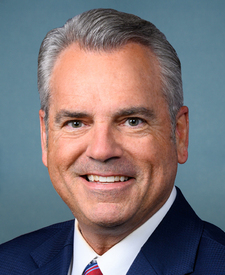
See how Mark Alford's votes line up with your values.
DeepSyte scores Mark Alford's record on the issues you care about — not party, not press releases. Take the 2-minute values quiz to see your personal alignment.
Sign in and take the values quiz to see how Mark Alford's votes line up with your views.
Prediction track record
How often we called Mark Alford's passage votes correctly, from their stated positions on each bill's tagged topics. Excludes “unclear” calls and abstentions.
A joint resolution to direct the removal of United States Armed Forces from hostilities within or against the Islamic Republic of Iran that have not been authorized by Congress.
A joint resolution to direct the removal of United States Armed Forces from hostilities within or against the Islamic Republic of Iran that have not been authorized by Congress.
Based on 3 data points across public statements and recorded votes · AI analysis of public records
118-s-4367·Consistent
Thomas R. Carper Water Resources Development Act of 2024
75/100
What they said
May 20, 2026
Congressman Alford supports the FY2027 Energy and Water Development appropriations bill, which he characterizes as advancing nuclear energy expansion, restoring Army Corps of Engineers funding, supporting rural infrastructure, and eliminating prior-administration programs.
Congressman Alford's statement supports the FY2027 Energy and Water Development appropriations bill, emphasizing restoration of Army Corps of Engineers funding and water projects. The bill voted on (Thomas R. Carper Water Resources Development Act of 2024) directly addresses Corps of Engineers authorities and water resources projects—a core element Alford highlighted. His yes vote aligns with his stated priority of restoring Corps funding. However, the statement emphasizes nuclear energy expansion and eliminating Biden-era programs, which are not substantively addressed in the specific bill text provided, creating some granularity mismatch between the broader appropriations priorities he described and the narrower water resources development provisions in this particular bill.
The lawmakers call for full funding of the B-21 Raider program in FY 2027 and recommend that the Department of Defense reassess and increase the current program of record beyond the originally planned 100 aircraft, citing global threats from China and conflicts in Eastern Europe and the Middle East.
The statement calls for expanded B-21 bomber funding and production to counter China and address global threats; the bill provides supplemental DOD appropriations for Indo-Pacific security, including defense articles and submarine industrial base improvements to counter China. Both address defense posture against China and regional threats. However, the statement focuses specifically on B-21 aircraft expansion, while the bill is a broader Indo-Pacific supplemental that does not explicitly mention the B-21 program. The rep's yes vote on Indo-Pacific defense funding is directionally consistent with support for military readiness against China, but the bill does not directly fund or authorize the B-21 expansion the statement advocates.
National Defense Authorization Act for Fiscal Year 2024
75/100
What they said
Apr 24, 2026
The lawmakers call for full funding of the B-21 Raider program in FY 2027 and recommend that the Department of Defense reassess and increase the current program of record beyond the originally planned 100 aircraft, citing global threats from China and conflicts in Eastern Europe and the Middle East.
Alford's statement calls for full funding and expansion of the B-21 Raider program in the FY 2027 NDAA. His yes vote on the FY 2024 NDAA (HR 2670) is generally consistent with support for defense procurement authorization bills, though this specific bill does not appear to contain B-21-specific provisions based on the available summary. The vote aligns directionally with his stated defense modernization priorities, but the bill predates his public call by approximately two years and addresses a different fiscal year.
Pairs with ambiguous language and high uncertainty are withheld until more data is available. Procedural, cloture, and amendment votes are excluded — they don't cleanly signal substantive support or opposition.
Pro analysis
AI rep analysis — Pro
Get an AI-narrated read on Mark Alford's full voting record against your stated values — aligned themes, conflicts, notable votes, and what to watch for.
We haven't extracted campaign positions for Mark Alford yet. Once their campaign website or position pages are processed, this card will track what they said vs how they voted.
Crossing the aisle
Passage votes where Mark Alford broke ranks with ≥75% of Republicans. Threshold catches substantively partisan splits; unanimous-ish or close votes are excluded.
Alford Applauds Over $27.7 Million in Federal Investments for Missouri VA Medical Facilities
Position: The release announces federal funding for infrastructure, safety upgrades, and facility modernization at Missouri VA medical facilities serving Fourth District veterans, and states that improving veterans' facilities is a priority.
Congressman Mark Alford (MO-04) today announced more than $27.7 million in federal funding for key infrastructure improvements, safety upgrades, and facility modernization projects at Missouri Veterans Affairs (VA) facilities serving Fourth District veterans.
These investments were funded through the House Appropriations Subcommittee on Military Construction and Veterans Affairs, where Congressman Alford serves as Vice Chair.
“Our nation owes an immeasurable debt of gratitude to the men and women who served in uniform,” said Congressman Mark Alford. “As Vice Chair of the Military Construction and Veterans Affairs Subcommittee, ensuring our veterans receive top-tier care in modern, safe, and fully equipped facilities remains one of my highest priorities. These investments in Columbia and Kansas City will directly improve healthcare services, facility safety, and patient experiences for thousands of veterans across Missouri and the Fourth District.”
Below is a breakdown of the funded projects across Missouri VA facilities:
Kansas City VA: $15,623,365.35
Harry S. Truman VA in Columbia: $12,080,410.76
Alford Announces $16.2 Million U.S. DOT Grant to Modernize COLT Railroad in Columbia
Position: The release announces a $16.2 million federal CRISI grant to modernize the COLT Railroad in Columbia, Missouri, and states that the representative advocated for the award. It expresses support for the funded rail upgrades but does not take a position on pending legislation.
Today, Congressman Mark Alford (MO-04) announced that the U.S. Department of Transportation’s Federal Railroad Administration (FRA) has awarded $16,207,000 through the Consolidated Rail Infrastructure and Safety Improvements (CRISI) Program to the City of Columbia, Missouri.
The funding will support the COLT Railroad Modernization Program, a vital initiative to upgrade the 21.4-mile Columbia Terminal Railroad (COLT) connecting Columbia and Centralia. Rep. Alford strongly championed this project, helping to secure the grant funding through robust advocacy, including sending a formal letter of support with Rep. Bob Onder (MO-03) to the FRA.
"The COLT railroad is a critical economic lifeline for Mid-Missouri, connecting our local manufacturers, agricultural producers, and building materials suppliers to the national freight network," said Congressman Alford. "I was proud to lead the charge and help secure this grant to ensure our region remains at the cutting edge of transportation innovation. This major investment will modernize our infrastructure, enhance safety, and pioneer autonomous rail technology right here in Missouri—all while supporting local jobs and boosting our economic competitiveness."
The total cost of the COLT Railroad Modernization Program is $20,827,000, backed by $16,207,000 in federal CRISI funding and $4,620,000 in non-federal cost shares contributed by private sector partners and the City of Columbia. Key components of the project include:
Alford Introduces Legislation to Strengthen SBA’s Rural and Faith-Based Outreach
Position: Introduces legislation to codify the SBA's Office of Rural Affairs with an Assistant Administrator and to establish a Center for Faith within the SBA's Office of Entrepreneurial Development to expand support for rural and faith-based entrepreneurs.
Congressman Mark Alford (MO-04), Chairman of the House Small Business Committee’s Subcommittee on Oversight, Investigations, and Regulations, introduced the Faith and Rural Small Business Act to strengthen the Small Business Administration’s (SBA) ability to serve rural and faith-based communities.
The legislation would codify the SBA’s Office of Rural Affairs and elevate its leadership to an Assistant Administrator. It would also establish a Center for Faith within the SBA’s Office of Entrepreneurial Development, led by a Director appointed by the SBA Administrator.
“The SBA should meet entrepreneurs where they are, whether that’s on Main Street in rural Missouri or in a faith community serving its neighbors. This legislation supports the SBA’s reorganization by strengthening its focus on rural America and faith-based entrepreneurship and ensuring more entrepreneurs can access the resources they need to succeed,” said Congressman Alford.
Read the full text of the legislation here.
The legislation builds on Alford’s efforts to make the SBA more responsive to communities outside Washington, D.C. In 2025, Alford introduced the Rural Innovation and Small Business Support Act to expand SBA outreach in rural communities and the Returning SBA to Main Street Act, which passed the House Small Business Committee and would decentralize SBA personnel across the country.
This legislation continues those efforts by strengthening the SBA’s Office of Rural Affairs and codifying a Center for Faith within the agency’s Office of Entrepreneurial Development.
The bill would amend the Small Business Act to formally establish both offices within the SBA’s organizational structure.
Alford, Davids Introduce Bipartisan Bill to Protect America’s Medical Supply Chains, Support Kansas City Area Innovation
Position: The release supports the Critical Biomanufacturing Input Assessment Act, which would direct the Department of Commerce to regularly assess U.S. reliance on foreign sources, including China, for biotechnology supplies and equipment. The sponsors argue this would identify supply chain vulnerabilities and reduce dependence on foreign suppliers.
Today, U.S. Representatives Mark Alford (R-MO-04) and Sharice Davids (D-KS-03) introduced the Critical Biomanufacturing Input Assessment Act. It’s a bipartisan bill that would help strengthen America’s biotechnology supply chains, support the growing medical industry in the Kansas City region, and address growing concerns about U.S. reliance on foreign suppliers — including China — for critical materials needed to produce medicines and other health products.
“As we work to bring more manufacturing back to American soil, we must ensure our biotechnology supply chains are secure, transparent and resilient,” said Congressman Alford. “This commonsense, bipartisan legislation will help identify vulnerabilities, reduce reliance on foreign adversaries like China, and protect the critical materials needed to produce lifesaving medicines and animal health products. I’m proud to partner with Representative Davids to strengthen innovation in the Kansas City region and safeguard our nation’s health and economic security.”
“Kansas City is creating the next generation of medicines, health products, and technologies that improve people’s lives — and we need to make sure American companies have the supplies they need to succeed,” said Congresswoman Davids. “This bipartisan bill will help us identify weaknesses in our supply chains, reduce our dependence on countries like China, strengthen American manufacturing, and create good-paying jobs while lowering healthcare costs. I appreciate Representative Alford’s partnership on this important, bipartisan effort.”
Many products Americans rely on — including medicines, vaccines, and animal health products — are made using biotechnology. But many companies do not have a clear picture of where the materials and equipment they depend on come from. Some critical supplies are made overseas, including in China, creating potential risks for our economy and national security. This bill will help identify these vulnerabilities before a disruption occurs.
The Critical Biomanufacturing Input Assessment Act would require the Department of Commerce to regularly review America’s reliance on foreign sources for important biotechnology supplies and equipment.
The information collected through this review would help:
The Kansas City region is one of the country’s fastest-growing biotechnology hubs. It is home to the KC BioHub, a partnership focused on making Kansas City a national leader in biotechnology research, innovation, and manufacturing. The region is also home to the Kansas City Animal Health Corridor, one of the largest concentrations of animal health companies in the world.
These companies and research institutions rely on specialized supplies and equipment to develop products that improve human and animal health. Making sure those supply chains are strong and reliable is critical to their continued success.
Alford Applauds Dept. of War Awarding F/A-XX Contract to Boeing
Position: The release applauds the Department of War's award of the F/A-XX sixth-generation fighter contract to Boeing and states support for robust, sustained funding for next-generation airpower and the rebuilding of the defense-industrial base.
Today, Congressman Mark Alford (MO-04) issued the following statement applauding the Department of War’s announcement that the contract to build the F/A-XX sixth-generation fighter jet to Boeing—meaning it will be built by Missouri workers in the Show Me State.
“Today’s announcement that the sixth generation F/A-XX fighter jet will be built by Boeing is a huge win for Missouri workers and economic growth in our state,” said Congressman Alford. “We have been vocal advocates of this from the start and worked tirelessly with the Trump Administration to make it a reality. The Show Me State will be a cornerstone of the rebuilding of our defense-industrial base. This is another step forward for our years-long campaign to develop a new national security corridor in the heart of America—with the Fourth District, its two major military installations, and numerous other defense equities smack in the middle of it all.”
Congressman Alford is a member of the powerful House Appropriations Committee and represents two military instillations—Fort Leonard Wood and Whiteman Air Force Base—in Missouri’s Fourth District.
Through his role on the Appropriations Committee, which controls the purse strings for the entire federal government, Congressman Alford has been a consistent advocate for robust and sustained funding for next-generation airpower like the F/A-XX.
Alford, Real Estate Caucus Call on Copyright Office to Reconsider Fee Increase for Multiple Listing Services
Position: Representatives Alford, Correa, Mann, and Petersen urge the U.S. Copyright Office to reconsider its proposed increase in group registration fees for non-photographic databases, including those used by Multiple Listing Services, from $500 to $700 per filing. They argue the increase is unjustified, burdens small local organizations, and conflicts with housing affordability goals.
Congressman Mark Alford (MO-04) led a letter with his Congressional Real Estate Caucus Co-Chairs—Reps. Lou Correa (CA-46), Tracey Mann (KS-01), and Brittany Petersen (CO-07)—to the U.S. Copyright Office. The Real Estate Caucus is urging the Copyright Office to reconsider its fee increase on non-photographic databases, which include many Multiple Listing Services (MLSs).
At a time when high prices driven many hardworking families farther away from the American Dream of homeownership, Congress has made housing affordability a bipartisan priority. Yet, this misguided fee increase would undermine this progress by reducing transparency and increasing costs.
Reps. Ryan Mackenzie (PA-07), Jack Bergman (MI-01), Monica De La Cruz (TX-15), and Jimmy Patronis (FL-01) joined the Real Estate Caucus Co-Chairs in sending the letter.
Read the full letter here or below:
“We write as Co-Chairs and members of the Bipartisan Congressional Real Estate Caucus to express our concern with the U.S. Copyright Office's final fee schedule submitted to Congress on July 14, 2026. In particular, the proposal would increase the fee for group registration of updates and revisions to non-photographic databases - the category used by many Multiple Listing Services (MLSs) - from $500 to $700 per filing. This comes only six years after the same fee increased from $85 to $500. We urge the Office to reconsider this additional increase before it takes effect.
“MLSs are a critical part of America's housing market. These organizations maintain the property information used every day by buyers, sellers, real estate professionals, lenders, and appraisers. They are also generally small, local, subscriber-supported organizations, not large corporations that can simply absorb repeated cost increases. Because MLS databases are continuously updated, many MLSs must register multiple times each year to maintain meaningful copyright protection against unauthorized scraping, copying, and misuse.
“The proposed increase is especially difficult to justify because MLSs remain stuck using a more expensive paper-based registration process while nearly all other copyright applicants can file electronically. The Office's own analysis reportedly places the cost of processing an MLS registration at approximately $500, yet the proposed fee is $700. It makes little sense to charge MLSs above the reported cost of providing the service while denying them access to the lower-cost, modern filing system available to other registrants. Local MLSs should not be forced to subsidize a bureaucratic process they cannot avoid or modernization efforts from which they do not yet benefit.
“We support a modern, efficient Copyright Office and recognize the need to recover reasonable costs. But fees should be fair, recover the reasonable cost of the service being provided, and structured to encourage -- not discourage -- copyright registration. Stakeholders have warned that MLS registrations are price sensitive and have already declined as fees have increased. At a time when Americans are facing serious housing affordability challenges, Washington should be looking for ways to reduce unnecessary costs in the housing market, not add to them.
“Accordingly, we respectfully ask the Copyright Office to:
“Congress has a 120-day review period, through November 12, to approve or disapprove the new fee schedule. During that time, we urge the Office to work with MLS stakeholders on a reasonable alternative that lowers processing costs, expands electronic access, and preserves strong copyright protections without imposing another disproportionate fee increase.
“Please respond within 14 days of receipt of this letter. We appreciate your prompt attention to this matter and look forward to working with you.”
Alford Bill to Provide Flexibility for SBA 504 Lending Passes House Small Business Committee
Position: Supports the 504 Program Level Flexibility Act, which would let the SBA raise 504 loan commitments up to 115 percent of the annual authorization level once per fiscal year with 30 days' notice to Congress, to meet rising small-business demand.
Today, the House Small Business Committee passed Congressman Mark Alford’s (MO-04) bipartisan 504 Program Level Flexibility Act, introduced with Representative Lateefah Simon (CA-12). The legislation would give the Small Business Administration (SBA) additional flexibility to meet increased demand for 504 loans that help small businesses make long-term investments in facilities, equipment, and expansion.
Read the full text of the 504 Program Level Flexibility Act here.
The bill allows the SBA Administrator to increase 504 loan commitments up to 115 percent of the annual authorization level if the agency determines demand could exceed that limit. The authority may be used once per fiscal year, and SBA must notify Congress at least 30 days before exercising it.
Watch Congressman Alford’s remarks in support of his legislation here or by clicking the image above.
“The 504 loan is one of the most important tools we have to help small businesses make long-term investments in their future,” said Congressman Alford. “As we work to bring manufacturing back to the United States and strengthen our domestic supply chains, demand for 504 financing is rising. This bill gives the SBA limited flexibility to meet that demand while maintaining congressional oversight. I’m proud to lead this bipartisan effort with Representative Simon.”
The legislation is part of a broader effort to expand access to SBA financing for small businesses and manufacturers. Congressman Alford’s STRONG Act would increase maximum loan sizes in the SBA’s 7(a) and 504 programs, while the Made in America Manufacturing Finance Act would further increase lending limits for small manufacturers seeking to purchase equipment, expand facilities, reshore production, and create jobs in the United States.
The 504 Program Level Flexibility Act now advances from the House Small Business Committee.
Alford Receives Assurance Basic Combat Training Is Staying at Fort Leonard Wood
Position: The release reports that the U.S. Army has confirmed no plans to relocate Basic Combat Training from Fort Leonard Wood and notes the Army's expansion of training capacity there.
| Congressman Mark Alford
Javascript must be enabled for the correct page display
Skip to Content
-->
facebook
twitter
youtube
instagram
Open search form
Search
Search form
Submit
Hit enter to search or ESC to close
Menuicon
Close Navigation Menuicon
-->
About
Biography
Committees and Caucuses
Events
Our District
Working for You
Media
Mark Alford's America Archive
Mark Alford's Capitol Recap Weekly Column
Mark Alford's Capitol Recap Podcast
Press Releases
In the News
Newsletter Archive
Photos
Videos
-->
Issues
Community Project Funding
Key Issues
Legislation
Sponsored Legislation
Co-sponsored Legislation
Voting Record
Services
Art Competition
Congressional Commendation
Event Request
Flag Request
Small Business
Grants
Help with a Federal Agency
Internships
Meeting Request
Service Academy Nominations
Tour Requests
Contact
Email Me
Event Request
Meeting Request
E-Newsletter Sign Up
Office Locations
Press Contacts
Open search form
Search Site
Submit
facebook
twitter
youtube
instagram
Press Releases
Alford Receives Assurance Basic Combat Training Is Staying at Fort Leonard Wood
Share on Facebook
Share on X
Print this Page
Share by Email
Washington,
August 18, 2026
Tags:
Veterans
RAYMORE, MO—Congressman Mark Alford today announced that the U.S. Army has confirmed there are no plans to relocate Basic Combat Training from Fort Leonard Wood.
After hearing concerns about the future of Fort Leonard Wood’s Basic Combat Training mission, Alford went directly to Army leadership to get answers and make sure Missouri’s voice was heard.
In a response to Alford’s June 26 letter, the Department of the Army made its position clear: “The Army has no plans to relocate the Basic Combat Training from Fort Leonard Wood.”
The Army also confirmed that it expanded Basic Combat Training capacity at Fort Leonard Wood in Fiscal Year 2025 to support the Regular Army’s growing accession mission. The Army expects that mission to increase to 65,000 accessions in FY27 as it works toward an end strength of 476,000 by FY29.
“This is great news for Fort Leonard Wood, our soldiers, our military families, and the entire region that proudly supports this incredible installation,” said Congressman Mark Alford.
“When questions were raised about whether Basic Combat Training could be moved from Fort Leonard Wood, I wasn’t going to sit on the sidelines and wonder what might happen. I went straight to the Army and demanded answers.”
“And now we have them: Basic Combat Training is not going anywhere.”
“Fort Leonard Wood has a proud history of training the men and women who defend our country. It is a critical part of our Army’s readiness, and it is a tremendous economic and community asset for Missouri. I am proud to stand with the soldiers, families, veterans, and communities who make Fort Leonard Wood so strong.”
The Army’s response also noted that the U.S. Army Transformation and Training Command will continue assessing training capacity at Army Training Centers to meet future accession requirements and will keep Congress informed of its analysis.
Alford said he will continue to closely monitor the Army’s plans and advocate for Fort Leonard Wood and the soldiers who train there.
“This is another victory for Missouri,” Alford said.
“We’ll keep fighting to make sure Fort Leonard Wood remains a premier training installation and that Missouri continues to play a critical role in preparing the next generation of American soldiers.”
###
Related News
House Passes Rep. Alford’s Bipartisan Bill to Help Veteran Business Owners Succeed
February 24, 2025 | Posted in Press Releases
Alford, Colleagues Call for Veteran Mental Health Scheduling Improvements
November 20, 2024 | Posted in Press Releases
Sign up for our newsletter
SUBSCRIBE
Congressman Mark Alford Advances Effort to Ban Congressional Stock Trading, House Passes Stop Insider Trading Act
Position: The release supports legislation prohibiting Members of Congress, their spouses, and dependent children from purchasing individual publicly traded stocks, and supports additional transparency requirements for stock sales. It describes House passage of the Stop Insider Trading Act and notes the bill now moves to the Senate.
Washington, D.C. — The U.S. House of Representatives has passed the Stop Insider Trading Act, marking a significant step forward in efforts to prohibit Members of Congress from trading individual stocks while serving in office.
For years, Americans have raised concerns about whether lawmakers should be allowed to personally trade stocks while making decisions that directly impact the economy and financial markets.
Congressman Mark Alford has been a leading voice on this issue, introducing the Preventing Elected Leaders from Owning Securities and Investments (PELOSI) Act to establish a stronger ethical standard.
Alford’s proposal was grounded in a straightforward principle: Members of Congress should not be permitted to profit from the same markets they influence through their official duties. His efforts helped elevate the issue in Congress and contributed to broader discussions on restoring public trust and strengthening accountability.
The Stop Insider Trading Act reflects many of the same principles championed by Congressman Alford. The legislation prohibits Members of Congress, their spouses, and dependent children from purchasing individual publicly traded stocks and imposes additional transparency requirements for stock sales.
“Public service is a privilege, not a pathway to personal profit,” said Congressman Alford. “The American people deserve confidence that their representatives are making decisions based on what is best for the country, not what benefits their personal portfolios.”
Alford emphasized that the bill represents meaningful progress toward rebuilding trust between Congress and the American people.
“Members of Congress should be focused on serving the people who sent them here, not managing a stock portfolio,” Alford added. “When we hold ourselves to a higher standard, we strengthen faith in our institutions.”
With House passage secured, the Stop Insider Trading Act now moves to the Senate as lawmakers continue efforts to address concerns surrounding congressional ethics, transparency, and accountability.
Reps Alford and Escobar Introduce Bipartisan Legislation to Cut Burdensome Tape and Accelerate Military Construction
Position: Introduces bipartisan legislation directing the Department of Defense to assess expanding the use of Intergovernmental Support Agreements with state and local governments to complete minor military construction projects faster and at lower cost.
WASHINGTON, D.C. — Congressman Mark Alford (R-MO), alongside Congresswoman Veronica Escobar (D-TX), introduced the bipartisan Streamlining Military Infrastructure Act, legislation to help the Department of Defense complete minor military construction projects faster, reduce unnecessary delays and make better use of existing partnerships with state and local governments.
Military installations across the country rely on timely infrastructure improvements to support servicemembers, strengthen readiness, and maintain mission capabilities. The legislation would examine how the Department of Defense can expand the use of Intergovernmental Support Agreements (IGSAs) to deliver these projects more efficiently and at a lower cost to taxpayers.
“Modernizing our military infrastructure doesn’t always require reinventing the wheel — it requires using the tools we already have in smarter ways,” said Congressman Mark Alford. “This legislation takes a practical approach to identify where stronger partnerships between military installations and local communities can help complete projects faster, reduce costs, and improve quality of life for our servicemembers. I’m proud to work across the aisle on this commonsense effort to strengthen readiness and ensure taxpayer dollars are being used responsibly.”
“Military families and servicemembers deserve the facilities and infrastructure they need without unnecessary delays caused by outdated processes,” said Congresswoman Veronica Escobar. “This legislation builds on proven partnerships to make military construction more efficient, less costly, and more responsive to the needs of our installations and communities.”
Intergovernmental Support Agreements allow military installations to partner with state and local governments to provide services and support installation needs. The Streamlining Military Infrastructure Act would direct the Department of Defense to assess whether expanding the use of these agreements for certain minor military construction projects could help reduce delays, lower costs, and address infrastructure needs more quickly.
Specifically, the legislation would:
To view the full bill text, click here.
The Streamlining Military Infrastructure Act builds on ongoing efforts to improve military readiness, strengthen partnerships with communities surrounding installations, and ensure the Department of Defense can meet infrastructure needs efficiently and effectively.
Source: open-data mirrors of the Senate eFD and House Clerk financial-disclosure systems. Disclosure within 30 days of trade is required by law (45 for spouse/dependent trades).
Top PAC donors · 2026 cycle
Political action committees that gave the most to this rep's principal campaign committee this cycle. PAC giving is direct organizational support — industry, ideological, or leadership.
1.US ONCOLOGY INC. NETWORK POLITICAL ACTION COMMITTEEHealth3 contributionsOncology healthcare network PAC — supports candidates backing policies on cancer care access, medical reimbursement, and healthcare infrastructure.AI$15,000
2.AIPAC3 contributions$15,000
3.THE BOEING COMPANY PAC9 contributions$11,000
4.NATIONAL PORK PRODUCERS COUNCIL PORK PAC2 contributions$10,000
5.MR. SOUTHERN MISSOURIAN IN THE HOUSE PACLeadership2 contributionsMember-of-Congress leadership PAC — supports allied candidates and Democratic causes, likely affiliated with a House member representing southern Missouri.AI$10,000
6.AMERICAN INSTITUTE OF CERTIFIED PUBLIC ACCOUNTANTS POLITICAL ACTION COMMITTEE3 contributions$10,000
7.NATIONAL ELECTRICAL CONTRACTORS ASSOCIATION PACBusiness2 contributionsTrade-association PAC for electrical contractors — backs candidates supporting infrastructure investment, prevailing-wage standards, and project labor agreements.AI$10,000
9.PATRIOTS IN ACTIONIdeological2 contributionsSingle-issue or ideological PAC — specific positions not clearly inferable from the name alone.AI · low$10,000
10.EMPLOYEES OF NORTHROP GRUMMAN6 contributions$9,000
Source: OpenFEC (api.open.fec.gov) Schedule A receipts where contributor type is “committee.” Aggregated by contributing committee. Self-transfers from joint-fundraising / victory committees are excluded.
Top individual contributors · 2026 cycle
Itemized individual contributions over $200 to this rep's campaign committee, aggregated by donor employer. PAC giving is shown above; this section is people, not organizations.
1.SELF$41,500
2.COMMUNITY$14,000
3.THE BOEING COMPANY PAC$13,000
4.GOLDEN VALLEY HEALTH$10,500
5.CORNERSTONE GOVERNMENT AFFAIRS$8,750
6.VETERANS GUARDIAN$7,500
7.WALZ TETRICK ADVERTISING$7,065
8.CBD AMERICAN SHAMAN$7,000
9.MCCARTHY AUTO GROUP$7,000
10.ENTREPRENEUR$7,000
Source: OpenFEC Schedule A receipts where contributor type is “individual,” aggregated by the donor's self-reported employer. This is a geographic / industry correlation, not a corporate endorsement.