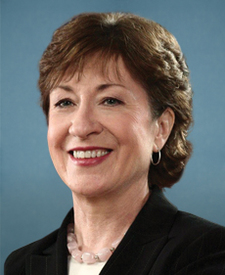
See how Susan M. Collins actually votes — against your values.
DeepSyte scores Susan M. Collins's record on the issues you care about — not party, not press releases. Take the 2-minute values quiz to see your personal alignment.
Sign in and take the values quiz to see how Susan M. Collins's votes line up with your views.
Prediction track record
How often we called Susan M. Collins's passage votes correctly, from their stated positions on each bill's tagged topics. Excludes “unclear” calls and abstentions.
100%
Accuracy
1
Correct
0
Incorrect
51
Pending
Right119-sjres-184
A joint resolution to direct the removal of United States Armed Forces from hostilities within or against the Islamic Republic of Iran that have not been authorized by Congress.
A joint resolution to direct the removal of United States Armed Forces from hostilities within or against the Islamic Republic of Iran that have not been authorized by Congress.
A bill to provide for appropriate cost-sharing for insulin products covered under private health plans, and to establish a program to support health care providers and pharmacies in providing discounted insulin products to uninsured individuals.
Based on 1 data point across public statements and recorded votes · AI analysis of public records
119-sjres-184·Consistent
A joint resolution to direct the removal of United States Armed Forces from hostilities within or against the Islamic Republic of Iran that have not been authorized by Congress.
92/100
What they said
Apr 30, 2026
Senator Collins voted to end U.S. military hostilities against Iran, stating that further military action must have a clear mission, achievable goals, and a defined strategy before continuing.
Voted Yea on A joint resolution to direct the removal of United States Armed Forces from hostilities within or against the Islamic Republic of Iran that have not been authorized by Congress.
Senator Collins' statement and her yes vote on the resolution are strongly aligned. She explicitly supports ending hostilities absent a clear mission and strategy, and the resolution directs removal of forces from unauthorized hostilities—precisely the position she articulated. Her vote directly implements the constitutional and War Powers Act principles she emphasized in her statement.
Pairs with ambiguous language and high uncertainty are withheld until more data is available. Procedural, cloture, and amendment votes are excluded — they don't cleanly signal substantive support or opposition.
Pro analysis
AI rep analysis — Pro
Get an AI-narrated read on Susan M. Collins's full voting record against your stated values — aligned themes, conflicts, notable votes, and what to watch for.
We haven't extracted campaign positions for Susan M. Collins yet. Once their campaign website or position pages are processed, this card will track what they said vs how they voted.
Crossing the aisle
Passage votes where Susan M. Collins broke ranks with ≥75% of Republicans. Threshold catches substantively partisan splits; unanimous-ish or close votes are excluded.
6
Cross-aisle votes
119-sjres-187·Aug 5, 2026·98% of R voted NO
A joint resolution providing for congressional disapproval under chapter 8 of title 5, United States Code, of the rule submitted by the Environmental Protection Agency relating to "Modification to the Start of the Submission Period for Perfluoroalkyl and Polyfluoroalkyl Substances (PFAS) Reporting and Recordkeeping Under TSCA 8(a)(7)".
A joint resolution to direct the removal of United States Armed Forces from hostilities within or against the Islamic Republic of Iran that have not been authorized by Congress.
A joint resolution to direct the removal of United States Armed Forces from hostilities within or against the Islamic Republic of Iran that have not been authorized by Congress.
A joint resolution to direct the removal of United States Armed Forces from hostilities within or against the Islamic Republic of Iran that have not been authorized by Congress.
A joint resolution providing for congressional disapproval under chapter 8 of title 5, United States Code, of the rule submitted by the Food and Nutrition Service relating to "Application of Bostock v. Clayton County to Program Discrimination Complaint Processing-Policy Update".
Senators Collins, Durbin Lead Call Urging FDA to Strengthen Efforts to Reduce Youth Vaping | U.S. Senator Susan Collins of Maine
Position: Senators Collins and Durbin urge the FDA to maintain strict oversight of flavored e-cigarette products and reject draft guidance that would increase authorizations of flavored nicotine delivery systems, citing evidence that flavors increase youth appeal and use.
Letter comes as the White House calls on FDA Commissioner Makary to approve flavored vapes that have been found to have increased youth appeal.
WASHINGTON, D.C. – Today, U.S. Senators Susan Collins and Dick Durbin (D-IL) sent a bipartisan letter to U.S. Food and Drug Administration Commissioner Marty Makary urging the agency to reconsider its recently issued draft guidance document, Flavored Electronic Nicotine Delivery Systems (ENDS) Premarket Applications – Considerations Related to Youth Risk. The Senators warned that this guidance could increase the number of flavored e-cigarettes or electronic nicotine delivery systems authorized by FDA, jeopardizing recent progress in reducing youth e-cigarette use.
Their letter follows reports that indicate that President Trump has pressed FDA Commissioner Marty Makary to move more quickly to approve flavored vapes and nicotine products that Commissioner Makary previously declined to authorize amid concerns about the public health risks and potential appeal to children.
“FDA must be careful to avoid changes that could jeopardize recent progress in reducing the number of youth who use e-cigarettes,” the Senators wrote. “Tobacco use often begins during adolescence, when people are more vulnerable to nicotine addiction and less aware of the risks of tobacco use. Nicotine can harm the parts of the adolescent brain responsible for attention, learning, mood, and impulse control and can prime the brain for addiction to other drugs.”
“We appreciate FDA’s recognition that the products that most egregiously target kids would face a ‘correspondingly high evidentiary burden to demonstrate that the benefits to adult smokers…outweigh the risks of youth initiation,’” they continued. “As sponsors of the ‘Family Smoking Prevention and Tobacco Control Act’ (P.L. 111-31), we intended FDA’s premarket review of new tobacco products to be utilized as an important tool to prevent new products from entering the market that are likely to increase youth use of tobacco. This draft guidance will increase the number of flavored e-cigarettes that FDA authorizes.”
“Given the importance of preventing youth use of all tobacco products and the strong evidence that flavors increase the appeal and use of e-cigarettes by youth, FDA should not ignore the basic reality that kids are drawn to what flavors are most available to them, particularly since FDA recognizes the underlying risk of flavors to youth… We request a timely response that addresses the concerns we have about the new draft guidance,” the Senators concluded.
Click here to read the complete text of their letter.
Senators Collins and Durbin have repeatedly worked together to crack down on youth vaping and hold e-cigarette manufacturers accountable. In 2020, they introduced the bipartisan Resources to Prevent Youth Vaping Act to force e-cigarette manufacturers to pay FDA user fees to strengthen oversight and youth vaping prevention efforts. In 2022, they co-led the successful effort to close the synthetic nicotine loophole, ending an industry tactic that allowed kid-friendly, flavored e-cigarettes to evade FDA regulation. In 2024, Senators Collins and Durbin pressed the Department of Justice and FDA interagency task force to crack down on the illicit sale and distribution of unauthorized e-cigarettes, warning that thousands of kid-friendly flavored products remained readily available for purchase.
Senator Collins Visits Mid-Maine Technical Center | U.S. Senator Susan Collins of Maine
Click HERE, HERE, HERE, and HERE for individual photos.
WATERVILLE, ME – Today, U.S. Senator Susan Collins visited the Mid-Maine Technical Center (MMTC) in Waterville, where she met with students and faculty and toured several of the center’s programs. She also saw firsthand MMTC’s new engineering and manufacturing program that is supported by federal funding she secured through her role on the Senate Appropriations Committee. The center serves students from Waterville, Winslow, and Messalonskee high schools.
“It was great to visit MMTC today to meet with students and instructors and to see several of the center’s programs in action, including the new engineering and manufacturing program that is supported by federal funding I secured through my role on the Senate Appropriations Committee,” said Senator Collins. “Seeing students work directly with advanced equipment and apply what they’re learning in real time shows how this kind of training helps prepare them well for careers in high-skilled, competitive fields. I was also impressed to meet students in the nursing program who are on track to earn their certified nursing assistant credentials before graduating, helping meet the pressing needs of Maine’s workforce.”
In 2024, Senator Collins secured $718,000 to support MMTC’s purchase and installation of machine tooling, 3D metal printing, and other equipment. Since 2021, Senator Collins has secured nearly $1.5 billion to support 672 projects across Maine’s 16 counties.
Senator Collins’ Statement on Her Vote to End Hostilities in Iran Ahead of 60-Day Deadline | U.S. Senator Susan Collins of Maine
Position: Senator Collins voted to end U.S. military hostilities against Iran, stating that further military action must have a clear mission, achievable goals, and a defined strategy before continuing.
WASHINGTON, D.C. – U.S. Senator Susan Collins released the following statement after her vote today in support of a resolution directing the removal of U.S. armed forces from hostilities against Iran:
“As I have said since these hostilities began, the President’s authority as Commander-in-Chief is not without limits. The Constitution gives Congress an essential role in decisions of war and peace, and the War Powers Act establishes a clear 60-day deadline for Congress to either authorize or end U.S. involvement in foreign hostilities. That deadline is not a suggestion; it is a requirement.
“Our military has performed magnificently and with great courage and sacrifice in diminishing the threat that Iran poses to our country, our allies, the broader Middle East, and the world.
“Further military action against Iran must have a clear mission, achievable goals, and a defined strategy for bringing the conflict to a close. I voted to end the continuation of these military hostilities at this time until such a case is made.”
Senator Collins Delivers Floor Remarks Urging Support for Her INSULIN Act | U.S. Senator Susan Collins of Maine
Position: Senator Collins urges support for the INSULIN Act, bipartisan legislation that would cap insulin costs at $35 per month for Americans with private or employer-sponsored insurance and establish a pilot program for uninsured Americans with diabetes.
Bill would cap the cost of insulin at $35 per month for Americans on private and employer-sponsored insurance, create pilot program for uninsured Americans with diabetes.
Click HERE to watch and HERE to download video of her remarks.
Click HERE for a full-resolution image.
WASHINGTON, D.C. – U.S. Senator Susan Collins today delivered remarks from the Senate floor urging her colleagues to support the Improving Needed Safeguards for Users of Lifesaving Insulin Now (INSULIN) Act, bipartisan legislation she introduced last month with Senators Jeanne Shaheen (D-NH), John Kennedy (R-LA), and Raphael Warnock (D-GA). The INSULIN Act would cap the cost of insulin at $35 per month for Americans on private and employer-sponsored insurance and create a pilot program to provide insulin at the same cost to Americans without insurance.
A transcript of her remarks is as follows:
“Mr. President, I rise today to speak about a bill that Senator Shaheen and I introduced recently. It is called the Improving Needed Safeguards for Users of Lifesaving Insulin Now Act, or the INSULIN Act. This bill would make insulin more affordable for Americans with diabetes.
“In 1997, Mr. President, I founded the Senate Diabetes Caucus after meeting with a family from Maine who had a 10-year-old son with type 1 diabetes. I'll never forget this young boy looking up at me and saying to me that he wished that he could just take one day off from having Type 1 diabetes, his birthday or Christmas, just one day. But of course, he could not. It was then that I knew that I had to dedicate my efforts toward earlier diagnosis, better treatments and technology, and one day, a cure.
“Now, Mr. President, insulin was first isolated more than 100 years ago in Canada, and the scientists who did discover it gave away, essentially, the patent rights because they wanted insulin to be available and affordable to everyone who needed it. Tens of millions of Americans rely on insulin as part of their daily treatment for their diabetes. For children, teens, and adults with Type 1 diabetes, insulin is not optional. It is literally a matter of life or death.
“While there are some exciting and extraordinary scientific breakthroughs in cell and gene therapy that may change this—and the sooner, the better—the fact is that today, people who are dependent on insulin still face great anxiety about its affordability. I have heard from far too many people across Maine and across this country who, because of the escalating cost of insulin, feel they have to ration their insulin and do not take the full dose that their physician has prescribed and that they need to be healthy. Let me tell you of one example. Bek Hoskins of Chelsea, Maine, is a young adult. Bek was forced to skip her doses of insulin to try to make it last longer, to stretch it out, because she simply could not afford the cost. In one profoundly memorable instance, Bek pushed her body's limit too far, and she ended up in the emergency room. Her husband, Barrett, rushed her through a snowstorm to the hospital, and she nearly died because she tried to go without insulin for two days. Such a dangerous, preventable crisis should never occur. We must address this life-threatening problem.
“Mr. President, the INSULIN Act will help make insulin more affordable for Americans, both those with and without insurance, by capping the cost and addressing fundamental flaws in the insulin market and the FDA approval process. I thank the American Diabetes Association, Breakthrough T1D, and The Endocrine Society for endorsing this much needed legislation.”
Maine Nurses Recognize Senator Collins with National Health Leadership Award | U.S. Senator Susan Collins of Maine
Senator Collins has led efforts to expand access to nursing education and support nurses through every phase of their careers.
Click HERE for a full-resolution image.
WASHINGTON, D.C. – Today, U.S. Senator Susan Collins, Chair of the Senate Appropriations Committee and member of the Health Education, Labor and Pensions (HELP) Committee, received the National Health Leadership Award from the American Association of Nurse Anesthesiology (AANA). The National Health Leadership Award is presented to individuals working at the federal level who have made a significant contribution to the formation of national health policy. The award recognizes Senator Collins’ support for the vital role that Certified Registered Nurse Anesthetists (CRNAs), also known as nurse anesthesiologists or nurse anesthetists, play in providing access to cost-effective, quality anesthesia services to patients.
“Senator Collins has been a champion of CRNAs on the state and federal level, working to strengthen the U.S. nursing workforce through education, training and retention programs, helping to ensure our ability to practice at the full scope of our licensure,” said AANA President Jeff Molter, MBA, MSN, CRNA. “She understands the important role CRNAs play in delivering quality, safe anesthesia care and has taken a leadership role on critical healthcare issues affecting our work on behalf of patients.”
“Nurses are invaluable leaders who truly understand what it means to care and serve others,” said Senator Collins. “As an original co-sponsor of the Senate Title VIII Reauthorization bill, I am keenly aware of the need to preserve and strengthen educational opportunities for aspiring nurses to support and expand the nursing workforce. I’m grateful for this recognition and look forward to exploring additional ways to support our nurses and rural health care in Congress.”
Senator Collins was presented the award by a group of CRNAs and nursing students from Maine. The group included:
Senator Collins has long championed the nursing workforce in Maine and nationwide. As Chair of the Senate Appropriations Committee, she has supported funding for the Title VIII Nursing Workforce programs. She is also co-leading legislation to reauthorize Title VIII programs through FY30. In addition, Senator Collins signed on to a critical bipartisan, bicameral letter in support of allowing education for CRNAs and other Advanced Practice Registered Nurses (APRNs) to be classified as “professional degrees” by the Department of Education.
Senator Collins Speaks at Opening of Residential Rehabilitation Treatment Program Facility at Togus VA Medical Center | U.S. Senator Susan Collins of Maine
VA facility is the first in Maine to offer long-term residential treatment specifically for veterans facing substance use disorder, PTSD, and depression.
Click HERE, HERE, HERE, HERE, and HERE for individual photos.
AUGUSTA, ME – U.S. Senator Susan Collins today delivered remarks at a ribbon-cutting ceremony for the new Residential Rehabilitation Treatment Program facility at the Department of Veterans Affairs (VA) Togus Medical Center. The facility will provide comprehensive treatment and rehabilitation services for veterans facing substance use disorder, as well as conditions such as post-traumatic stress disorder (PTSD) and depression. Prior to its completion, the State of Maine did not have a dedicated, long-term residential rehabilitation treatment center for veterans, requiring many to travel to Massachusetts or Vermont for care through the VA, where they face an average wait time of 132 days to enter a long-term residential treatment program.
“When our veterans come home, we need to welcome them all the way home by making sure they get the services and care they earned. For too long, Maine veterans have had to travel to Massachusetts or Vermont to receive long-term residential rehabilitative care through the VA. Now, they will be able to access it closer to home here in our state’s capital,” said Senator Collins. “I was proud to take part in the ceremony today and to recognize the sacrifices of the men and women this center was built to support. Caring for our veterans, both their visible wounds and their hidden injuries, is a necessary part of our obligation to them for their service to our country.”
The 15,000-square-foot facility includes 12 private bedrooms for men and women, individual and group treatment spaces, and community areas such as a recreation room and visiting spaces. The stand-alone building also connects to the main Togus hospital via a corridor. The new long-term rehabilitation program will provide tailored treatment plans that typically last several weeks with services including counseling, medication management, peer support, and case management.
Senator Collins and the rest of the Maine congressional delegation pushed in 2019 for the VA to establish a long-term mental health and substance use disorder treatment center in Maine, prior to its approval by the Department in 2020. In 2021, the Maine delegation again urged the VA to expedite construction of the Maine center and to include it on the Department’s Priority Projects list.
Maine Delegation Seeks Answers on USPS Failing to Pay Rockland-area Contractor More Than $349,000, Jeopardizing Mail Service for Maine Island Communities | U.S. Senator Susan Collins of Maine
WASHINGTON, D.C. — Maine’s Congressional Delegation is calling on the U.S. Postal Service (USPS) to immediately resolve its payment issue with a Maine contractor that serves multiple island communities in the state. In a letter to Postmaster General David Steiner, U.S. Senators Susan Collins and Angus King and U.S. Representatives Chellie Pingree and Jared Golden requested clarification regarding reports that the USPS failed to pay the Rockland-based Penobscot Island Air (PIA) more than $349,000 for mail-delivery service. The Delegation also raised questions about why USPS has, according to PIA, repeatedly failed to make timely payments for several years. After PIA announced it would not make its scheduled deliveries this past Tuesday in protest, USPS agreed to pay 25% of the outstanding balance, and PIA promptly resumed service. Yet questions remain as to whether Penobscot Island Air can be assured that the remaining balance will be paid in full and in a timely manner.
“For decades, Penobscot Island Air has helped the USPS deliver essential mail to Maine’s island residents. We urge you to immediately resolve the outstanding back payments and provide clarification on how these payment lapses occurred, as well as how delays can be prevented in the future,” the Delegation wrote. “From Matinicus to Vinalhaven, island communities in Maine rely on the USPS to pay bills, receive life-saving medications, and stay connected with friends and family. Penobscot Island Air is an indispensable bridge between the mainland and islands that helps the Postal Service fulfill its promise of reaching every American, even in the most rural communities.”
“While it is promising to hear that the USPS has reached a partial payment agreement to pay Penobscot Island Air about 25% of its outstanding balance, we need greater assurance from the USPS that Maine island contractors will receive fair and prompt compensation for the services they provide. We respectfully request detailed answers... and ask that USPS continue to work urgently with Penobscot Island Air to resolve these back payments immediately and ensure that future payment processing is timely and consistent,” the Delegation concluded.
Click here for the complete text of the letter.
VIDEO: Senator Collins Joins Steve Michaud of Maine Hospital Association for Fireside Chat | U.S. Senator Susan Collins of Maine
At American Hospital Association’s Annual Meeting, Senator Collins discusses efforts to support Maine patients and providers, lower health care costs.
Click HERE for a high-resolution photo
Click HERE to watch and HERE to download video of the full discussion
WASHINGTON, D.C. – This week, U.S. Senator Susan Collins, Chair of the Senate Appropriations Committee, joined Steve Michaud, the longtime President of the Maine Hospital Association, for a conversation at the American Hospital Association’s annual meeting in Washington, D.C., about the challenges facing our nation’s health care system and how she is working to address them. Senator Collins highlighted her efforts to fund biomedical research and to create the Rural Health Transformation Program (RHTP). Maine received $190 million for rural health care providers through the RHTP last December, the first of five annual installments. She also discussed several pieces of bipartisan legislation she is working to pass this year, including a bill to improve the affordability of insulin by capping out of pocket costs at $35 and two other bills that provide support to caregivers.
On Biomedical Research Funding:
Steve Michaud: Senator Collins, my good friend, welcome. Thank you for being here with us today. Thank you for everything you've done for the hospitals in Maine and across the country.... First of all, we thank you for your unbelievable leadership there in appropriations. I know the State of Maine sure does know what the benefit is of having the Chair of Appropriations as their Senator… we've seen the impact of the investments in hospitals and health care, but also across the State of Maine, what you've done for the Maine economy, but you also, at a national level, have invested in research and other healthcare programs that are important to everybody in this room. So, question is: how do we help you? How do we help ourselves? How do we sustain the level of investment you've made in those critical programs?
Senator Collins: I have worked extremely hard throughout my time in the Senate on health care issues. They're the issues that I think affect every single family in our country, and that I care deeply about. In this last Congress, when I became Chair of the Appropriations Committee, I looked at the President's budget, and I was very alarmed at the cutbacks that were proposed in a lot of areas of medical research. An example is the National Institutes of Health, where the President's first budget proposed a reduction of 41%... it also would have decimated the National Science Foundation and slash funding for the Centers for Disease Control, all so important to a healthy America. So, I worked in a bipartisan way, and I'm pleased to say that not only did we reject OMB’s cut of 41% in NIH and the decimation of the National Science Foundation, but we actually increased funding… for NIH. This year, the President's budget did a little bit better. Russ Vought submitted a 12% cut. I still don't want that. We need to make sure that America continues to be the global leader in biomedical research, and that's my goal. I don't want to lose our young scientists and researchers to other countries like China.
On the Rural Health Transformation Program:
Steve Michaud: The Rural Health [Transformation] fund, something near and dear to our hearts.... First of all, thank you. We all, I think we know why there is even a fund in existence, and that was your work on that. And we thank you for that. It has enormous potential… for rural states like ours, there's no question, and it's for all rural states, but we're now faced with implementation…. What is your vision of an effective rollout…. What should we be talking about with Congress in order to make sure this is implemented the way, at least for sure, you intended?
Senator Collins: It represents the largest investment in rural health care in two decades. In 2003, I came up with having a $25 billion rural health care bill that was attached to a tax bill during the Bush Administration. So, when the Administration was trying hard to get my vote for the One Big Beautiful Bill, which had very good tax provisions in it, but in my view, very harmful Medicaid cut provisions in it, I proposed from the very beginning that we have a bill to help our rural health care, our rural providers, our rural health clinics. The hospitals in particular were a major focus of mine because I was really concerned about how our rural hospitals would survive…. I think that is critically important for us to work together to shape what the next tranche is going to be. But this program is potentially, literally lifesaving. What I found in my state is, if you lose the rural hospital or the rural health clinic or the providers, people feel they can't live in that area of the state. We've got obstetrics deserts in the State of Maine and that, I'm sure, is common throughout rural parts of the country. That's something that this fund needs to help us solve.
Senator Collins: I think we're going to see an insulin bill come to the floor. Insulin has been around for more than 100 years, and it should not be as expensive as it is. Three of the major pharmaceutical companies have capped the cost per month, but that only applies to Medicare and maybe Medicaid. But if you have private insurance, or if you're uninsured, you don't benefit from that cap. So, again, Senator Shaheen and I have a bill that I think the HELP Committee is likely to approve, so that's something I think will make a difference.
On Alzheimer’s and Caregiving:
Senator Collins: As someone whose life has been touched by Alzheimer's disease—I lost my father, my grandfather, two uncles and a brother-in-law—I know firsthand how devastating that disease is. And I know how hard it was for my mother, for eight years, to take care of my father at home before he went into the Veterans’ Home in our hometown of Caribou. But just recently, a neighbor of mine in Bangor was trying to take care of his sick wife, then he unfortunately developed health problems. That's not uncommon. Caregiving takes a tremendous toll on the family members—tremendous. We need more respite care so that they can have a break from that 24/7 care of their loved one. But we also need to help caregivers who have dropped out of the workforce in order to take care of a sick child or a sick parent. Right now, they're losing out financially, but they're also losing out for when they retire. So, Senator Mark Warner and I have recently introduced two bills, and basically what they do is, when the caregiver returns to the workforce, they can do catch-up contributions to their retirement plan, like their 401K… 53% of caregivers get no compensation whatsoever, and they're also losing out when they retire. So, I want to allow them to catch up for that year or years that they spent out of the workforce simply because they were caring for a loved one. I think that is the least we can do.
Senator Collins Announces Release of More than $4.3 Million in Additional Federal Home Heating Aid for Mainers | U.S. Senator Susan Collins of Maine
Release of funding follows bipartisan letter to OMB led by Senators Collins, Reed, and Murkowski urging immediate release of remaining LIHEAP funding.
WASHINGTON, D.C. – U.S. Senator Susan Collins, Chair of the Senate Appropriations Committee, announced today that $421,500,000 million in Low-Income Home Energy Assistance Program (LIHEAP) funding has been released, with $4,375,915 being allocated for the State of Maine.
This release of funding follows a letter to OMB last week led by Senators Collins, Jack Reed (D-RI), and Lisa Murkowski (R-AK) along with a bipartisan group of 35 other Senators urging the White House Office of Management and Budget (OMB) to immediately release the approximately $400 million in remaining LIHEAP funds that Congress delivered in Fiscal Year 2026 (FY26). Senator Collins also spoke personally with U.S. Department of Health and Human Services Secretary Robert F. Kennedy Jr., to request that these remaining funds be released.
“It is welcome news that following our recent outreach, the funding for this critical program has been released to states,” said Senator Collins. “LIHEAP provides vital relief to thousands of Mainers, helping them avoid the constant worry of choosing between heating their homes and covering other basic necessities. That is why I am proud that the Senate Appropriations Committee worked in a bipartisan manner to increase funding for the program this year.”
Overriding the Administration’s proposed elimination of LIHEAP, Senators Collins, Reed, and Murkowski successfully led bipartisan efforts to provide a total of $4.045 billion for the program in FY26 – a $20 million increase over the previous year. Much of that funding has been distributed to help low-income families and seniors on fixed incomes, with more than $38 million already distributed to households in Maine this winter.
Nationwide, an estimated 6.2 million households received assistance with heating and cooling costs through LIHEAP last year. In Maine, households received $41.6 million in LIHEAP funding last year.
Eligibility for LIHEAP is based on income, family size, and the availability of resources. Senior citizens and those receiving Social Security Disability or SSI benefits are encouraged to apply as early as possible, but applications will be open to everyone through May 29, 2026, or until program funding is exhausted. Maine residents can check their eligibility and apply for the program here.
Senators Collins, Reed, Murkowski Lead Bipartisan Group Urging OMB to Release Remaining LIHEAP Funds | U.S. Senator Susan Collins of Maine
Position: Senators Collins, Reed, and Murkowski, leading a bipartisan group of 35 colleagues, urge the OMB Director to immediately release approximately $400 million in remaining LIHEAP funds appropriated by Congress for fiscal year 2026 to help low-income households and seniors pay utility bills.
WASHINGTON, D.C. – U.S. Senator Susan Collins, Chair of the Senate Appropriations Committee, along with U.S. Senators Jack Reed (D-RI) and Lisa Murkowski (R-AK), both members of the Appropriations Committee, led a bipartisan group of 35 of their Senate colleagues in urging White House Office of Management and Budget (OMB) Director Russell Vought to swiftly release the approximately $400 million in remaining Low-Income Home Energy Assistance Program (LIHEAP) funds that Congress delivered in Fiscal Year 2026 (FY26).
LIHEAP is a federally funded program that helps low-income households pay utility bills, address energy crises, and lower costs by improving home energy efficiency through weatherization. Over the last year, nearly six million households nationwide received LIHEAP assistance.
“As the main federal program that helps low-income households and seniors with their energy bills, LIHEAP provides critical assistance during the cold winter and hot summer months,” the Senators wrote. “With low-income families and seniors feeling additional strains on their household budgets, a timely release of LIHEAP funding is even more critical to ensure families do not need to choose between paying their energy bills and other essentials, like food or medicine.”
“We urge you to immediately release the remaining roughly $400 million of FY26 Low-Income Home Energy Assistance Program (LIHEAP) funding available under PL 119-75. […] Our states are ready to deploy these funds to help vulnerable households as soon as they receive them from HHS,” the Senators concluded.
Overriding the Administration’s proposed elimination of LIHEAP, Senators Collins, Reed, and Murkowski successfully led bipartisan efforts to provide a total of $4.045 billion for the program in FY26 – a $20 million increase over the previous year. Much of that funding has been distributed to help struggling families and seniors on fixed incomes, with more than $38 million already distributed to households in Maine this winter.
Click here to read the complete text of the letter.
Source: GDELT 2.0 GKG, filtered to a curated list of national outlets. Inclusion is not endorsement; opinion pieces and reported news are mixed.
Recent stock activity
Periodic transaction reports filed under the STOCK Act — disclosed by the rep, sourced from public filings.
No disclosed trades on record.
Source: open-data mirrors of the Senate eFD and House Clerk financial-disclosure systems. Disclosure within 30 days of trade is required by law (45 for spouse/dependent trades).
Top PAC donors · 2026 cycle
Political action committees that gave the most to this rep's principal campaign committee this cycle. PAC giving is direct organizational support — industry, ideological, or leadership.
4.GOP WINNING WOMEN 2026Leadership2 contributionsRepublican party-aligned PAC focused on supporting female GOP candidates and women's engagement in Republican politics.AI$26,945
5.COLLINS MAINE 20202 contributions$24,419
6.SAVE THE SENATE 20202 contributions$24,075
7.PROTECTING THE MAJORITY1 contribution$14,851
8.SENATE FIREWALL 20201 contribution$14,282
9.TEAM COLLINS 20201 contribution$12,149
10.KEEP THE SENATE RED1 contribution$11,009
Source: OpenFEC (api.open.fec.gov) Schedule A receipts where contributor type is “committee.” Aggregated by contributing committee. Self-transfers from joint-fundraising / victory committees are excluded.
Top individual contributors · 2026 cycle
Itemized individual contributions over $200 to this rep's campaign committee, aggregated by donor employer. PAC giving is shown above; this section is people, not organizations.
1.SELF$822,627
2.BLACKSTONE$74,500
3.KKR$70,000
4.AMERICAN AIRLINES$37,720
5.APOLLO$32,000
6.KPS CAPITAL PARTNERS$28,000
7.GENERAL DYNAMICS$26,287
8.THE DEANE GROUP$25,500
9.APOLLO GLOBAL MANAGEMENT$24,500
10.DCI GROUP$21,000
Source: OpenFEC Schedule A receipts where contributor type is “individual,” aggregated by the donor's self-reported employer. This is a geographic / industry correlation, not a corporate endorsement.