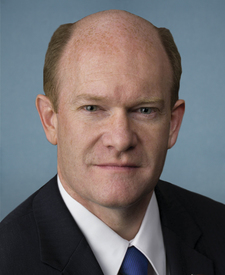
See how Christopher A. Coons actually votes — against your values.
DeepSyte scores Christopher A. Coons's record on the issues you care about — not party, not press releases. Take the 2-minute values quiz to see your personal alignment.
Sign in and take the values quiz to see how Christopher A. Coons's votes line up with your views.
Prediction track record
How often we called Christopher A. Coons's passage votes correctly, from their stated positions on each bill's tagged topics. Excludes “unclear” calls and abstentions.
0%
Accuracy
0
Correct
1
Incorrect
38
Pending
Wrong119-sjres-184
A joint resolution to direct the removal of United States Armed Forces from hostilities within or against the Islamic Republic of Iran that have not been authorized by Congress.
A joint resolution to direct the removal of United States Armed Forces from hostilities within or against the Islamic Republic of Iran that have not been authorized by Congress.
A joint resolution to direct the removal of United States Armed Forces from hostilities within or against the Islamic Republic of Iran that have not been authorized by Congress.
Based on 1 data point across public statements and recorded votes · AI analysis of public records
118-sjres-38·Consistent
A joint resolution providing for congressional disapproval under chapter 8 of title 5, United States Code, of the rule submitted by the Federal Highway Administration relating to "Waiver of Buy America Requirements for Electric Vehicle Chargers".
75/100
What they said
Jun 17, 2026
The senators advocate for federal investment in domestic manufacturing capacity and reduced dependence on foreign supply chains, particularly from China, to strengthen economic security, create jobs, and lower consumer costs.
Voted Nay on A joint resolution providing for congressional disapproval under chapter 8 of title 5, United States Code, of the rule submitted by the Federal Highway Administration relating to "Waiver of Buy America Requirements for Electric Vehicle Chargers".
The statement advocates for strengthening domestic manufacturing and reducing dependence on foreign supply chains, particularly from China. The bill nullifies a waiver that temporarily exempted EV chargers from Buy America requirements, effectively reinforcing domestic content standards. The senator's NO vote on this amendment aligns with the stated position favoring domestic manufacturing — voting against the waiver removal preserves the temporary exemption, which could be seen as protecting foreign suppliers. However, the amendment's specific mechanics and the senator's substantive intent are not entirely clear from the vote record alone, and the statement does not explicitly address EV chargers or this particular rule.
Pairs with ambiguous language and high uncertainty are withheld until more data is available. Procedural, cloture, and amendment votes are excluded — they don't cleanly signal substantive support or opposition.
Pro analysis
AI rep analysis — Pro
Get an AI-narrated read on Christopher A. Coons's full voting record against your stated values — aligned themes, conflicts, notable votes, and what to watch for.
We haven't extracted campaign positions for Christopher A. Coons yet. Once their campaign website or position pages are processed, this card will track what they said vs how they voted.
Crossing the aisle
No party-break passage votes recorded for Christopher A. Coons. Either they've voted with Democrats on every substantive passage vote in the corpus, or their tenure overlaps few high-threshold party-line votes so far.
Senators Coons, Murray call for immediate independent investigation of extended deployments and unacceptable quality of life issues on aircraft carriers as USS Lincoln heads home
Position: Senators Coons and Murray call for an immediate independent Department of Defense review of extended deployments aboard the USS Ford and USS Lincoln, and a power outage aboard the USS Benfold, citing documented quality of life and operational concerns affecting sailors, Marines, and their families.
Lawmakers seek answers on glaring quality of life and operational issues aboard not only the USS Lincoln, but the USS Ford and USS Benfold, which recently suffered a dayslong power outage
WASHINGTON – U.S. Senators Chris Coons (D-Del.) and Patty Murray (D-Wash.) called for the Department of Defense (DOD) to immediately open an independent review of the extended deployments of the USS Ford and USS Lincoln, as well as the USS Benfold’s four-day power loss, in a letter to Defense Secretary Pete Hegseth and acting Navy Secretary Hung Cao. Senator Coons is ranking member of the Defense Appropriations Subcommittee, and Senator Murray is vice chair of the Senate Appropriations Committee.
“We are writing to express our deep concern regarding the recent extended deployments of the USS Gerald R. Ford and USS Abraham Lincoln, and the USS Benfold’s recent undisclosed power loss, and what it means for our sailors, Marines, and their families, as well as for the Navy’s overall military readiness,” wrote Ranking Member Coons and Vice Chair Murray. “Given the serious quality of life and operational concerns that have been documented and the Department’s inability – or refusal – to provide the congressional defense committees with full and accurate information, we request that the Navy initiate an immediate independent strategic review of these deployments, and brief Congress on its findings.”
The lawmakers note that a variety of serious quality of life issues have been documented aboard these aircraft carriers, and service members and their families deserve better: “This administration has tried to downplay or paper over these reports, but the fact is our servicemembers and their families have reported alarming concerns that deserve redress and accountability.”
Ranking Member Coons and Vice Chair Murray called on DOD to immediately conduct a review of these issues and to provide additional responses to a series of questions about the extended deployments by September 1, 2026.
The full text of the letter is available here and below:
Dear Secretary Hegseth and Acting Secretary Cao:
We are writing to express our deep concern regarding the recent extended deployments of the USS Gerald R. Ford and USS Abraham Lincoln, and the USS Benfold’s recent undisclosed power loss, and what it means for our sailors, Marines, and their families, as well as for the Navy’s overall military readiness. Given the serious quality of life and operational concerns that have been documented and the Department’s inability—or refusal—to provide the congressional defense committees with full and accurate information, we request that the Navy initiate an immediate independent strategic review of these deployments, and brief Congress on its findings.
While the reporting that the Lincoln is now on its way home is welcome news, we still have many unanswered questions about the quality of life issues reported on these ships. This administration has tried to downplay or paper over these reports, but the fact is our servicemembers and their families have reported alarming concerns that deserve redress and accountability. Our military family members with loved ones serving on these ships deserve honest answers, and the Pentagon’s denials to date are an insult to the service of these sailors and Marines.
These firsthand accounts from the Ford, Lincoln, and Benfold have included mental health and morale concerns, supply issues for basic necessities such as food, clean water and hygiene items, air conditioning, and cleanliness and sewage issues in bathrooms. There have also been reports of long lines at the mess halls and ship stores and disrupted and lost mail service. After working long shifts on duty during combat operations, our sailors and Marines should not have to worry about basic day-to-day functions, whether they’ll have a full meal, or be able to communicate with their family members.
It also appears that the Navy was inadequately prepared for predictable risks associated with the Iran war, and we are deeply concerned about the implications for future operations or management of a peer conflict. Among these concerns is the availability of replacement carrier groups across the combatant commands and the disruption of the Navy’s supply chain in the Middle East. We are also concerned about the future unbudgeted maintenance costs for the Ford and Lincoln and the length of time required to complete these repairs, which have not yet been outlined to Congress despite our requests.
We insist you immediately direct an independent strategic review of the extended deployments of the Ford and Lincoln, and the Benfold’s four-day power loss. This review should be conducted by senior civilian executives and former military officers. It should examine readiness issues relating to operations, manning, quality of life, including mental health, and culture on the ships as well as communications with the crews’ families. The review should provide recommendations in these areas to improve future extended deployments for sailors and Marines serving on carriers and all other Department of the Navy vessels.
As you begin this investigation, please also provide responses to the following questions:
We request a written response to these questions and establishment of an independent strategic review by September 1, 2026. Thank you for your prompt attention to these important issues.
Senator Coons sponsors Billionaires Income Tax Act to address tax fairness, reduce nation’s deficits
Position: Senator Coons supports the Billionaires Income Tax Act, which would impose a tax on unrealized capital gains for the wealthiest Americans, generating over $500 billion in revenue over ten years to reduce the federal deficit.
WILMINGTON – U.S. Senator Chris Coons (D-Del.) announced he would cosponsor the Billionaires Income Tax Act, legislation that would require the wealthiest Americans to pay taxes on income generated by their assets, creating more than $500 billion in new federal tax revenue over 10 years. Senator Coons’ support for the legislation comes following news that the national debt has surpassed $40 trillion for the first time in American history, underscoring the urgent need for Congress to take steps to address the nation’s long-term fiscal challenges.
The national debt reached $40 trillion earlier this month, adding more than $1 trillion in debt in just five months, according to the U.S. Treasury Department. The federal government is spending more and more tax dollars to pay interest on the nation’s growing debt, putting increasing pressure on the federal budget and limiting the resources available for investments that strengthen the economy and programs that Americans rely on. The national debt has ballooned as tax revenues have fallen in recent decades – repeated Republican tax cuts for wealthy Americans have caused tax revenue as a percentage of GDP to decline 14% since 2000, according to the Federal Reserve.
“Our national debt is a crisis that we cannot afford to leave to our children, and the problem is driven in large part by the fact that too many Americans aren’t paying their fair share. Right now, some of the wealthiest Americans can defer taxes on enormous gains indefinitely, while middle-class Delawareans see taxes taken out of every single paycheck. This legislation requires the very wealthiest Americans to pay taxes on their gains and slashes our deficit while leaving tax rates the same for nearly every American,” said Senator Coons. “As interest costs put growing pressure on our budget, we need to reduce our deficits and protect the investments that keep our economy strong.”
The Billionaires Income Tax Act would apply to fewer than 1,000 of the wealthiest taxpayers in a country of more than 342 million people. Under the proposal, taxpayers with more than $100 million in annual income or more than $1 billion in assets for three consecutive years would be subject to the tax. By taxing the unrealized capital gains of these individuals, the proposal would raise more than $500 billion over ten years, providing an opportunity to strengthen the nation’s fiscal position and shore up funding for our military, national parks, affordable housing, and many other vital programs.
The Billionaires Income Tax Act was introduced by Senator Ron Wyden (D-Ore.). Congressman Steve Cohen (D-Tenn.) and Congressman Don Beyer (D-Va.) introduced companion legislation in the House. The legislation has more than 20 Senate cosponsors.
You can find the bill text here.
Senators Coons, McCormick introduce bipartisan bill to strengthen NIH mentorship and support next generation of biomedical researchers
Position: Senators Coons and McCormick introduced bipartisan legislation to formalize mentorship standards across NIH career development and research training programs to support early-career biomedical researchers and reduce attrition from the research field.
WASHINGTON – U.S. Senators Chris Coons (D-Del) and Dave McCormick (R-Pa.) introduced the NIH Mentorship Modernization Act, bipartisan legislation to strengthen America’s scientific workforce by formalizing consistent, evidence-based mentorship standards across National Institutes of Health (NIH) career development and research training programs.
The biomedical research enterprise depends on a steady pipeline of talent, but too many early-stage investigators leave the field for the private sector before they ever reach an R01 grant –the traditional marker of an independent research career. This attrition point, the gap between early career development awards and R01-level funding, is one of the most vulnerable stages in a researcher’s career and a critical juncture where the nation risks losing its most promising scientific talent. Strong mentorship has been shown to help early-career researchers navigate this gap, stay in the research pipeline, and go on to lead their own research programs.
The legislation formalizes mentorship as a standard part of NIH-funded career development and training programs, giving young, accomplished researchers the structured support they need to remain in research rather than exit the industry. It builds on existing mentorship practices, preserves flexibility for research institutions, and minimizes unnecessary administrative burden by relying on NIH’s existing reporting requirements.
“The next generation of scientists will contain the next generation of disease outbreaks and cure the next generation of illnesses, but first those scientists must be properly prepared for their careers,” said Senator Coons. “Mentorship is a powerful way of ensuring we have capable and qualified researchers to keep our nation healthy.”
“America’s leadership in biomedical research depends on developing the next generation of scientific talent,” said Senator McCormick. “Strong mentorship helps young researchers succeed, drives innovation, and ensures taxpayer investments in medical research deliver lasting results. As the fourth-largest recipient of NIH funding in the nation, Pennsylvania has a strong stake in maintaining a world-class biomedical research workforce. This bipartisan legislation strengthens that pipeline while giving institutions the flexibility they need to build on what already works.”
Studies consistently show that researchers with engaged mentors are more likely to remain in research careers, secure independent grant funding, publish impactful research, advance professionally, and report greater career satisfaction.
The NIH supports thousands of early-career researchers through career development and research training awards. While many of these programs include mentored research experiences, mentorship expectations vary considerably across institutions.
In fiscal year 2025, Delaware was awarded $94.4 million in grants, supporting 701 jobs and generating $222 million in economic activity across the state. Delaware’s broader bioscience industry supports nearly 8,000 jobs across 890 businesses, with leading NIH-funded institutions that include the University of Delaware, Nemours, Delaware State University, and ChristianaCare.
Across the country, NIH awarded $36.94 billion in research funding in fiscal year 2024, supporting 407,782 jobs and generating $94.58 billion in economic activity nationwide. Every $1 invested in NIH-funded research generates approximately $2.56 in economic activity, underscoring the importance of maintaining a strong pipeline of talented biomedical researchers.
The NIH Mentorship Modernization Act would:
“Scientific breakthroughs depend on talented researchers having the support and guidance they need at critical stages of their careers. This bipartisan legislation underscores that effective mentorship is not incidental to scientific success but essential to it. By supporting the development of early-career investigators, the NIH Mentorship Modernization Act will help strengthen the research workforce and foster innovations that improve lives,”said Fabrice Veron, interim vice president for research, scholarship and innovation, University of Delaware.
Read the full text of the bill here.
Senators Coons, Rounds introduce bipartisan legislation to fortify our electric grid against emerging quantum cyber threats
Position: Senators Coons and Rounds introduced legislation to strengthen electric grid cybersecurity by directing federal agencies to evaluate quantum-related vulnerabilities, assist utilities in adopting post-quantum cryptography standards, and improve coordination between grid operators and government partners.
WASHINGTON – U.S. Senators Chris Coons (D-Del.) and Mike Rounds (R-S.D.) introduced the Quantum Grid Utility Assurance and Resilient Defense Act of 2026 (Quantum-GUARD Act) to strengthen electric grid resilience by proactively addressing cybersecurity threats posed by quantum computing.
Quantum computing technology is rapidly progressing, and powerful quantum computers may soon be able to break widely used encryption standards that protect the cybersecurity of critical systems and sensitive data. In 2024, the National Institute of Standards and Technology (NIST) finalized post-quantum cryptography (PQC) standards that are more resistant to quantum-enabled decryption.
Critical infrastructure sectors face unique challenges in adopting these new standards. The Quantum-GUARD Act seeks to address those challenges. It directs federal agencies to evaluate quantum-related cybersecurity vulnerabilities, assist electric utilities in transitioning to PQC, and improve coordination between grid operators, cybersecurity experts, and government partners.
“Quantum computing has the potential to create new economic opportunities, but it also presents tremendous cybersecurity risks. We need to make sure essential infrastructure like our electrical grid is secured against this coming wave of quantum cyber threats,”said Senator Coons. “As the technology races forward and our adversaries continue to seek vulnerabilities in our critical systems, we need to pass the Quantum-GUARD Act to ensure our government is using every available tool to meet this threat.”
“As advances in quantum computing increase cybersecurity threats to the United States, we must continue to strengthen protections for our nation’s most sensitive data,” said Senator Rounds. “I’m pleased to be co-leading the Quantum-GUARD Act, which will codify parts of President Trump’s executive order regarding advanced cryptographic attacks and support our electrical grid’s transition to post-quantum cryptography.”
“QED-C supports efforts to strengthen cybersecurity preparedness and accelerate the deployment of post-quantum cryptography (PQC) across critical infrastructure, including the electric grid. As QED-C reported in QuEnergy Resilience, using PQC to secure communications for monitoring and control of the electric grid is widely recognized as one of the most feasible and highest-impact actions to secure grid operations, with strong alignment across industry, national laboratories, and academia,” said Celia Merzbacher, executive director of the Quantum Economic Development Consortium (QED-C), managed by SRI International.
“Quantum computing may seem like science fiction, but it’s only a matter of time before an operationally relevant quantum computer arrives. The cybersecurity impacts of quantum computing will be immense, and the Quantum-GUARD Act would help both government and industry tackle this problem. Prompting the Federal Energy Regulatory Commission to consider the reliability risks associated with quantum computing and directing the Department of Energy to create a sandbox to test technology and implementation strategies against quantum capabilities are good steps to take,” said Michael Daniel, president & CEO of the Cyber Threat Alliance.
“Quantum computing will bring great benefits, but it also creates cybersecurity risk. Post-quantum cryptography will help ensure that our nation’s power grids are resistant to quantum attack. The Quantum Industry Coalition supports the Quantum-GUARD Act and thanks Senators Coons and Rounds for their leadership in introducing it,” said Paul Stimers, executive director, Quantum Industry Coalition.
“The threat quantum computing poses to the systems that run our electric grid is real, and the hardest part of getting ahead of it is not the cryptography itself but migrating the equipment already in the field. This bill gets the approach right. It directs FERC to weigh quantum risk where it matters, and it puts DOE's convening power behind the practical work of helping utilities and vendors move deployed IT and OT systems to post-quantum cryptography. That focus on real-world adoption, not just research, is what the sector needs,” said Patrick C. Miller, president & CEO, Ampyx Cyber.
“Preparing critical infrastructure for the transition to post-quantum cryptography starts with understanding where and how today’s cryptography is used. The Quantum-GUARD Act creates an important opportunity to help utilities and vendors test cryptographic discovery and migration approaches in realistic IT and OT environments, while giving FERC and NERC better evidence to inform future reliability policy,” said Dr. Allan Friedman, cyber supply chain expert and technologist-in-residence, TPO.group.
“Post-quantum cryptography (PQC) is how we make sure the systems running America’s power grid stay secure in the quantum era, but migrating critical infrastructure takes years of preparation. The Quantum-GUARD Act gets that preparation underway now. American Binary strongly supports the Act and thanks Senators Coons and Rounds for their efforts to codify our country's necessary PQC migration,” said Kevin Kane, CEO, American Binary.
“As a leader in quantum technologies, IonQ wholly endorses this significant legislation that addresses the necessary transition to post-quantum cryptography in the energy sector,” said Dean Acosta, chief corporate affairs and government relations officer, IonQ.
Read the full text of the bill here.
Read a one-pager of the bill here.
Senators Coons, Rounds introduce bill to preserve records for at-risk Afghan allies
Position: The senators support legislation to establish a Department of Defense process for identifying, verifying, and preserving service records of Afghan allies who served alongside U.S. forces during the Afghanistan war, with provisions for appeals and reconsideration.
WASHINGTON – U.S. Senators Chris Coons (D-Del.) and Mike Rounds (R-S.D.) introduced the Afghan Ally Records and Credential Heritage (ARCH) Act, legislation to establish a process at the Pentagon to identify, verify and preserve the service records of certain Afghan allies who served alongside our forces during the war in Afghanistan. The bill is also cosponsored by Amy Klobuchar (D-Minn.) and Thom Tillis (R-N.C.).
Under the ARCH Act, the Department of Defense would establish a secure online application system through which eligible Afghan allies or their representatives could submit service information and supporting documentation. After reviewing available military, contractor, and biometric records, the department would preserve verified records for future use. The bill also provides applicants with notice of adverse decisions, an opportunity to appeal and the ability to request reconsideration when new evidence becomes available.
“We owe an enormous debt to the Afghans who supported U.S. forces during their 20-year mission in Afghanistan,” said Senator Coons. “In exchange for that huge risk to themselves and their families, we promised them protection. This is a first step to fulfilling that promise by ensuring those who put their lives on the line for our country don’t fall through the cracks.”
“Thousands of brave Afghans stood shoulder-to-shoulder with American service members in some of the most dangerous missions of the war,” said Senator Rounds. “Many of these individuals risked everything to support the United States, yet the records documenting their service remain vulnerable to loss or destruction. The ARCH Act creates a secure process to preserve this documentation, making certain that accurate records are maintained.”
“We must keep our covenant with the Afghans who served beside us, risking everything — often at great personal expense to themselves and their families — to further America’s mission,” said Senator Klobuchar. “Our bipartisan legislation will ensure Afghan allies can be confident their service records will be preserved to help them establish facts about their service in future applications to the U.S. government.”
“We owe it to our Afghan allies to provide a fair and efficient process to preserve the service records documenting the sacrifices they made while serving alongside U.S. forces,” said Senator Tillis. “I’m proud to cosponsor this effort to ensure those records are available for those who stood with our servicemembers in Afghanistan.”
Specifically, the ARCH Act would:
The legislation recognizes the service of former members of Afghanistan's special operations forces, the Afghan Air Force, the Special Mission Wing, intelligence personnel, justice-sector officials, female members of the former Afghan security forces and other individuals who supported the United States mission in Afghanistan between 2001 and 2021.
The ARCH Act is supported by AfghanEvac, No One Left Behind, With Honor, REACT DC, the Lamia Afghan Foundation, the Center for Law and Social Policy, the Afghan Scout Relief Fund and Keeping Our Promise Inc.
“For the men and women who served as commandos, pilots, intelligence officers, and judges alongside American forces, and for all the women who served in the ranks of the Afghan National Defense and Security Forces, the record of that service is the difference between being recognized and being erased,” said Shawn VanDiver, president of AfghanEvac and a U.S. Navy veteran. “When Kabul fell, so did easy access to the documents and biometrics that prove who stood with us, and every day those records sit unprotected is a day we risk losing them for good. The ARCH Act makes sure that proof survives, so our allies can still be identified, verified, and protected when it counts. We're grateful to Senators Rounds, Klobuchar, Coons, and Tillis for their bipartisan leadership, and we urge the Senate to move this bill without delay.”
“Retaining Afghan allies’ service records is a national security necessity, and is vital to supporting our wartime allies,” said Andrew Sullivan, executive director of No One Left Behind. “No One Left Behind proudly endorses the Afghan Allies Records and Credential Heritage Act, a bipartisan recognition that would document the service and contributions Afghan allies made alongside American service members. Evacuating allies left behind remains a moral obligation, and this legislation is an important step in accomplishing that mission.”
“The United States and coalition forces relied on brave Afghan allies for years. In the wake of war and withdrawal, many records of their service were lost,” said Rye Barcott, co-founder and CEO of With Honor. “With Honor Action is proud to endorse the ARCH Act, which provides a formal process for Afghan allies to document their service alongside U.S. military forces. We are encouraged to see the inclusion of this language in the Senate’s draft of the FY27 National Defense Authorization Act, and urge Congress to preserve this provision as they work to conference this bill. With Honor Action thanks Senators Mike Rounds, Amy Klobuchar, and Thom Tillis for making sure that Afghans who served alongside Americans are never denied recognition simply because of missing paperwork.”
Read the full text of the bill here.
Senators Coons, Schatz, colleagues introduce bill to restore press freedom at the Pentagon
Position: Senators Coons, Schatz, and colleagues introduced legislation to restore press access at the Department of Defense, opposing restrictions on journalist access to Pentagon information that they characterize as suppressing independent reporting.
WASHINGTON – U.S. Senators Chris Coons (D-Del.), Brian Schatz (D-Hawaii), and 13 of their Senate colleagues introduced the Protecting Pentagon Press Access Act to restore press access at the Department of Defense, reversing attempts by Secretary Pete Hegseth to suppress independent reporting at the Pentagon.
“The First Amendment and a free press aren’t sidelined during a time of war, they become more important than ever. Under Secretary Hegseth, the Pentagon has hidden from the American people and their representatives in the press, denying the public critical information about the war in Iran and our own security here at home,” said Senator Coons. “Congress must pass this legislation swiftly and restore the press’ ability to accurately and transparently report on the Pentagon’s activity.”
“At a time of war, transparency and independent, accurate reporting matter more than ever,” said Senator Schatz. “Our bill will reverse the Pentagon's effort to shut out the free press and make sure the public gets the information it deserves.”
Since taking office, Secretary Hegseth imposed a series of unreasonable and retaliatory restrictions on credentialed journalists’ access to the Pentagon and their ability to report. These measures go well beyond reasonable rules of conduct and reverse the Pentagon’s longstanding approach to the press, which has been maintained by officials from both parties.
The Protecting Pentagon Press Access Act would:
In addition to Senators Coons and Schatz, the bill is also cosponsored by U.S. Senators Adam Schiff (D-Calif.), Jeanne Shaheen (D-N.H.), Jon Ossoff (D-Ga.), Chris Van Hollen (D-Md.), Tammy Duckworth (D-Ill.), Tim Kaine (D-Va.), Richard Blumenthal (D-Conn.), Elizabeth Warren (D-Mass.), Cory Booker (D-N.J.), Ron Wyden (D-Ore.), Jeff Merkley (D-Ore.), and Jacky Rosen (D-Nev.).
The Protecting Pentagon Press Access Act is supported by the Reporters Committee for Freedom of the Press and Reporters Without Borders.
The text of the bill can be found here.
Senator Coons, Tillis, introduce legislation to further protect law enforcement after targeted shootings of officers
Position: The senators introduce legislation to create new federal criminal charges targeting individuals who intentionally attack law enforcement officers, framing this as necessary accountability for crimes against police.
Introduction follows killing of Corporal Matthew “Ty” Snook in Delaware last December
WASHINGTON – U.S. Senators Chris Coons (D-Del.), Thom Tillis (R-N.C.), Catherine Cortez Masto (D-Nev.) and Mike Crapo (R-Idaho), today introduced the Protect and Serve Act of 2026 to deter attacks on law enforcement officers by creating new federal charges against criminals who intentionally target them. The introduction comes in honor of law enforcement officers in Delaware and North Carolina who were killed in targeted attacks.
Senator Coons was inspired to introduce the Protect and Serve Act of 2026 following the tragic shooting of Corporal Grade One Matthew “Ty” Snook, who was killed in the line of duty on December 23, 2025, at a Wilmington Division of Motor Vehicles office. Corporal Snook was a father, husband, brother, and friend who died serving and protecting the people of Delaware.
“No law enforcement officer should have to fear for their lives just because they put on their badge before they go to work each day. Yet too many officers have been killed in targeted attacks designed specifically to take the lives of law enforcement, leaving a gaping tear in the hearts of spouses, parents, children, and communities,” said Senator Coons. “I’m proud to introduce the Protect and Serve Act of 2026 because those who perpetrate crimes like this one should be punished to the fullest extent of the law.”
“Law enforcement officers in North Carolina and across the country are heroes who risk their lives every day to protect our communities,” said Senator Tillis. “Those who commit senseless acts of violence against law enforcement officers must be held accountable for their actions, which is why I am proud to lead the bipartisan Protect and Serve Act of 2026. Officers put their lives on the line to protect us, and we should do the work in Congress to protect them.”
“Targeted violence towards a law enforcement officer is completely unacceptable and anyone who tries to hurt a cop because of their job should be held accountable to the fullest extent of the law,” said Senator Cortez Masto. “Our police officers put their lives on the line every day to protect their communities, and this bipartisan bill shows we have their backs.”
“Law enforcement officers put their lives on the line to protect our communities and uphold the rule of law,” said Senator Crapo. “Those who deliberately target officers with the intent to kill must face severe consequences. The Protect and Serve Act would give federal prosecutors additional tools to hold these violent offenders accountable and reinforce our commitment to those who protect and serve.”
“Our members are under fire by individuals motivated by nothing more than a desire to kill or injure a cop. Despite a decrease in the nation’s homicide rate, firearms attacks on law enforcement officers have remained alarmingly high, underscoring a dangerous and persistent trend of deliberate attacks – too many of which are not spontaneous confrontations, but calculated assaults intended to inflict maximum harm on officers,” said Patrick Yoes, national president of the Fraternal Order of Police. “We are deeply grateful to Senators Tillis and Coons, with whom we have been working to develop this ‘Protect and Serve Act’ to better protect our men and women in law enforcement. The bill they have introduced is a product of true collaboration and we sincerely appreciate their leadership and dedication. We look forward to working with them and with our other Senate allies to get this bill to a vote on the floor.”
The Protect and Serve Act of 2026 will protect our servicemen and women who put their lives on the line each and every day. It establishes a new federal crime against those who kill or seriously injure law enforcement officers in targeted attacks meant to kill them solely because of their status as law enforcement officers. It has been revised from prior versions to focus federal prosecutors on the most heinous attacks designed to kill law enforcement.
The Protect and Serve Act of 2026 is endorsed by the National Fraternal Order of Police.
Read the full text of the bill here.
Senators Coons, Murkowski introduce bipartisan bill to use Temporary Protected Status to help vulnerable Afghans in the United States
Position: Senators Coons and Murkowski introduce bipartisan legislation to grant Temporary Protected Status to eligible Afghan nationals already in the United States who supported U.S. forces, citing moral obligation and national security interests.
WASHINGTON – U.S. Senators Chris Coons (D-Del.) and Lisa Murkowski (R-Alaska) today introduced the Afghanistan TPS Act of 2026, legislation to protect eligible Afghan nationals already living in the United States from being forced to return to Taliban-controlled Afghanistan by granting them Temporary Protected Status (TPS), a successful and bipartisan multi-decade program to help immigrants from nations impacted by armed conflict, natural disasters, or other severe humanitarian crises.
Senators Amy Klobuchar (D-Minn.) and Bill Cassidy (R-La.) joined Senators Coons and Murkowski in introducing the legislation. A bipartisan companion bill was introduced in the House of Representatives by Jason Crow (D-Colo.), Sam Liccardo (D-Calif.), Don Bacon (R-Neb.), and María Elvira Salazar (R-Fla.).
“We owe an enormous debt to the Afghans who supported U.S. forces during their 20-year mission in Afghanistan,” said Senator Coons. “In exchange for that huge risk to themselves and their families, we promised them protection, protection that is more important than ever in light of the crises that have been created across their home country by the Taliban’s authoritarian regime. I’m grateful to Senator Murkowski for helping lead this bipartisan bill to ensure properly vetted Afghans are welcomed in the United States and protected from the imminent danger the Taliban would pose to them if they were forced back across the world.”
“Ensuring the safety of Afghan nationals who bravely fought side by side with U.S. Armed Forces against the Taliban is not only a moral obligation, but also extends to our national security interests. Failing to do so would undermine the credibility of future U.S. commitments to those who stand alongside us in times of strife,” said Senator Murkowski. “That’s why I joined Senator Coons in developing this narrowly tailored legislation, which provides TPS protection only to those Afghans who have already been living in the United States, have cleared rigorous national security background checks, and would require additional security evaluations when necessary. Forcing these individuals to return to the Taliban before it is safe in Afghanistan would be an egregious breach of the trust and commitment to those who risked everything to fight for their freedom.”
“We must keep our covenant with the Afghans who served beside us, risking everything — often at great personal expense to themselves and their families — to further America’s mission,” said Senator Klobuchar. “Our bipartisan legislation will help ensure Afghan allies can safely remain in the country. It’s important to do what we can to help our Afghan friends find stability, opportunity, and community in their new home.”
The bill would designate Afghanistan under TPS through July 1, 2029, allowing eligible Afghan nationals already in the United States to continue living and working here temporarily. Applicants would be required to submit biometric and biographic information and complete applicable criminal and national-security background checks. The bill comes upon the fifth anniversary of the withdrawal from Afghanistan and as Afghanistan continues to face a severe humanitarian and human rights crisis under Taliban rule. Many Afghans who have come to America in recent years aided U.S. and NATO troops and would put themselves and their families at great risk if forced to return to the country. However, last year, the Department of Homeland Security terminated Afghanistan’s TPS designation, stripping eligible Afghans of their legal status and work authorization and potentially forcing them to return to a dangerous environment.
First created during the George H.W. Bush administration, TPS allows the federal government to grant short-term work permits and a shield from deportation to immigrants from specific, named countries where returning citizens would put them in serious danger. The Trump administration has sought to end most TPS programs, which could lead to the deportation of hundreds of thousands of migrants from four different continents.
The Afghanistan TPS Act would:
The legislation is endorsed by AfghanEvac, No One Left Behind, Iraq and Afghanistan Veterans of America, Veterans of Foreign Wars, Global Refuge, Refugees International, Afghan-American Foundation, Afghans for a Better Tomorrow, International Refugee Assistance Project, International Rescue Committee, Church World Service, Human Rights First, HIAS, Refugee Congress, Service Employees International Union (SEIU), Team America Relief, The Lamia Afghan Foundation, World Relief; New Life Church, Center for Gender & Refugee Studies, Center for Refugee Services, International Institute of New England, Afghan Promise, Afghan Community Cultural Center – Texas, Afghan Labor Advocacy Network, World Hazara Council USA, Asian Americans Advancing Justice Southern California, Austin Jews and Partners for Refugees, California Hazara Community, Unitarian Universalists for Social Justice, Red T, Refugee Advocacy Lab, REACT DC, New Neighbor Interfaith Alliance, Interfaith Coalition for Immigrant Justice, Massachusetts Afghan Alliance, Immigrant Defenders Law Center, Immigrant Legal Advocacy Project, Hearts & Homes for Refugees, New Milford Area Rotary, and more.
“America made a promise to the Afghans who stood with us, and Senators Coons and Murkowski are helping keep it, joined by Senators Cassidy and Klobuchar. This bill is simple and overdue. It shields vetted Afghan allies from deportation to a country run by the Taliban that wants them dead, and it lets them keep working and supporting their families while they're here,” said Shawn VanDiver, President of AfghanEvac. “These are people who are already in our communities, already vetted, and already contributing. Temporary Protected Status is a bridge, not a path to citizenship, and it comes with full national-security vetting and a hard deadline for DHS to act. That two Democrats and two Republicans are leading this together shows keeping our word to our allies was never a partisan question. We're grateful to all four senators, and we urge their colleagues to move quickly, because our allies cannot afford for the Senate to wait.”
“Afghan partners took extraordinary risks on our behalf for twenty years, and the ongoing threats to their lives in Afghanistan are well documented. How we treat them now determines whether America has the same support in the next national security conflict. Sending people who worked and sacrificed for the United States back to Taliban-controlled Afghanistan hands our adversaries a propaganda win and unnecessarily puts our allies at risk,” said Andrew Sullivan, Executive Director of No One Left Behind. “This bipartisan bill, alongside the House companion, promotes national security by enforcing rigorous vetting and thorough security checks while protecting vetted Afghan nationals. No One Left Behind is proud to endorse this legislation, and we thank Senators Coons and Murkowski for their bipartisan work behind it.”
“Newly arrived Afghans are pillars in their communities across the United States. Many of them served alongside American service members during the mission while others fought for democracy and women's rights. Now, they are under attack and at risk of detention and deportation for no other reason than their country of origin,” said Arash Azizzada, Executive Director for Afghans For A Better Tomorrow. “Afghans deserve much-needed protections and Congress must act to pass this bipartisan, critical and life-saving legislation. Afghans cannot wait a day longer without passage of the Afghanistan TPS Act.”
“IAVA will always stand by our Afghan Allies. We have always said that our national security and credibility as a moral nation depends on how we treat those who saved countless lives of men and women in uniform for over two decades in Afghanistan combat,” said Dr. Kyleanne Hunter, CEO of Iraq and Afghanistan Veterans of America (IAVA). “We are encouraged by Senator Coons and Senator Murkowski joining the fight to uphold our promise to our Allies and for introducing a Senate companion to the Afghanistan TPS of 2026. We’re hopeful this is a meaningful stepping stone towards a lasting pathway to citizenship and thankful to Congress for acknowledging this need, which has remained unanswered for too long.”
“Afghans seeking safety in the United States have endured years of upheaval, displacement, and danger that no family should ever have to navigate. The situation inside Afghanistan has only grown more dire — widespread hunger, collapsing public services, and the near‑total erasure of women’s rights have created one of the world’s most severe humanitarian emergencies,” said Krish O'Mara Vignarajah, President and CEO of Global Refuge. “Offering Temporary Protected Status to Afghans who have built their lives here is not only lawful and necessary — it is a reaffirmation that America does not turn its back on people who sought refuge in moments of crisis. And it does not forget its commitments to its allies and partners. I commend the bipartisan and principled leadership behind this bill and urge Congress to move swiftly to provide the stability and safety these individuals deserve.”
“Making promises to vulnerable Afghans is the minimum that our country can do to stand alongside those who have supported our country in so many ways. The Afghanistan TPS Act gives vetted Afghans who are already here the stability to work, support their families, and live without the fear of deportation,” said Beth Oppenheim, CEO of HIAS. “HIAS is proud to stand behind this bipartisan bill, because welcoming the stranger and protecting the vulnerable are not partisan values, they are enduring American ones.”
“The Afghanistan of today is a stark departure from the country that so many Afghans and Americans sacrificed to build after 2001. Women and girls have been systematically erased from public life, nearly half the population depends on humanitarian assistance, and a collapsing healthcare system struggles to provide even the most basic care. These are not distortions, they are documented facts,” said Mohammed Naeem, Senior Director for Advocacy Strategy at Refugees International. “We are grateful to Senators Coons, Murkowski, Klobuchar, and Cassidy for answering the call and introducing this critical bill. Without its passage, we risk sending Afghan families back to conditions defined by dehumanization, deprivation, and despair. That is not the promise we made to our Afghan allies. Congress can instead reaffirm that America is a nation that honors its word—and that our word does not end when the headlines fade.”
Full text of the legislation is available here.
Senator Coons, colleagues celebrate unanimous passage to extend bankruptcy financial tools to small businesses and American families
Position: The senators express support for the Bankruptcy Threshold Adjustment Act of 2026, which reinstates higher debt limits for Subchapter V and Chapter 13 bankruptcy to expand access to bankruptcy protections for small businesses and families.
WASHINGTON – U.S. Senators Chris Coons (D-Del.), Chuck Grassley (R-Iowa) and Dick Durbin (D-Ill.) celebrated the unanimous passage by the U.S. Senate of their Bankruptcy Threshold Adjustment Act of 2026, which would restore Americans’ access to critical bankruptcy programs by reinstating modern debt limits for Subchapter V and Chapter 13. The legislation is also cosponsored by U.S. Senators John Cornyn (R-Texas), Sheldon Whitehouse (D-R.I.) and the late Senator Lindsey Graham (R-S.C.).
“Americans going through one of the most difficult seasons of their lives shouldn’t then be faced with bureaucratic hurdles and outdated rules as they try to restore their financial well-being,” said Senator Coons. “This bipartisan bill will make the path through bankruptcy a little easier for families and small businesses struggling to stay afloat.”
“Our nation’s bankruptcy code should work for Americans, not against them. By eliminating barriers to reorganization and restoring modern debt limits, the bipartisan Bankruptcy Threshold Adjustment Act would provide American families and small businesses the tools they need to regain their financial footing in a quicker, more streamlined process,” said Senator Grassley. “I thank my colleagues in the Senate for their unanimous support of our legislation, and I urge the House of Representatives to swiftly pass this needed legislation.”
“Bankruptcy is often a painful last resort for small business owners. This bill makes permanent a quicker and cheaper pathway for entrepreneurs to settle debts, keep the lights on, and keep serving their neighbors. It also expands eligibility for Chapter 13 bankruptcy to help more families manage rising costs, stay in their homes, and get back on their feet. With unanimous passage in the Senate, I encourage the House of Representatives to quickly pass this bill—and for the President to sign it into law,” said Senator Durbin.
In 2025, Delaware had 568 cases filed for Chapter 13 bankruptcy. The Bankruptcy Threshold Adjustment Act of 2026 offers more support to Delaware families and small businesses who are just trying to make ends meet and fighting rising costs. This legislation will permanently restore the Subchapter V debt limit to $7.5 million and the Chapter 13 debt limit to $2.75 million, so that more families have access to financial tools they need to regain financial security.
Senator Coons has worked hard to make bankruptcy law more fairer throughout his time in the Senate. In 2019, Senator Coons voted to enact the Small Business Reorganization Act into law, which streamlined the Chapter 11 bankruptcy process for small business owners by reducing procedural burdens and lowering filing costs. In 2022, Senator Coons supported the Bankruptcy Threshold Adjustment Extension Act, extending the $7.5 million debt limit for small businesses filing under Subchapter V and establishing a new debt limit of $2.75 million for individuals and families filing under Chapter 13. When that bill expired in 2024, the debt thresholds for both programs reverted to lower levels.
Read the full text of the bill here.
Senators Coons, Young introduce bipartisan legislation to invest in startups and entrepreneurs across the country
Position: Senators Coons and Young support reauthorization of the Economic Development Administration's Build to Scale program through fiscal year 2030 to fund startup development and regional innovation ecosystems.
WASHINGTON – U.S. Senators Chris Coons (D-Del.) and Todd Young (R-Ind.) introduced the Build to Scale Reauthorization Act of 2026, which would reauthorize the Economic Development Administration’s (EDA) Build to Scale program through fiscal year 2030.
“Delaware is a state built on innovation. We know what it takes to turn a good idea into a thriving business: support, investment, and expertise,” said Senator Coons. “This bipartisan bill brings those needed pieces to startups and entrepreneurs across the country, so Americans can continue to reach for their dreams, create jobs, and grow our economy.”
“America’s long-term economic strength depends on our ability to turn innovation into opportunity,” said Senator Young. “The Build to Scale program helps entrepreneurs, universities, investors, and local organizations work together to develop new technologies, launch businesses, and create good-paying jobs. This legislation will ensure Hoosier innovators and communities across the country have the tools they need to compete in the industries of the future.”
Since 2014, the Build to Scale program has strengthened regional innovation ecosystems by supporting entrepreneurs, technology startups, and organizations that connect startups with the capital, infrastructure, and expertise needed to grow. The program has awarded more than $272 million to 426 projects across all 50 states, Washington, D.C., and Puerto Rico, helping support more than 58,600 jobs and 6,200 startups.
Build to Scale funding is essential to Delaware’s innovation economy. The Delaware Innovation Space (DISI) has received $2.25 million in funds through this program to advance Delaware entrepreneurs’ access to state-of-the-art laboratory spaces. Reauthorizing funding for the Build to Scale programs would mean supporting Delawarean entrepreneurs and innovation.
The Build to Scale Reauthorization Act of 2026 would:
The Build to Scale Reauthorization Act of 2026 was introduced in the U.S. House of Representatives in May by Representatives Haley Stevens (D-Mich.) and Jim Baird (R-Ind.).
This bill is supported by the Delaware Innovation Space and the Delaware Prosperity Partnership (DPP).
“EDA’s Build to Scale program has played an instrumental role in strengthening the entrepreneurial ecosystem for scalable, science-based startups,” said William D. Provine, Ph.D., president & CEO of the Delaware Innovation Space. “Its support has helped us build more commercially viable companies that have crossed the ‘valley of death’ between scientific discovery and successful commercialization. In 2025, The Innovation Space and the companies we support generated an estimated $704 million in economic output and supported nearly 2,500 jobs across the United States. Reauthorizing Build to Scale will help more promising science-based companies reach the market, grow, and contribute to America’s economic competitiveness.”
“Delaware Prosperity Partnership strongly supports the reauthorization of the Build to Scale (B2S) Program. This legislation is an opportunity to strengthen Delaware's innovation economy by accelerating the commercialization of emerging technologies, expanding access to entrepreneurial resources, and fostering strategic partnerships among industry, academia, local accelerators, and government. With past EDA Build to Scale funding, The Delaware Innovation Space in Wilmington has been able to expand its support of regional and national science and technology startups and early-stage companies. Future B2S investment could enhance the state's capacity to grow and attract scalable startups, create quality jobs, increase access to capital, and reinforce Delaware's position as a cradle of innovation,” says Becky Harrington, DPP’s interim president and CEO.
Further endorsements of the Build to Scale Reauthorization Act of 2026 include: SSTI, the Association of University Research Parks (AURP), Cornell University, Georgetown University’s Office of Technology Commercialization, the Center on Rural Innovation, US Ignite, Launch Tennessee, JumpStart Inc., Rev1 Ventures, Arch Grants, mHUB, BioSTL, the Maryland Clean Energy Center, the Washington Technology Industry Association, and the Greater Phoenix Economic Council.
Read the full text of the bill here.
Articles from a curated list of national outlets that mention Christopher A. Coons.
No recent news mentions yet.
Source: GDELT 2.0 GKG, filtered to a curated list of national outlets. Inclusion is not endorsement; opinion pieces and reported news are mixed.
Recent stock activity
Periodic transaction reports filed under the STOCK Act — disclosed by the rep, sourced from public filings.
No disclosed trades on record.
Source: open-data mirrors of the Senate eFD and House Clerk financial-disclosure systems. Disclosure within 30 days of trade is required by law (45 for spouse/dependent trades).
Top PAC donors · 2026 cycle
Political action committees that gave the most to this rep's principal campaign committee this cycle. PAC giving is direct organizational support — industry, ideological, or leadership.
1.COONS LEADERSHIP FUND3 contributions$27,700
2.THE PEOPLE'S VOICES PAC2 contributions$10,000
3.HAWAII PAC2 contributions$10,000
4.AMERICAN ISRAEL PUBLIC AFFAIRS COMMITTEE POLITICAL ACTION COMMITTEEIdeological1 contributionPAC arm of the American Israel Public Affairs Committee, federalized in 2021. Backs candidates of both parties who support U.S.-Israel security and economic ties.AI$6,400
5.WINE AND SPIRITS WHOLESALERS OF AMERICA, INC. POLITICAL ACTION COMMITTEEBusiness1 contributionTrade association PAC for wine and spirits wholesalers — backs candidates and policies supporting alcohol distribution, retail licensing, and industry regulatory interests.AI$5,000
6.OFFICE OF THE COMMISSIONER OF MAJOR LEAGUE BASEBALL POLITICAL ACTION COMMITTEE1 contribution$5,000
8.NCTA - THE INTERNET & TELEVISION ASSOCIATION POLITICAL ACTION COMMITTEE (NCTA PAC)1 contribution$5,000
9.NATIONAL BEER WHOLESALERS ASSOCIATION POLITICAL ACTION COMMITTEEBusiness1 contributionTrade association PAC for beer wholesalers — backs candidates supporting alcohol distribution regulations, tax policy, and industry supply-chain interests.AI$5,000
10.NATIONAL APARTMENT ASSOCIATION POLITICAL ACTION COMMITTEEReal Estate1 contributionTrade association PAC for apartment owners and operators — backs candidates supporting property-rights protections, favorable tax treatment of rental housing, and reduced regulatory burdens on multifamily housing.AI$5,000
Source: OpenFEC (api.open.fec.gov) Schedule A receipts where contributor type is “committee.” Aggregated by contributing committee. Self-transfers from joint-fundraising / victory committees are excluded.
Top individual contributors · 2026 cycle
Itemized individual contributions over $200 to this rep's campaign committee, aggregated by donor employer. PAC giving is shown above; this section is people, not organizations.
1.YOUNG CONAWAY STARGATT & TAYLOR LLP$129,125
2.APOLLO GLOBAL MANAGEMENT$50,000
3.LOCKHEED MARTIN$32,500
4.CAPITAL GROUP$23,750
5.QUINN EMANUEL URQUHART & SULLIVAN$22,000
6.LEIDOS$20,750
7.BLACKSTONE$20,000
8.CAPITAL GROUP COMPANIES$17,500
9.K&L GATES LLP$17,000
10.GIBSON DUNN & CRUTCHER$16,400
Source: OpenFEC Schedule A receipts where contributor type is “individual,” aggregated by the donor's self-reported employer. This is a geographic / industry correlation, not a corporate endorsement.