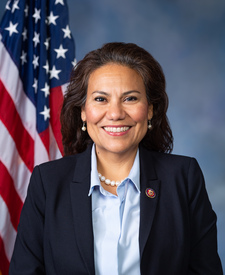
See how Veronica Escobar actually votes — against your values.
DeepSyte scores Veronica Escobar's record on the issues you care about — not party, not press releases. Take the 2-minute values quiz to see your personal alignment.
Sign in and take the values quiz to see how Veronica Escobar's votes line up with your views.
Prediction track record
How often we called Veronica Escobar's passage votes correctly, from their stated positions on each bill's tagged topics. Excludes “unclear” calls and abstentions.
To prohibit the disclosure of records by the Secretary of Housing and Urban Development of individuals for the purposes of immigration enforcement, and for other purposes.
Based on 1 data point across public statements and recorded votes · AI analysis of public records
119-hr-3486·Consistent
Stop Illegal Entry Act of 2025
85/100
What they said
May 11, 2026
Rep. Escobar advocates for the Dignidad Act, a bipartisan immigration reform bill that would provide a pathway to work and travel authorization for long-term undocumented residents, mandate employer verification of work authorization, and maintain a pathway to citizenship for DACA recipients, while removing a broader pathway to citizenship for other undocumented immigrants.
Rep. Escobar's stated position emphasizes bipartisan immigration reform centered on work authorization pathways, employer verification, and DACA protections—a pragmatic compromise approach. The Stop Illegal Entry Act focuses exclusively on criminal penalties for illegal reentry and felony convictions, with no provisions addressing work authorization, employer verification, or pathways for long-term residents. Her NO vote on this amendment is consistent with her stated framework: the bill does not advance the constructive, pathway-based approach she advocates, instead taking a purely enforcement-focused direction that contradicts her compromise model.
Pairs with ambiguous language and high uncertainty are withheld until more data is available. Procedural, cloture, and amendment votes are excluded — they don't cleanly signal substantive support or opposition.
Pro analysis
AI rep analysis — Pro
Get an AI-narrated read on Veronica Escobar's full voting record against your stated values — aligned themes, conflicts, notable votes, and what to watch for.
We haven't extracted campaign positions for Veronica Escobar yet. Once their campaign website or position pages are processed, this card will track what they said vs how they voted.
Crossing the aisle
Passage votes where Veronica Escobar broke ranks with ≥75% of Democrats. Threshold catches substantively partisan splits; unanimous-ish or close votes are excluded.
Congresswoman Escobar Statement on Eminent Domain Action of Mt. Cristo Rey
Position: Congresswoman Escobar opposes the Trump administration's use of eminent domain to seize land at Mt. Cristo Rey for border wall construction, citing the site's cultural and religious significance and arguing that alternative border security approaches exist.
Today, Congresswoman Veronica Escobar (TX-16) released the following statement in response to reports that the Trump administration has filed an eminent domain suit for possession of nearly 15 acres of land at Mt. Cristo Rey:
“Mt. Cristo Rey's cultural and religious significance is central to our region. Seizing this community asset in order to build a border wall is consistent with the Trump administration’s blatant disregard for what communities like ours value.
“There are a number of other ways to provide border security. Instead, the Trump administration prefers to destroy this sacred site.
“I support the Catholic Diocese of Las Cruces in their opposition to the federal government’s actions to degrade a site so significant to our shared identity, and I have reached out to my New Mexico colleagues so we can collaborate on ways to save this site.”
Texas Tribune: U.S. Rep Veronica Escobar's bipartisan immigration bill draws GOP support - and backlash
Position: Rep. Escobar advocates for the Dignidad Act, a bipartisan immigration reform bill that would provide a pathway to work and travel authorization for long-term undocumented residents, mandate employer verification of work authorization, and maintain a pathway to citizenship for DACA recipients, while removing a broader pathway to citizenship for other undocumented immigrants.
WASHINGTON — When Democrats took control of Washington after the 2020 election, Rep. Veronica Escobar thought comprehensive immigration reform was within reach.
The El Paso Democrat helped craft a bill party leaders introduced at the start of Joe Biden’s term to create an eight-year pathway to citizenship for the millions of undocumented immigrants living in the country. But the Democratic legislation never got enough buy-in within the party and was deemed a non-starter by Republicans.
The episode was instructive for Escobar, who succeeded Beto O’Rourke in Congress halfway through Donald Trump’s first term and, in short order, made her name as an authority on immigration among House Democrats.
“It was a real wake-up call for me on the politics within my own party,” Escobar said. “It really was during that first two years of the Biden administration that I realized, No. 1, we’re not going to get this done as a Democratic-only bill. No. 2, it really is going to need to be bipartisan if it’s going to stick. And No. 3, I think we’re going to lose elections because of immigration.”
After Republicans rode the issue to a House majority in 2022, Escobar changed tack. She teamed up with Republican Rep. Maria Elvira Salazar, a Cuban American who represents a heavily Hispanic district anchored in Miami, to write an immigration reform bill called the Dignidad, or Dignity, Act. Crafted “in some respects in secret” to avoid momentum-sapping backlash, Escobar said, the compromise that emerged included a pathway to work and travel authorization for long-term undocumented residents and a mandate for employers to check staffers’ work authorization status.
They re-introduced the bill last year, with a key change to make it more palatable to Republicans, as the political battlefield on immigration was veering from the now-quiet border to Trump’s mass deportation push.
In turn, the new Dignity Act has sparked an emerging debate that reflects the shifting political realities for both parties around immigration. Democrats, acknowledging that some Biden-era immigration policies were out of step with the electorate, reined in a key sticking point of the bill’s prior version by removing the pathway to citizenship beyond DACA recipients. Yet, there would still be a way for undocumented immigrants to get temporary legal status, a point that’s the crux of the GOP’s disjointed response to the bill.
What emerges is a picture of an uneasy Republican coalition in which business leaders, grassroots conservatives and the Hispanic voters who helped power Trump’s 2024 victory all lack alignment on how to proceed.
Through the careful building of a coalition — Escobar and Salazar only let cosponsors join in bipartisan pairs — the Dignity Act is now up to 40 cosponsors, half in each party. In Texas, that includes Rep. Henry Cuellar, D-Laredo, and Rep. Monica De La Cruz, R-Edinburg, both in the moderate wings of their party.
But at the same time, the Dignity Act has unearthed a wave of conservative opposition, led by a fellow Texan, Flower Mound freshman Rep. Brandon Gill. Gill has been the tip of the spear in the pressure campaign against the bill, calling it a betrayal of conservative values and tantamount to offering amnesty, a dead letter in the GOP.
“The glue that held that [2024 GOP] coalition together was the mass deportation message that we ran on, because that is something that — particularly for working-class voters — resonates,” Gill said. “Because they’re the ones whose communities are being transformed. They’re the ones whose wages are being suppressed or whose jobs are being taken by this mass influx of illegal aliens that Democrats, by the way, created.”
To that end, Gill, an emerging force in the GOP, has sparred with Salazar about the bill on social media and made a point of endorsing candidates in Republican primaries who share his commitment to a more hardline immigration policy.
The Dignity Act doesn’t have support from GOP House leadership, and has no obvious pathway to passage at the moment. But despite the backlash, Escobar still sees a window — though narrow — for action, especially as Trump’s polling on immigration slips.
“There is an acknowledgment from the [Republican] side that the status quo cannot remain,” Escobar said. “I do think this is the moment. If we don’t get it done before August recess, it’s going to be really hard to get it done in the future.”
For decades, the basis of any immigration compromise has been a pathway to citizenship for undocumented immigrants — a priority for many Democrats — in exchange for heightened border security, a Republican priority, and stricter employment verification. Efforts to break through the impasse have repeatedly fallen short, establishing bipartisan immigration reform as one of Congress’ legislative white whales.
The Dignity Act has a different framework. It includes a modified version of the DREAM Act, which would offer conditional permanent residency status and eventual citizenship to DACA recipients, or people brought to the U.S. as children who have lived most of their lives here.
But aside from Dreamers, there’s no pathway to citizenship for undocumented immigrants in the bill — the key change from the 2023 version. Instead, they can earn legal status through the Dignity Program — a seven-year pathway contingent on passing a criminal background check, paying $7,000 in restitution plus taxes owed and providing proof that the applicant worked or was in school for at least four of the seven years. Dignity status, which authorizes holders to work and travel freely, would last for seven years and could be renewed indefinitely for recipients in good standing.
“Dignity is not amnesty,” Salazar said at a press conference last year. “Dignity does not grant a path to citizenship to anybody. Dignity is the Solomonic way to fix a 40-year problem.”
Crucially, the Dignity Program is only eligible to immigrants who arrived in the U.S. before the end of 2020 — meaning any migrants from the Biden era are ineligible. And those who have achieved Dignity status are barred from claiming means-tested federal benefits or entitlement programs.
Escobar said a common criticism she heard “and totally understood” during the Biden administration was frustration over new arrivals getting work authorization while older immigrants who had been in the U.S. for decades never did.
“Even within the immigrant community, with mixed-status families, there was a sense that it was profoundly unfair,” Escobar said. “And this bill tackles that head-on.”
The funds generated from the Dignity program would go to apprenticeship and skills training programs for U.S. citizens.
The bill also reforms asylum and employment practices and bolsters border security. It phases in a requirement that employers use E-Verify to confirm the work authorization status of their employees. It funds border security infrastructure, including “physical barriers,” and technology and raises pay for some Border Patrol agents. And it overhauls how asylum works, including an end to the controversial catch-and-release practice.
Asylum cases would need to be determined within 60 days, and applicants would be screened and held in newly built humanitarian campuses. Those whose asylum cases are denied or who fail their credible fear interview, which establishes eligibility for asylum based on potential for persecution or torture in their home country, would be subject to expedited removal.
In addition, the bill would expand opportunities for legal immigration, doubling the per-country annual cap for green cards, removing children and spouses from being counted toward caps on employment-based visas, and making changes aimed at whittling down visa backlogs.
As Republicans attempt to hold their coalition together for the midterms, Gill said he sees immigration policy — and mass deportation — as a unifying force, especially for keeping working-class voters under the GOP tent.
“That’s the glue that held the coalition together,” Gill said. “So I think to betray that, to go back on our word on the core thesis of the last election cycle, from a political standpoint, would fracture and, in many ways, just dissolve that coalition entirely.”
Across the Republican conference, Gill said there is “virtually no tolerance or appetite for amnesty of any kind.” He said GOP members who support the bill have told him they are mainly interested in codifying border security. But he thinks Democrats cannot be trusted on the issue.
Salazar argues the exact opposite, telling Politico that “what I’m doing is I’m really trying to preserve the Republican base that gave victory to Trump,” particularly the new Hispanic voter converts.
A White House official said the Trump administration is “always happy” to review congressional proposals but declined to weigh in further on the bill, saying they were “focused on enforcing the current immigration laws and deporting the millions and millions of criminal illegal aliens that Joe Biden let in our country.”
Among Dignity Act supporters, the list of cosponsors includes numerous members in competitive districts, but also some of the more ideologically driven politicians in both parties. Escobar said there’s a Democratic wait list for members to get on the bill once they can be paired with a new GOP cosponsor.
The proposal has earned the support of business groups and immigration advocates alike, from the libertarian group Americans for Prosperity to the U.S. Chamber of Commerce to the liberal pro-immigration group FWD.us.
In the Lone Star State, the Texas Business Leadership Council and the Texas Restaurant Association have signed on as endorsers.
Justin Yancy, the president of the TBLC, said he often hears from construction and agriculture industry leaders, in particular, about the need for immigration reform. While his organization strongly supports the goal of a secure border, Yancy said, he also wants to see new pathways to legal immigration, such as those in the Dignity Act, in order to meet labor needs.
A mass deportation strategy, by contrast, is not economically viable, he said.
“Deporting everyone would be catastrophic for the economy — not just in Texas, but around the country,” Yancy said. “That’s just a nonstarter.”
Texas, Yancy said, needs “more employees, not fewer”. And people eligible for Dignity status under the bill would not be taking jobs, he said, given labor shortages that are causing economic upheaval in key industries.
The vociferous opposition of Gill and others speaks to the increasingly strained relationship between big business groups and the GOP. Gill said if the GOP wants to be the party of the working class, it has to reject business’ arguments on immigration.
“Mass migration does, in many ways, at least in the short term, benefit large businesses who basically view these people as labor input,” Gill said. “But the people who are harmed are the people whose jobs are taken away. And those are the people who don’t have fancy lobbyists in Washington, who can’t spend millions of dollars on political campaigns, but they’re the ones who show up and vote.”
But while Gill still sees immigration as Republicans’ strongest issue, Escobar thinks there’s an opening for bipartisanship.
She saw the recent head-rolling at the Department of Homeland Security, including the ouster of Kristi Noem as secretary and Greg Bovino as Border Patrol sector chief, as evidence that the White House recognized it needed to change tactics on immigration.
“Does that mean they will embrace the Dignity Act?” Escobar said. “I think it depends on whether a lot of these groups lobby the White House directly. Because ultimately, if Donald Trump gives his blessing, it’s done.”
Congresswoman Escobar Cosponsors Energy Bills Relief Act
Position: Congresswoman Escobar supports the Energy Bills Relief Act, which expands renewable energy deployment to lower utility costs for consumers and prevent corporations from passing energy infrastructure costs to ratepayers.
RESOURCES FOR DHS EMPLOYEES CAN BE FOUND HERE
This week, Congresswoman Veronica Escobar (TX-16) joined over 130 House Democrats led by the House Sustainable Energy and Environment Coalition (SEEC) Clean Energy Deployment Task Force Co-Chairs Reps. Mike Levin (CA-49) and Sean Casten (IL-06) on the Energy Bills Relief Act, a family- and consumer-focused approach to United States energy policy that ensures Americans have access to the most reliable and low-cost source of power available – renewable energy.
“Hardworking Americans are already facing skyrocketing utility bills, so it’s no wonder rate payers are afraid of being saddled with utility cost increases that might come from energy-intensive data centers," said Congresswoman Escobar. "I'm proud to cosponsor the Energy Bills Relief Act, which would ensure consumers aren't on the hook for higher energy costs. Corporations have been unwilling to meaningfully engage with communities or be transparent about their data centers, so we can’t risk them passing on their costs to consumers as well; this legislation provides guardrails to prevent that from happening."
Electricity rates are surging nationwide, and millions of households are struggling to pay their rising energy bills. The most effective way to lower utility costs for American households is to expand access to renewable energy — the most reliable and low-cost energy source.
We have the tools to power America with abundant, reliable, American-made clean energy. The missing link between those tools and expanded access to that low-cost and efficient energy is a consumer-first energy policy.
For too long, U.S. energy policy has boosted the profits of energy producers at the expense of energy consumers. The Energy Bills Relief Act shifts our focus to lowering costs and increasing reliability for American homes and businesses by deploying more renewable energy. It is firmly rooted in the American values of choice and competition. It prioritizes consumers and ensures access to low-cost energy for our homes, businesses, and economy.
Congresswoman Escobar Statement on FISA Reauthorization Bill
Position: Section 702 of FISA is a valuable intelligence tool, but Congress must strengthen protections for Americans' constitutional rights and civil liberties, particularly in response to the Trump Administration's approach to surveillance.
RESOURCES FOR DHS EMPLOYEES CAN BE FOUND HERE
Today, Congresswoman Veronica Escobar (TX-16) released the following statement on the FISA reauthorization bill:
“Section 702 of the Foreign Intelligence Surveillance Act is a powerful tool for collecting foreign intelligence and helping keep our country safe. But with that power comes a real responsibility to protect the constitutional rights and civil liberties of the American people. The Trump Administration has engaged in a whole-of-government approach to overriding Americans’ civil liberties and constitutional rights, and Congress must use every opportunity to protect our citizens from this administration.
TRANSCRIPT: Congresswoman Escobar Provides Opening Remarks on Republican Budget Bill
Position: Congresswoman Escobar opposes the FY2026 budget resolution, citing concerns about cuts to Medicare and nutrition assistance, failure to renew ACA subsidies, increased funding for ICE and CBP, and the overall economic impact on American families from tariffs and inflation.
RESOURCES FOR DHS EMPLOYEES CAN BE FOUND HERE
This afternoon, Congresswoman Veronica Escobar (TX-16) provided opening remarks at the the FY2026 Budget Resolution at the House of Representatives Committee on Rules, which begins the Senate-led reconciliation process.
The video can be found here and a (lightly edited) transcript has been provided below:
Rules Committee Chairwoman Virginia Fox: Miss Escobar, you're recognized.
Congresswoman Escobar: Thank you so much, Chairwoman Fox and Ranking Member McGovern. I'm here to voice my strong opposition to this budget resolution, both because of its outrageous spending allocations and because of my serious concerns with the process of how this was done.
It's important for everyone to understand what is happening in America today. Americans are struggling. The latest Gallup poll shows that nearly half of American adults - 47% - describe American's current economic conditions as poor. That's up from 40% one month ago, and it's clear why they feel this way.
Republicans' so-called "One Big Beautiful Bill," slashed access to Medicare and Nutrition Assistance programs. Republicans refuse to renew subsidies that helped Americans pay for their health insurance, causing their premiums to shoot up by 114%.
Trump's tariffs have cost the average family more than $1,700 in 2025 alone, and now his war in Iran has made gas prices skyrocket and prices are likely to get worse.
Instead of focusing on how we stop this economic collapse, Republicans are demanding an additional $70 billion, potentially as high as $140 billion, for CPB and ICE. The One Big Beautiful Bill, which provides tax breaks to billionaires by making drastic cuts to programs Americans depend on, also gave ICE and CBP $140 billion. This was for President Trump's mass deportation program, but that $140 billion could fund the entire Department of Homeland Security through next year.
So why are we really here? In the wake of the killings of Renée Good and Alex Pretti, Republicans are choosing to jam through additional funding for ICE and CBP instead of working with us to find bipartisan solutions that both protect our communities and ensure that ICE and CBP are just as accountable to the public as normal law enforcement agencies are.
I have the privilege of sitting on both the House Budget Committee with my colleague and friend, Mr. Arrington. I also sit on the House Appropriations Committee, and this partisan approach to government funding is not the way we should do things. The original Homeland Security Appropriations bill that passed out of the committee had protections for U.S. Citizens against what we saw in Minneapolis and many other American cities. But Donald Trump and Stephen Miller stripped out those protections because they knew they could do this: use Republicans in Congress to jam through a bill that grossly inflates these agencies' budgets, and also clears the way for a supplemental defense package that will fund the president's war in Iran, a war that has already cost us an estimated $50 billion.
Let's be clear: Section 4108 of this bill sets the stage for a future supplemental defense funding package, without us knowing what the actual cost of that will be. Just two weeks ago, during a hearing in the Budget Committee, I asked the OMB Director, Mr. Vought, if he could tell me how much would be requested in the Iran supplemental, and he either couldn't tell me or he wouldn't tell me. He wouldn't even ballpark it.
We should not be clearing the way to fund Trump's war of choice, which has not only driven up the cost of everyday essentials, but more importantly, resulted in the death of 13 American service members.
Frankly, I am astonished to see my colleagues in the House of Representatives rubber stamp this. This budget resolution will allow Senate Republicans to jam the House with little to no consideration. By allowing the Senate to move on reconciliation first, that means the House will not be able to hold any committee markups and will instead have to eat whatever the Senate passed reconciliation bill includes.
I am going to be voting no on this rule, no on the concurrent resolution, and I urge my colleagues to do the same. We have an obligation to treat a matter as serious as increasing the deficit with the attention it deserves.
Thank you, Madam Chair. I yield back.
Congresswoman Escobar Again Calls on Meta to Hold Public Listening Sessions on El Paso Data Center
Position: Congresswoman Escobar calls on Meta to hold public listening sessions and provide transparency to El Paso residents regarding the impacts of a new data center in the area.
RESOURCES FOR DHS EMPLOYEES CAN BE FOUND HERE
Today, Congresswoman Veronica Escobar (TX-16) sent a second letter to Meta calling on the company to hold public listening sessions and provide clear answers to El Pasoans about the impacts of its new data center.
Congresswoman Escobar Joins Bipartisan Legislation to Increase Mental Health Services at Schools
Position: Congresswoman Escobar supports legislation to increase federal funding for mental health professionals and services in schools, opposing the Trump administration's cancellation of $1 billion in previously appropriated mental health funding for children.
RESOURCES FOR DHS EMPLOYEES CAN BE FOUND HERE
This week, Congresswoman Veronica Escobar (TX-16) co-sponsored the bipartisan Expanding Access to Mental Health Services in Schools Act. Led by Representatives Rosa DeLauro (CT-3), Brian Fitzpatrick (PA-1) and Jahana Hayes (CT-5), this legislation would address the urgent need for mental health professionals in schools.
“Our children need support and mental health access and services more than ever. The Trump administration, which has prioritized war with Iran and tax breaks for billionaires, has slashed federal funding for mental health professionals at schools,” said Congresswoman Escobar. “Access to mental health resources and professionals isn't a luxury — it’s a necessity, and there’s still more work we need to do to help our nation’s kids. I’m proud to join this legislation to undo the Trump administration’s damaging cuts.”
The Bipartisan Safer Communities Act - legislation which Congresswoman Escobar voted for -provided $500 million in additional funding for this critical program through fiscal year 2026. However, the Trump Administration recently canceled $1 billion for mental health services for children, saying that the programs funded by a bipartisan law aimed at stemming gun violence in schools were no longer in “the best interest of the federal government.”
Specifically, the Expanding Access to Mental Health Services in Schools Act would:
Source: GDELT 2.0 GKG, filtered to a curated list of national outlets. Inclusion is not endorsement; opinion pieces and reported news are mixed.
Recent stock activity
Periodic transaction reports filed under the STOCK Act — disclosed by the rep, sourced from public filings.
No disclosed trades on record.
Source: open-data mirrors of the Senate eFD and House Clerk financial-disclosure systems. Disclosure within 30 days of trade is required by law (45 for spouse/dependent trades).
Top PAC donors · 2026 cycle
Political action committees that gave the most to this rep's principal campaign committee this cycle. PAC giving is direct organizational support — industry, ideological, or leadership.
1.BOLD DEMOCRATS I - UNITEMIZEDLeadership4 contributionsMember-of-Congress leadership PAC — supports Democratic candidates and causes aligned with its founder's priorities.AI$36,468
2.NATIONAL INDEPENDENT AUTOMOBILE DEALERS ASSOCIATION PAC FUND7 contributions$35,000
3.UNITED ASSOCIATION POLITICAL EDUCATION COMMITTEE (UNITED ASSOCIATION OF JOURNEYMEN AND APPRENTICES OF THE PLUMBING & PIPEFITTING INDUSTRY OF THE UNITED STATES AND CANADA)6 contributions$30,000
4.THE HOME DEPOT INC. POLITICAL ACTION COMMITTEEBusiness6 contributionsRetail corporation PAC — supports candidates aligned with business-friendly policies on tax, labor, and regulatory matters.AI$30,000
5.BORDER HEALTH FEDERAL PAC5 contributions$25,000
6.SEIU COPE (SERVICE EMPS INT'L UNION CMTE ON POLITICAL EDUCATION)Labor4 contributionsTrade-union PAC for the Service Employees International Union — backs candidates supporting union organizing, collective bargaining, worker benefits, and labor-friendly workplace standards.AI$20,000
7.AMERICAN FEDERATION OF TEACHERSLabor4 contributionsTrade-union PAC for public-school teachers — backs candidates supporting public education funding, teacher compensation, and collective-bargaining rights.AI$20,000
8.AMERICAN CRYSTAL SUGAR COMPANY PACAgriculture4 contributionsAgricultural company PAC for a major sugar producer — backs candidates supporting farm subsidies, tariff protections, and agricultural trade policies.AI$20,000
9.CHC BOLD PACLeadership3 contributionsMember-of-Congress leadership PAC affiliated with the Congressional Hispanic Caucus — directs contributions to allied Democratic candidates.AI$15,000
10.COMMUNICATION WORKERS OF AMERICA-COMMITTEE ON POLITICAL EDUCATION POLITICAL CONTRIBUTIONS COMMITTEE2 contributions$10,000
Source: OpenFEC (api.open.fec.gov) Schedule A receipts where contributor type is “committee.” Aggregated by contributing committee. Self-transfers from joint-fundraising / victory committees are excluded.
Top individual contributors · 2026 cycle
Itemized individual contributions over $200 to this rep's campaign committee, aggregated by donor employer. PAC giving is shown above; this section is people, not organizations.
1.WESTSTAR BANK$11,250
2.INKIT$10,500
3.PIVOTAL VENTURES$7,000
4.GORDON DAVIS$7,000
5.TRANSTELCO$7,000
6.JOBE MATERIALS$7,000
7.EPT LAND$7,000
8.TROPICANA BUILDING$7,000
9.HOUGHTON FINANCIAL$7,000
10.W SILVER RECYCLING$7,000
Source: OpenFEC Schedule A receipts where contributor type is “individual,” aggregated by the donor's self-reported employer. This is a geographic / industry correlation, not a corporate endorsement.