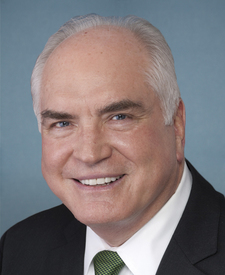
See how Mike Kelly actually votes — against your values.
DeepSyte scores Mike Kelly's record on the issues you care about — not party, not press releases. Take the 2-minute values quiz to see your personal alignment.
Sign in and take the values quiz to see how Mike Kelly's votes line up with your views.
Prediction track record
How often we called Mike Kelly's passage votes correctly, from their stated positions on each bill's tagged topics. Excludes “unclear” calls and abstentions.
24 predictions on record · none have been resolved by a passage vote yet. Check back as bills move.
Pending vote119-hr-5340
To prohibit the disclosure of records by the Secretary of Housing and Urban Development of individuals for the purposes of immigration enforcement, and for other purposes.
We haven't yet found statement/vote pairs on the same topic for Mike Kelly. This usually means either the rep hasn't taken public positions on bills that have come to a passage vote, or those bills haven't been tagged yet. The checker runs as new press releases and votes come in.
Pro analysis
AI rep analysis — Pro
Get an AI-narrated read on Mike Kelly's full voting record against your stated values — aligned themes, conflicts, notable votes, and what to watch for.
We haven't extracted campaign positions for Mike Kelly yet. Once their campaign website or position pages are processed, this card will track what they said vs how they voted.
Crossing the aisle
No party-break passage votes recorded for Mike Kelly. Either they've voted with Republicans on every substantive passage vote in the corpus, or their tenure overlaps few high-threshold party-line votes so far.
Kelly leads 50+ Members in letter encouraging Trump administration to protect U.S. manufacturers from Chinese automotive, battery companies
Position: The representatives urge the Trump administration to prevent Chinese automotive and battery companies from manufacturing in the United States, citing concerns about unfair government subsidies, market domination, and national security threats.
WASHINGTON, D.C. -- Today, U.S. Representatives Mike Kelly (R-PA) and Gus Bilirakis (R-FL) led this letter to U.S. Treasury Secretary Scott Bessent, Commerce Secretary Howard Lutnick, and U.S. Trade Ambassador Jamieson Greer, encouraging the Trump administration to refrain from any decision that would allow Chinese automotive and battery companies access to manufacture in the United States.
The automotive industry is a foundational piece of the U.S. economy, contributing upwards of 5% of U.S. GDP and generating millions of manufacturing jobs across the country. Recently, Chinese automotive companies have accelerated investment in North America and flooded global markets with the long-term goal of dominating market share and controlling automotive manufacturing and supply chains globally. Further, Chinese automakers are heavily subsidized by the Chinese government, creating an unlevel playing field for American automakers.
"We must be clear-eyed about China’s goals in expanding their automotive footprint across the globe. China’s intent is not fair competition, as evident by their actions in other critical sectors," the Members write. "They have drastically inflated supply in their domestic auto market through unfair government subsidies and other benefits intended to artificially prop up companies, forcing them to export and expand to foreign markets at below-market prices. China’s goal is not to compete in the U.S. automotive market, but instead to hollow it out and ultimately limit consumer choice to Chinese brands. Allowing Chinese automotive and battery companies to manufacture in the U.S. would jeopardize our national security."
Members joining Reps. Kelly and Bilirakis on the letter include:
Representatives Carol Miller (R-WV), Michael Rulli (R-OH), Troy Balderson (R-OH), Nichole Malliotakis (R-NY), Nicholas A. Langworthy (R-NY), Neal P. Dunn, M.D. (R-FL), Robert E. Latta (R-OH), John Joyce, M.D. (R-PA), Beth Van Duyne (R-TX), Brian Fitzpatrick (R-PA), Morgan Griffith (R-VA), Keith Self (R-TX), Mariannette Miller-Meeks, M.D., Kat Cammack (R-FL), Ron Estes (R-KS), Andy Barr (R-KY), Richard Hudson (R-NC), Aaron Bean (R-FL), Lance Gooden (R-TX), John Moolenaar (R-MI), Vern Buchanan (R-FL), Ashley Hinson (R-IA), Craig Goldman (R-TX), Randy Weber (R-TX), Tom Barrett (R-MI), Erin Houchin (R-IN), Earl J. "Buddy" Carter (R-GA), Diana Harshbarger (R-TN), Rick Allen (R-GA), Tim Walberg (R-MI), Jefferson Shreve (R-IN), Gary Palmer (R-AL), Bill Huizenga (R-MI), Darin LaHood (R-IL), Cliff Bentz (R-OR), Laurel Lee (R-FL), Chuck Fleischmann (R-TN), Blake Moore (R-UT), Max Miller (R-OH), Kevin Hern (R-OK), Pete Stauber (R-MN), Mike Carey (R-OH), Jack Bergman (R-MI), Rudy Yakym III (R-IN), Harold Rogers (R-KY), Claudia Tenney (R-NY), Gabe Evans (R-CO), Dan Crenshaw (R-TX), Nathaniel Moran (R-TX), Mark Messmer (R-IN), Russ Fulcher (R-ID).
You can read their full letter here.
Issues:TradeTax Reform, Small Business, & The Economy
Kelly votes to fund Department of Homeland Security
Position: Rep. Kelly supports funding for the Department of Homeland Security, including Immigration and Customs Enforcement and Customs and Border Protection, and criticizes Democrats for opposing this funding.
WASHINGTON, D.C. -- Today, the U.S. House of Representatives passed by voice vote a measure to fund the Department of Homeland Security (DHS) -- including funding for the Transportation Security Administration (TSA), the Federal Emergency Management Agency (FEMA), the U.S. Secret Service, and other agencies -- after the majority of congressional Democrats previously voted to keep DHS shut down for more than 70 days.
This vote follows a separate vote Wednesday night to advance a budget resolution that would fund Immigrations and Customs Enforcement (ICE) and Customs and Border Protection (CBP). The budget resolution, commonly referred to as "Reconciliation 2.0," would allow congressional Republicans to pass DHS funding -- specifically for ICE and Border Patrol employees -- by a simple majority in both the House and Senate.
"Over the last two months, during a period of heightened global tensions, Democrats have shamefully played games with American national security. This legislation says, 'enough is enough,'" said Rep. Kelly. "From the start, House Republicans have voted to fund DHS. Democrats have not. This legislation puts our national security and the American people first."
BACKGROUND
On March 27, Rep. Kelly and House Republicans voted for the fourth time to fund the Department of Homeland Security and to end the shutdown.
This new budget resolution would allow for a simple majority in both the House and Senate to advance DHS funding. Previously, A 60-vote majority is needed to advance a funding bill in the Senate, meaning Senate Democrats would have been required to join congressional Republicans to fund DHS.
Democrats have prolonged the shutdown by refusing to vote for funding for Immigration and Customs Enforcement (ICE) and Customs and Border Protection (CBP).
Kelly votes for Farm Bill, backs Pennsylvania agriculture and farm families
Position: Rep. Kelly voted in favor of the Farm, Food, and National Security Act of 2026, citing its support for Pennsylvania farmers through expanded investments, improved risk management tools, conservation programs, and enhanced market access.
WASHINGTON, D.C. -- Today, U.S. Rep. Mike Kelly (R-PA) voted in favor of the "The Farm, Food, and National Security Act of 2026," also known as the Farm Bill. The legislation is a comprehensive package of legislation that supports America's farmers, ranchers, agriculture producers, and more.
The legislation now heads to the U.S. Senate for consideration.
The Farm Bill's programs expand investments in rural communities, bring science-backed management back to our national forests, and restore regulatory certainty in the interstate marketplace.
Further, these programs improve risk management tools for specialty crop producers, lower energy costs in rural America, and prioritize American commodities on the global stage. The new farm bill will expand producers’ access to credit, promote precision agriculture, and enhance conservation programs for working lands.
"The 2026 Farm Bill builds upon the historic investments in agriculture programs included in the Working Families Tax Cuts passed last summer," said Rep. Kelly, who serves as Ways & Means Tax Subcommittee Chairman. "Nearly 1 in 10 jobs in Pennsylvania is tied to agriculture. This legislation strengthens Pennsylvania farm families by investing more here at home, while also allowing local producers to trade in new international markets. The Farm Bill is a win across the board for producers and consumers alike."
The Farm Bill is supported by the Pennsylvania Farm Bureau, Pennsylvania Corn Growers Association, and more than 500 stakeholders nationwide.
By The Numbers: How The Farm Bill Helps Pennsylvania Farmers
$155 million more in projected risk projection over the next decade via ARC and PLC in Title I of the Farm Bill.
30 million new base acres nationwide.
Up to $41 million more every year in conservation through EQIP, ACEP, CSP, and RCPP programs.
$30 million in savings for Pennsylvania producers thanks to more affordable crop insurance premiums.
Saves over 46,000 family farms from the Death Tax.
$1.25 billion invested in agricultural research facilities at public universities such as Pennsylvania State University.
$1.1 billion investment in research, block grants, and crop insurance to support the $1.5 billion in specialty crops produced in Pennsylvania each year.
Promotes national security with more than $1.6 billion for federal livestock biosecurity, protecting more than $5.8 billion in livestock and poultry products produced in Pennsylvania.
Issues:Agriculture
Kelly backs foster care, pro-family bills during Ways & Means markup
WASHINGTON, D.C. -- Today, U.S. Rep. Mike Kelly (R-PA) voted in favor of a series of six bipartisan bills modernizing the John H. Chafee Foster Care Program for Successful Transition to Adulthood.
The markup follows a roundtable featuring First Lady Melania Trump earlier this month, during which she advocated for these pro-family policies as part of her Fostering the Future Initiative.
"Strong families create strong communities. We must ensure families and children are set up for success, so no one has to endure hardships and trauma when all they are seeking is a loving home," Rep. Kelly said. "Children are 25 percent of our population, but they are 100 percent of our future."
The bills are:
H.R. 7432, the "Foster Youth Housing Opportunity Act"
H.R. 7463, the "Foster Youth Postsecondary Education Access and Success Act"
H.R. 7343, the "Foster Youth Workforce Opportunity Act"
H.R. 7529, the “Fresh Starts for Foster Youth Act"
H.R. 7655, the “Support for Expectant and Parenting Foster Youth Act"
H.R. 7995, the “Chafee Opportunities for New Networks and Existing Connection Trust (CONNECT) Act”
BACKGROUND
Each year, nearly 16,000 foster youth age out of the foster care program. Young adults who age out of foster care at age 18 experience high rates of homelessness and are less likely to graduate from high school, gain employment, or enroll in post-secondary education compared to their peers.
The Government Accountability Office published a report last year that found states have been returning Chafee funds since at least 2007. Each year, 30 or so states return about $6 to $11 million, despite evidence of unmet need.
Learn more about Rep. Kelly's work supporting foster care initiatives here and here.
Issues:Pro-Life & Family Values
Kelly to Health System CEOs: "It's about the math."
WASHINGTON, D.C. -- Today, during a hearing with leaders of some of the nation's top hospital CEOs, U.S. Rep. Mike Kelly (R-PA) questioned the executives about ways rural health care can improve while also highlighting the need for more affordable and accessible health care in Rural America.
In December, the Centers for Medicare & Medicaid Services (CMS) announced that all 50 states will receive awards under the Rural Health Transformation Program, a $50 billion initiative established under President Trump’s Working Families Tax Cuts legislation. This includes more than $193 million for Pennsylvania in fiscal year 2026.
"If you can't exist in a small market, that's not because you don't want to be there. It's because you can't afford to be there. You can't have the people in the lobby looking for help when you don't have a doctor or nurse there to take care of them," said Rep. Kelly. "It's math. You're not in rural areas because you can't afford to be there. The cost of operation is ruining everybody."
"My philosophy is that we have to be two things at once: large enough to bring scale, resources and stability, and local enough to respond to the unique needs of each community we serve. Rural and community hospitals face the same market pressures as their urban and academic counterparts, only with fewer resources. They confront workforce shortages, declining patient volumes, rising labor and supply costs and an increasingly complex regulatory environment, often while operating on extremely thin margins," said Wright Lassiter, III., President and CEO CommonSpirit Health, a Catholic non-profit hospital system, in prepared remarks. "By bringing the resources of a larger system to those communities, we can help smaller hospitals manage expensive technology requirements, difficult payer contracting negotiations, workforce shortages and other pressures while addressing local gaps in care."
BACKGROUND
The Rural Health Transformation Program is a federal investment which aims to help states expand access to care in rural communities, strengthen the rural health workforce, modernize rural facilities and technology, and support innovative models that bring high-quality, dependable care closer to home.
Nearly 40% of the population in Pennsylvania's 16th Congressional District resides in rural areas.
Learn more about the hearing here.
Issues:Health Care
U.S. House passes Kelly-led IRS Whistleblower Improvement Act
WASHINGTON, D.C. -- On Monday, the U.S. House of Representatives passed the IRS Whistleblower Program Improvement Act, bipartisan legislation introduced by U.S. Representatives Mike Kelly (R-PA), Chairman of the Ways & Means Subcommittee on Tax, and Mike Thompson (D-CA), Ranking Member of the Ways & Means Subcommittee on Tax, to strengthen and modernize the Internal Revenue Service’s (IRS) Whistleblower Awards Program.
The IRS Whistleblower Program Improvement Act now heads to the Senate for consideration.
"Today's vote is a win for the American taxpayer and the American worker," said Rep. Kelly. "Our commonsense, bipartisan legislation ensures the integrity of our Nation's tax laws. When individuals come forward to expose wrongdoing by tax cheats and fraudsters, they help ensure our voluntary tax system remains fair for all Americans. Strengthening this program is a smart way to recover unpaid taxes while improving efficiency and accountability across the system."
“Whistleblowers play a critical role in government oversight – whether it be uncovering bad actors within government or, in the case of the IRS Whistleblower Program, tracking down those in the private sector who are defrauding American taxpayers,” said Ways and Means Committee Chairman Jason Smith (MO-08). “At a time when it appears we need an all-of-the-above approach to combatting fraud across various government programs, improving the IRS Whistleblower program will better protect whistleblowers and appropriately award them for their contributions to stopping tax fraud, tax evasion, and other similar crimes. Ways and Means Tax Subcommittee Chairman Kelly’s IRS Whistleblower Program Improvement Act builds on his long-standing commitment to reform and to combatting the epidemic of fraud we see stealing hard-earned dollars from the American people.”
“Whistleblowers often face uncertainty and long delays. And in some cases, they face real personal and professional risk just for coming forward. We need to be doing everything we can to fix those problems,” said Rep. Thompson. “The IRS Whistleblower Program Improvement Act will support the IRS’s crackdown on tax cheats and protect the brave whistleblowers who are helping to make our tax system more fair. I look forward to continuing my work with Rep. Kelly to get this through the Senate and signed into law.”
BACKGROUND
The IRS whistleblower program has enabled the agency to collect more than $7.5 billion from individuals and businesses caught dodging taxes, while also serving as a powerful deterrent against sophisticated tax evasion schemes. The IRS Whistleblower Program Improvement Act reinforces and modernizes the program by improving the appeals process, protecting whistleblower anonymity, encouraging timely award payments, and strengthening oversight and reporting to Congress.
These reforms aim to keep the program focused, predictable, and effective, ensuring a fair shake for taxpayers while maximizing the return on enforcement efforts without expanding broad-based audits.
You can watch Rep. Kelly's remarks on the House floor here.
Issues:Tax Reform, Small Business, & The Economy
During Ways & Means hearing with U.S. Trade Ambassador, Kelly reaffirms need for level playing field with China
Position: Rep. Kelly supports the Trump administration's trade policies toward China, particularly efforts to reduce the trade deficit and address Chinese investment in North American automotive supply chains, which he characterizes as posing economic and national security risks.
WASHINGTON, D.C. -- Today, during a Ways & Means Committee hearing with U.S. Trade Ambassador Jamieson Greer, U.S. Rep. Mike Kelly (R-PA) supported the Trump administration's efforts to create fair and equal trade agreements with China.
Kelly highlighted the success of the Trump administration's America First trade policies, notably the trade deficit with China, which declined by $130 billion, or 30%, last year. Kelly also noted areas of concern, particularly the acceleration of Chinese investment into North America in the automotive industry.
"China’s intent is not fair competition. China’s goal is not to compete in the U.S. market, but instead to hollow it out and ultimately limit consumer choice to Chinese brands," Kelly said. "Such investments pose a significant economic and national security risk to U.S. commerce as goods can be transshipped through Mexico and into heavily integrated supply chains which enjoy preferential treatment under U.S.-Mexico-Canada Agreement."
President Trump is scheduled to meet with Chinese President Xi Jinping in May.
You can watch Kelly's full remarks here.
Issues:TradeTax Reform, Small Business, & The Economy
Position: Rep. Kelly supports increased oversight and fraud prevention in Medicare to reduce waste and protect taxpayers, and questions why fraud-prevention methods used by Medicare Advantage plans are not deployed in traditional Medicare.
WASHINGTON, D.C. -- Today, during a Ways & Means Committee hearing, U.S. Rep. Mike Kelly (R-PA) supported efforts by the Trump administration to weed out Medicare fraud, errors, and abuse that are costing American taxpayers more than $60 billion per year.
The Medicare Trust Fund, which funds Medicare, is projected to out in 2033.
"The financial harm being done to taxpayers and patients through fraud is staggering," Rep. Kelly said. "We're $39 trillion in debt, and we're looking at a system that has so much fraud in it. This isn't a Republican problem or a Democrat problem. It's an American problem because the American taxpayer is footing the bill for this fraud."
Kelly called for greater oversight of the Medicare program and questioned what fraud-prevention methods Medicare Advantage plans to use that the government is not deploying in traditional Medicare.
You can watch his full question and answer exchange with hearing witnesses here.
Learn more about the hearing here.
Issues:Health Care
Source: open-data mirrors of the Senate eFD and House Clerk financial-disclosure systems. Disclosure within 30 days of trade is required by law (45 for spouse/dependent trades).
Top PAC donors · 2026 cycle
Political action committees that gave the most to this rep's principal campaign committee this cycle. PAC giving is direct organizational support — industry, ideological, or leadership.
1.NATIONAL AUTOMOBILE DEALERS ASSOCIATION PACBusiness5 contributionsTrade association PAC for new-car dealers — backs candidates supporting dealer franchise protections, vehicle sales regulations, and automotive retail interests.AI$25,000
2.TAKE BACK THE HOUSE 2020Leadership3 contributionsMember-of-Congress leadership PAC — supports candidates aligned with Republican efforts to gain House seats.AI$22,105
3.HUCKPACLeadership3 contributionsMember-of-Congress leadership PAC — directs contributions to allied Republican candidates and causes.AI$15,000
4.AMERICAN ISRAEL PUBLIC AFFAIRS COMMITTEE PACIdeological3 contributionsFederal PAC arm of AIPAC, established 2021. Backs candidates from both parties who support U.S.-Israel security and economic ties.AI$15,000
5.NATIONAL ASSOCIATION OF REALTORS PACReal Estate3 contributionsReal-estate industry PAC — backs candidates supporting property-rights protections, mortgage-lending access, and tax incentives for homeownership.AI$15,000
6.SHEET METAL & AIR CONDITIONING CONTRACTORS PAC3 contributions$15,000
7.WINNING PA1 contribution$11,919
8.FIRSTENERGY PAC2 contributions$10,000
9.AICPA PAC2 contributions$10,000
10.AMERICAN PODIATRIC MEDICAL ASSOCIATION POLITICAL ACTION COMMITTEE2 contributions$10,000
Source: OpenFEC (api.open.fec.gov) Schedule A receipts where contributor type is “committee.” Aggregated by contributing committee. Self-transfers from joint-fundraising / victory committees are excluded.
Top individual contributors · 2026 cycle
Itemized individual contributions over $200 to this rep's campaign committee, aggregated by donor employer. PAC giving is shown above; this section is people, not organizations.
1.THE PARKER FOUNDATION$14,000
2.SELF$11,000
3.ALLIANT$11,000
4.DAVITA$8,250
5.ARSEN CAPITAL PARTNERS$7,000
6.APOLLO MANAGEMENT$7,000
7.SOROBAN CAPITAL PARTNERS LP$7,000
8.ANDERSON COACH & TRAVEL$7,000
9.O'BRIEN AUTOMOTIVE TEAM$7,000
10.ELLWOOD FORGE$7,000
Source: OpenFEC Schedule A receipts where contributor type is “individual,” aggregated by the donor's self-reported employer. This is a geographic / industry correlation, not a corporate endorsement.