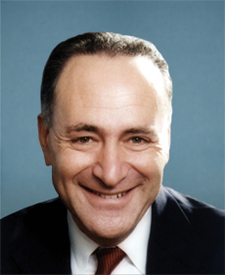
See how Charles E. Schumer actually votes — against your values.
DeepSyte scores Charles E. Schumer's record on the issues you care about — not party, not press releases. Take the 2-minute values quiz to see your personal alignment.
Sign in and take the values quiz to see how Charles E. Schumer's votes line up with your views.
Prediction track record
How often we called Charles E. Schumer's passage votes correctly, from their stated positions on each bill's tagged topics. Excludes “unclear” calls and abstentions.
84 predictions on record · none have been resolved by a passage vote yet. Check back as bills move.
Pending vote119-hr-5282
Reauthorizing Support and Treatment for Officers in Crisis Act of 2025
To prohibit the disclosure of records by the Secretary of Housing and Urban Development of individuals for the purposes of immigration enforcement, and for other purposes.
Based on 1 data point across public statements and recorded votes · AI analysis of public records
118-hr-3935·Notable gap
FAA Reauthorization Act of 2024
15/100
What they said
Apr 14, 2026
Schumer and Ryan demand that the Trump administration immediately release $28 million in federal funding for Rhinecliff Train Station upgrades and repairs, and call for an end to unexplained delays by the Federal Railroad Administration that threaten to derail the project.
Schumer's statement demands immediate release of $28 million in federal railroad funding for Rhinecliff Train Station and criticizes Trump administration delays at the Federal Railroad Administration. The bill is the FAA Reauthorization Act of 2024, which reauthorizes Federal Aviation Administration programs through FY2028 and addresses aviation infrastructure, not rail infrastructure. These address different transportation modes and different federal agencies (FRA vs. FAA). Schumer's yes vote on an FAA amendment does not align with his stated priority of pressuring the Trump administration to release stalled railroad funding.
Pairs with ambiguous language and high uncertainty are withheld until more data is available. Procedural, cloture, and amendment votes are excluded — they don't cleanly signal substantive support or opposition.
Pro analysis
AI rep analysis — Pro
Get an AI-narrated read on Charles E. Schumer's full voting record against your stated values — aligned themes, conflicts, notable votes, and what to watch for.
We haven't extracted campaign positions for Charles E. Schumer yet. Once their campaign website or position pages are processed, this card will track what they said vs how they voted.
Crossing the aisle
No party-break passage votes recorded for Charles E. Schumer. Either they've voted with Democrats on every substantive passage vote in the corpus, or their tenure overlaps few high-threshold party-line votes so far.
SCHUMER ANNOUNCES JOB CORPS CENTERS TO REMAIN OPEN AFTER TRUMP ADMINISTRATION FULLY RESCINDS PLAN TO CLOSE ONE OF AMERICA’S LARGEST JOB TRAINING PROGRAMS | U.S. Senator Chuck Schumer of New York
Position: Schumer opposed the Trump administration's plan to eliminate Job Corps centers and advocated for their continued operation. The administration has now rescinded its closure plan following Schumer's advocacy.
After Trump Attempted To Eliminate Job Corps Program, Schumer Announces Trump Admin Formally Backs Off Plan To Shut Down America’s 99 Job Corps Centers That Provide Workforce Training For Tens of Thousands of Americans Each Year
Five Job Corps Centers In Upstate NY – Located In Albany, Sullivan, Orleans, Oneonta & Chautauqua – Help Workers Get Skills Needed To Access Careers In Healthcare, Construction, Manufacturing, And Other Fields
Schumer: A Win-Win-Win For Students, Small Businesses, & Upstate Communities
After Schumer stood at Job Corps centers across Upstate NY to lead the fight to protect one of the nation’s largest and most effective workforce training programs from Trump’s effort to eliminate it, U.S. Senator Chuck Schumer announced the Trump administration has officially rescinded its plan to shut down America’s 99 Job Corps centers.
A new federal settlement agreement between Job Corps and the Trump administration includes protections against the closing of Job Corps campuses and stopping of operations, among other provisions. Schumer explained that the Job Corps centers and programming help train tens of thousands of students across America each year, including thousands in New York, providing them with the skills they need to enter in-demand fields.
“When the Trump administration announced that Job Corps was going to be eliminated, I got to work to protect it—traveling across Upstate New York to stand shoulder to shoulder with students, staff, and small businesses that have seen firsthand the benefits of this program. Today, I’m proud to announce that the administration has officially backed off its ill-conceived plan to close one of America’s largest workforce training programs,” said Senator Schumer. “Saving Job Corps is a win-win-win because students get the skills they need to get a good job, small businesses get the trained workforce they need to grow, and Upstate communities get a boost to their economies. Job Corps is about more than training. It’s about giving people across Upstate New York a pathway to a good-paying career, strengthening local communities, and building the healthcare, construction, and manufacturing workforce that will keep our state strong. And I’ll always fight to protect it.”
After hearing about Trump’s proposed cuts, Schumer traveled to Job Corps centers across Upstate New York, from the Iroquois Job Corps center in Orleans County to the Cassadaga Job Corps center in Chautauqua County and the Oneonta Job Corps Center in Otsego County, to stand with students, staff, and small business owners and demand we protect this vital pipeline for skilled workers to fill jobs. Earlier this year, the Fiscal Year 2026 Labor, Health and Human Services, Education funding bill rejected Trump’s call to eliminate Job Corps and instead provides $1.76 billion in federal funding to keep them open. Schumer also secured language that blocks the closure of Job Corps centers unless such closures meet specific requirements.
In May 2025, Trump paused operations at Job Corps centers nationwide. Afterward, a federal judge temporarily blocked Trump from shutting down Job Corps centers, and another federal judge said operations must resume until the previous case is resolved. Schumer explained that the Trump administration not only attempted to shut down Job Corps centers, but in his budget request, Trump said he wanted to totally zero out funding for the program, effectively killing the program without needing the approval of federal courts.
In addition to fighting back on Trump’s proposed elimination of funds for Job Corps in the Fiscal Year 2026 appropriations bill, Schumer led efforts in the Senate to oppose the Trump administration’s destructive and potentially illegal actions like pausing existing funds for the Job Corps centers. Schumer called on U.S. Department of Labor Secretary Lori Chavez-DeRemer to protect Job Corps and demanded answers on these destructive efforts. Due to Schumer’s leadership, the Fiscal Year 2026 Labor, Health and Human Services, Education funding bill rejected Trump’s call to eliminate Job Corps and instead provides $1.76 billion in federal funding—consistent with the previous year—to keep them open and includes language to protect against efforts to illegally shut down specific centers.
Schumer said Job Corps centers have helped millions of young people ages 16 to 24 finish high school, learn technical skills, and get jobs in in-demand fields such as healthcare and construction. Low-income and at-risk young people have received stable housing and healthcare while developing the skills they need to get good-paying jobs after graduation. Across Upstate NY, centers in Albany, Sullivan, Orleans, Otsego, and Chautauqua Counties serve thousands of young New Yorkers and employ over 500 staff. To learn more about Job Corps, visit https://www.jobcorps.gov, or to apply, visit https://enroll.jobcorps.gov.
AFTER HIS ADVOCACY, SCHUMER ANNOUNCES TOWN OF PLATTSBURGH ADDED TO LAKE CHAMPLAIN BASIN PROGRAM—OPENING UP NEW FEDERAL FUNDING TO ADDRESS CRUMBLING INFRASTRUCTURE AT FORMER AIR FORCE BASE—AND LAUNCHES PUSH TO REAUTHORIZE PROGRAM | U.S. Senator Chuck Schumer of New York
Position: Senator Schumer secured federal funding for the Town of Plattsburgh through the Lake Champlain Basin Program to address crumbling infrastructure at a former Air Force Base, and he is advocating for reauthorization of the program in upcoming legislation.
Town Of Plattsburgh To Receive Fed Support After Schumer Brought US Army Corps Of Engineers To Meet With Town About How To Deal With Critical Infrastructure Left From The Former Air Force Base
Following Schumer’s Advocacy, Town of Plattsburgh Added To Lake Champlain Basin Program Unlocking Critical Opportunities For Inventorying And Remediation Funding; Senator Vows To Fight To Reauthorize Critical Program In Upcoming Bill
Schumer: Investing In Lake Champlain Conservation Program Is A WIN – WIN That Will Help Protect Both The Lake And Town Residents
Following his advocacy, U.S. Senate Democratic Leader Chuck Schumer today announced that the Town of Plattsburgh has been added to the Lake Champlain Basin Program (LCBP), which unlocked new federal funding opportunities that will help the Town fix crumbling infrastructure at the former Air Force Base.
Schumer previously secured a meeting between Town of Plattsburgh officials and the U.S. Army Corps of Engineers to assess the condition and scope of the base’s Cold War-era infrastructure. Schumer said that meeting directly led to the Town’s inclusion in the LCBP that will help the Town secure necessary federal investment to inventory and begin to address the outdated infrastructure. Schumer also launched his push to reauthorize the critical federal program that supports Lake Champlain and its surrounding area.
“For decades, Plattsburgh Air Force Base played a vital role in protecting our country during the Cold War. Now, with Plattsburgh International Airport, it continues its service to the North Country as a travel hub for Northern New Yorkers. However, its Cold War-era infrastructure is falling apart, creating sinkholes and sending unwanted sediments into Lake Champlain, and locals are concerned the next storm could bring more damage,” said Senator Schumer. “That’s why I was proud to ensure the Town of Plattsburgh was added to the Lake Champlain Basin Program so we can unlock new federal funding to assess and inventory the infrastructure and provide a funding source for future remediation of the crumbling drainage system. As Congress begins to work on our next water funding bill, I am thinking of the Town of Plattsburgh as I fight to reauthorize this vital program for the Lake Champlain region.”
Plattsburgh Air Force Base closed three decades ago, and much of the infrastructure was installed when the base was built in the mid-1950s. When the base closed, the town had concerns that the infrastructure built by the Air Force may not be up to current standards. Since then, pipes that were designed to drain water away from the flight line are collapsing due to heavy rains, creating sinkholes, sending unwanted and likely contaminated sediments into Lake Champlain, and creating concern that more damage could be coming.
“A town of our size could easily be overwhelmed by a project of this magnitude. We would never have the financial resources to begin studying the problem, let alone start the actual construction process to rehabilitate the failing infrastructure left behind when the Airbase closed. We are deeply appreciative of the connections that Senator Schumer has made on our behalf. His involvement in the process has been invaluable and is a testament to his commitment to the North Country. The importance of this project to the continued economic development of the former Plattsburgh Air Force Base cannot be overstated. This is a project with a generational impact that will ensure a sustainable future for an extremely vital portion of the Town of Plattsburgh,” said Supervisor Chuck Kostyk, Town of Plattsburgh.
Last year, U.S. Senator Chuck Schumer secured a meeting in Plattsburgh between Town officials and the U.S. Army Corps of Engineers regarding the former Air Force Base. Michael Cashman, then serving as Town Supervisor, had asked Schumer for assistance in assessing the condition and scope of the Cold War-era infrastructure, and the senator worked for weeks to help get the USACE to agree to send out a team of engineers to see the site, now operating commercial flights as Plattsburgh International Airport, firsthand and provide technical expertise as the town evaluates next steps. The Army Corps, with Schumer’s support, then helped ensure the Town of Plattsburgh’s inclusion in the LCBP to unlock federal funding opportunities to conduct a $650,000 study to assess and inventory the infrastructure and potentially remediate the problem. The LCBP and its Lake Champlain Watershed Environmental Assistance Program support New York and Vermont’s efforts to improve Lake Champlain’s water quality, support wildlife habitat, and enhance the environment throughout the lake’s watershed.
Schumer has a long history of supporting the LCBP. Schumer has cosponsored numerous bills to support the foundation, growth, and continued funding of the LCBP. Apart from fighting to secure the program funding through annual appropriations bills, Schumer also secured an additional $40 million in funding as part of his Bipartisan Infrastructure & Jobs Law. Back in 2024, under Schumer’s leadership in the Senate, economically disadvantaged communities like Plattsburgh only have to provide a 10% local cost share, down from the previous level of 35%. This year, he proudly cosponsored the LCBP Enhancements Act of 2026, which would reauthorize the program and maintain its funding through 2032, improve oversight of the program’s fiscal agent to ensure funds are administered in a timely and proper manner, and formally authorize the partnership between the LCBP and the Great Lakes Fishery Commission (GLFC), allowing for greater support for Lake Champlain. Additionally, Schumer is pushing to increase funding for LCBP through the Fiscal Year 2027 Interior Appropriations bill. This funding is critical to restore, protect, and prevent pollution of the Lake Champlain ecosystem and also to plan responses for climate-related disasters. Schumer today launched his push to reauthorize the LCBP in the upcoming bipartisan Water Resources Development Act (WRDA), so the program can continue its mission while working with the U.S. Environmental Protection Agency (EPA) to make its grants more accessible to the local communities and dedicated partners on the shore like the Town of Plattsburgh.
Schumer has delivered many millions of dollars in federal funding to support Plattsburgh, Clinton County, and the Plattsburgh Airport. Through the American Rescue Plan, Schumer delivered millions of dollars in federal funding to help Clinton County recover from the COVID-19 pandemic, including $15.61 million for Clinton County, $2.14 million for the City of Plattsburgh, and $1.31 million for the Town of Plattsburgh. Schumer has delivered millions of dollars for Plattsburgh International Airport, including $184,000 from the Airport Improvement Program just last year, $1.4 million from the Airport Improvement Program in 2024, and nearly $6 million for various projects through the Airport Improvement Grant program. Schumer earlier this year also successfully increased funding for the vital Essential Air Service program Plattsburgh International Airport relies on, providing $514 million for the EAS program – a nearly 15% increase from last year, rejecting President Trump’s proposal to cut the program by 50% and preventing the Department of Transportation from haphazardly terminating any EAS contracts.
AS FALLOUT FROM LAST YEAR’S MEDICAID CUTS THREATENS HEALTH CARE FOR NEARLY 60,000 IN THE NORTH COUNTRY, SCHUMER VISITS ADIRONDACK MEDICAL CENTER TO PUSH BILL TO REVERSE MEDICAID CUTS, PROTECT RURAL HOSPITALS, LOWER HEALTH CARE COSTS, AND SAVE COUNTY BUDGETS | U.S. Senator Chuck Schumer of New York
Position: Senator Schumer opposes the Medicaid cuts enacted in the prior year's legislation and advocates for passage of his bill to reverse those cuts, restore ACA premium tax credits, and protect rural hospitals from financial distress.
Last Year Congressional Republicans Unilaterally Passed Largest Health Care Cut In History – Now NY Hospitals Are Dealing With The Impacts – With Adirondack Medical Center Listed As One Of NY’s Top Financially Distressed Rural Hospitals
Schumer’s Legislation Will Reverse Medicaid Cuts Before Permanent Damage Is Done And 1.5 Million New Yorkers Lose Health Care, Revive ACA Tax Credits, And Make Health Insurance More Affordable And Accessible For Families
Schumer: We Must Reverse These Awful Medicaid Cuts And Protect Health Care For The North Country
As the fallout from devastating Medicaid cuts in the “Big, Ugly Betrayal” law begins in the North Country, U.S. Senate Democratic Leader Chuck Schumer today visited Adirondack Medical Center and announced his legislation – the Protecting Health Care And Lowering Costs Act – to repeal these devastating health care cuts and revive the ACA premium tax credits, which would lower families’ health care costs and help them keep their insurance coverage.
Standing at Adirondack Medical Center in Saranac Lake, which was named by the Center for Healthcare Quality and Payment Reform as at risk due to financial distress, and where 37% of the population is covered by Medicaid, Schumer explained that we have only just begun to feel the negative impacts of health care cuts – with hospitals around the country reducing staff and cutting back on services. Adirondack Medical Center treats over 5,500 unique Medicaid patients. The hospital generates $214 million in economic activity and supports 1,100 jobs.
“The ‘Big, Ugly Betrayal’ and its huge Medicaid cuts is one of the most devastating bills for health care we’ve ever seen. Nearly 60,000 New Yorkers in the North Country are expected to lose their Medicaid coverage, with our rural communities and the hospitals that serve them hit the hardest,” said Senator Schumer. “This is a gut punch to North Country health care, drives up costs for consumers, and will hurt so many seniors, families, and children who rely on Medicaid just to survive. Adirondack Medical Center was already one of the most financially distressed hospitals in the state. If we don’t reverse these devastating cuts, it will only get worse for hospitals, nursing homes, and health care centers across Upstate NY.”
Schumer continued, “That’s why I’m here to push for my bill to repeal all of the health care cuts and revive the ACA premium tax credits that ended last year. We should be making health care more affordable, not ripping it away and making it more expensive to get coverage. The fallout is just beginning from the devastating cuts in this horrible bill, with rural hospitals across the country treating more patients without insurance, facing longer ER wait times, and trying to figure out how to make ends meet. We must right this wrong, and I will lead the way to protect our hospitals and make health care more affordable.”
Schumer’s new legislation would reverse all the health care cuts in the “Big, Ugly Betrayal,” including those to Medicaid, and would permanently revive the ACA premium tax credits that expired in December 2025. The entire Democratic caucus has signed on to co-sponsor the legislation. The full text of the legislation can be seen here. The “Big, Ugly Betrayal” is estimated to kick nearly 15 million people across America off their health insurance and totals more than one trillion dollars in health care cuts.
“In the North Country, the average couple is expected to pay an increased $253 per month, higher than the statewide average, due to the lack of extension of ACA premium tax credits in last year’s bill,” said Schumer.
Senate Democrats are fighting back and pushing to reverse these devastating cuts and revive tax credits to make health care affordable. Overall, these cuts could rip away health coverage for nearly 60,000 New Yorkers in the North Country's 21st Congressional District, while also increasing ER wait times, increasing out-of-pocket costs & premiums, reducing medical services, and blowing huge holes in county budgets.
In addition, Schumer said the health care cuts will shift the cost of care to local governments, resulting in agonizing decisions, with county executives and state legislators forced to decide where to make up for the huge budget hole caused by the staggering loss in federal funding. Counties like Franklin and taxpayers across the North Country will be forced to shoulder the burden of these Medicaid cuts, using more local dollars to manage people’s coverage with less federal funding coming in.
The plan to cut Medicaid has already started to hit New York, with experts saying this is only the beginning. Ellis Medicine last year announced it was moving outpatient surgical procedures performed at Bellevue Woman’s Center in Niskayuna to its main campus in Schenectady due to uncertainty about federal Medicaid cuts. Patients worry this is the first step in the Niskayuna hospital’s eventual closure. Last year, Garnet Health laid off 42 employees and cut programs for Hudson Valley patients, citing the disastrous Medicaid cuts in the “Big, Beautiful Bill.” Also last year, Kaleida Health announced it will close Buffalo Therapy Services clinics, leading to more layoffs.
Schumer said this is a dark preview of what could come now that the largest health care cut in history has been enacted. The Medicaid cuts threaten to force health care facilities to offer fewer services and reduce staff, undoubtedly reducing access to health care for millions of Americans. Overall, New York State estimates that the state will lose $13.5 billion because of the new federal health care cuts. With local communities already panicking about the devastating impact of these unpopular cuts, Schumer is leading the fight to fix this disastrous policy and protect health care for millions of Americans.
SCHUMER STATEMENT ON TRUMP’S EXECUTIVE ORDER RENAMING LAKE ONTARIO “LAKE AMERICA” | U.S. Senator Chuck Schumer of New York
Position: Schumer opposes Trump's tariff policies, arguing they harm working families, seniors, and small businesses in Upstate New York by driving up costs. He characterizes the lake-renaming executive order as a distraction from the administration's economic policies.
New York, N.Y. – U.S. Senate Democratic Leader Chuck Schumer today released the following statement about President Trump’s executive order renaming Lake Ontario “Lake America”:
“Instead of lowering costs and cancelling his damaging tariffs, Trump is doubling down on a juvenile effort to rename one of the Great Lakes. He’s escalating his reckless tariff war with our closest trading partner and ally, which will continue to drive up costs for Upstate New York families, seniors and small businesses. It’s a pathetic attempt at distraction, and it’s working families who are paying the price.”
AFTER STEADY DRUMBEAT OF ADVOCACY, SCHUMER DELIVERS FOR FORT DRUM, ANNOUNCES BASE HAS BEEN SELECTED BY ARMY FOR NEXT-GENERATION NUCLEAR POWER PROGRAM TO STRENGTHEN ENERGY RESILIENCE AT DOMESTIC MILITARY INSTALLATIONS | U.S. Senator Chuck Schumer of New York
Position: Senator Schumer advocates for federal support of next-generation nuclear microreactor technology at military installations, specifically celebrating Fort Drum's selection for the Army's Janus Program to enhance energy resilience and reduce dependence on the commercial power grid.
Fort Drum Will Be Home To Next-Generation Nuclear Microreactor To Protect Domestic Military Bases From Grid Failures, Critical Energy Deficiencies, And Other Threats
Earlier This Month, Schumer Urged The Army To Pick Fort Drum To Demonstrate Safe And Secure, On-Site Nuclear Power Generation
Schumer: Fort Drum Will Lead The Next Frontier In Nuclear Power!
After calling on U.S. Army Secretary Dan Driscoll to pick Fort Drum for a next-generation nuclear power program, U.S. Senator Chuck Schumer today announced the Army heeded his call and has selected Fort Drum to spearhead the Janus Program and the Army’s nuclear energy innovation. Schumer explained that the Army will deploy a commercial nuclear microreactor to strengthen the installation’s energy resilience and ability to support military operations on post. Ensuring military sites have secure, reliable power if the commercial power grid goes down is critical for the Army’s readiness. Fort Drum is uniquely qualified to help the Army meet its nuclear energy goals due to its infrastructure, power projection capability, and the 10th Mountain Division’s mission requirements.
“As a steadfast supporter and fierce advocate of Fort Drum, I’m proud to announce that the Army heeded my call, selecting Fort Drum to spearhead the deployment of nuclear microreactor technology in the North Country. This is a major win that will strengthen the base’s energy security, protect our Army from grid failures, and reduce strain on the local power grid,” said Senator Schumer. “As one of our nation’s most advanced and strategic military installations, the critical missions Fort Drum supports and executes to advance our national defense require safe and secure, as well as reliable and resilient, onsite power generation. That is why Fort Drum is perfectly poised to lead the next frontier in nuclear power, and I commend the Army for recognizing this and selecting Fort Drum.”
The Department of the Army’s Janus Program is an initiative to deploy commercially-owned and operated nuclear microreactors on certain domestic Army installations by 2030. Through the deployment of these microreactors, the program will help strengthen the Army’s installation energy resilience, support evolving mission requirements, and advance the military’s adoption of nuclear energy. Last year, the Army announced that nine military installations—including Fort Drum—were shortlisted for consideration to host a commercial nuclear microreactor under the Janus Program. This week, the Army announced that Fort Drum and four other installations were selected and paired with vendors for the first round of microreactor deployments under the Janus Program.
Schumer earlier this month, in a letter to U.S. Secretary of the Army Dan Driscoll, explained that Fort Drum—home to Wheeler-Sack Army Airfield and the 10th Mountain Division, the most deployed conventional Army unit since 2001—is one of the most strategic military installations and power projection capabilities in the United States. A nuclear microreactor would provide Fort Drum with a reliable, independent, and continuous source of energy for mission-critical support functions, command and control elements, mobilization activities, and other vital capabilities, including during grid-level energy infrastructure outages. Schumer added that Fort Drum’s location would allow the Army to assess a microreactor’s performance under harsh weather and other conditions needed to inform its efforts to integrate energy solutions into future operations. Schumer also explained Fort Drum currently uses approximately 60 megawatts of power, most of which is pulled from the local grid.
Fort Drum is a vital economic and community anchor for the North Country, supporting thousands of military and civilian jobs. Fort Drum is well-equipped to demonstrate how nuclear power can reduce vulnerabilities and reinforce critical U.S. defense infrastructure. It is expected that the commercial microreactor would not require significant land use changes and would be designed to produce up to 20 megawatts (MW) of power to support installation operations. Fort Drum officials and the local community have conveyed support for the site’s selection for the Janus Program.
Across decades of service as Fort Drum’s leading champion in Congress, Schumer has fought tirelessly to elevate Fort Drum and the 10th Mountain Division to US Department of Defense and Army leadership, and the Senator has proudly delivered billions of dollars in federal funding to enhance Fort Drum’s capabilities and readiness, upgrade outdated infrastructure, add thousands of new personnel, and safeguard the future of the North Country’s pillar of national defense and primary economic engine for generations to come.
Last year, after personally meeting with 10th Mountain Division Commanding General Scott Naumann and Army Secretary Dan Driscoll to push for critical upgrades to Wheeler-Sack Army Airfield, Schumer landed $18 million in federal funding as a downpayment on the long-overdue modernization of the airfield’s lighting and electrical system, which currently uses components that date as far back as the 1950s and are far beyond the end of their useful life. The year prior, Schumer fought for and delivered $18.5 million in the Senate’s Fiscal Year 2026 National Defense Authorization Act (NDAA) for the planning and design of a new aircraft maintenance hangar and an Operational Readiness Training Complex at Fort Drum. Schumer also secured nearly $10 million in the FY2023 end-of-year spending package for the planning and design of a new physical fitness testing facility field house, and to modernize one of the installation’s key Access Control Points (ACP).
In 2022, after a series of personal appeals to former Army Secretary Christine Wormuth and announcing that Fort Drum was selected as a finalist, Schumer successfully secured one of the Army’s prestigious Multi-Domain Task Force (MDTF) for Fort Drum. That same year, after personal calls to former Army Secretary Mark Esper and Army Chief of Staff James McConville, the Senator successfully secured over $27 million in federal funding to construct a new railhead at Fort Drum and replace the installation’s existing water supply, which was vulnerable to multiple forms of contamination. Schumer was also proud to fight for and deliver more than $21 million for a new Unmanned Aerial Vehicle (UAV) Hangar in 2020, $19 million in funding for a new non-commissioned officer (NCO) training academy in 2015, and many more exciting wins in support of Fort Drum, the 10th Mountain Division, and the brave men and women who serve there.
SCHUMER CONVENES SMALL BUSINESS LEADERS TO ADDRESS SUPPLY CHAIN CHALLENGES FACING FINGER LAKES CRAFT BEVERAGE INDUSTRY | U.S. Senator Chuck Schumer of New York
Position: Senator Schumer opposes tariffs on craft beverage industry inputs, citing their role in raising costs for small producers, and supports federal assistance to strengthen supply chain resilience in Upstate New York's craft beverage sector.
Schumer Says Tariff Costs, Shifting Consumer Trends, And Distribution Disruptions Threaten Upstate New York’s Craft Beverage Industry
Senator Backs New York Wine & Grape Foundation’s $500,000 SBA Proposal To Strengthen Supply Chain Resilience
Schumer: Support Upstate New York’s Craft Beverage Industry
U.S. Senator Chuck Schumer earlier this week convened leaders from craft breweries, wineries, distilleries, and other industries at the Schuyler County Business Park to discuss the growing challenges facing the industry, including changing consumption trends, rising costs from tariffs, and distribution disruptions that are all straining the supply chain.
Schumer emphasized that these pressures are hitting small- and mid-sized producers particularly hard and could have a significant impact on rural communities across Upstate New York that rely on craft beverage businesses to support farms, tourism, and restaurants.
“New York’s craft breweries, wineries, and distilleries are a cornerstone of Upstate’s economy, and I have fought for years to help these small businesses grow and reach new markets. Today, costs from unwise tariffs, changing consumer trends, and major logistical disruptions are making doing business even harder and putting that progress at risk. That’s why I’m backing the New York Wine & Grape Foundation’s collaborative effort to strengthen our regional supply chain and help producers weather and overcome these challenges,” said Senator Schumer. “New York’s craft beverage industry has been brewing success for years, especially in the Finger Lakes, and we’re not going to let these challenges knock it flat. I’ll keep fighting to make sure Upstate New York’s craft beverage businesses have the federal support they need to navigate these challenges and continue to strengthen local economies.”
New York’s craft beverage industry has consistently grown in recent years. According to the New York State Brewers Association (NYSBA), the number of breweries in New York grew from 95 in 2012 to more than 500 in 2024. New York is now the nation’s second-largest craft beer market, with an estimated $4.8 billion economic impact, while annual craft brewery production increased from 557,436 barrels in 2011 to 1,434,992 barrels in 2023. New York is also the third-largest wine-producing state in the nation, behind only California and Washington. New York’s wine and grape industries are a major economic engine as well. According to the New York Wine & Grape Foundation’s latest annual report, the state’s wine and grape industries have directly generated more than $16.81 billion in direct economic impact.
Nigar Hale, Executive Director of The Watkins Glenn Area Chamber of Commerce, said, “Craft beverage is woven into the fabric of our rural economy, supporting local farms, tourism, restaurants, and small businesses. We’re facing real challenges, particularly within the distribution side of the supply chain. I appreciate that the Senator took the time to seek out our perspective and listen to the challenges we’re facing firsthand. It was a valuable opportunity to continue the dialogue and work toward solutions.”
Ian Conboy, Lucky Hare Brewing Company, said, “New York’s craft breweries are manufacturers, employers, tourism destinations, and important parts of our communities. Rising costs for aluminum, ingredients, and equipment continue to put pressure on small independent breweries. We appreciate Senator Schumer listening to New York brewers and working to ensure federal policy supports American manufacturers and keeps our industry strong.”
Rick Rainey, Forge Cellars, said, “The New York wine industry has a substantial economic impact for the state of New York and all of the residents. Senator Schumer’s efforts to help bring more New York wine to more New Yorkers is a big win-win for our state and can have far reaching positive impact. #NYdrinksNY”
Schumer said the industry is facing continued uncertainty from counterproductive U.S. tariffs that raise the cost of cans, packaging, equipment, and other inputs for New York craft producers. The latest threat of additional 50% tariffs on Canadian imports has created additional uncertainty, raising costs and making it harder for businesses to plan ahead. Schumer has long worked with local vineyards and the New York Wine & Grape Foundation to increase export access to Canada, including Ontario’s Liquor Control Board of Ontario (LCBO), one of the largest single wine buyers in the world. Historically, his work helped Finger Lakes wines reach LCBO shelves in recent years, unlocking an important market for New York producers.
In part, thanks to Schumer’s efforts, Canada had become the largest market for American wine outside the U.S., making continued access to Canadian consumers especially important for New York’s wine industry. However, in response to the Trump administration’s reckless tariffs in 2025, Canada imposed retaliatory measures, causing Canadian imports of U.S. alcoholic beverages to plummet by approximately $581 million, or 81 percent, in a one year period compared to a similar period the year prior.
“Instead of focusing our energy on outcompeting rivals like China, the Trump administration has unwisely chosen to pick a damaging and cost-spiking tariff fight with our closest ally and biggest trading partner, Canada. And that is deeply damaging to this industry and to the Upstate economy in general, which borders Canada,” said Senator Schumer.
At the same time, changing national consumption patterns are creating new challenges for New York’s wine industry, requiring local growers and producers to adapt to a changing marketplace and face increased competition. Schumer said higher costs, downturns in consumption, and the loss of access to much of the Canadian market have major regional consequences on the craft beverage industry.
These challenges have been further compounded by four logistics disruptions in the past six months. In March 2026, the closure of DNT Express, a Clyde-based freight forwarder that served Finger Lakes wineries, eliminated a critical logistics provider. In May, Manhattan Beer & Beverage acquired the Opici Wine Distributor’s New York portfolio, affecting Finger Lakes wineries and creating another major distribution transition. In July, national beverage distributor RNDC filed for Chapter 11 bankruptcy, adding further uncertainty to an already strained distribution system. Lastly, the closure of the historic Pleasant Valley Wine Company eliminated another important regional storage and distribution resource. Together, these disruptions have left producers scrambling for reliable freight forwarding, cold storage, and distribution capacity. To help address these challenges, Schumer announced his support for the New York Wine & Grape Foundation’s application for $500,000 through the U.S. Small Business Administration’s Supply Chain Acceleration and Logistics Enablement (SCALE) Program to support the marketing research, business modeling, governance, financial analysis, and legal planning needed to evaluate a multi-beverage logistics cooperative serving New York’s wine, beer, spirits and cider producers. A cooperative could help restore reliable storage and shipping capacity, expand market access, and strengthen supply chain resilience.
Schumer said the Schuyler County Business Park underscores the importance of strategic federal investment in Upstate communities, with the park serving as a platform for economic development in the Southern Tier, including the growth of the region’s craft beverage industry, such as Lucky Hare Brewing Company. Schumer previously visited the business park in 2023 to promote the bipartisan ONSHORE Act, which sought to strengthen industrial sites, infrastructure, and workforce development so rural communities can attract businesses and critical supply chains.
Schumer’s letter to the Administrator of the U.S. Small Business Administration, Kelly Loeffler, can be found HERE or below:
I am pleased to write in strong support of the New York Wine & Grape Foundation’s application for $500,000 through the U.S. Small Business Administration’s Supply Chain Acceleration and Logistics Enablement (SCALE) Program. This funding will enable the Foundation to conduct a comprehensive feasibility study for a producer-owned logistics cooperative serving New York’s wine, beer, spirits, and cider producers.
Established by New York State in 1985 as an economic development entity, the New York Wine & Grape Foundation has the statewide industry, relationships, authority, and technical capacity necessary to coordinate this effort. New York’s craft beverage producers – particularly small and mid-sized businesses in the Finger Lakes and other rural communities across Upstate New York – have been hit by overlapping losses in freight-forwarding, cold-storage, and distribution capacity. The foundation has brought craft beverage associations together around a collaborative response and is well-positioned to develop a durable solution that strengthens market access and supply-chain resilience.
If awarded, the foundation will complete the marketing research, business modeling, governance design, financial analysis, and legal planning needed to evaluate and establish a multi-beverage logistics cooperative. A successful cooperative would restore reliable storage and shipping capacity, expand access to markets, and help New York producers across the industry remain competitive.
For additional information, please do not hesitate to contact me or my Grants Director, Kaia Moore, in my Washington office at grants@schumer.senate.gov. Thank you for your consideration.
SCHUMER PUSHES FOR $6.2 MILLION IN FED FUNDING FOR ALFRED STATE COLLEGE PROPOSAL TO TRAIN NEXT GENERATION OF HEALTHCARE WORKERS AND STRENGTHEN WESTERN NEW YORK HEALTHCARE SYSTEMS | U.S. Senator Chuck Schumer of New York
Position: Senator Schumer is advocating for $6.2 million in federal Department of Labor funding to support Alfred State College's healthcare workforce training program in rural Western New York, which aims to address critical staffing shortages in nursing, radiology, and healthcare management across the region.
Schumer Says Effort Will Strengthen Regional Healthcare Ecosystem, Meet Growing Demand For Healthcare Workers, And Support Good-Paying Jobs Across Allegany, Steuben & Livingston Counties
Alfred State Partners With Jones Memorial, St. James, And Noyes Memorial Hospitals To Provide Hands-On Training And Help More Students Advance In Healthcare Careers
Schumer: Federal Funding Will Help Strengthen Rural Healthcare And Expand Access To Skilled Professionals Across Upstate NY
U.S. Senator Chuck Schumer today visited Alfred State College to launch a push in support of the college's new proposal to strengthen the regional healthcare workforce. Schumer called on the U.S. Department of Labor to deliver $6,197,191 in federal funding to expand healthcare education and training, strengthen career pathways to good-paying jobs, and prepare the next generation of healthcare professionals to address critical staffing shortages in rural communities across Upstate New York, including Allegany, Steuben, and Livingston counties.
“From the classroom to the clinic, this innovative healthcare program will strengthen the regional healthcare system and help address critical staffing shortages,” said Senator Schumer. “At a time when rural healthcare systems across Upstate New York are facing significant pressures, from cuts to critical programs and federal policies creating even greater uncertainty, it is vital that we invest in preparing a pipeline of the next generation of healthcare workers. I’m proud to support Alfred State College’s proposal, in partnership with hospitals and healthcare facilities from across the region, to prepare over 500 people for healthcare careers in Western New York.”
Last month, Schumer explained in a letter to Acting U.S. Secretary of Labor Keith Sonderling that the college’s proposal, titled “Curriculum to Career: Expanding the Healthcare Workforce in Rural Western New York,” would directly address workforce shortages in nursing, radiology, healthcare management, and more. The effort will create new pathways to healthcare education and good-paying jobs while also addressing the shortage of healthcare professionals. By expanding clinical placements, paid internships, on-the-job training, healthcare program enrollment, and stackable credentials, the project will help more students move from the classroom into the healthcare workforce.
Alfred State College projects the initiative will help 543 participants start an accredited training and/or degree-seeking education. The effort comes as rural healthcare systems and communities across Upstate New York face significant pressures, from cuts to critical programs to policies creating greater uncertainty. A 2025 report examining healthcare professional shortages in 16 rural New York counties identified major healthcare gaps—including practitioners, providers, and physical facilities—in rural counties such as Allegany, Steuben, Cattaraugus, and Wyoming.
"We are deeply grateful to Senator Schumer for his steadfast leadership and unwavering advocacy for Alfred State College and rural Western New York. Welcoming him alongside our vital regional partners at Jones Memorial, St. James, and Noyes Hospitals underscores our shared commitment to solving the healthcare workforce shortage in Allegany, Steuben, and Livingston counties. With the $6.2 million support from the WORC Grant, our Curriculum to Career initiative will allow us to expand clinical placements, launch hands-on training and microcredentials, and prepare the next generation of essential healthcare professionals right here in our community,” said Dr. Steven A. Mauro, President of Alfred State College.
“Developing a workforce pipeline and providing career development through education are key business and recruitment/retention focus areas for Noyes Health. This grant, and the partnership with Alfred State will significantly enhance our ability to attract, retain, and grow talent in our region to develop the healthcare workforce of the next generation. We greatly appreciate the leadership at Alfred State and Senator Schumer’s support in this coming to fruition,” said J. Chad Teeters, MD, MBA, MS, FACC, President/CEO, UR Medicine - Noyes Health.
“St. James Hospital is incredibly thankful for Senator Schumer's dedication to addressing the unique challenges faced by rural healthcare providers. His leadership in advocating for workforce training grants will have a profound and lasting impact, allowing us to expand access to quality care, improve health outcomes, and create sustainable career pathways for individuals in our rural areas. Support of workforce investment grants is a testament to his commitment to the well-being of all constituents and our community,” said Wendy Disbrow, MBA, RN, President and CEO of St. James Hospital.
“The years following the pandemic taught us that we cannot solve gaps in the rural workforce by working in silos. It takes a joint effort by employers and educators along with resource support. The Workforce Opportunity for Rural Communities (WORC) initiative is vital for institutions like ours. It will allow us to fill the skilled healthcare labor gaps, leveraging the local rural workforce and in turn strengthening economic development,” said James Helms, FACHE, FHFMA, CPA, President / CEO of Jones Memorial Hospital.
Schumer explained that the proposal will help build a stronger healthcare pipeline by giving students and current healthcare workers more opportunities to gain the skills and experience needed by local employers. Alfred State College will work with three regionally significant healthcare partners: Jones Memorial Hospital in Wellsville, St. James Hospital in Hornell, and Noyes Memorial Hospital in Dansville. The initiative will provide on-the-job training for healthcare workers, expand the number of clinical placements, and provide paid summer internships for students enrolled in healthcare majors. These hands-on opportunities will help students and workers gain valuable experience while giving local healthcare providers a stronger and sustained pipeline of skilled talent. It will also increase enrollment in healthcare programs at Alfred State College among both traditional students and adult learners. In 2025, the incoming class at Alfred State College reached 1,493 full-time new students on census date, the largest group since 2010, for a total enrollment of 3,758, with most degree-seeking undergraduate students being in-state students from across New York.
Schumer previously delivered federal investment to support successful industry-based workforce training programs at Alfred State. In 2021, Schumer announced $1.4 million in federal funding to meet training needs like specialized welding skills for two major industrial employers in the region and support nearly 200 new jobs. Schumer explained that two of the counties—Allegany and Steuben—in the project area are part of the federally designated Appalachian region and have faced high levels of poverty, low job growth, and health disparities. Workforce Opportunity and Innovation Act (WORC) grants, through the U.S. Department of Labor, in partnership with the Appalachian Regional Commission, allow recipients to help their communities diversify their local economies by developing a skilled workforce and providing equitable access to marginalized communities.
Schumer’s letter to Acting Secretary of Labor Keith Sonderling can be found HERE or below:
Dear Acting Secretary Sonderling,
I am pleased to write in support of the application submitted by Alfred State College of Technology to the U.S. Department of Labor’s Workforce Opportunity for Rural Communities (WORC) Initiative. SUNY Alfred’s proposal, “Curriculum to Career: Expanding the Healthcare Workforce in Rural Western New York,” will directly addresses workforce shortages in nursing, radiology, and healthcare management that impair the quality of healthcare received by rural residents.
As Western New York’s leading technical college, Alfred State is uniquely positioned to continue helping grow the region’s workforce. This collaborative effort between Alfred State College, local hospitals, and workforce development agencies will result in an increased and improved pipeline of healthcare workers across New York’s Appalachian Region. Alfred State will provide summer internships for students enrolled in healthcare majors, provide an increased number of clinical placements, and implement stackable degree pathways through micro-credential and certificate programs. The proposal will also serve current healthcare workers by providing on-the-job training, flexible course delivery, and tuition support to allow providers the opportunity to develop additional skills while working.
Quality healthcare is the bedrock for a healthy community, especially in rural areas. The Southern Tier, at the northern tip of Appalachia, continues to be one of the most economically distressed areas of the Northeast. This project offers an opportunity to reverse this trend by building on SUNY Alfred’s existing technical curriculum.
I applaud Alfred State College of Technology for its foresight, and sincerely hope their application is met with your approval. If you have questions, please do not hesitate to contact me or my Grants Director at grants@schumer.senate.gov. Thank you for your consideration.
SCHUMER PRESSES USDA TO HELP WESTERN NEW YORK GRAPE FARMERS AFTER CONCORD GRAPE CONTRACTS WERE CANCELED, URGES GRAPE JUICE PURCHASE FOR FOOD ASSISTANCE PROGRAMS | U.S. Senator Chuck Schumer of New York
Position: Senator Schumer calls on the USDA to purchase surplus Concord grape juice for domestic food assistance programs to support Western New York grape farmers whose contracts were canceled by a processor.
Lake Erie Region Is Largest Grape Growing Area East Of Rocky Mountains – Supporting 2,000 Jobs – But Earlier This Year Major NY Grape Processor Abruptly Canceled Contracts With Western NY Farmers
Schumer Explains USDA Has Authority To Purchase Excess Grapes For Domestic Food Assistance Programs & Help Keep Upstate Concord Grape Farmers Growing
Schumer To USDA: Buy Juice And Boost Growers!
As Western New York grape farmers are facing growing uncertainty – after their contracts for this season were suddenly terminated – U.S. Senator Chuck Schumer stood at the Cornell Lake Erie Research and Extension Laboratory and called on the U.S. Department of Agriculture (USDA) to purchase concord grape juice for use by domestic nutrition programs across the country. Earlier this year, Refresco suddenly canceled contracts with approximately 126 farmers across New York and Pennsylvania after they had already invested in preparing their vineyards for this season, leaving local growers in a lurch. Schumer is pushing the USDA to help Western New York’s farmers, many of whom rely on contracts with Refresco, by purchasing some of this surplus product to ensure the continued success of Concord grape growers in New York.
“Upstate New York is known for the top-notch quality of our Concord grapes, which are made into everything from juices to jellies and are an important part of our state’s agricultural economy. But earlier this year, on top of skyrocketing costs, many Western New York farmers had their Concord grape contracts cancelled by Refresco, leaving growers in a lurch and without the certainty they rely on to know they’ll have a market for their harvest,” said Senator Schumer. “That’s why I’m calling on the USDA to buy Concord grape juice for domestic nutrition programs and boost our growers because when the farmers who feed our families need help from forces beyond their control, we need to act. I’ve worked with USDA on surplus grape purchases before, and I’m urging the USDA to again provide certainty to Upstate farmers, put American-grown grapes to good use, and strengthen the domestic food supply chain we all depend on. It’s a win-win-win.”
Chautauqua County is the leading grape-producing county in the state and the largest grape-growing county in the country outside of California. Every year, about 800 growers produce 150,000 tons or more of grapes on more than 22,000 acres on the Lake Erie Plain across northern Pennsylvania and Western New York. Products like juices and jellies that come from Concord grapes are processed locally and sold across the world. The Cornell Cooperative Extension estimates that the Lake Erie Grape Belt region supports about 2,000 jobs, contributes upwards of $300 million in economic impact, and supports a fruit and vegetable processing industry that employs over 5,000 workers.
“Our grape growers are an important part of Chautauqua County’s agricultural heritage and local economy, and we appreciate our federal partners, including Senator Schumer, for recognizing the challenges facing our growers and working to support them,” said Chautauqua County Executive PJ Wendel. “The grape industry supports thousands of jobs and contributes significantly to our regional economy, making it important that we continue to work together to ensure our growers have the resources and support they need to remain successful. We are grateful for the continued advocacy and partnership of our federal representatives as we work to strengthen and protect the future of the grape industry throughout the Lake Erie Grape Belt.”
"We are grateful to Senator Schumer for stepping up for our growers during this unprecedented crisis,” said New York Wine and Grape Foundation Executive Director Sam Filler. “The immediate relief a Section 32 purchase would provide is essential—but we also recognize that the Concord grape industry needs a long-term strategic roadmap to build resilience. That's why we're excited about the potential for Specialty Crop Block Grant funding that we expect to be announced this Fall to support comprehensive industry planning. Together, these investments—emergency relief now, plus strategic planning for tomorrow—give us the real opportunity to turn this crisis into a catalyst for innovation and sustainable growth in the Lake Erie Grape Belt."
“New York Farm Bureau appreciates Senator Chuck Schumer’s support of New York grape growers in the Lake Erie region, who suffered the abrupt loss of market earlier this year due to Refresco’s cancellation of contracts. This loss of market has already posed a substantial economic risk to growers. If USDA were to purchase these grapes through Section 32 funds, it would not only provide immediate relief to New York grape growers, but it would also allow grapes to be included in the school lunch program. With harvest season quickly approaching, the time is now to help our New York grape growers,” said David Fisher, President of the New York Farm Bureau.
“For 150 years, the western New York grape industry has grown in good economic times and endured through challenging times because of the strong partnership between the western New York family farmers, university research and extension personnel, and local, state, and federal legislatures. Currently, global grape over-production is depressing our local market and this is when the industry-university-government relationship is needed most. We are appreciative of the support from Senator Schumer for programs to purchase surplus juice for domestic programs and to support innovative research through the Specialty Crop Research Initiative are critical for the industry to thrive and grow into the future,” said Dr. Terry Bates, Director of Cornell Lake Erie Research and Extension Lab and Cornell AgriTech
“Our growers have faced real headwinds these past few seasons, and this kind of federal support makes a tangible difference. Across Chautauqua County and the local region, 126 farms across 2,500 acres of Concord grapes were affected by the sudden loss of a processor contract, putting these farms and businesses at serious risk. We’re grateful to Senator Schumer for recognizing the importance of the Concord grape industry to Chautauqua County and for pushing the USDA to act,” said Robert Patterson, Jr., President, Chautauqua County Farm Bureau and Westfield Maid Cooperative.
“As the owner of multiple agr-businesses, I am experiencing the economic ripple-effects of canceled grape contracts by multiple processors. My vineyard operation will have in excess of 600 tons of grapes with no home this fall, and my equipment dealership is suffering as a result of numerous customers facing steep financial losses due to canceled grape contracts. Rising input costs in 2026 due to a trade war and an apparently endless Iranian war have made for very difficult times in the Agricultural sector. Senator Schumer’s efforts working in conjunction with the USDA to assist with the current oversupply issue is greatly appreciated and prove that some lawmakers still care about our nation's food supply and the well-being of those who produce those products,” said Chad Schofield, owner of Schofield Farms LLC, Westfield Ag and Turf, Affinity Agriculture LLC, and Repurposed Organics, LLC.
Western New York’s grape industry is an economic anchor for the state’s agricultural industry, as Lake Erie’s shallow depth extends the growing season by moderating temperatures as it keeps air moving when grapes are at risk for frost. The region extends far beyond Chautauqua County. Niagara County is home to the Niagara Escarpment American Viticultural Area, which contains nearly 60 farms across more than 1,000 acres of vineyard. The Niagara grape was created in Niagara County by cross-breeding Concord and Cassady grapes and is now a staple for making white grape juice.
In March, Refresco, a major processor for many New York grape farmers, canceled all of its contracts with grape growers. Refresco bought from 126 grape growers across New York and Pennsylvania in the Lake Erie region. Since then, New York’s grape growers have been struggling in the face of an uncertain future. Schumer explained in a letter to USDA Secretary Brooke Rollins that purchasing grapes for use by domestic nutrition programs will alleviate stress for Concord grape growers in Western New York who now do not have a buyer for their crops.
Section 32 funds are authorized by Section 32 of the Agricultural Adjustment Act of 1933 and used by USDA to purchase agricultural products, which are in turn used for nutrition programs such as the school lunch program. These “bonus buys” have been used by USDA in the past to stabilize agricultural markets, support communities, and deliver nutritious food to those who need it most. In fact, earlier this year, Schumer fought to secure exactly such a purchase by USDA to stabilize prices for New York grape farmers. Section 32 has also been deployed successfully for Concord grapes in 2006, 2007, 2009, 2014, 2017, and 2024.
Schumer explained farmers are also facing rising costs across the board. A recent report from New York State showed the state’s farmers faced increased expenses of $20,000 annually. According to a recent report from the U.S. Congress Joint Economic Committee – Minority, the average farmer spent as much as $1,500 more to refill their farm’s on-site fuel tank compared to the same high point during the 2025 planting season. In New York, it cost $1,494 more to fill up a typical farm fuel tank, $199 more to fill up a typical grain truck, and $243 more to fill up a typical tractor compared to last year. The New York Farm Bureau revealed fertilizer prices have skyrocketed since last year, from approximately $400 a ton to $580 a ton, a more than 40% increase, with anhydrous ammonia now over $1,000 a ton. Farmers across the country have reported delaying or even forgoing fertilizer purchases due to cost spikes, leading them to plant fewer acres and risk future profits.
SCHUMER URGES ARMY TO SELECT FORT DRUM FOR NEXT-GENERATION NUCLEAR POWER PROGRAM TO STRENGTHEN ENERGY RESILIENCE AT DOMESTIC MILITARY INSTALLATIONS | U.S. Senator Chuck Schumer of New York
Position: Senator Schumer urges the U.S. Army to select Fort Drum for the Janus Program to deploy a commercial nuclear microreactor, arguing that the installation's strategic mission, personnel, and infrastructure make it well-suited to demonstrate next-generation nuclear power technology and strengthen military energy resilience.
Last Year, Fort Drum Was Among Nine Sites Shortlisted For Army’s Next-Generation Nuclear Microreactor Program To Protect Domestic Military Bases From Grid Failures, Critical Energy Deficiencies, And Other Threats
Fort Drum’s Strategic Mission Sets, Wheeler-Sack Army Airfield, Skilled Personnel, And Existing Infrastructure Make It The Best-In-Class To Demonstrate Safe And Secure, On-Site Nuclear Power Generation
Schumer To Army: Fort Drum Needs Reliable Power To Protect National Security
After the U.S. Army named Fort Drum as one of nine domestic Army installations under consideration to host the Janus Program, U.S. Senator Chuck Schumer today urged U.S. Secretary of the Army Dan Driscoll to select Fort Drum for the Army’s effort to deploy a commercial nuclear microreactor to strengthen the installation’s energy resilience and support critical military operations. Schumer explained that the effort is to ensure military sites have secure, reliable power if the commercial power grid goes down and that after analyzing sites across the United States, including energy requirements and power infrastructure, that the Army shortlisted Fort Drum.
“Fort Drum’s facilities, personnel, and infrastructure make it uniquely positioned to spearhead the Army’s Janus Program and demonstrate this important, innovative nuclear microreactor technology. Fort Drum is top-of-class to lead in advanced nuclear development. Bringing a safe and secure nuclear energy source to Fort Drum is a win-win for strengthening the base’s energy security and protecting our Army from vulnerabilities like grid failures,” said Senator Schumer. “As one of the most advanced and strategic military installations in the country, Fort Drum is ready, and the critical missions it carries out to protect our nation demand reliable, resilient, and independent onsite power generation.”
The Department of the Army’s Janus Program is an initiative to deploy commercial nuclear microreactors on domestic military installations. The program will help strengthen the Army’s installation energy resilience, support future mission requirements, and advance next-generation nuclear energy. The program aims to have a working prototype operating on a domestic Army base by the end of 2028. Last year, the Army announced that nine military installations—including Fort Drum—were shortlisted for consideration to host a commercial nuclear microreactor under the Janus Program.
Schumer explained that Fort Drum, home to Wheeler-Sack Army Airfield, which serves as the primary mobilization airfield for the 10th Mountain Division, is one of the most strategic military installations in the United States. A nuclear microreactor would provide Fort Drum with a reliable, independent, and continuous source of energy for mission-critical support functions, command and control elements, mobilization activities, and other vital capabilities, including during grid-level energy infrastructure outages and the disruption of key power supplies. Schumer added that Fort Drum’s location would allow the Army to assess a microreactor’s performance under harsh weather and other conditions needed to inform its efforts to integrate energy solutions into future operations. Schumer also explained Fort Drum currently uses over 60 megawatts of power, most of which is pulled from the local grid.
Fort Drum is a vital economic and community anchor for the North Country, supporting thousands of military and civilian jobs. Schumer underscored that Fort Drum is well-equipped to demonstrate how nuclear power can reduce vulnerabilities and reinforce critical U.S. defense infrastructure. It is expected that the commercial microreactor would not require significant land use changes and would be designed to produce up to 20 megawatts (MW) of power to support installation operations. Fort Drum officials and the local community have conveyed support for the site’s selection for the Janus Program.
Schumer’s letter to U.S. Secretary of the Army Dan Driscoll can be found HERE or below:
Late last year, the U.S. Army announced a list of nine domestic military installations—including Fort Drum, New York—to be considered for the deployment of a commercial nuclear microreactor under the Army’s Janus Program. The Janus Program is a critical opportunity to strengthen the Total Army’s installation energy resilience through the deployment of next-generation nuclear energy and support future mission requirements consistent with the goals of the National Defense Strategy. I write to encourage you to select Fort Drum, given the installation’s distinct combination of operational need, personnel, and existing infrastructure that make it an optimal site to spearhead the Janus Program.
Fort Drum is one of the most advanced and strategic military installations in the United States. Fort Drum has the facilities, personnel, and infrastructure needed to be the best-in-class site to field a nuclear microreactor. The garrison is home to Wheeler-Sack Army Airfield, which serves as the primary mobilization airfield for the 10th Mountain Division and is a strategic asset and power projection capability for the Joint Force. Moreover, Fort Drum and the 10th Mountain Division’s operational tempo and strategic importance make the installation the ideal candidate to demonstrate the need for secure, onsite power generation to support military installations and critical mission sets.
As the Army continues to prepare for large-scale combat operations (LSCO) and conflicts in increasingly contested environments, where adversaries will target critical infrastructure, including the potential disruption of highly interconnected key power supplies and grid-level energy infrastructure, military installations must be capable of executing their mission even during prolonged outages and disruptions to the local grid. A nuclear microreactor would provide Fort Drum with a reliable, non-carbon polluting, independent, and continuous source of energy for mission-critical support functions, command and control elements, mobilization activities, and other vital capabilities during contingency operations. It would also allow the Army to validate the operational benefits of advanced nuclear energy while strengthening the resilience of one of its premier power projection platforms.
Furthermore, serving as the home to the 10th Mountain Division—the most deployed conventional Army unit since 2001—Fort Drum has long been a leader in developing, testing, and proving the Army’s cold-weather and expeditionary capabilities, including hosting large-scale training exercises for multi-domain operations in harsh climate and austere environments that simulate conditions warfighters may encounter downrange. Fort Drum’s permissive training environment would allow the Army to assess a microreactor’s performance under realistic operational conditions, enhance the installation’s energy resilience by reducing grid dependency vulnerabilities and interdependencies, and strengthen the Army’s ability to maintain a high readiness posture, including by informing its efforts to integrate resilient energy solutions into future operations.
For these reasons, I urge you to select Fort Drum to host a nuclear microreactor as part of the Army’s Janus Program. I appreciate the careful consideration you will give Fort Drum’s candidacy during the site selection process, and I am confident you will find that Fort Drum has the personnel, infrastructure, resources, and capacity consistent with the Army’s basing criteria under the Janus Program.
SCHUMER: AFTER SECOND CASE OF MEASLES IN ERIE COUNTY THIS MONTH – THE FIRST CASES SINCE 2018 – TRUMP ADMIN AND SECRETARY KENNEDY ARE PUTTING WESTERN NEW YORK KIDS IN DANGER WITH WEAK RESPONSE; SENATOR LAUNCHES THREE-PRONGED PUSH TO REHIRE CDC EXPERTS, RESTORE MEASLES-RELATED GRANTS & FUND PROGRAMS THAT REDUCE SPREAD OF MEASLES | U.S. Senator Chuck Schumer of New York
Position: Senator Schumer opposes the Trump administration's and Secretary Kennedy's approach to public health infrastructure, arguing that cuts to CDC funding, firing of vaccine experts, and promotion of vaccine skepticism have contributed to measles outbreaks in Western New York and nationwide. He calls for restoring CDC expertise, measles-related grants, and federal public health funding.
Two Erie County Residents Have Tested Positive For Measles This Month After No Cases For Eight Years And County Officials Worry There Are More Unreported Cases – As Nationwide Cases Exceed 2,000 For Second Year In A Row
As Secretary Kennedy Puts Upstate New Yorkers’ Public Health At Risk By Unraveling Public Health Infrastructure And Promoting Anti-Vax Conspiracies, Vaccination Rates Plunge Below CDC Herd Immunity Threshold; Schumer Calls On Trump Admin To Boost Resources For Measles Monitoring And Vaccine Programs To Keep WNY Kids Safe
Schumer: The Longer RFK Jr. Fails To Stop More Measles Cases, The More WNYers Are Put At Risk – Especially Kids
As Erie County faces two cases of measles this month, the first cases in eight years, U.S. Senator Chuck Schumer today stood with public health officials, concerned parents, and doctors and demanded that the Trump administration take immediate action to address measles outbreaks across the country. Schumer will explain that under the Department of Health and Human Services (HHS) Secretary Robert F. Kennedy, Jr.’s leadership, the Trump administration has facilitated the rapid growth of measles cases after it gutted funding for vaccine awareness and public health, destabilized HHS’s infectious disease workforce, and continues to sow doubt about the safety of the measles vaccine. For the second year in a row, there have been more than 2,000 cases of measles nationwide, which is why Schumer demanded that Secretary Kennedy bring back CDC experts fired by ‘DOGE,’ restore measles-related grants, and boost funding for public health programs to keep Western New York kids safe from measles.
“The Trump administration has taken a wrecking ball to programs that keep New Yorkers safe from measles, and Erie County is paying the price. For eight years, Erie County has been measles-free, but just this month we’ve already seen two cases, with experts fearing more to come,” said Senator Schumer. “That’s because under Secretary Kennedy’s leadership, the Trump administration has walked our country into the nation’s largest surge of measles outbreaks in 33 years. Firing vaccine experts, gutting public health funding, and undermining vaccines isn’t reform. It’s reckless, radical, and rooted in conspiracy, not science. Today, I am here to launch a three-pronged push to get the Trump administration to bring back CDC experts, restore measles-related grants, and boost federal funding for public health programs so we can prevent more cases before the disease spreads.”
Schumer explained earlier this month that the first Erie County resident in eight years tested positive for measles in a case connected to international travel. A week later, a second Erie County resident who had not reported travel out of the county tested positive for measles in an unrelated case. Because of the second case, Erie County’s Health Commissioner raised concerns that there are probably more unreported cases. This brings the total number of measles cases in New York state to 13 after a sky-high 48 cases last year. Nationwide measles cases have surpassed 2,000 for the second year in a row, more than any other year since the virus was declared eliminated in 2000. Across the country, doctors have seen more cases of serious illnesses that vaccines have long helped prevent, including measles, due to declining vaccination rates.
Schumer said that under Secretary Kennedy’s leadership, the Trump administration has failed to slow the growth in measles cases. The senator last summer called on the Trump administration to take the rising number of measles cases seriously, and since then, it has only gotten worse. The Trump administration fired one-third of the Centers for Disease Control and Prevention (CDC)’s workforce, including leaders in measles response, as part of ‘DOGE’s broader mass federal firings. Secretary Kennedy oversaw the cancellation of grants to combat vaccine hesitancy and billions of dollars in grants to help state and local public health departments prevent the spread of infectious diseases. Despite having his own family vaccinated for measles, Secretary Kennedy has also stoked fears about the vaccine, leading to vaccination rates plunging far below the herd immunity threshold, putting New Yorkers at risk every single day.
Schumer said, amid this major surge in measles cases, the Trump administration must take immediate action to protect Western New Yorkers – especially kids. Schumer today launched his three-pronged push to fight the measles crisis, which includes:
Schumer called on Secretary Kennedy and the Trump administration to take immediate action to keep our communities safe from rising cases of measles. Schumer’s letter to Secretary Kennedy can be found HERE.
“Measles was all but eliminated in the United States more than two decades ago,” Buffalo Mayor Sean Ryan said. “It is unacceptable that, in 2026, Buffalo and communities across the country are once again facing outbreaks as public health infrastructure is weakened and confidence in vaccines is undermined. I join Senator Schumer in calling on the federal government to restore support for local health departments and provide the resources communities need to keep residents safe.”
“The fact that measles is back should serve as a wake up call to everyone to check their own immune status and be aware of those around us with compromised immune systems. This is a highly transmissible virus but we can all take steps to limit that transmission and protect ourselves,” said Deputy Erie County Executive Lisa M. Chimera. “I thank Senator Schumer for focusing on stopping measles’ spread also the Erie County Department of Health for the work they are doing to stop it as well.”
“Measles is a dangerously contagious virus that represents a looming public health threat. As other parts of the country have experienced intense measles outbreaks in unvaccinated populations, we have been preparing in Erie County,” said Erie County Commissioner of Health Dr. Gale Burstein. “These two confirmed cases – the first since 2018 in our county – are a powerful warning that highlight our main concern: for the health of people who are not fully vaccinated against measles, or who do not have immunity. This is the time for Western New York residents to know their measles immunity status, take steps to get an MMR vaccine if indicated, and be aware of the most vulnerable people in your lives – unvaccinated infants and children, and people who are seriously immunocompromised. As media and social media are flooded with messages that undermine the credibility of vaccines and public health, we are fighting the germs and we are fighting a misinformation machine, too. We are fortunate to have a medical community in Erie County that supports science, evidence and the credible body of knowledge around immunizations.”
At Jericho Road, we are committed to the health and safety of every patient and family we serve in Erie County. We are fortunate to have a safe, highly effective way to protect against measles — the MMR vaccine. We are actively working with our care teams and public health partners to ensure our patients are protected. We encourage everyone in our community who is unvaccinated or unsure of their vaccination status to speak with their primary care team. Vaccination is one of the most powerful tools we have to keep our community healthy, and together, we can prevent the spread of this disease. We are grateful to Senator Schumer for shining a light on the importance of vaccinations, and for his leadership in advocating for critical measles-related grants and funding that strengthen vaccination programs and expand access to care. His continued commitment to investing in public health resources is essential to protecting the well-being of New Yorkers,” said Jericho Road Health Center Chief Executive Officer Dr. Allana Krolikowski.
“Measles is a highly contagious respiratory disease, and vaccination remains the best way to prevent measles. While Western New York has a relatively high vaccination rate against measles, there are certain groups of vulnerable individuals – including those who are too young to be vaccinated or those who are immunocompromised – who are more susceptible to contracting measles and experiencing more serious symptoms and long-term effects. The more people throughout the region who are vaccinated, the more likely we are to protect these vulnerable populations,” said Dr. Mark Hicar, pediatric infectious disease specialist at Golisano Children’s Hospital of Buffalo.
Source: GDELT 2.0 GKG, filtered to a curated list of national outlets. Inclusion is not endorsement; opinion pieces and reported news are mixed.
Recent stock activity
Periodic transaction reports filed under the STOCK Act — disclosed by the rep, sourced from public filings.
No disclosed trades on record.
Source: open-data mirrors of the Senate eFD and House Clerk financial-disclosure systems. Disclosure within 30 days of trade is required by law (45 for spouse/dependent trades).
Top PAC donors · 2026 cycle
Political action committees that gave the most to this rep's principal campaign committee this cycle. PAC giving is direct organizational support — industry, ideological, or leadership.
1.JACKSON LEWIS P.C. POLITICAL ACTION COMMITTEE1 contribution$9,000
2.BLUE SENATE 2022Leadership1 contributionDemocratic Senate leadership PAC — supports Democratic Senate candidates and coordinates party fundraising for federal races.AI$6,321
Source: OpenFEC (api.open.fec.gov) Schedule A receipts where contributor type is “committee.” Aggregated by contributing committee. Self-transfers from joint-fundraising / victory committees are excluded.
Top individual contributors · 2026 cycle
Itemized individual contributions over $200 to this rep's campaign committee, aggregated by donor employer. PAC giving is shown above; this section is people, not organizations.
1.ROBLOX$7,000
2.CAHILL GORDON & REINDEL LLP$7,000
3.NASDSAQ$7,000
4.RIPPLE$6,600
5.MOHAWK AMBULANCE$5,000
6.THEGROUP$5,000
7.NEW YORK STATE BROADCASTERS ASSOC.$5,000
8.HOSPITAL FOR SPECIAL SURGERY$5,000
9.MILES BRUNDAGE$3,500
10.THE CITY COLLEGE OF NEW YORK$3,205
Source: OpenFEC Schedule A receipts where contributor type is “individual,” aggregated by the donor's self-reported employer. This is a geographic / industry correlation, not a corporate endorsement.