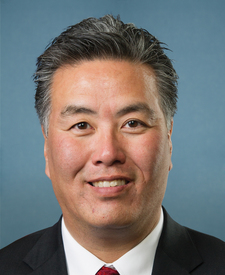
See how Mark Takano's votes line up with your values.
DeepSyte scores Mark Takano's record on the issues you care about — not party, not press releases. Take the 2-minute values quiz to see your personal alignment.
Sign in and take the values quiz to see how Mark Takano's votes line up with your views.
Prediction track record
How often we called Mark Takano's passage votes correctly, from their stated positions on each bill's tagged topics. Excludes “unclear” calls and abstentions.
To prohibit the disclosure of records by the Secretary of Housing and Urban Development of individuals for the purposes of immigration enforcement, and for other purposes.
No paired statements and votes yet for Mark Takano
We haven't yet found statement/vote pairs on the same topic for Mark Takano. This usually means either the rep hasn't taken public positions on bills that have come to a passage vote, or those bills haven't been tagged yet. The checker runs as new press releases and votes come in.
Pro analysis
AI rep analysis — Pro
Get an AI-narrated read on Mark Takano's full voting record against your stated values — aligned themes, conflicts, notable votes, and what to watch for.
We haven't extracted campaign positions for Mark Takano yet. Once their campaign website or position pages are processed, this card will track what they said vs how they voted.
Crossing the aisle
Passage votes where Mark Takano broke ranks with ≥75% of Democrats. Threshold catches substantively partisan splits; unanimous-ish or close votes are excluded.
Reps. Takano, Casten, Foster, Beyer, and Obernolte Lead Bipartisan Coalition to Create the Congressional Office of Technology | U.S. Congressman Mark Takano of California's 39th District
Position: Introduces the Congressional Office of Technology Improvement and Enhancement Act to re-establish an independent, bipartisan source of technology and science expertise for Congress, similar to the former Office of Technology Assessment defunded in 1995.
WASHINGTON, D.C. — Today, Reps. Mark Takano (CA-39), Sean Casten (IL-6), Bill Foster (IL-11), Don Beyer (VA-8), and Jay Obernolte (CA-23) introduced the Congressional Office of Technology Improvement and Enhancement Act to restore Congress’ capacity to confront emerging issues in science and technology.
For more than twenty years, Congress had the Office of Technology Assessment, an independent, bipartisan agency set up to provide information on technology and its potential impacts. However, in 1995 the agency was defunded, stripping Congress of the ability to access unbiased scientific and technological expertise as we entered the digital age.
As emerging technologies—from artificial intelligence to fusion energy and biotechnology—rapidly reshape everyday American life, we are witnessing the consequences of defunding a vital source of scientific and technical expertise for Congress.
The need for expert advice and analysis will only continue to grow as Congress works to anticipate the effects of scientific breakthroughs and cutting-edge technology. As Congress considers drafting legislation on emerging technology, Members of Congress require access to unbiased assessments of what is on the horizon.
“Congress cannot continue flying blind into the future. We must have an office of independent experts as we face important decisions to guide emerging technology,” said Congressman Mark Takano. “Establishing the Congressional Office of Technology will enable Members of Congress to work with experts across disciplines, receive informed and unbiased feedback on legislation, and gain detailed understandings of the issues that will impact our nation. I am proud to lead this bipartisan legislation alongside my colleagues who share my commitment to independent scientific expertise.”
"Each of us who serve in Congress brings a unique perspective and expertise which informs how we serve our constituents. I am confident in my ability to evaluate energy technologies and their impact on our economy and environment, but I cannot claim the same level of expertise on cybersecurity or gene-drive technologies. How many technologies with truly revolutionary potential have we failed to fund in favor of less useful dead ends? Congressional Office of Technology Improvement and Enhancement Act will ensure we're prepared to tackle the technological challenges of the future," said Congressman Sean Casten.
"For years, Congress has not been adequately prepared to engage with complex technical issues that are increasingly important to the legislation we consider. As AI-driven technology rapidly reshapes our future, it has never been more important for Members of Congress to have access to forward-looking, non-partisan technical expertise and advice. That's why I'm proud to lead the effort to revive the OTA and bring Congress into the 21st century,” said Congressman Bill Foster.
"Today Congress is confronted by complex issues ranging from cybersecurity to AI to energy and climate, and so much more — and reconstituting the Office of Technology Assessment would provide the Legislative Branch with a crucial internal source of expertise and counsel,” said Congressman Don Beyer. “Our bill would restore and update this key resource and bolster Congress' independence and knowledge in a key area for years to come."
“Effective policymaking requires a thorough understanding of the science and technology behind the issues Congress is tasked with addressing,” said Congressman Jay Obernolte. “The Congressional Office of Technology will strengthen Congress’s ability to evaluate emerging technologies by providing independent analysis, timely technical assistance, and long-term assessments of technological developments. Modernizing these resources is critical to ensuring Congress can make informed policy decisions and develop thoughtful, evidence-based legislation that addresses complex challenges without unnecessarily hindering innovation.”
“More than ever, Congress needs robust, independent science and technology policy advice it can trust,” said Daniel Schuman, Executive Director of the American Governance Institute. “Rep. Takano has long championed restoring that capability through the Office of Technology Assessment, and we agree the time has come for Congress to regain this essential expertise.”
“There is no better time than the present to reboot the mission of the OTA with the proposed Congressional Office of Technology. Artificial intelligence is reshaping the assumptions on which policymaking rests faster than policymakers can build their own expertise,” said Daniel Correa, Chief Executive Officer of Federation of American Scientists. “We applaud this bipartisan effort and their leadership decision, which will assist policymakers in making transparent, evidence-based decisions that are as forward-looking as possible.”
“As the pace of scientific and technological innovation continues to accelerate, it is more important than ever that our legislators are well equipped with the knowledge and expertise required to tackle the policy challenges of today and tomorrow,” said Luke Hogg, Executive Vice President at the Foundation for American Innovation Action. “Reviving Congress’ long dormant capacity for technical assessment is the first step towards a better equipped legislature. We are elated by the introduction of the Congressional Office of Technology Improvement and Enhancement Act and look forward to working with Representatives Takano, Obernolte, Beyer, Foster, and Casten and their colleagues to build up technical capacity within Congress.”
Text of the Congressional Office of Technology Improvement and Enhancement Act can be found here.
Rep. Takano, Sen. Sanders Reintroduce 32 Hour Workweek Act | U.S. Congressman Mark Takano of California's 39th District
Position: Representative Takano and Senator Sanders reintroduced the Thirty-Two Hour Workweek Act, which would amend the Fair Labor Standards Act to reduce the standard workweek from 40 to 32 hours for nonexempt employees and require overtime pay for hours beyond 32.
WASHINGTON, D.C. — Today, Representative Mark Takano (CA-39), a senior member of the House Education and the Workforce Committee, and Senator Bernie Sanders (I-VT) reintroduced the Thirty-Two Hour Workweek Act.
The bill, first introduced by Rep. Takano in 2021, amends the Fair Labor Standards Act to reduce the standard workweek from 40 hours to 32 hours for nonexempt employees. Covered employees would be eligible to receive overtime compensation for any hours worked beyond 32 hours in a standard workweek.
It’s time for labor law to catch up to the modern-day nature of work. Since 1979, American workers’ productivity has risen 93.2% while wages have risen only 33.7%. Though Americans are more productive than ever, their pay remains relatively stagnant and federal labor protections have not seen meaningful change for over 85 years.
The Thirty-Two Hour Workweek Act ensures that all American workers reap the benefits of their increased productivity by having more of their time back or receiving more time and a half pay.
“The 40-hour workweek was established in law nearly 90 years ago,” said Congressman Mark Takano. “Since then, cell phones, the internet, and now AI have increased worker productivity, but the profits have been largely concentrated at the top by billionaires and corporations. Work has fundamentally changed. It’s time that labor standards caught up. I’m proud to continue partnering with Senator Sanders in reintroducing this bill to make sure that the gains from historically high productivity are felt by all American workers.”
“At a time when artificial intelligence and robotics will radically transform our economy, it is imperative that the financial gains from this new technology benefit working families, not just a handful of billionaires and corporate CEOs. One important way to do that is through a 32-hour workweek with no loss in pay or benefits,” Senator Bernie Sanders said. “A 32-hour workweek is not a radical idea. What’s radical is that, despite an explosion in technology and productivity over the last fifty years, millions of workers are working longer hours for lower wages while nearly $80 trillion in wealth has been redistributed from the bottom 90 percent to the top 1 percent. That has got to change. It’s time to reduce the stress level in our country and allow workers and their families to enjoy a better quality of life. It’s time to pass this bill.”
The Thirty-Two Hour Workweek Act has been endorsed by: Association of Flight Attendants-CWA (AFA-CWA), The American Federation of Labor and Congress of Industrial Organizations (AFL-CIO), The International Federation of Professional and Technical Engineers (IFPTE), National Employment Law Project (NELP), National Nurses United (NNU), Radio and Machine Workers of America (UE), Service Employees International Union (SEIU), United Auto Workers (UAW), United Food and Commercial Workers (UFCW) and WorkFour.
Full text of the bill can be found here.
Rep. Takano Addresses 63rd Anniversary of March on Washington Rally: “America is an Idea Worth Fighting For.” | U.S. Congressman Mark Takano of California's 39th District
Position: Rep. Takano argues that birthright citizenship is under threat and that norms alone will not protect American civil liberties, and calls for defending a civic definition of American identity based on equality, liberty, and justice rather than ancestry or origin.
WASHINGTON, D.C. — Today, Representative Mark Takano (CA-39) participated in the 63rd anniversary of the March on Washington alongside Minority Leader Representative Hakeem Jeffries (NY-8), Congressional Black Caucus Chairwoman Representative Yvette Clarke (NY-9), Representative Alexandria Ocasio-Cortez (NY-14), and Senator Bernie Sanders (I-VT).
Leaders provided remarks at the steps of the Lincoln Memorial, then participated in a march to the Martin Luther King Jr. Memorial led by Reverend Al Sharpton.
Below are Rep. Taknao’s remarks as prepared:
“We are not here simply to remember history. We are here because the work that began 63 years ago is unfinished. We are here because the battles we thought had been long settled have resurfaced:
“Birthright citizenship is under attack. Americans feel the need to carry a passport to prove they belong. Fascists are using their power to intimidate Americans into silence.
“These are not echoes of some distant past. They are the reality of this moment.
“And this moment is an awakening: norms alone will not protect us.
“Every generation must take up the work of renewing and perfecting the idea of America so that America lives up to its promise. There are those who would have us believe America is about blood and soil. Replacing America’s founding principles with a narrow definition of who belongs and who does not. That being an American is about how many generations your family has lived here, where your parents were born, and what you look like.
“But that is not the America generations of people have struggled, marched, bled, and died for.
“And what is the idea of America?
“It is the idea that all of us are created equal. That government derives its power from the people. That every person deserves liberty and justice. And that being an American is not determined by your race, your religion, or where your parents came from, or who you love.
“The work of renewing and perfecting the idea of America does not happen on its own.
“John Lewis fought for that idea. At 23 years old he stood here in 1963 and demanded that America live up to it promise. Two years later, on the Edmund Pettus Bridge, police beat him for demanding the right to vote. He knew what awaited him on the other side of the bridge. Yet, he crossed it anyway.
“Because America was an idea worth fighting for.
“Wong Kim Ark fought for that idea. Born in San Francisco to immigrant parents, he challenged the government when it tried to deny him entry into his own country. In 1898, he took his fight to the Supreme Court—and won. If you are born here, you are an American. Period. More than a century later, we are fighting that battle again.
“Because America is an idea worth fighting for.
“And my own family fought for that idea. During World War II, my great-uncle Monzo served in the 442nd Regimental Combat Team. Fighting and bleeding alongside other segregated units like the Buffalo Soldiers and Tuskegee Airmen. He fought for the United States while my parents and grandparents were among more than 120,000 Japanese Americans incarcerated by their own government.
“Think about that contradiction. A country that questioned their loyalty and took away their freedom. And still, Japanese American soldiers fought and died for an America that had not yet lived up to its promise. The motto of the 442nd was simple: Go for Broke. Risk everything. Give everything. And they did.
“Today, we are being called to our own “Go for Broke” moment. To fight for the character of our country. We fight for an America where nobody feels that they have to carry a passport to prove they belong. We fight for an America where citizenship cannot be stripped away because of who your parents are. We must fight for an America where the government does not use fear and intimidation to silence its own people. And we must fight for an America where every eligible citizen can vote and have that vote counted.
“The people who gathered here 63 years ago understood something we cannot afford to forget: Progress is not permanent. Rights do not protect themselves. Democracy does not defend itself.
“Every generation inherits the idea of America—and then must decide whether it is willing to fight for it.
“My great-uncle Monzo made his choice. Wong Kim Ark made his choice. John Lewis made his choice. Dr. King made his choice. Now it is our turn!
“Because America does not belong to one political party. America does not belong to a bloodline. And it certainly doesn’t belong to one man.
“America belongs to all of us. Let’s Go For Broke. Go all in for democracy. Go all in for equality. Go all in for freedom. We cannot turn back. Let’s finish the assignment, make Dr. King’s dream a reality, and fulfill the promise of a better America.”
Video of Rep. Takano remarks can be found here.
Rep. Takano Introduces the Health Data Access, Transparency and Affordability (DATA) Act | U.S. Congressman Mark Takano of California's 39th District
Position: Introduces legislation amending ERISA to require third-party service providers, such as pharmacy benefit managers, to provide health plan fiduciaries with pricing and claims information, with Labor Department penalties of $10,000 per day for violations and protections against discriminatory use of the data.
WASHINGTON, D.C. — Today, Representative Mark Takano (CA-39) introduced the Health Data Access, Transparency, and Affordability (DATA) Act to demand transparency from service providers, like third party administrators and pharmacy benefit managers, when health plan fiduciaries request information. The Health DATA Act builds upon reforms enacted by Congress as part of the bipartisanNo Surprises Act.
Fiduciaries are responsible for overseeing the health care plans that employees rely on. The Health DATA Act amends the Employee Retirement Income Security Act of 1974 (ERISA) to close loopholes that allow third parties – like pharmacy benefit managers (PBMs) – to hide information from fiduciaries about pricing and overpayment. The bill authorizes the Secretary of Labor to penalize violators $10,000 per day if third parties fail to provide health plan fiduciaries with the information they need to make healthcare more affordable.
The bill also ensures that the data shared to plan fiduciaries cannot be used to discriminate against individuals and that data is subject to existing privacy and antidiscrimination laws.
“Third parties hold data on individual patients and pricing for drugs and procedures,” said Congressman Mark Takano. “Those who oversee health plans must have access to this data to ensure fair pricing for those receiving employer sponsored healthcare. Without access to this information, employees are vulnerable to being overcharged or price gouged. Gaps in recent legislative efforts have allowed third parties like PBMs to keep this data hidden, leaving fiduciaries with an incomplete picture of how to best serve the over 165 million Americans on employer-sponsored health plans.”
Full text of the Health DATA Act can be found here.
Rep. Takano Introduces Promoting Authenticity with Influencer Disclaimer (PAID) Act to Demand Disclosure of Campaign Paid Content from Influencers | U.S. Congressman Mark Takano of California's 39th District
Position: Introduces the PAID Act, which would amend the Federal Election Campaign Act to require influencers paid by political committees or candidates to disclose that they were compensated for posted content.
WASHINGTON, D.C. — Today, Representative Mark Takano (CA-39) introduced the Promoting Authenticity with Influencer Disclaimer (PAID) Act. The PAID Act would amend the Federal Election Campaign Act to require any person who is paid by a political committee or candidate to include a disclaimer that they were paid to post content.
The Federal Election Commission (FEC) has attempted to bring transparency to the creator economy since 2013. Due to the lack of laws surrounding creators coordinating with campaigns, they have been unable to demand disclosures on paid candidate content. The PAID Act will create a clear statutory disclaimer requirement for the FEC to finally enforce.
Reporting shows campaigns and PACs paying hundreds of thousands of dollars for influencer originated content in recent years. This type of paid advertising has no guardrails or transparency, and campaigns will continue to double down on this influencer nondisclosure loophole in order to sway elections.
“Our social media feeds must be fixed,” said Congressman Takano. “Users deserve to know if a creator has been compensated by a campaign to post for them. Current campaign disclosure laws have not kept up with this new creator economy, and voters deserve to know who is financing their feeds before heading to the polling booths. We cannot allow the candidates who finance the most checks to dominate public discourse and drown out competing voices.”
Full text of the PAID Act can be found here.
Takano, Adams, Sanders Reintroduce Restoring Overtime Pay Act | U.S. Congressman Mark Takano of California's 39th District
Position: The release advocates for the Restoring Overtime Pay Act, which would expand overtime eligibility by gradually increasing the salary threshold to the 55th percentile of full-time salaried workers nationwide, affecting approximately 29.3 million workers.
WASHINGTON, D.C. – Today, Representative Mark Takano (CA-39), Representative Alma Adams (NC-12) and Senator Bernie Sanders (I-VT) reintroduced the Restoring Overtime Pay Act to expand and strengthen overtime protections for workers, legislation that is especially vital as President Donald Trump’s policies drive up costs for everyday Americans.
Currently, just eight percent of full-time salaried workers are eligible for overtime pay based on their salaries alone. In 1975, nearly 63 percent of all full-time salaried workers were guaranteed overtime pay. While 60 percent of Americans are living paycheck-to-paycheck, the Trump Administration is trying to make it more difficult for working families to make ends meet by weakening the protections set by the Biden Administration. In response, this bold, commonsense legislation will help restore fairness to an economy rigged against workers and their families.
The Restoring Overtime Pay Act expands and strengthens overtime protections for up to 29.3 million workers by gradually increasing the overtime salary threshold to the 55th percentile of full-time salaried workers nationwide.
“Americans are working more for less,” said Rep. Takano. “Expanding the overtime threshold for salaried employees is the best way to ensure that families can survive the cost-of-living crisis caused by Donald Trump. I am proud to introduce this bill to help make sure over 29 million workers get paid fairly.”
“For far too long, tens of millions of Americans have been denied overtime pay because of outdated federal law,” said Rep.?Adams. “In my district, thousands of residents are struggling to make ends meet while the Trump administration puts the interests of billionaires above those of ordinary Americans. Working people need overtime pay now more than ever, and I am proud to partner with Congressman Takano and Senator Sanders to introduce the Restoring Overtime Pay Act and ensure workers are paid what they’re owed.”
“At a time of massive income and wealth inequality, when over 60% of Americans are living paycheck to paycheck, it is beyond unacceptable that President Trump is denying overtime pay to millions of workers who desperately need it to keep up with the outrageously high cost of living,”?said Sen. Sanders.?“We should be making it easier, not harder, for Americans who work more than 40 hours a week to get the time-and-a-half pay that they have earned and deserve. That’s precisely what this bill would do.”
Endorsing Orgs: AFL-CIO; American Federation of State, County and Municipal Employees (AFSCME); American Federation of Teachers (AFT); Asian Pacific American Labor Alliance-AFL-CIO (APALA); Center for Law and Social Policy (CLASP); the Clearinghouse on Women’s Issues; Communications Workers of America (CWA); Demos; Equal Rights Advocates; Family Values@ Work; the Feminist Majority Foundation; International Association of Machinists & Aerospace Workers (IAM); International Federation of Professional and Technical Engineers (IFPTE); National Education Association (NEA); National Employment Law Project (NELP); National Employment Lawyers Association; National Institute for Workers’ Rights; National Partnership for Women & Families; National Women’s Law Center; NETWORK Lobby for Catholic Social Justice; North Carolina Justice Center; Oxfam America; Patriotic Millionaires; Public Justice Center; Service Employees International Union (SEIU); UNITE HERE; United Autoworkers (UAW), United Electrical, Radio & Machine Workers of America (UE); United Food and Commercial Workers (UFCW); United for Respect; United Steelworkers (USW); Wind of the Spirit Immigrant Resource Center; WorkLife Law; Indiana Community Action Poverty Institute.
Read the one-pager and section-by-section summary of the Restoring Overtime Pay Act.
Takano, Simon, Schatz Reintroduce Day of Silence Resolution to Demand Fair Treatment of LGBTQI+ Students | U.S. Congressman Mark Takano of California's 39th District
Position: The representatives support federal recognition and protection of LGBTQI+ students' rights to safe school environments free from bullying, harassment, and discrimination, and oppose policies they characterize as targeting or attacking LGBTQI+ students.
WASHINGTON, D.C. — Today, Chair of the Congressional Equality Caucus, Representative Mark Takano (CA-39), Representative Lateefah Simon (CA-12), and Senator Brian Schatz (D-HI) reintroduced the Day of Silence resolution to bring attention to bullying, harassment, and discrimination LGBTQI+ students face in school.
“The classroom should be a space for every student to learn in a safe environment without fear of being singled out for who they are,” said Rep. Mark Takano, Chair of the Congressional Equality Caucus. “Seeing adults from local school boards to state legislatures, Congress, and even the President targeting students who are simply trying to find their place in the world is one of the worst kinds of bullying. I am proud to reintroduce this resolution as a former public school teacher, as Chair of the Congressional Equality Caucus, and as someone who wants every LGBTQI+ student to learn and grow safely.”
“Every child should feel safe at school,” said Senator Brian Schatz. “As attacks against LGBTQ+ students continue across the country, we need to protect these students and fight back against the discriminatory policies that harm them. Our resolution reaffirms our support for LGBTQ+ students and their right to live freely and openly.”
“Every child deserves the chance to safely be their most authentic self at school. Schools should open doors, not close them,” said Vice Chair of the Congressional Equality Caucus Lateefah Simon. “As Republicans escalate their dangerous attacks on the LGBTQ+ community at the federal and state level, it is more important than ever that we join together to assure that all students are protected against discrimination and to reaffirm their basic civil rights. Our Day of Silence resolution recognizes the bullying and harassment that LGBTQ+ youth may face and demands equal opportunity and basic civil rights in all public schools. I thank Equality Caucus Chair Takano and Senator Schatz for their partnership to ensure that all school children can fully participate in their education, extracurriculars, and their future.”
“Glisten is grateful for the leadership of Congressman Mark Takano and we applaud his introduction of the 2026 Day of Silence resolution,” said Melanie Willingham-Jaggers, CEO, Glisten. “Our latest National School Climate Survey provides evidence of what we know to be true – that LGBTQ+ students are being subject to an ongoing, brutal attack on their very existence. This is particularly felt among transgender and nonbinary young people who are being silenced by having their existence criminalized. We hope this resolution will remind the entire LGBTQ+ student community that there are people in power who care deeply about their wellbeing and who have not given up on them.”
Full text of the resolution can be found here.
Rep. Takano Slams SCOTUS Decision Ruling Against Conversion Therapy Bans | U.S. Congressman Mark Takano of California's 39th District
Position: Rep. Takano opposes the Supreme Court's decision striking down Colorado's conversion therapy ban and calls for federal legislation to prohibit conversion therapy practices by licensed mental health professionals on minors.
WASHINGTON, DC — Following the Supreme Court’s ruling in Chiles v. Salazar, a case on the constitutionality of Colorado’s ban on licensed mental health professionals engaging in conversion therapy for minors, Congressional Equality Caucus Chair Rep. Mark Takano released the following statement:
“Young LGBTQI+ people will suffer because of today’s Supreme Court decision. This decision, however, doesn’t change the fact that these practices are still dangerous, disproven, and denounced by every major medical association in the United States,” said Rep. Mark Takano, Chair of the Congressional Equality Caucus. “Providers who engage in these practices are actively endangering the wellbeing of young LGBTQI+ people and defrauding their families by promising to “fix” something that is simply not broken. Young LGBTQI+ people should not have to be subjected to this kind of cruelty—especially by licensed health care providers. The Congressional Equality Caucus will continue to push federal legislation to address this harmful and fraudulent practice.”
“Conversion therapy” refers to range of discredited practices that have long been known to cause significant and lasting psychological harm to patients by purportedly forcing patients to change their sexual orientation or gender identity.? These practices are often aimed at minors, and evidence shows that LGBTQ+ youth who undergo conversion therapy are more than twice as likely to report having attempted suicide compared to those who did not. All major U.S. medical or mental healthcare associations have condemned conversion therapy, including the American Medical Association, the American Psychological Association, the American Psychiatric Association, the American Academy of Child & Adolescent Psychiatry, theAmerican Academy of Pediatrics, and the American Academy of Family Physicians. As of 2026, 23 states and D.C. entirely prohibit—and 4 states and Puerto Rico restrict—licensed healthcare providers from subjecting LGBTQI+ minors to conversion therapy. Today’s ruling undermines these important protections for young LGBTQI+ people.
In August 2025, CEC Chair Rep. Mark Takano (CA-39), Vice Chair Rep. Ted Lieu (CA-36), and Senator Jeff Merkley (D-OR) led 187 Members of Congress in an amicus brief urging the Supreme Court to uphold Colorado’s conversion therapy ban. Read the Equality Caucus’s press release on the amicus brief here. Read the amicus brief here.
Rep. Takano Blasts Sheriff Bianco's Ballot Seizure | U.S. Congressman Mark Takano of California's 39th District
Position: Rep. Takano opposes Sheriff Bianco's seizure of ballots from a special election, characterizing it as a politically motivated action lacking specific fraud allegations and raising concerns about oversight and transparency.
WASHINGTON, D.C. — Representative Mark Takano (CA-39) released the following statement after reports that Riverside County Sheriff Chad Bianco seized over 600,000 ballots:
"The Sheriff has sown distrust by seizing more than 600,000 ballots from last year’s special election. He has made no specific allegations of fraud and now has sole access to these ballots, raising serious concerns about oversight and transparency. I support state-level efforts to halt this politically motivated fishing expedition, which repeats the same unfounded attacks on voter confidence that we have seen since 2020. Our elections are safe and secure. No elected official should play politics with the integrity of the ballot box."
Rep. Takano Invites ICE-Detained U.S. Citizen & Combat Veteran George Retes to State of the Union | U.S. Congressman Mark Takano of California's 39th District
Position: Rep. Takano opposes the Trump Administration's immigration enforcement policies, characterizing them as overreaching and cruel, and citing the wrongful detention of a U.S. citizen and veteran as evidence of systemic abuse in federal immigration enforcement.
WASHINGTON, D.C. — Today, House Committee on Veterans’ Affairs Ranking Member Mark Takano (CA-39) announced that he is inviting George Retes to be his guest at the State of the Union.
George Retes is a 26-year-old U.S. citizen and disabled U.S. Army veteran whose service included a deployment to Iraq before he transitioned into civilian life as a security guard in his native Ventura County, California.
In July 2025, during a large-scale federal immigration raid, George—while commuting to work—was stopped by ICE agents who broke his car window. He was subsequently pepper-sprayed, pinned down with officers kneeling on his back and neck, and detained for three days without charges, access to legal counsel, contact with his family, or medical care. All this was done by the federal government in full knowledge that George was a U.S. citizen and a veteran.
“George Retes is a U.S. citizen and an Iraq War veteran, and yet he was treated like an enemy by his own government,” said Ranking Member Takano. “His story exemplifies the overreach and cruelty of the Trump Administration and their heavy-handed immigration policies, sweeping up innocent men, women, and children in a desperate bid to fill arbitrary quotas. I am honored to have George as my guest at the State of the Union. His presence will speak volumes.”
“I served my country. I wore the uniform, I stood watch, and I believe in the values we say make us different. And yet here, on our own soil, I was wrongfully detained,” George wrote in the San Francisco Chronicle. “This isn’t just my story. It’s a warning. Because if it can happen to me, it can happen to any one of us.”
Requests to interview George can be sent to Matt.Schoonmaker@mail.house.gov.
Source: GDELT 2.0 GKG, filtered to a curated list of national outlets. Inclusion is not endorsement; opinion pieces and reported news are mixed.
Recent stock activity
Periodic transaction reports filed under the STOCK Act — disclosed by the rep, sourced from public filings.
No disclosed trades on record.
Source: open-data mirrors of the Senate eFD and House Clerk financial-disclosure systems. Disclosure within 30 days of trade is required by law (45 for spouse/dependent trades).
Top PAC donors · 2026 cycle
Political action committees that gave the most to this rep's principal campaign committee this cycle. PAC giving is direct organizational support — industry, ideological, or leadership.
1.UNITED FOOD AND COMMERCIAL WORKERS INTERNATIONAL UNION ACTIVE BALLOT CLUBLabor2 contributionsTrade-union PAC for the United Food and Commercial Workers — backs candidates supporting union organizing, collective bargaining, worker protections, and labor-friendly workplace standards.AI$10,000
2.AMERICAN CRYSTAL SUGAR COMPANY PACAgriculture2 contributionsAgricultural company PAC for a major sugar producer — backs candidates supporting farm subsidies, tariff protections, and agricultural trade policies.AI$10,000
3.INLAND EMPIRE STRIKES PAC2 contributions$10,000
4.AMERICAN FEDERATION OF TEACHERS COMMITTEE ON POLITICAL EDUCATIONLabor2 contributionsTrade-union PAC for the American Federation of Teachers — backs candidates supporting public education funding, teacher compensation, collective bargaining rights, and labor-friendly policies.AI$10,000
5.TRUEDEM LEADERSHIP FUND2 contributions$10,000
6.SHEET METAL WORKERS' INTERNATIONAL ASSOCIATION POLITICAL ACTION LEAGUELabor2 contributionsTrade-union PAC for sheet metal workers — backs candidates supporting prevailing-wage standards, apprenticeship programs, and union-friendly labor policies.AI$10,000
7.INTERNATIONAL BROTHERHOOD OF ELECTRICAL WORKERS POLITICAL ACTION COMMITTEELabor2 contributionsTrade-union PAC for the International Brotherhood of Electrical Workers (IBEW). Backs candidates supporting prevailing-wage standards, infrastructure investment, apprenticeship programs, and union organizing rights.AI$10,000
8.EQUALITY PACIdeological2 contributionsIdeological PAC — supports candidates and causes aligned with progressive values and social equality advocacy.AI$10,000
9.MATSON, INC. FEDERAL ELECTION COMMITTEE2 contributions$10,000
10.EQUALITY PROJECT PACIdeological3 contributionsIdeological PAC focused on civil rights and equality advocacy — supports candidates aligned with progressive social and economic justice priorities.AI$10,000
Source: OpenFEC (api.open.fec.gov) Schedule A receipts where contributor type is “committee.” Aggregated by contributing committee. Self-transfers from joint-fundraising / victory committees are excluded.
Top individual contributors · 2026 cycle
Itemized individual contributions over $200 to this rep's campaign committee, aggregated by donor employer. PAC giving is shown above; this section is people, not organizations.
1.KELLER ANDERLE SCOLNICK LLP$14,000
2.WELLS FARGO$7,000
3.NEW PACIFIC REALTY CORP.$7,000
4.VETERANS UNITED HOME LOANS$7,000
5.WARNER BROTHERS$7,000
6.BROOKHILL CORP.$7,000
7.COLANTUONO, HIGHSMITH & WHATLEY, PC$7,000
8.AR ASSET MANAGEMENT, INC.$6,000
9.CATALYST$5,000
10.SEIU$5,000
Source: OpenFEC Schedule A receipts where contributor type is “individual,” aggregated by the donor's self-reported employer. This is a geographic / industry correlation, not a corporate endorsement.