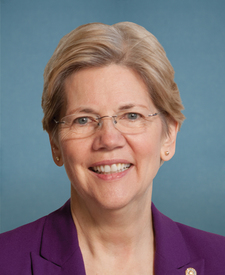
See how Elizabeth Warren actually votes — against your values.
DeepSyte scores Elizabeth Warren's record on the issues you care about — not party, not press releases. Take the 2-minute values quiz to see your personal alignment.
Sign in and take the values quiz to see how Elizabeth Warren's votes line up with your views.
Prediction track record
How often we called Elizabeth Warren's passage votes correctly, from their stated positions on each bill's tagged topics. Excludes “unclear” calls and abstentions.
100%
Accuracy
1
Correct
0
Incorrect
87
Pending
Right119-sjres-184
A joint resolution to direct the removal of United States Armed Forces from hostilities within or against the Islamic Republic of Iran that have not been authorized by Congress.
A joint resolution to direct the removal of United States Armed Forces from hostilities within or against the Islamic Republic of Iran that have not been authorized by Congress.
Based on 3 data points across public statements and recorded votes · AI analysis of public records
119-sjres-184·Consistent
A joint resolution to direct the removal of United States Armed Forces from hostilities within or against the Islamic Republic of Iran that have not been authorized by Congress.
88/100
What they said
May 29, 2026
Senator Warren criticizes the Trump administration's handling of evacuations from the Middle East following military action in Iran, arguing that the administration failed to use available military resources (TRANSCOM) to safely evacuate American civilians and left thousands stranded with inadequate information.
Voted Yea on A joint resolution to direct the removal of United States Armed Forces from hostilities within or against the Islamic Republic of Iran that have not been authorized by Congress.
Senator Warren's statement criticizes the Trump administration for launching military action against Iran without proper authorization and failing to adequately evacuate American civilians. The joint resolution directly addresses both concerns: it invokes the War Powers Resolution to require removal of U.S. Armed Forces from unauthorized hostilities in Iran, and it explicitly preserves the authority to conduct evacuations of U.S. citizens. Warren's yes vote on passage aligns with her stated position that the Iran military action was illegal and that the administration mishandled the evacuation response.
Providing for congressional disapproval under chapter 8 of title 5, United States Code, of the rule submitted by the Department of Education relating to "Waivers and Modifications of Federal Student Loans".
85/100
What they said
Jun 8, 2026
The lawmakers urge the Trump administration to immediately address the student loan default crisis by protecting borrowers' access to affordable repayment plans, clearing debt relief application backlogs, and creating new forbearance options. They argue the administration's policies have worsened defaults and caused economic harm to millions of borrowers.
Voted Nay on Providing for congressional disapproval under chapter 8 of title 5, United States Code, of the rule submitted by the Department of Education relating to "Waivers and Modifications of Federal Student Loans".
The statement criticizes the Trump administration for blocking borrowers from accessing lower student loan payments and debt relief, and urges protection of affordable repayment options. The bill nullifies a 2022 Department of Education rule that suspended loan payments and discharged debt—a rule that provided borrower relief. The rep's NO vote opposes nullification of that relief rule, which aligns with the statement's call to protect borrower access to affordable repayment and debt relief. The alignment is strong on the core question of preserving borrower protections, though the statement focuses on Trump-era policies while the bill addresses a prior Obama-era rule.
A joint resolution providing for congressional disapproval under chapter 8 of title 5, United States Code, of the rule submitted by the Department of Education relating to "Improving Income Driven Repayment for the William D. Ford Federal Direct Loan Program and the Federal Family Education Loan (FFEL) Program".
25/100
What they said
Jun 8, 2026
The lawmakers urge the Trump administration to immediately address the student loan default crisis by protecting borrowers' access to affordable repayment plans, clearing debt relief application backlogs, and creating new forbearance options. They argue the administration's policies have worsened defaults and caused economic harm to millions of borrowers.
Voted Nay on A joint resolution providing for congressional disapproval under chapter 8 of title 5, United States Code, of the rule submitted by the Department of Education relating to "Improving Income Driven Repayment for the William D. Ford Federal Direct Loan Program and the Federal Family Education Loan (FFEL) Program".
The statement urges protection of borrowers' access to affordable repayment plans and opposes ending the SAVE income-driven repayment plan. The bill nullifies the Department of Education rule that created the SAVE plan. The rep voted NO on the resolution, meaning they voted to preserve the SAVE rule. This is directly consistent with the statement's position opposing the elimination of SAVE and supporting affordable repayment options.
Pairs with ambiguous language and high uncertainty are withheld until more data is available. Procedural, cloture, and amendment votes are excluded — they don't cleanly signal substantive support or opposition.
Pro analysis
AI rep analysis — Pro
Get an AI-narrated read on Elizabeth Warren's full voting record against your stated values — aligned themes, conflicts, notable votes, and what to watch for.
We haven't extracted campaign positions for Elizabeth Warren yet. Once their campaign website or position pages are processed, this card will track what they said vs how they voted.
Crossing the aisle
Passage votes where Elizabeth Warren broke ranks with ≥75% of Democrats. Threshold catches substantively partisan splits; unanimous-ish or close votes are excluded.
5
Cross-aisle votes
119-hr-5334·Jul 29, 2026·77% of D voted YES
Lindsey O. Graham Sanctioning Russia and Iran Act of 2026
A joint resolution providing for congressional disapproval of the proposed foreign military sale to the Government of Turkiye of certain defense articles and services.
Warren Secures Wins on Military Right to Repair, Defense Contractor Stock Buybacks, Service Member Safety in Senate FY 2027 NDAA | U.S. Senator Elizabeth Warren of Massachusetts
Position: Senator Warren secured provisions in the FY 2027 NDAA addressing military right to repair, restrictions on defense contractor stock buybacks, military housing improvements, service member health and safety, and AI oversight to prevent contractor price gouging.
Executive Summary of the FY 27 NDAA (Website)
Washington, D.C. — During the Senate Armed Services Committee’s (SASC) markup of the Fiscal Year 2027 National Defense Authorization Act (FY27 NDAA) this week, U.S. Senator Elizabeth Warren (D-Mass.), Ranking Member of the Senate Armed Services Personnel Subcommittee, secured key wins including on right to repair, defense contractor stock buybacks, military housing, consumer protection, service member health and safety, and more. All were secured with bipartisan support in the Senate Armed Services Committee.
Senator Warren secured the following provisions in SASC’s version of the FY 27 NDAA:
“Giant military contractors are cheating our government out of billions in taxpayer dollars and lining their executives’ and shareholders’ pockets instead of investing in our national defense. It’s time to stop these contractors from putting Wall Street over our national security,” said Senator Warren.
Military Housing and Child Care
Service Member Health and Safety
Politicization of the Military
Pharmacy and Pharmaceutical Supply Chains
Artificial Intelligence and Preventing Contractor Price Gouging
Following Hearing, Warren Presses Trump Military Official to Release Data Revealing Whether Military Contractor is Overcharging Military for Prescription Drugs | U.S. Senator Elizabeth Warren of Massachusetts
Position: Senator Warren is pressing the Defense Department to release data on whether Express Scripts, the military's pharmacy benefit manager, is overcharging the military for prescription drugs through its own affiliated pharmacies while under-reimbursing competitors, citing potential conflicts of interest and self-dealing.
Largest pharmacy benefit manager in the U.S. may be sending affiliated pharmacies inflated payments, elbowing out competitors
“[T]axpayers deserve to know that (government funds) are being used for their intended purpose, not for potential self-dealing by DHA contractors.”
Washington, D.C. — U.S. Senator Elizabeth Warren (D-Mass.), a member of the Senate Armed Services Committee (SASC), wrote to Assistant Secretary of Defense for Health Affairs Keith Bass, urging him to follow through on commitments he made to release data that would allow Congress to evaluate whether Express Scripts, the largest pharmacy benefit manager in the United States and military pharmacy contractor, may be sending inflated payments to its own pharmacies and under-reimbursing competing pharmacies.
“[T]axpayers deserve to know that [government funds] are being used for their intended purpose, not for potential self-dealing by [Defense Health Agency] contractors,” said Senator Warren.
The Defense Health Agency (DHA) spends billions of dollars to provide TRICARE pharmacy benefits — as part of the military health care system — to 9.6 million service members, retirees, and family members. Since 2009, DHA has awarded Express Scripts an exclusive TRICARE pharmacy contract, which involves running the military’s retail pharmacy network and mail order program.
But Express Scripts also owns mail order and specialty pharmacies that participate in the TRICARE network. Reporting has revealed that Express Scripts appears to be charging the military $484 more, on average, to dispense generic drugs through Express Scripts’ own mail-order pharmacies than through competing pharmacies.
“[This] creates a clear conflict of interest,” said Senator Warren. As a result of onerous contract terms offered by Express Scripts, more than 13,000 retail pharmacies have left the TRICARE network since 2022, leaving hundreds of thousands of military families without an in-network pharmacy.
In a recent hearing, Senator Warren pressed Assistant Secretary Bass to commit to conducting annual audits of TRICARE’s pharmacy contract and providing Congress with the difference in reimbursement rates, fees, and other price concessions for Express Scripts-owned pharmacies and their competitors in the network. Bass agreed, but with no particular timeline in place.
“You gave me your commitment that you would do so. I appreciate your prompt attention to this matter and request that you provide my office with all relevant and pertinent data in accordance with these commitments by June 22, 2026,” concluded Senator Warren.
Senator Warren has led the fight for affordable health care and fair practices for military families:
Warren Celebrates Wins on Key Military Child Care, Military Health Care, Blast Overpressure Care at Armed Services Personnel Markup | U.S. Senator Elizabeth Warren of Massachusetts
Position: Senator Warren celebrates the inclusion of her proposals in the FY 2027 NDAA markup, including measures to support military child care workers, hold pharmacy benefit managers accountable for potential overcharging of the Department of Defense, enhance sexual assault protections for military women, and improve traumatic brain injury care for service members. She also criticizes the Trump administration's politicization of the military.
Video of Remarks (SASC Personnel Subcommittee Stream)
Washington, D.C. — U.S. Senator Elizabeth Warren (D-Mass.), ranking member of the Senate Armed Services Subcommittee on Personnel, delivered opening remarks Subcommittee’s markup of the Fiscal Year 2027 National Defense Authorization Act (NDAA), celebrating her wins on key priorities, including on supporting military child care workers, holding pharmacy benefit managers accountable for potentially ripping off DoD and taxpayers, enhancing sexual assault protections for women, and improving blast overpressure care.
“It is critical that we show that Congress is continuing to work in a bipartisan manner to support our service members and military families,” said Senator Warren.
Senator Warren called out the Trump administration’s politicization of the military, including Secretary Hegseth’s unprecedented intervention in military promotions, and attacks on DoD civilians.
“President Trump also continues to politicize the military for cheap political theater…This politicization will create lasting damage to our military and to our nation,” said Senator Warren.
The senator highlighted the inclusion of her proposals, including:
“[I]t is long past time for all the branches to fully update them based on requirements Congress passed in the FY 2025 NDAA. This Committee will be watching closely to ensure that happens,” Senator Warren said.
“This makes it harder for our troops and their families to fill prescriptions at their local pharmacies…We need to be doing more to stop this apparent profiteering at the expense of our service members, their families, and American taxpayers,” Senator Warren continued.
“We unfortunately continue to hear of cases of sexual assault in the military, such as the cases of an Army OB/GYN who has been accused of recording videos of nearly 100 female patients without their consent…This policy helps keep patients safe, so I am glad that the mark directs the Defense Health Agency to review which hospitals are compliant with required chaperone policies and to develop a plan and recommendations based on their findings. Congress should go further by mandating this policy in law,” said Senator Warren.
“Traumatic brain injuries have become the ‘signature injury’ of the war against Iran, and the sooner we begin to implement these logs and do a better job tracking these injuries and making regular assessments to catch brain injuries, the better we can ensure that service members get the care they need,” said Senator Warren.
Transcript: Senator Warren’s Remarks on FY 2027 NDAA Markup
June 9, 2026
Senate Armed Services Committee Subcommittee on Personnel
Senator Elizabeth Warren: Thank you, Mr. Chairman, and thank you for continuing this subcommittee’s tradition of holding an open session for this markup. It is critical that we show that Congress is continuing to work in a bipartisan manner to support our service members and military families.
This markup comes at a time where President Trump and Secretary Hegseth are risking the lives of service members in an illegal war with Iran while making life more difficult for troops and their families back home. It also comes at a time where the Trump administration continues to politicize the military to serve their own agenda.
I am particularly disturbed by Secretary Hegseth taking unprecedented actions to intervene in military promotions. In DOD’s latest list of 22 Navy promotions to become one-star admirals, zero of these promotions were women and reporting indicates that the last time the Navy promoted a woman to a one-star role was last June. And Secretary Hegseth reportedly removed the nominations of two women and two Black men from the original promotion list. It’s also unclear why Secretary Hegseth has also now blocked the appointment of nine Air Force Colonels. He’s also reportedly delayed the promotion of at least two dozen senior Air Force officers “while the Pentagon reviews their ties to diversity, equity, and inclusion policies.” President Trump also continues to politicize the military for cheap political theater, including his most recent reported stunt to recruit hundreds of troops to watch his UFC cage-fighting event at the White House. This politicization will create lasting damage to our military and to our nation.
DOD has also shown a blatant disregard for the critical role DOD civilians play to support the military. It was shameful this administration failed to include any pay raises for civilian employees in its budget request. This mark includes some funding for civilians through bonuses, but at a time when President Trump’s policies drive up costs for all Americans, it is unfair—and insulting—to deny DOD civilians a pay raise.
All of that said, I am proud of the bipartisan work done by this subcommittee to take care of troops and military families. I would like to thank the Chairman and his staff for their continued collaboration and adherence to tradition during the drafting of this mark. I am glad that this mark includes funding for the chronically underfunded Defense Health Program so that we can better support the health of our warfighters and their families. It also fully funds the Defense POW/MIA Accounting Agency, which is critical for bringing home service members to their families.
I would like to highlight just a few other important provisions that have made it into this bipartisan mark. This mark continues to push DOD to ensure our service members and their families have access to high-quality child care by fully updating its pay scales for child care workers, including those who support kids with special needs. I’m also glad that the mark increases funding for child care and youth programs. While the services have made some progress in updating these pay scales, it is long past time for all the branches to fully update them based on requirements Congress passed in the FY 2025 NDAA. This Committee will be watching closely to ensure that happens.
This mark also requires GAO to review the TRICARE pharmacy program, including whether the Defense Health Agency is effectively assessing conflicts of interest in the program due to vertical integration. Express Scripts, the largest pharmacy benefit manager in the United States, has held the exclusive TRICARE pharmacy contract for nearly twenty years. During that time, it’s forced thousands of pharmacies out of the TRICARE network, allowing the company to potentially steer more business to its own mail-order pharmacies. This makes it harder for our troops and their families to fill prescriptions at their local pharmacies, and it allows Express Scripts to rake in more profits and allegedly to charge DOD a higher rate. We need to be doing more to stop this apparent profiteering at the expense of our service members, their families, and American taxpayers.
We unfortunately continue to hear of cases of sexual assault in the military, such as the cases of an Army OB/GYN who has been accused of recording videos of nearly 100 female patients without their consent. DHA took an important step last December to establish a policy requiring all military treatment facilities to offer a chaperone to any patient during sensitive medical examinations. This policy helps keep patients safe, so I am glad that the mark directs the Defense Health Agency to review which hospitals are compliant with required chaperone policies and to develop a plan and recommendations based on their findings. Congress should go further by mandating this policy in law.
I am glad that this mark also continues to push DOD to prioritize the brain health of our warfighters. I’ve been proud to work on this on a bipartisan basis on this issue subcommittee for years and want to thank Senator Ernst for her partnership. This year’s bill continues to make progress on this issue by requiring DOD to brief this committee on the feasibility of regular cognitive testing and establishing blast overpressure and traumatic brain injury logs to better catch these brain injuries.
Traumatic brain injuries have become the “signature injury” of the war against Iran, and the sooner we begin to implement these logs and do a better job tracking these injuries and making regular assessments to catch brain injuries, the better we can ensure that service members get the care they need.
I am also glad that the mark encourages DOD to improve early identification of brain injuries, including through partnering with non-profit organizations that specialize in treating these injuries. The mark requires DOD to brief the committee on opportunities with existing non-profit partnerships for TBI treatment and early intervention. I want to call out organizations like Home Base in Massachusetts that have a strong track record of getting 95 percent of the Special Operators they treat for these types of brain injuries back into the field. DOD should continue to work with them to ensure service members have access to the care they need.
These are just some of the key provisions in the Chairman’s mark, and I look forward to working with my colleagues on this subcommittee and the full committee to see what else we can do to improve the lives of our service members and their families.
I want to thank all of the members of the subcommittee and full committee for their work on this bill, as well as their staff. I especially want to thank the committee staff - Jon Clark, Gary Leeling, Andy Scott, Jenny Davis, Noah Sisk, Sofia Kamali, Glen Diehl, Megan Galindo, Madeline Guenther, Brendan Gavin, Katie Magnus, Isaac Jalkanen, Greg Lilly, and Leah Brewer.
Warren, Merkley, Pressley, Carson Lead 60+ Lawmakers in Urging Trump Administration to Immediately Address Largest Student Loan Default Crisis on Record | U.S. Senator Elizabeth Warren of Massachusetts
Position: The lawmakers urge the Trump administration to immediately address the student loan default crisis by protecting borrowers' access to affordable repayment plans, clearing debt relief application backlogs, and creating new forbearance options. They argue the administration's policies have worsened defaults and caused economic harm to millions of borrowers.
Washington, D.C. — U.S. Senators Elizabeth Warren (D-Mass.) and Jeff Merkley (D-Ore.), along with Representatives Ayanna Pressley (D-Mass.) and André Carson (D-Ind.), led 62 members of Congress in pressing the Department of Education (ED) to immediately address the largest student loan default and delinquency crisis on record, which has been made worse by the Trump administration’s policies.
“(I)nstead of pursuing solutions that protect borrowers, the Trump administration has deflected blame, punted responsibility for the default crisis to another agency, and raised costs for borrowers at every turn. We urge you to provide meaningful support to borrowers,” said the lawmakers.
A February 2026 analysis by The Century Foundation and Protect Borrowers revealed that close to 9 million student loan borrowers are now in default, up from 5 million last summer. 3.6 million borrowers defaulted during the first year of the Trump administration alone. 75 percent of borrowers who moved from delinquency to default on a student loan under the Trump administration had never previously defaulted.
“The Trump administration’s actions have fueled this default and delinquency crisis,” wrote the lawmakers, highlighting the administration’s decision to block borrowers from accessing lower student loan payments and reduced access to debt relief.
Making matters worse, millions of borrowers will soon face an increased risk of delinquency and default due to the Trump administration’s decision to end the affordable SAVE income-drive repayment (IDR) plan. Instead of helping those vulnerable borrowers, the Trump administration will automatically enroll them in more expensive loan repayment plans if they do not apply for an IDR plan within 90 days.
The rise in delinquencies and defaults will have devastating economic effects and raise costs for American families. The Trump administration has threatened to restart forcibly collecting wages, Social Security, and tax refunds for defaulted borrowers, meaning that more than $30 billion could be seized from Americans’ incomes by the end of next year. Around 2 million borrowers saw their credit score drop by an average of 100 points over the course of 2025, which can restrict access to credit or loans that help them afford everything from housing to medical bills. According to Moody’s Analytics, a 1% increase in the student loan delinquency rate is associated with a statistically significant decline in home ownership.
The lawmakers urged ED to immediately take the following steps to address the default cliff:
The coalition requested that ED commit to clearing the backlog of applications for loan debt relief and create a new form of forbearance to support borrowers by June 22, 2026.
Minority Leader Chuck Schumer (D-N.Y.), Senator Bernie Sanders (I-Vt.), Ranking Member of the Senate Health, Education, Labor, and Pensions Committee, along with Senators Angela Alsobrooks (D-Md.), Richard Blumenthal (D-Conn.), Cory Booker (D-N.J.), Tammy Duckworth (D-Ill.), Dick Durbin (D-Ill.), Kirsten Gillibrand (D-N.Y.), Martin Heinrich (D-N.M.), Mazie Hirono (D-Hawaii), Tim Kaine (D-Va.), Ben Ray Luján (D-N.M.), Ed Markey (D-Mass.), Tina Smith (D-Minn.), Chris Van Hollen (D-Md.), Raphael Warnock (D-Ga.), and Ron Wyden (D-Ore.) joined in signing.
Representatives Alma Adams (D-N.C.), Yassamin Ansari (D-Ariz.), Suzanne Bonamici (D-Ore.), Julia Brownley (D-Calif.), Greg Casar (D-Texas), Judy Chu (D-Calif.), Gil Cisneros (D-Calif.), Yvette Clarke (D-N.Y.), Steve Cohen (D-Tenn.), Lou Correa (D-Calif.), Danny Davis (D-Ill.), Madeleine Dean (D-Pa.), Dwight Evans (D-Pa.), Cleo Fields (D-La.), Shomari Figures (D-Ala.), John Garamendi (D-Calif.), Chuy Garcia (D-Ill.), Sylvia Garcia (D-Texas), Adelita Grijalva (D-Ariz.), Jahana Hayes (D-Conn.), Pramila Jayapal (D-Wash.), Henry Johnson (D-Ga.), Robin Kelly (D-Ill.), Ro Khanna (D-Calif.), Summer Lee (D-Pa.), Stephen Lynch (D-Mass.), Jim McGovern (D-Mass.), LaMonica McIver (D-N.J.), Eleanor Holmes Norton (D-D.C.), Alexandria Ocasio-Cortez (D-N.Y.), Ilhan Omar (D-Minn.), Chellie Pingree (D-Maine), Delia Ramirez (D-Ill.), Luz Rivas (D-Calif.), Jan Schakowsky (D-Ill.), Terri Sewell (D-Ala.), Lateefah Simon (D-Calif.), Mark Takano (D-Calif.), Bennie Thompson (D-Miss.), Rashida Tlaib (D-Mich.), Paul Tonko (D-N.Y.), Lori Trahan (D-Mass.), Nydia Velázquez (D-N.Y.), Maxine Waters (D-Calif.), and Frederica Wilson (D-Fla.) joined in signing the letter.
Senator Warren has led the fight to make our higher education system more affordable, cancel student loan debt, and hold student loan servicers accountable for incompetence and malfeasance. She launched the Save Our Schools campaign in a coordinated effort to fight back against President Trump’s attempts to abolish the Department of Education:
Warren, Kelly Press Trump Admin to Support American Workers by Reinstating Port Fees on Chinese Ships | U.S. Senator Elizabeth Warren of Massachusetts
Position: Senators Warren and Kelly call on the Trump administration to reinstate Section 301 port fees and restrictions on Chinese ships to protect U.S. shipbuilding workers and domestic maritime manufacturing, reversing the administration's suspension of these measures.
Washington, D.C. — U.S. Senators Elizabeth Warren (D-Mass.) and Mark Kelly (D-Ariz.) urged United States Trade Representative Jamieson Greer to protect American workers and promote domestic ship manufacturing by reinstating the Trade Act of 1974’s Section 301 port fees on Chinese ships.
“Section 301 port fees [] are critical to revitalizing U.S. shipbuilding. Presidents of both parties have long recognized the serious threat that Chinese shipbuilding dominance poses to the United States, and…[these] fees and restrictions on Chinese vessels [] would have protected American shipbuilding businesses and workers,” wrote the senators.
In 2000, China produced less than 5 percent of commercial ships. Last year, Chinese ships accounted for more than half of commercial ships produced worldwide. At the same time, U.S. shipyard production has almost entirely collapsed, accounting for only 0.1% of global production, leaving America’s economy reliant on Chinese ships.
In the past, Presidents of both parties have recognized the threat of Chinese shipbuilding dominance and acted to counter it, including by investigating China’s targeting of maritime, logistics, and shipbuilding. As a result of a Biden-era investigation, the Trump administration initially proposed fees of up to $1 million on Chinese-owned and operated ships as well as restrictions on the use of non-U.S. built, flagged, or operated ships to transport U.S. goods.
The prospect of these fees led to a 23.5 percent decrease in orders at Chinese shipyards in just nine months.
But President Trump’s reckless trade war reversed this progress. China imposed its own fees on U.S. ships and massive tariffs on critical minerals used in military technology and semiconductors. As a result, the Trump administration made several concessions — including suspending the shipping fees and restrictions for one year — so China would drop its restrictions on critical minerals. Within days, the backlog of orders on hand at Chinese ports rose 25 percent.
Even since suspending the fees, the Trump administration has reiterated the need to “reclaim America’s maritime strength” and generate “demand for U.S.-built ships, shipyards, and mariners,” in its “Maritime Action Plan.”
“Without meaningful fees on Chinese vessels, this ‘plan’ is meaningless,” wrote the senators.
“We urge the Administration to stand up for American shipbuilders and reinstate the fees and restrictions imposed pursuant to USTR’s section 301 investigation into Chinese shipbuilding,” concluded the senators.
The senators urged Ambassador Greer to reinstate the fees and restrictions on Chinese ships entering U.S. ports, commit to keeping them in place, explain how the pause on fees is affecting American workers, and reveal whether the Trump administration secured any meaningful concessions from China for pausing the fees and restrictions.
Senator Kelly is the lead sponsor of the bipartisan Shipbuilding and Harbor Infrastructure for Prosperity and Security (SHIPS) for America Act; Senator Warren is a co-sponsor of the bill.
Warren, Blumenthal Press SSA Commissioner, Former DOGE Staffers on Alarming Whistleblower Disclosure Detailing Trump Admin Plot to "Kill Off" Millions in Social Security Database | U.S. Senator Elizabeth Warren of Massachusetts
Position: Senators Warren and Blumenthal oppose the Trump administration's alleged use of the Department of Government Efficiency (DOGE) to mark millions of individuals as dead in Social Security records as part of immigration enforcement, characterizing it as illegal weaponization of Social Security to coerce deportations.
Lawmakers seek answers from former DOGE personnel about efforts to mark as dead millions of individuals in Social Security records as part of the Trump immigration enforcement agenda
Text of Letter to Bisignano (PDF) | Text of Letter to Gracias (PDF) | Text of Letter to Koval (PDF) | Text of Letter to Rehling
Washington, D.C. – U.S. Senators Elizabeth Warren(D-Mass.),) a Member of the Senate Finance Committee, and Richard Blumenthal (D-Conn.), Ranking Member of the Permanent Subcommittee on Investigations (PSI), pressed Social Security Administration (SSA) Commissioner Frank Bisignano and ​​three former Department of Government Efficiency (DOGE) staffers on an alarming new whistleblower account detailing Trump administration plans to mark 2.7 million people as dead in a Social Security database as part of its immigration enforcement agenda.
A former SSA career official has publicly come forward for the first time to share firsthand knowledge of actions DOGE officials took to “kill off” more than 6,000 immigrants in SSA’s records and its larger plans to mark as dead 2.7 million more individuals. The whistleblower, Jeremiah Schofield, has shared new details of conversations a DOGE staffer had about the specific motivation for this plan: either “the lives of these individuals would be ruined. . . and they would be driven to ‘self-deport’” or “they would have to go to a local Social Security office, at which point SSA field office staff would send them to DHS offices” where officials would “detain them for deportation.”
“Donald Trump has waged war on Social Security, and DOGE has been the tip of the spear, sowing chaos and corruption everywhere,” said Senator Warren. “This looks like an illegal attempt by DOGE to weaponize Social Security to carry out Trump’s cruel immigration agenda.”
“As always with the Trump Administration, cruelty is the point. Thanks to this brave whistleblower’s disclosure, we have more evidence that the Trump Administration used DOGE not just to recklessly slash government programs – they were looking for ways to purposefully hurt people, especially immigrants,” said Senator Blumenthal. “Senator Warren and I are demanding answers about how DOGE and the Trump Administration weaponized the Social Security Administration to carry out its lawless immigration enforcement agenda.”
Senator Warren spearheaded the launch of Senate Democrats’ Social Security War Room, a coordinated effort to protect Social Security and fight back against Trump administration attacks making it harder for Americans to access their benefits. The War Room has succeeded in stopping many harmful policies in their tracks through rigorous oversight. Senator Warren has specifically sounded the alarm on DOGE’s chaos at Social Security, last year leading senators in pressing SSA Commissioner Frank Bisignano on concerns that DOGE efforts to hastily upgrade Social Security tech infrastructure could cause major disruptions for beneficiaries.
In July, Sen. Blumenthal released a PSI Minority staff report unveiling that DOGE generated at least $21.7 billion in waste across the federal government between January and July 2025. The report, “The $21.7 Billion Blunder: Analyzing the Waste Generated by DOGE,” followed a months-long investigation into Elon Musk and DOGE and detailed a comprehensive account of how taxpayer dollars were squandered by DOGE despite its ostensible goal of eliminating government waste. That report followed an April 2025 memo completed by PSI Minority staff that estimated the legal liability Elon Musk was able to avoid through his previous efforts to gut the federal workforce and exert influence over federal agencies while he was at the helm of DOGE. PSI found that Musk and his companies were able to avoid at least $2.37 billion in potential liability due to federal investigations or other regulatory actions.
After Foreign Governments Dump Billions into Paramount-Warner Bros. Bid, Warren, Blumenthal, Schiff, Liccardo Seek CFIUS Review of National Security Threats | U.S. Senator Elizabeth Warren of Massachusetts
Position: The lawmakers call for a comprehensive CFIUS review of foreign sovereign wealth fund investment in a Paramount-Warner Bros. merger, citing national security risks including potential foreign access to Americans' personal data and influence over major media operations.
Foreign-backed deal could give Gulf sovereign wealth funds significant influence over one of America’s largest media and entertainment conglomerates
Deal could provide foreign entities with access to the sensitive personal data of millions of Americans; influence over key programming and editorial decisions
Washington, D.C. - U.S. Senator Elizabeth Warren (D-Mass.), Ranking Member of the Senate Banking, Housing, and Urban Affairs Committee, led Senators Richard Blumenthal (D-Conn.) and Adam Schiff (D-Calif.) and Representative Sam Liccardo (D-Calif.) in pressing Treasury Secretary Scott Bessent, in his role as Chair of the Committee on Foreign Investment in the United States (CFIUS), to conduct a full review of any national security risks posed by foreign ownership of Paramount’s proposed acquisition of Warner Bros. Discovery.
The lawmakers sounded the alarm over national security concerns stemming from the deal’s $24 billion in funding from Saudi Arabia, Abu Dhabi, and Qatar sovereign wealth funds, which would result in foreign investors holding between 49.5 to 100 percent of Paramount’s equity interests.
“If this deal goes through, this funding structure could provide foreign entities with access to the sensitive personal data of millions of Americans and significant influence over what would be one of the nation’s largest media and entertainment conglomerates,” wrote the lawmakers.
Recent reports reveal what appear to be attempts by Paramount to evade CFIUS review; executives claimed they eliminated potential CFIUS jurisdiction over the deal because the sovereign wealth funds have agreed to forgo governance rights.
“The recently released details of this deal — and [Paramount’s attempts to evade review] — instead reveal its urgency,” wrote the lawmakers.
The lawmakers argue that Paramount’s assertion that the sovereign wealth funds are merely passive investors does not exempt the transaction from review. Under the 2018 Foreign Investment Risk Review Modernization Act (FIRRMA), Congress has an obligation to scrutinize certain non-controlling foreign investments involving companies that maintain sensitive personal data on Americans. The lawmakers also note that federal law explicitly covers transactions designed to evade or circumvent review.
“This entire series of events raises questions about bribery and inappropriate political influence over merger review processes — making it all the more important that CFIUS conducts a thorough, non-political, fact-based national security review,” the lawmakers concluded.
Last month, Trump administration FCC Chair Brendan Carr acknowledged that there “is a role for CFIUS” in the Paramount merger review process, stating it will “ultimately make an up-or-down decision on that foreign investment.”
Senator Warren first led colleagues in calling for a CFIUS review of the Paramount-Warner Bros. deal in December 2025, after news reports indicated foreign entities would fund the deal. In March, Senator Warren released the Treasury Department’s response, in which it dodged its responsibility to conduct a serious national security review.
Senator Warren has led Congressional efforts to closely scrutinize Paramount’s mergers and beat back against corporate media consolidation:
At Hearing, Secretary Bessent Defends President Trump's Stock Trades, Dodges Warren's Push For Investigation On Potential Insider Trading | U.S. Senator Elizabeth Warren of Massachusetts
Position: Senator Warren argues that President Trump's stock trades constitute a conflict of interest and potential insider trading, and calls for stronger federal anticorruption and conflict-of-interest rules applicable to the President and Congress.
President Trump’s recent ethics disclosures reveal more than 3,400 stock trades worth hundreds of millions of dollars in the first three months of 2026
Warren: “We need stronger anticorruption rules and conflict of interest rules in Washington for everyone, and that includes the President, and it includes Congress.”
Warren: “Instead of draining the swamp, what Donald Trump is doing is he is enriching himself by taking advantage of his position.”
Washington, D.C. — At a hearing of the Senate Finance Committee, U.S. Senator Elizabeth Warren (D-Mass.) pressed Treasury Secretary Scott Bessent on whether President Donald Trump’s stock trades pose a conflict of interest, highlighting Secretary Bessent’s previous statements in support of a congressional stock trading ban. Secretary Bessent defended President Trump’s trades, ignoring Senator Warren’s push for an investigation into potential insider trading.
Last month, President Trump's latest financial disclosures showed he made over 3,400 trades worth hundreds of millions of dollars in the first fiscal quarter of 2026.
Despite Secretary Bessent’s previous public support for a congressional stock trading ban, he defended the President's trades, stating, “President Trump is not sitting in the Oval Office engaging in a high-frequency trading strategy. Clearly, he had an outside manager who was doing that.”
Senator Warren highlighted that President Trump signed the 113-page ethics disclosure publicly listing all of his individual stock trades, and those trades occurred as the President made decisions affecting those stocks.
On January 6, President Trump purchased up to a million dollars' worth of Nvidia stock. The following week, his administration loosened the rules on export controls so that Nvidia could sell its chips to China, raising the company's stock and ultimately benefiting President Trump. The disclosure also showed a purchase of tens of thousands of dollars worth of stock in Robinhood and the Bank of New York Mellon Corporation (BNY). On April 6, the Treasury Department announced it had chosen to implement the new Trump accounts program with BNY and Robinhood. Both stocks have risen since the announcement.
Senator Warren continued to press Secretary Bessent’s views on whether it's a conflict of interest for President Trump to trade stocks and if the Securities and Exchange Commission (SEC) should investigate these trades. Secretary Bessent dodged the question, refusing to answer directly.
Senator Warren concluded the hearing by calling for stronger reforms against corruption: “We need stronger anticorruption rules and conflict of interest rules in Washington for everyone, and that includes the President, and it includes Congress. And instead of draining the swamp, what Donald Trump is doing is he is enriching himself by taking advantage of his position.”
Transcript: Hearings to examine the President's proposed budget request for fiscal year 2027 for the Department of the Treasury.
Senate Finance Committee
June 3, 2026
Senator Elizabeth Warren: Thank you, Mr. Chairman. So, Secretary Bessent, let's start with something you and I agree strongly on. Last year, you came out in support of a trading ban for members of Congress, and I have introduced legislation to do exactly that. You explained the need for a ban on our trading stock by saying, “You look at some of these eye-popping returns, every hedge fund would be jealous of them,” and that “If any private citizen traded that way, the SEC would be knocking on their door.” Those are strong words from someone who used to run a hedge fund. Last month, President Trump's latest financial disclosures came out, and they show that he made more than 3400 stock trades, worth more than a quarter of a billion dollars, in just the first three months of 2026. That's roughly half of what all 535 members of Congress made last year combined. And the value of virtually every one of those stocks that the President traded in is directly affected by President Trump's official actions.
Secretary Bessent, you and I agree that it is a conflict of interest for members of Congress to trade stocks. Do you also agree that it's a conflict of interest for President Trump to trade stocks?
Secretary Bessent: A couple of things, Senator. One, President Trump is not sitting in the Oval Office engaging in a high-frequency trading strategy. Clearly, he had an outside manager who was doing that, and I think it's incumbent upon both houses of Congress to get their house in order before you move to the administrative branch.
Senator Warren: Before? You think it's okay for the president to do this? Let's be clear, you are a Wall Street guy, so you know better. The investments that President Trump has made are not blind. President Trump literally signed the 113-page document publicly listing all of his individual stock trades at the same time that he is making decisions affecting those stocks. So you're going to sit here with a straight face and say it's not a conflict of interest for the President of the United States to do that?
Secretary Bessent: I'm going to say this body needs to get its house in order first.
Senator Warren: How about we get the White House in order at the same time?
Secretary Bessent: I would encourage you to do that.
Senator Warren: I don't trade in individual stocks. I don't own any individual stocks. My house is in order, thank you, Mr. Secretary.
Secretary Bessent: Others on this committee can't say that, Senator.
Senator Warren: Let's look at some individual trades. On January 6, Donald Trump purchased up to a million dollars' worth of Nvidia stock. One week later, his administration changed US policy and loosened the rules on export controls so that Nvidia could sell its chips to China. Now the price of Nvidia stock is through the roof. So, Secretary Bessent, you said last year if any private citizen traded the way members of Congress do, “the SEC would be knocking on their door.”
So, my question is, should the SEC be knocking on President Trump's door to start an investigation over this trade?
Secretary Bessent: Again, if this body wants to ban individual stock trading, which I would advocate for yourself, start there. And if you want legislative action to continue, that's your prerogative.
Senator Warren: So it's our prerogative. So you would support our saying that President Trump should be investigated over this? Our trades should be investigated and President Trump’s should be investigated?
Secretary Bessent: I would support you getting your house in order, Senator.
Senator Warren: And how about the White House getting its house in order? Would you support that investigation?
Secretary Bessent: Again, please lead by example.
Senator Warren: I would like to see the President of the United States lead by example. You say there should be an investigation when that kind of activity takes place. How about we start with the White House?
Secretary Bessent: You create statutes. The president does not.
Senator Warren: Let's do one more. President Trump bought tens of thousands of dollars worth of stock in Robinhood and the Bank of New York Mellon Corporation, known as BNY. On April 6, your Treasury Department announced it had chosen the financial agent to implement the new Trump accounts program, BNY, and its partner, Robinhood. Both stocks, of course, have risen since then.
So, Secretary Bessent, let me ask you a different question. If these stock purchases that Trump made were made using inside information, would that be illegal?
Secretary Bessent: Again, I'm not a lawyer. I'm not going to speak to that.
Senator Warren: Would it be worth investigating? You don't have to be a lawyer. You’re the one who said what should be investigated.
Secretary Bessent: Why don't we investigate many people on this committee, Senator? Why don’t we start here?
Senator Warren: And you don’t think the White House should have to follow the same set of rules that are already the law?
Secretary Bessent: I think you should get your house in order here.
Senator Warren: My house is in order, thank you, Mr. Secretary.
Secretary Bessent: And you should have your fellow committee members, many on your—mostly on your side of the aisle—do the same.
Senator Warren: We need stronger anticorruption rules and conflict of interest rules in Washington for everyone, and that includes the President, and it includes Congress. And instead of draining the swamp, what Donald Trump is doing is he is enriching himself by taking advantage of his position. That is not public service. He's the one who should lead by example.
Senator Warren has led the fight to root out corruption and hold the Trump administration accountable:
Warren, Lawmakers Slam White House After Reports of "Egregious Corruption" Involving Lucrative Pentagon Loan Gifted to Trump Jr.-Tied Company | U.S. Senator Elizabeth Warren of Massachusetts
Position: The lawmakers express opposition to alleged White House interference in Department of Defense contracting processes that benefited Trump Jr.-linked companies, arguing the conduct represents corruption that undermines fair procurement and national security.
New reporting revealed White House interfered to secure DoD loan for Trump Jr.-linked Vulcan Elements
“If this report is accurate, it reveals a staggering level of corruption and influence peddling that … enrich(ed) the President’s son at the expense of U.S. national security and taxpayer dollars.”
Washington, D.C. — U.S. Senators Elizabeth Warren (D-Mass.), Richard Blumenthal (D-Conn.) and Mazie Hirono (D-Hawaii), along with Representatives Jason Crow (D-Colo.) and Mike Levin (D-Calif.), pressed White House Chief of Staff Susie Wiles following reports that the White House interfered to deliver a lucrative Department of Defense (DoD) contract to Vulcan Elements, a key Trump Jr.-linked company.
“If this report is accurate, it reveals a staggering level of corruption and influence peddling that superseded this process, enriching the President’s son at the expense of U.S. national security and taxpayer dollars,” wrote the lawmakers.
After President Trump was elected to his second term, Donald Trump Jr., his son, joined venture capital firm 1789 Capital as a partner. Since then, 1789 Capital-backed companies have won hundreds of millions of dollars’ worth of contracts and loans from Trump’s DoD.
New reports appear to indicate egregious corruption behind closed doors at the White House and Pentagon to influence the DoD’s approval of one of these loans. The most valuable DoD award to date is a $620 million loan to Vulcan Elements. The loan was worth twice Vulcan Elements’ entire valuation. After the award, “estimates of its valuation grew tenfold”— creating an immediate windfall for the President’s son.
Reporting revealed that Vulcan’s approval for the loan came amid White House interference in the process. Specifically, “interviews and Defense Department records reviewed by ProPublica show that the request to loan hundreds of millions of dollars to the firm linked to Trump Jr. was made by Peter Navarro, a White House adviser to President Donald Trump and a friend of Trump Jr.’s,” and that Navarro’s prodding prompted staff to fast-track the approval.
In addition to the $620 million loan, Vulcan landed $10 million in direct contracts with DoD and received a $50 million equity investment from the Department of Commerce ("Commerce").
“The American public – and service members that are in harm’s way – expect that the DoD contracting process is fair, unbiased, and competitive to ensure that only the best companies, providing only the best products, receive taxpayer dollars,” wrote the lawmakers.
The lawmakers also raised concerns about other instances of Trump administration investments that have — or could — enrich Trump Jr. Last year, PsiQuantum, a quantum chip start-up backed by 1789 Capital, received a $10.8 million Pentagon contract, and Commerce recently took a $100 million equity stake in the company. In another case, after a story broke that the Trump administration was considering funding a group of drone companies, including a drone company that “counts Donald Trump Jr. as a shareholder and advisory board member,” the company’s stock value increased by more than 50 percent.
The lawmakers asked Wiles to provide answers to their questions regarding these Pentagon contracting decisions no later than June 16, 2026.
“Congress and the public deserve answers about whether the White House is rigging or intervening in Pentagon contracting decisions in order to benefit the President’s family, and if so, who is responsible and how this impacts national security and the expenditure of taxpayer dollars,” the lawmakers concluded.
Senator Warren previously pressed Secretary of Defense Pete Hegseth on potential conflicts of interest surrounding the awarding of multiple lucrative DoD contracts and loans to companies associated with President Donald Trump’s son, Donald Trump Jr.
Senator Warren has led the fight to root out corruption and hold the Trump administration accountable:
In Response to Warren, King, and Wyden Request, Government Watchdog Launches Probe Into Ineffective "Free File" Tax Program | U.S. Senator Elizabeth Warren of Massachusetts
Position: Senator Warren supports restoring the Direct File program, which allows Americans to file taxes directly with the IRS for free, and opposes reliance on the Free File program operated by for-profit tax preparation firms due to its documented underperformance, consumer deception, and data security failures.
Washington, DC - In response to a recent request from U.S. Senators Elizabeth Warren (D-Mass.), a member of the Senate Finance Committee, Angus King (I-Maine), and Ron Wyden (D-Ore.), Ranking Member of the Senate Finance Committee, the Government Accountability Office (GAO) confirmed it is launching a new probe into the Free File program, an IRS partnership with private tax prep companies. The lawmakers’ request followed the Trump administration’s decision to end the Direct File program — instead touting its failed Free File program, which has a nearly two-decade-long record of underperformance.
“GAO accepts your request as work that is within the scope of its authority. We anticipate that staff with the required skills will be available shortly to initiate an engagement,” wrote GAO.
In April 2022, GAO released a report entitled “IRS Should Develop Additional Options for Taxpayers to File for Free,” highlighting the need for the government to develop new ways for low- and middle-income Americans to file their taxes for free. In response, the Biden administration created the Direct File program, which allowed Americans to file their tax returns online, for free, and directly with the IRS.
Last October, the Trump administration killed the Direct File program, asserting that the Free File program, which is operated by for-profit tax preparation firms and has a lengthy track record of underperformance, could meet taxpayers’ needs.
In addition to GAO’s earlier report, numerous reports by Congressional committees, nonpartisan watchdogs, and media outlets have identified serious problems with Free File. Free File partners have deliberately misled taxpayers into paying for assistance when they are eligible to file for free. Investigations by Senator Warren and others found that Free File partners have leaked sensitive taxpayer data to private tech companies, putting taxpayers’ most sensitive information at risk.
The new GAO investigation will help evaluate the program’s user experience, accessibility, accuracy, and costs, and address broader concerns surrounding Free File’s underperformance and the difficulties that low- and middle- income Americans encounter when trying to truly file their taxes for free.
Senator Warren is a leading voice in advocating for taxpayers and for improved IRS resources:
In April 2026, Senator Warren introduced the Stop Corporations and High Earners from Avoiding Taxes and Enforce the Rules Strictly (Stop CHEATERS) Act, a bill to restore and revitalize the IRS with additional funding for tax enforcement, technology operations support, systems modernization, and taxpayer services like free taxpayer assistance.
In April 2026, Senator Warren took to the Senate floor to seek unanimous consent to pass the Direct File Act. The bill would reverse the Trump administration’s decision to end the highly successful Direct File program—which allowed Americans to file their taxes online, for free, and directly with the government—and make the program permanent.
In February 2026, Senator Warren led over 150 lawmakers in introducing the Direct File Act, new legislation that would reverse the Trump administration’s decision to end the highly successful Direct File program — which allowed taxpayers to file their taxes online, for free, and directly with the government — and make the program permanent.
In February 2026, Senator Warren led her colleagues in pressing Treasury Secretary Scott Bessent and Internal Revenue Service (IRS) Chief of Taxpayer Services Ken Corbin on the Treasury Department’s decision to end Direct File and instead promote Free File.
Source: GDELT 2.0 GKG, filtered to a curated list of national outlets. Inclusion is not endorsement; opinion pieces and reported news are mixed.
Recent stock activity
Periodic transaction reports filed under the STOCK Act — disclosed by the rep, sourced from public filings.
No disclosed trades on record.
Source: open-data mirrors of the Senate eFD and House Clerk financial-disclosure systems. Disclosure within 30 days of trade is required by law (45 for spouse/dependent trades).
Top PAC donors · 2026 cycle
Political action committees that gave the most to this rep's principal campaign committee this cycle. PAC giving is direct organizational support — industry, ideological, or leadership.
No PAC contributions ranked for the 2026 cycle yet.
Source: OpenFEC (api.open.fec.gov) Schedule A receipts where contributor type is “committee.” Aggregated by contributing committee. Self-transfers from joint-fundraising / victory committees are excluded.
Top individual contributors · 2026 cycle
Itemized individual contributions over $200 to this rep's campaign committee, aggregated by donor employer. PAC giving is shown above; this section is people, not organizations.
1.LIFE YIELD$7,000
2.ALSOP LOUIE PARTNERS$7,000
3.TEI$7,000
4.ANALYSIS GROUP$7,000
5.SCALED AGILE INC.$5,000
6.MIT/HARVARD$4,058
7.UNIVERSITY OF PENNSYLVANIA$3,535
8.CONRAD LLC$3,500
9.AMERICAN NATIONAL CORPORATION$3,300
10.SMITHSONIAN ASTROPHYSICAL OBSERVATORY$2,466
Source: OpenFEC Schedule A receipts where contributor type is “individual,” aggregated by the donor's self-reported employer. This is a geographic / industry correlation, not a corporate endorsement.