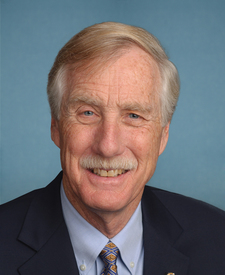
See how Angus S. King actually votes — against your values.
DeepSyte scores Angus S. King's record on the issues you care about — not party, not press releases. Take the 2-minute values quiz to see your personal alignment.
Sign in and take the values quiz to see how Angus S. King's votes line up with your views.
Prediction track record
How often we called Angus S. King's passage votes correctly, from their stated positions on each bill's tagged topics. Excludes “unclear” calls and abstentions.
90 predictions on record · none have been resolved by a passage vote yet. Check back as bills move.
Pending vote119-sjres-123
A joint resolution to direct the removal of United States Armed Forces from hostilities within or against the Islamic Republic of Iran that have not been authorized by Congress.
No paired statements and votes yet for Angus S. King
We haven't yet found statement/vote pairs on the same topic for Angus S. King. This usually means either the rep hasn't taken public positions on bills that have come to a passage vote, or those bills haven't been tagged yet. The checker runs as new press releases and votes come in.
Pro analysis
AI rep analysis — Pro
Get an AI-narrated read on Angus S. King's full voting record against your stated values — aligned themes, conflicts, notable votes, and what to watch for.
We haven't extracted campaign positions for Angus S. King yet. Once their campaign website or position pages are processed, this card will track what they said vs how they voted.
Crossing the aisle
No party-break passage votes recorded for Angus S. King. Either they've voted with I party on every substantive passage vote in the corpus, or their tenure overlaps few high-threshold party-line votes so far.
King Critical of Massive Cuts to National Parks Budget |
Position: Senator King opposes the Administration's proposed one-third cut to the National Park Service budget, arguing that the cuts are unjustified given the agency's popularity, existing deferred maintenance backlog, and recent staffing reductions.
WASHINGTON, D.C. – U.S. Senator Angus King (I-ME), a member of the Senate Committee on Energy and Natural Resources (ENR) and Ranking Member of the National Parks Subcommittee, criticized the Administration for drastic cuts to the National Park Service’s budget. In an ENR committee hearing this week, King questioned Secretary of the Interior Doug Burgum on the rationale behind cutting the chronically-underfunded park service funding by a third when there is a history of a deferred maintenance backlog.
“Let's talk about the National Park Service. You and I talked about this before. [The] National Park Service budget is cut by one third. About $1 billion, which is one day of the Iran war just to put it in context. I don't understand why. In terms of the overall budget, in terms of what is being proposed for expenditures in many other areas, why are we cutting the most popular program the federal government runs? I understand there's always room for rightsizing and analysis of staffing and those kinds of things, but this is not a gotcha question. I'm puzzled why the administration would cut by one third the funding of one of the most important agencies that we have in terms of direct interface with the public? It’s not just about people at the parks. They need the backup from the rest of the organization. Why such a major cut?” asked Senator King.
Secretary Burgum replied, “You said a number of things that were qualifying in there, but I think there is a belief that we can deliver the services that people desire and the outcomes people are looking for. One thing I found as governor and I’m finding in this role is there is a high degree of interest in inputs and less interest in outcomes. If you said ‘the goal is, Secretary, please deliver higher customer satisfaction at all of your parks. Go get it done as efficiently as you can, we want to have citizens very satisfied.’ But it’s never about satisfaction. It’s always about the spending like a bigger input somehow implies a better outcome. I just don’t believe that.”
Senator King replied, “I would understand that, but has been an outside consultant's study of the staff size or internal study? If there has been such, I would certainly like to see it. You probably knew I was going to bring this chart. This is FTEs in the National Park Service going back 10 or 15 years. Here's where we are now. We were understaffed back then. The number we were working from was 23,000 and now we are down to about 15,000 I think. So this is where we are going. Again, if there is a study or a rational basis for the cuts being made, I just don't see it.".
Later in the exchange, Senator King raised concerns about massive staffing cuts and how those, coupled with the budget cuts, could harm visitor satisfaction in the future.
As a lifelong advocate for conservation and Chairman of the Energy and Natural Resources Subcommittee on National Parks, Senator King is among the Senate’s most prominent voices advocating for our national parks. Senator King helped lead the passage the Great American Outdoors Act (GAOA) into law; the legislation that included the Legacy Restoration Fund (LRF). Because of his work, in 2020, Senator King was awarded the inaugural National Park Foundation (NPF) “Hero” Award. Since the creation of the LRF, Senator King has pushed park leaders to discuss funding maintenance efforts, maintaining a sufficient NPS workforce, and managing growing park visitation. Senator King’s work on the National Parks Subcommittee is the culmination of more than four decades of work on land conservation efforts in Maine, including helping to establish the Land for Maine’s Future program in 1987 and supporting extensive conservation projects during his time as Governor.
King, Moran Introduce Bipartisan Legislation to Strengthen VA Workforce, Improve Outcomes for Veterans |
Position: Senators King and Moran introduce legislation requiring the VA to develop a long-term workforce strategy aligned with service demand, improve hiring and retention of veterans and military families, and notify Congress of significant staffing changes.
WASHINGTON, D.C. – U.S. Senators Angus King (I-ME) and Jerry Moran (R-KS), both members of the Senate Committee on Veterans’ Affairs, are introducing bipartisan legislation that would require the Department of Veterans’ Affairs (VA) to develop a long-term workforce strategy to improve outcomes at the VA. The Optimizing the VA Workforce for Veterans Act would direct the VA to develop, maintain, and provide Congress with a strategic plan that aligns staffing levels with current and projected demand for VA services, down to the local level, and in accordance with industry best practices.
The VA would further be required to set goals and strategies to improve the productivity of the workforce, recruit and retain veterans, military spouses, veteran caregivers and survivors to fulfill staffing needs and reduce the time it takes to hire and onboard new employees. This legislation also requires VA to notify Congress in advance of significant staffing changes or a reduction in force, with a detailed justification of potential impacts. This comes on the heels of the Department of Government Efficiency’s (DOGE) indiscriminate cuts last year to the VA workforce and its services.
“Our veterans served this country with grit and class, and now it is our turn to return the favor and provide access to the high-quality care and benefits they have rightly earned,” said Senator King. “The current workforce shortage at the VA is an unforced error that we must now expeditiously work to mitigate. The bipartisan Optimizing the VA Workforce for Veterans Act would require the VA to produce a long-term workforce strategy that would improve outcomes for our veterans – going down to the most local level, matching industry best practices, and taking into account the current and future demand for services. I am grateful to work alongside my colleague and friend, Senator Moran, to continue prioritizing our American heroes.”
“Veterans deserve a VA workforce that is adequately staffed to deliver the healthcare and benefits they have earned through service,” said Senate Veterans’ Affairs Committee Chairman Senator Moran. “By creating a mandatory workforce strategy focused on improved outcomes, this legislation will help the department more effectively recruit, retain and manage its workforce. Through this legislation, VA will be better equipped to provide veterans, their spouses, dependents and survivors with the timely, high-quality health care and benefits they deserve. I appreciate Sen. King for joining me on this legislation, and I look forward to working toward its passage.”
“Veterans deserve a VA that works for them, delivering the benefits and services that will make a meaningful difference in their lives after service,” said Joseph R. Chenelly, National Executive Director, AMVETS. “VA’s workforce strategy must track with the needs of veterans across the country in order for VA to meet its mission. I thank Chairman Moran and Senator King for introducing this important legislation.”
“The Nurses Organization of Veterans Affairs (NOVA) strongly supports Senator Moran and King’s Optimizing the Department of Veterans Affairs Workforce bill,” said Michelle Salazar-Rodriguez, NOVA President. “We commend the requirement for a comprehensive five-year strategic human capital plan. With this plan, the legislation aims to ensure Veterans and their families receive timely access to high-quality care. By calling for thorough assessments of current and projected demand for each VA benefit and service, along with a workforce gap analysis aligned with industry best practices, the bill takes a thoughtful and forward-thinking approach to building a stronger VA workforce. As nurses who care for Veterans, we believe this balanced approach will benefit Veterans and VA staff and urge Congress to pass the bill quickly.”
Representing one of the states with the highest rates of military families and veterans per capita, Senator King is a staunch advocate for America’s servicemembers and veterans. Additionally, King has repeatedly spoken out against cuts to the Department of Veterans Affairs workforce. During a SVAC hearing in January, King pressed VA Secretary Doug Collins to release the VA contracts that he canceled, including those canceled in Maine, so that veterans are aware of potential impacts on patient care and benefits. Last year, he sent a letter to Secretary Doug Collins raising concerns about a leaked report that highlighted plans called for by Elon Musk’s DOGE to cut 83,000 VA employees. Earlier this year, he was honored by The American Legion with its 2026 Distinguished Public Service Award. Last year, Senator King was honored by the Disabled American Veterans as its 2025 Legislator of the Year. He was also recognized by the Wounded Warrior Project as the 2024 Legislator of the Year for his “outstanding legislative effort and achievement to improve the lives of the wounded, ill, and injured veterans.”
King to Hegseth - “Why Are We Abandoning Ukraine?” |
Position: Senator King opposes the administration's decision to zero out military and humanitarian aid to Ukraine in the fiscal year 2027 Department of Defense budget, arguing that continued U.S. support is essential given Russia's unprovoked aggression and Ukraine's role in defending democracy.
WASHINGTON, D.C. – U.S. Senator Angus King (I-ME), a member of the Senate Armed Services Committee (SASC), today raised concerns regarding the administration’s decision to abandon Ukraine by zeroing out military and humanitarian support in this year’s Department of Defense (DoD) budget despite widespread American support for continued financial and military assistance. In the annual SASC committee hearing on the DoD’s fiscal year 2027 budget, King pressed the Under Secretary of Defense and Comptroller Jules Hurst, and Secretary of Defense Pete Hegseth, on the complete lack of resources being provided to Ukraine as the countrycontinues to defend itself against Russia’s unprovoked and bloody aggression. The small democratic nation has defended itself over the course of the four year war with the help of American equipment, training, and funding.
“One of the factors of this budget that has not gotten any publicity is there is zero funding for Ukraine. That is correct, Mr. Hurst?”asked Senator King.
Mr. Hurst replied, “That is correct. There is no USAI funding in this budget.”
“There was $400 million appropriated last year by a bipartisan bicameral act of Congress. What has become of that money? My understanding is not a dollar of it has been dispersed,” Senator King questioned.
“It was released very recently. We got these funds, I believe, in March. It takes time for the funds to flow through department, but it’s going to be put to work very shortly. We are going to work with the UCOM to make sure we use these funds in the most appropriate way possible,” Mr. Hurst answered..
“This [chart] indicates what has happened to our support for Ukraine over the years. The orange bars are US support; the blue is Europe. As you can see, Europe is 99% in the year 2026, same thing with humanitarian and other aid to Ukraine,”Senator King continued. “And yet, this is, I believe, an existential struggle for the future of democracy where we had an aggressive country invade a neighboring country without any justification whatsoever. By the way, that invading country is the major winner so far of the war in Iran. Estimates are [Russia has] gotten $40 to $80 billion of additional revenues from oil and the relief of sanctions as a result of the war in Iran. Secretary Hegseth, why are we abandoning Ukraine?”
“If you would hold that chart back up, I think that is a beautiful chart. That's exactly what we want. We want Europe stepping up and shouldering the burden. They are rich countries worth $20 trillion versus an economy of $2 trillion. Europe can step up, and they have through our [Prioritised Ukraine Requirements List (PURL)] initiative and European command. That's exactly what the American people want to see, other countries stepping up. If that is that important to Europe, which I understand why it is, and the incursion of Russia and the bravery of the Ukrainians, then European countries should pay for it. That is exactly what that chart says, and that is the Administration policy,” Secretary Hegseth answered.
“We don't have any interest in what happens in Ukraine, is what you’re saying? It’s only the Europeans?” asked Senator King.
Secretary Hegseth replied, “I’m saying the threat is far closer to rich and capable countries in Europe and they should step up to lead the charge; and that is why that chart is a good thing to see.”
“They have stepped up. But I think the American people should understand that we have stepped back,” Senator King finished.
As a member of the Senate Armed Services Committee and the Senate Select Committee on Intelligence, Senator King is recognized as an authoritative voice on national security and foreign policy issues. Senator King has been a vocal supporter for Ukraine, voting in support of bipartisan legislation that would help Ukraine defend itself. In the days prior to that vote, he spoke on the Senate floor to his colleague that Ukraine’s fight is a “battle for the soul of Democracy in the world.” In January 2023, Senator King travelled with Armed Services Chairmen Jack Reed (D-R) in a visit to meet Ukraine President Vladimir Zelenskyy in Kiev.
King: Iran War Proving Value of Diversifying Energy Sources |
Position: Senator King argues that diversifying energy sources to include renewables is economically valuable and enhances national security by reducing dependence on volatile global oil markets, particularly in light of rising prices due to the Iran war.
To watch or download the exchange click here
WASHINGTON, D.C. – U.S. Senator Angus King (I-ME), a member of the Senate Committee on Energy and Natural Resources (ENR), today argued that current—and rising—oil and gas prices due to the war in Iran are demonstrating the economic value of a more diverse energy strategy that includes renewables. In a committee hearing, King pressed Department of the Interior Secretary Doug Burgum on the importance of expanding American energy resilience by increasing wind and solar energy production to better shield Americans from worldwide spikes in oil prices,
“Energy dominance. You use that term 3 or 4 times. If $4.30 gas and almost $6 diesel is energy dominance, I'd rather go back to what we had before. What's going on now, because of the illegal war in Iran, is drastically affecting our national security and will continue to do so in affecting the people of America. And it seems to me that the situation we're in now is a real lesson in the importance of weaning ourselves from fossil fuels, because we can produce all the oil we want, but as you well know, oil is a worldwide commodity and the price is not set in Maine or North Dakota or Texas. It's set on a worldwide basis, and that's exactly what we're suffering from now. So, I believe and I would like your view, that a more diverse energy source, particularly one that's based on resources that we control rather than a worldwide price, would be beneficial to the country. Your thoughts?” asked Senator King.
Secretary Burgum replied, “Well, I think having secure supply chains is essential. But the idea that somehow, going down a path of wind and solar makes things more affordable is just not factually true.”
“Why is that not? Wind and solar are the lowest cost energy sources today by a factor of about two,” Senator King pushed back.
Secretary Burgum answered, “But I disagree, because we have no ability to dispatch wind and solar. And so we, if you're going to have wind and solar as part of the mix and the over rotation to those and then prematurely shutting down baseload. Every state that has a renewable target has electricity prices about 50% higher.”
“Nobody is saying shut down renewable or baseload prematurely,” said Senator King.
Later in the exchange, Senator King added that Burgum’s opposition to renewables lies in stark contrast to his home state of North Dakota, where wind power accounts for 35 percent of its energy supply – allowing residents a cushion from the instability of global oil and natural gas markets.
Senator King is a national leader in advocating for climate solutions that support Maine communities and has been one of the Senate’s most vocal advocates for improving renewable energy technologies and development as a way to unlock America’s clean energy future. Last week, he criticized the Administration for creating uncertainty by canceling approved clean energy projects – especially ones officially permitted and under construction. He has repeatedly emphasized the importance of permitting reform to unlocking the promise of clean energy development opportunities. He has stressed the importance of streamlining and speeding project timelines while maintaining environmental standards to the Secretaries of Energy and Interior.
Maine Delegation Demands Answers from USPS for Failing to Pay Rockland Contractor More Than $349,000, Jeopardizing Mail Service for Maine Island Communities |
WASHINGTON, D.C.—Maine’s Congressional Delegation is calling on the U.S. Postal Service (USPS) to immediately resolve its payment issue with a Maine contractor that serves island communities. In a letter to Postmaster General David Steiner, U.S. Senators Angus King and Susan Collins and U.S. Representatives Chellie Pingree and Jared Golden condemned USPS for failing to pay the Rockland-based Penobscot Island Air (PIA) more than $349,000 for mail-delivery service and demanded answers about why USPS has, according to PIA, repeatedly failed to make timely payments for several years. After PIA announced it would not make its scheduled deliveries on Tuesday in protest, USPS agreed Wednesday to immediately pay 25% of the outstanding balance, and PIA promptly resumed service. But questions and concerns still remain.
“For decades, Penobscot Island Air has helped the USPS deliver essential mail to Maine’s island residents. We urge you to immediately resolve the outstanding back payments and provide clarification on how these payment lapses occurred, as well as how delays can be prevented in the future,” the delegation wrote. “From Matinicus to Vinalhaven, island communities in Maine rely on the USPS to pay bills, receive life-saving medications, and stay connected with friends and family. Penobscot Island Air is an indispensable bridge between the mainland and islands that helps the Postal Service fulfill its promise of reaching every American, even in the most rural communities.”
USPS’s failure to pay PIA is the latest example of recent disruptions to mail delivery in Maine. Over the past several months, delegation offices have received hundreds of complaints from constituents about delayed and inconsistent deliveries—particularly in rural communities.
Together, these issues underscore the importance of ensuring that USPS has the necessary resources and staff to fulfill its mission of providing all Americans with reliable, affordable, and universal mail service—and that its agreements with contractors like PIA are fully honored.
The letter is available here and is copied below.
Dear Postmaster General Steiner:
We write to seek clarification regarding reports of Penobscot Island Air’s (PIA) payment issues with the United States Postal Service (USPS). For decades, Penobscot Island Air has helped the USPS deliver essential mail to Maine’s island residents. We urge you to immediately resolve the outstanding back payments and provide an explanation of how these payment lapses occurred, as well as how delays can be prevented in the future.
From Matinicus to Vinalhaven, island communities in Maine rely on the USPS to pay bills, receive life-saving medications, and stay connected with friends and family. Penobscot Island Air is an indispensable bridge between the mainland and islands that helps the Postal Service fulfill its promise of reaching every American, even in the most rural communities.
On April 21, Penobscot Island Air alerted island residents that they would be halting mail deliveries for the day due to the back payments they are owed by the USPS. According to PIA, these back payments amount to over $349,000. While PIA had received partial payments for the balance, the last payment they received was on March 13. They had also made numerous attempts to resolve these payment issues through direct outreach to the USPS. The amount owed, the ongoing delay in payment, and the failure to resolve these issues in a timely fashion are alarming and unacceptable.
Mail deliveries for the USPS account for almost a fifth of PIA’s annual revenue. We are concerned that PIA’s operations will continue to be disrupted without reliable processing of this critical stream of income. The USPS cannot afford to jeopardize a dedicated, decades-long partnership, and Maine island residents cannot afford any discontinuation in service, even for a few days.
Penobscot Island Air is one of many contractors in the state that deliver mail to island communities by air and sea. This incident raises concerns over whether the USPS is faithfully fulfilling the terms of all these contracts.
While it is promising to hear that the USPS has reached a partial payment agreement to pay Penobscot Island Air about 25% of its outstanding balance, we need greater assurance from the USPS that Maine island contractors will receive fair and prompt compensation for the services they provide. We respectfully request detailed answers to the following questions and ask that USPS continue to work urgently with Penobscot Island Air to resolve these back payments immediately and ensure that future payment processing is timely and consistent.
Thank you for your attention to this time-sensitive issue. We look forward to your prompt response.
King, Colleagues Raise Concerns about U.S. Forest Service Reorganization, Cuts to Services |
Position: Senator King and 33 colleagues oppose the announced U.S. Forest Service reorganization, expressing concern that workforce reductions will harm the agency's ability to manage national forests, conduct forestry research, and deliver services to public and private landowners.
WASHINGTON, D.C. –U.S. Senator Angus King (I-ME), member of the Senate Committee on Energy and Natural Resources, is joining 33 of his senate colleagues to raise concerns about harmful workforce reductions at the United States Forest Service (USFS). In a to USFS Deputy Secretary Stephen Vaden, the Senators expressed their disapproval of the announced reorganization of the USFS which would amount to cuts for forestry research and public and private forest management.
“We write with strong concerns regarding the announced reorganization of the U.S. Forest Service (USFS),” wrote the Senators. “While we have expressed support for improving the operations of the USFS, we believe the reorganization announced on March 31, 2026, may lead to additional capacity and workforce reductions throughout the agency, harming its ability to deliver on its mission.”
“The USFS is charged with managing the 193 million-acre National Forest System (NFS), performing world-class forestry research, and delivering forestry assistance to improve the management of the more than 800 million acres of public and private forestlands across the country, including over 141 million acres of urban forests in our cities and towns,” the Senators continued. “After the deep cuts over the previous year, a 2025 survey by the Partnership for Public Service found that the USFS was significantly worse at fulfilling stakeholder needs and providing quality service than a year earlier. In addition, the sweeping changes being proposed – potentially impacting more than 6,500 employees – combined with the thousands of employees already lost through deferred resignation programs threatens to further erode the agency’s ability to complete its mission.”
Senator King is seen as a national leader in efforts to support Maine’s forest products industry. King previously introduced the bipartisan Future Logging Careers Act to help train the next generation of Maine loggers and the bipartisan Timber Innovation for Building Rural Communities Act to improve forest health and support Maine’s rural economy. He also introduced legislation to establish a “Future of Forests” panel tasked with making recommendations to secure the health of America’s forests. Senators King was key in establishing the Forest Opportunity Roadmap Maine (FOR/ME) Initiative, a participant-led initiative that is helping to diversify the state’s wood products businesses, attract investments, support research and development, and develop greater economic prosperity for rural communities impacted by mill closures.
Joining King on the letter are U.S. Senators Amy Klobuchar (D-MN), Martin Heinrich (D-NM), Jeff Merkley (D-OR), Angela Alsobrooks (D-MD), Tammy Baldwin (D-WI), Richard Blumenthal (D-CT), Cory Booker (D-NJ), Catherine Cortez Masto (D-NV), Tammy Duckworth (D-IL), Dick Durbin (D-IL), John Fetterman (D-PA), Ruben Gallego (D-AZ), Kristin Gillibrand (D-NY), Maggie Hassan (D-NH), Mazie Hirono (D-HI), Tim Kaine (D-VI), Mark Kelly (D-AZ), Andy Kim (D-NJ), Ben Ray Luján (D-NM), Ed Markey (D-MA), Alex Padilla (D-CA), Gary Peters (D-MI), Bernie Sanders (I-VT), Brian Schatz (D-HI), Adam Schiff (D-CA), Jeanne Shaheen (D-NH), Elissa Slotkin (D-MI), Tina Smith (D-MN), Chris Van Hollen (D-MD), Mark Warner (D-VA), Raphael Warnock (D-GA), Peter Welch (D-VA), and Ron Wyden (D-OR).
The full text of the letter can be found here and below.
We write with strong concerns regarding the announced reorganization of the U.S. Forest Service (USFS). While we have expressed support for improving the operations of the USFS, we believe the reorganization announced on March 31, 2026, may lead to additional capacity and workforce reductions throughout the agency, harming its ability to deliver on its mission.
The USFS is charged with managing the 193 million-acre National Forest System (NFS), performing world-class forestry research, and delivering forestry assistance to improve the management of the more than 800 million acres of public and private forestlands across the country, including over 141 million acres of urban forests in our cities and towns. After the deep cuts over the previous year, a 2025 survey by the Partnership for Public Service found that the USFS was significantly worse at fulfilling stakeholder needs and providing quality service than a year earlier. In addition, the sweeping changes being proposed – potentially impacting more than 6,500 employees – combined with the thousands of employees already lost through deferred resignation programs threatens to further erode the agency’s ability to complete its mission.
Given changes to the USFS in the last year and its ongoing, critical work, it is unclear how the announced reorganization will improve the USFS’s ability to deliver on its statutory responsibilities, including mitigating wildfire risk, executing forest and watershed restoration projects, and increasing trail maintenance. In addition, given the potential for an active and extreme wildfire season the USFS should prioritize preparing for such a wildfire season rather than hastily executing a reorganization that will impact large swaths of its agency. It is likely that this sort of disruption will have lasting impacts on forest management as a whole, and wildfire preparedness and response, specifically.
This reorganization also jeopardizes the world-class research the USFS produces to improve management of the NFS, assist public and private forest landowners with insect and disease outbreaks, and spur innovative approaches to managing wildfire. The hundreds of USFS Research & Development (R&D) scientists and experienced staff located at the 57 R&D facilities the administration plans to close need to be on the ground in geographically-based federal research facilities. For example, it is impossible to study loblolly pine, redwoods, and 'ohi'a lehua outside of their ecosystems. While the USFS indicated within the proposed reorganization that the NFS and R&D mission areas will be reconfigured but largely maintained, the President’s Fiscal Year 2027 budget proposes eliminating funding for both these functions of the USFS. For example, the reorganization plan proposes closing 57 R&D facilities while maintaining 20, yet the President’s Fiscal Year 2027 budget proposes fully eliminating funding for USFS R&D altogether. These conflicting proposals only create confusion and underscore the chaos the reorganization could have on critical research across the country.
Given the importance of this issue, we request responses to each of the following questions no later than May 1, 2026.
The USFS serves a key role in supporting local economies, stewarding natural resources, and performing world-class research. The workforce reductions over the last year have already diminished the USFS’s ability to deliver its mission and the recently announced USFS reorganization could further exacerbate those losses. We look forward to your timely response on this important matter.
Senator King Statement Upon Senate’s Passage of ICE, CBP Funding |
Position: Senator King opposes the Senate's passage of ICE and CBP funding without meaningful reforms to conduct standards, citing constitutional violations and the failure of bipartisan negotiations to establish guardrails such as body cameras, name identification, judicial warrants, and anti-racial-profiling measures.
WASHINGTON, D.C. –U.S. Senator Angus King (I-ME) today released a statement after the Senate passed funding for Customs and Border Protection (CBP) and Immigration and Customs Enforcement (ICE) on a 50-48 vote:
“The United States Senate just passed a funding bill for Customs and Border Protection (CBP) and Immigration and Customs Enforcement (ICE) without any meaningful reforms to the conduct of either. It is a shame that it took nearly four months to pass this bill, and even more of an embarrassment that this bill passed on a partisan vote after several attempts at good faith bipartisan negotiations to put in place standards of conduct across federal law enforcement agencies.
“The recent well-documented conduct of ICE has clearly and repeatedly violated the Fourth and Fifth Amendments – with deeply unfortunate results. In nearly every other law enforcement agency across our nation, the standards of conduct include no masks, name and badge number identification, judicial warrants, required body cameras, training and hiring standards for sensitive locations, and no racial profiling. Maine people, as well as Minnesotans, know too well the abuses that can come from the current lack of such guidelines and restrictions.
“It was the failure to adopt any reasonable reforms that compelled me to vote against this irresponsible bill.”
Senator King has been outspoken in his efforts to negotiate necessary guardrails for ICE and CBP in the wake of unprofessional and unconstitutional behavior among those agencies. In January, King appeared on Face the Nation where he explained his Constitutional concerns over how ICE was operating in Maine, as well as possible paths forward for the Department of Homeland Security (DHS) funding package. In February, he released a statement on congressional efforts to curtail ICE’s activities in Maine and across the country—again calling for the implementation of guardrails. Most recently, King called on former DHS Secretary Kristi Noem for a detailed explanation and update about ICE’s presence in Maine, including what their mission was and who they were targeting. When given the chance to vote for a DHS budget that funded TSA, FEMA, CISA and the Coast Guard – holding ICE and CBP funding for bipartisan negotiations – Senator King voted in favor of this approach all eleven times it was considered on the Senate floor.
King, Colleagues Push Back Against Executive Order Positioning USPS as Elections Regulator |
Position: Senators oppose an executive order directing the USPS to create and maintain mail-in absentee voter lists, arguing it unconstitutionally positions the USPS as an election regulator, infringes on state and congressional authority over federal elections, and creates barriers to voting by mail.
WASHINGTON, D.C. –U.S. Senators Angus King (I-ME) and 37 of his Senate colleagues are demanding the United States Postal Service (USPS) uphold existing federal law – and its own rulemaking and commitments – to best protect Americans’ constitutional right to vote. In a letter to the Postmaster General and Board of Governors of the USPS, the Senators demand that USPS follow existing federal law instead of an executive order signed by President Trump that would direct the USPS to create and maintain “Mail-in Absentee Participations Lists” that would determine which voters are eligible to receive and cast absentee ballots through the mail.
The order attempts to turn the USPS into an election administrator and regulator, when it is supposed to be a nonpartisan agency whose only priority is to deliver the mail. This directive would have a chilling effect on the eligibility of American voters to exercise their constitutional right to vote by imposing unnecessary barriers and would corrupt the independent mission of the USPS by giving the agency the authority to determine who can vote by mail.
“The Constitution provides no role for the President in regulating federal elections. And no statute delegates to the President any authority to regulate elections or voter eligibility either, including via USPS,” wrote the senators. “By issuing the executive order, however, the President is attempting to unconstitutionally consolidate power to personally regulate American elections.”
The senators continued, “These directives clearly infringe on the states’ and Congress’ constitutional role to regulate the manner in which federal elections are held and would deny eligible voters their ability to cast a ballot. The prohibition on transmitting ballots from individuals not on the absentee voter list acts as a ban on vote-by-mail for any state unwilling to share its absentee voter lists with USPS or any voter who happens to be excluded from the list. Furthermore, under this executive order, it is the Postal Service who will have the final say about whether to transmit a voter’s absentee ballots to election officials—granting USPS the ability to disenfranchise American voters.”
“For over 250 years, the Postal Service has bound our country together with a constitutionally recognized mail service, and for 250 years, the American people have democratically elected their leaders. Any attempt to effectuate this order would violate the Constitution, break these bonds, and threaten the foundations of American democracy,” the senators concluded.
Senator King has been a vocal supporter of the USPS’s critical role in American society and in Maine, one of the nation’s oldest and most rural states that relies heavily on the services provided by the USPS to receive prescriptions and other necessities. Earlier this year, he joined his Senate colleagues on a letter to USPS Postmaster General David Steiner pushing to protect the timely delivery of mail across the nation—resisting a change that would make it harder for Maine people to access basic services like prescription drug deliveries, bill payments, and votes cast by mail. Last year, he sent a letter to then-Postmaster General Louis DeJoy, urging him to stop any changes to the USPS service standards that would result in job losses and further degrade mail delivery performance. That letter came soon after Maine’s postal workers and elected officials voiced their opposition of the USPS’ plans to move some of the Hampden facility’s processing operations to a facility in Scarborough, nearly 130 miles away — raising the possibility of needless delays in delivery.
Joining King on the letter are U.S. Senators Gary Peters (D-MI), Alex Padilla (D-CA), Dick Durbin (D-IL), Angela Alsobrooks (D-MD), Tammy Baldwin (D-WI), Richard Blumenthal (D-CT), Cory Booker (D-NJ), Maria Cantwell (D-WA), Chris Coons (D-DE), Tammy Duckworth (D-IL), John Fetterman (D-PA), Ruben Gallego (D-AZ), Maggie Hassan (D-NH), Martin Heinrich (D-NM), Tim Kaine (D-VA), Mark Kelly (D-AZ), Andy Kim (D-NJ), Amy Klobuchar (D-MN), Ben Ray Luján (D-NM), Ed Markey (D-MA), Jeff Merkley (D-OR), Patty Murray (D-WA), Jack Reed (D-RI), Jacky Rosen (D-NV), Bernie Sanders (I-VT), Brian Schatz (D-HI), Adam Schiff (D-CA), Chuck Schumer (D-NY), Jeanne Shaheen (D-NH), Elissa Slotkin (D-MI), Chris Van Hollen (D-MD), Mark Warner (D-VA), Elizabeth Warren (D-MA), Peter Welch (D-VT), Sheldon Whitehouse (D-RI), and Ron Wyden (D-OR).
The full text of the letter can be found here and below.
Dear Chairwoman McReynolds, Vice Chairman Kan, Governor Stroman, Governor Tangherlini, and Postmaster General Steiner:
We write regarding an alarming development related to election mail and American democracy. On March 31, President Trumpissued an executive order that seeks to transform the United States Postal Service (USPS) into an election administration agency with the power to determine who can vote by mail and to establish ballot specifications.1 The executive order is a blatant violation of the Constitution and statutes governing postal operations. We demand you follow the law and not implement this executive order.
The right to vote is the most sacred and cherished right of the American people. It is the bedrock of American democracy. The Framers of our Constitution understood this and accordingly vested the primary authority to regulate the “times, places, and manner” of federal elections with the states subject to alterations by statute enacted by Congress.2 The Constitution similarly vests the authority to determine the eligibility of voters with the states.3 The Constitution provides no role for the President in regulating federal elections. And no statute delegates to the President any authority to regulate elections or voter eligibility either, including via USPS.
By issuing the executive order, however, the President is attempting to unconstitutionally consolidate power to personally regulate American elections. Specifically, the order directs USPS to conduct a rulemaking to establish specifications for election mail and create and maintain a Postal Service Mail-In and Absentee Participation List. Remarkably, the order prohibits the delivery of absentee ballots from individuals that are not on the USPS absentee voter list. These directives clearly infringe on the states’ and Congress’ constitutional role to regulate the manner in which federal elections are held and would deny eligible voters their ability to cast a ballot. The prohibition on transmitting ballots from individuals not on the absentee voter list acts as a ban on vote-by-mail for any state unwilling to share its absentee voter lists with USPS or any voter who happens to be excluded from the list. Furthermore, under this executive order, it is the Postal Service who will have the final say about whether to transmit a voter’s absentee ballots to election officials—granting USPS the ability to disenfranchise American voters. Were the Postal Service to issue such a regulation, it would be a flagrantly illegal and unconstitutional attempt to regulate federal elections and would disenfranchisevoters.
As you know, the President does not possess the power to manage the operations of the Postal Service or direct USPS or thePostmaster General to enact these requirements or rules. In 1970, when Congress reorganized the Post Office Department into thenow United States Postal Service, it created “an independent establishment of the executive branch,” and it bestowed the postal power on the Board of Governors of the Postal Service—not the President.4 This independence is a hallmark of the Postal Service and its operations.
Similarly, it is universally understood that the Postal Service does not regulate or administer American elections. As the Postal Service acknowledged in a rulemaking just last year, “the Postal Service does not administer elections, establish the rules or deadlines that govern elections, or determine whether or how election jurisdictions utilize the mail.”5 As the Postal Service hasstated, they do not advocate for particular forms of voting and simply serve to collect and transport the mail to its destination, including election mail.6 This neutral and apolitical role to transmit the mail is critical to ensuring trust in the electorate and facilitating American elections, while respecting the constitutional role of the states. To prepare for the 2026 midterm elections, USPS already released its 2026 Election Mail and Political Mail Guide and issued its 2026 General Election Mail Preparedness Memorandum to every employee in January.7 During the 2024 general election, the Postal Service successfully delivered over 99 million ballots and over 97% were delivered in fewer than three days.8 The Postal Service must continue this proud and successful tradition.
Accordingly, the Postal Service should not implement the President’s unconstitutional executive order. Like the President, the PostalService has no authority to regulate the manner of voting in federal elections, nor who is eligible to vote by mail in such elections. For over 250 years, the Postal Service has bound our country together with a constitutionally recognized mail service, and for 250 years, the American people have democratically elected their leaders. Any attempt to effectuate this order would violate the Constitution, break these bonds, and threaten the foundations of American democracy.
King Asks Energy Secretary How Canceling Approved, Permitted Renewable Projects Promotes Certainty in Marketplace |
Position: Senator King opposes the cancellation of approved and permitted renewable energy projects, arguing that such cancellations undermine investor certainty and contradict the need for expanded energy development to address cost-of-living concerns.
To watch or download the exchange, click here
WASHINGTON, D.C. —Senator Angus King (I-ME), a member of the Energy and Natural Resources Committee (ENR), today criticized the Administration for creating uncertainty by canceling approved clean energy projects – especially ones actively under construction. In an ENR hearing, King pressed Department of Energy (DOE) Secretary Christopher Wright on the current administration’s decisions to revoke energy permits as there is bipartisan agreement that America’s energy portfolio must increase across the board to improve the cost of living.
Senator King began, “Do you feel that certainty is important in permitting and that is an important quality we need to be able to move permitting faster, that is correct, isn't it?”
“Yes,” Secretary Wright agreed.
“How do you feel about offshore wind projects being canceled that were fully permitted and under construction? What does that say about certainty for investment?” Senator King continued.
“I will come back— there is some complexities to that issue, both with security concerns with drones that we learned more recently on the wars—,” Secretary Wright started.
“Isn't that a risk of the developer?” Senator King asked.
“It is a risk I think we need to manage with the developer just to make sure we are not introducing a critical vulnerability off of our east coast population. To your broader point, yes, Senator, I believe we need the parties to come together, we need a robust dialogue about that, and we need to deliver more certainty—,” Secretary Wright answered.
“The idea of getting all of your permits, going through the process, being under construction and having the government say you can't do this, you wouldn't like that very much if you were in that position, is that correct?” Senator King asked.
“That is correct,” Secretary Wright responded.
As a member of the Senate Energy and Natural Resources Committee, Senator King is a national leader in advocating for climate solutions that support Maine communities and has been one of the Senate’s most vocal advocates for improving renewable energy technologies and development as a way to unlock America’s clean energy future. He has repeatedly emphasized the importance of permitting reform to unlocking the promise of clean energy development opportunities created in the historic Inflation Reduction Act . He has stressed the importance of streamlining and speeding project timelines while maintaining environmental standards to the Secretaries of Energy and Interior.
To Fight Robocalls, King Cosponsors Legislation to Step Up Penalties |
Position: Senator King supports legislation to strengthen enforcement of robocall regulations and increase penalties for illegal robocalls under the Telephone Consumer Protection Act, giving consumers and small businesses the ability to seek damages for unconsented telemarketing calls.
WASHINGTON, D.C. – U.S. Senator Angus King (I-ME) is cosponsoring bicameral legislation cracking down on the enforcement of illegal robocalls. The Protecting American Consumers from Robocalls Act improves enforcement, and increases penalties for robocallers who violate the Telephone Consumer Protection Act (TCPA). The legislation would give the TCPA and the Do-Not-Call Registry added enforcement powers by providing all telephone subscribers, including small businesses, the ability to seek damages for all unconsented-to telemarketing calls immediately after such a call.
Robocall scams often target the most vulnerable within our communities, including senior citizens, immigrant communities, and people with disabilities. Small businesses also are bombarded with these illegal calls, creating additional and burdensome costs and interfering with productivity.
“At best, illegal robocalls are a constant annoyance — at worst, they’re scams that target our most vulnerable citizens or tie up businesses’ phone lines,” said Senator King. “The Protecting American Consumers from Robocalls Act would enhance enforcement and increase penalties for those who break the law. It’s time telemarketers are held accountable so Americans can live their lives without the flood of scam calls and texts overwhelming our phones.”
More specifically, the Protecting American Consumers from Robocalls Act would:
Joining King on the legislation are U.S Senators Dick Durbin (D-IL), Tina Smith (D-MN), Mazie Hirono (D-HI), Peter Welch (D-VT), Bernie Sanders (I-VT), and U.S Representatives Jan Schakowsky (D-IL-09) and Kevin Mullin (D-CA-15).
Senator King has consistently called for the Federal Communications Commission (FCC) to enforce regulations on telemarketing calls. In 2024, he cosponsored the Deter Obnoxious, Nefarious, and Outrageous Telephone (DO NOT) Call Act which would crack down on illegal robocalls and robotexts. In 2023, he sent a letter to the FCC calling for issue guidance restating long-held requirements for unwanted telemarketing calls to assist telemarketers and sellers in complying with the rules. In 2019, he also cosponsored Telephone Robocall Abuse Criminal Enforcement and Deterrence (TRACED) Act which makes it easier for regulators to find scammers, increases civil forfeiture penalties for those who are caught, promotes call authentication and blocking adoption, and brings relevant federal agencies and state attorneys general together to address impediments to criminal prosecution of robocallers who intentionally flout laws. The bill was signed into law by the President in 2019.
Source: GDELT 2.0 GKG, filtered to a curated list of national outlets. Inclusion is not endorsement; opinion pieces and reported news are mixed.
Recent stock activity
Periodic transaction reports filed under the STOCK Act — disclosed by the rep, sourced from public filings.
No disclosed trades on record.
Source: open-data mirrors of the Senate eFD and House Clerk financial-disclosure systems. Disclosure within 30 days of trade is required by law (45 for spouse/dependent trades).
Top PAC donors · 2026 cycle
Political action committees that gave the most to this rep's principal campaign committee this cycle. PAC giving is direct organizational support — industry, ideological, or leadership.
1.PIERCE ATWOOD, LLC.5 contributions$93,175
2.LEAGUE OF CONSERVATION VOTERS ACTION FUND5 contributions$56,550
3.BLUE SENATE 2018Leadership1 contributionDemocratic Senate leadership PAC — supports Democratic candidates in federal Senate races.AI$31,634
4.JSTREETPAC3 contributions$31,575
5.DEMOCRACY ENGINE, INC. PAC2 contributions$28,827
6.BLUE SENATE 2024Leadership1 contributionDemocratic Senate leadership PAC — supports Democratic Senate candidates and coordinates party fundraising for federal races.AI$28,047
7.VALUE CLICK MEDIA1 contribution$17,790
8.COUNCIL FOR A LIVABLE WORLD CANDIDATE FUND1 contribution$10,546
Source: OpenFEC (api.open.fec.gov) Schedule A receipts where contributor type is “committee.” Aggregated by contributing committee. Self-transfers from joint-fundraising / victory committees are excluded.
Top individual contributors · 2026 cycle
Itemized individual contributions over $200 to this rep's campaign committee, aggregated by donor employer. PAC giving is shown above; this section is people, not organizations.
1.VETERANS HEALTH ADMINISTRATION$250
2.AUBURN MANUFACTURING, INC.$200
3.BOWDOIN COLLEGE$100
4.ISF TRADING CO, INC.$100
5.BORDEN COTTAGE$80
Source: OpenFEC Schedule A receipts where contributor type is “individual,” aggregated by the donor's self-reported employer. This is a geographic / industry correlation, not a corporate endorsement.