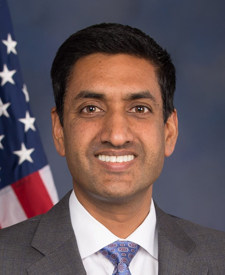
See how Ro Khanna's votes line up with your values.
DeepSyte scores Ro Khanna's record on the issues you care about — not party, not press releases. Take the 2-minute values quiz to see your personal alignment.
Sign in and take the values quiz to see how Ro Khanna's votes line up with your views.
Prediction track record
How often we called Ro Khanna's passage votes correctly, from their stated positions on each bill's tagged topics. Excludes “unclear” calls and abstentions.
Based on 5 data points across public statements and recorded votes · AI analysis of public records
118-hr-6285·Consistent
Alaska’s Right to Produce Act of 2023
92/100
What they said
Mar 30, 2026
The release advocates for eliminating the tax credit for enhanced oil recovery (EOR), characterizing it as a fossil fuel subsidy that increases corporate profits without lowering consumer energy prices and undermines climate and economic priorities.
Rep. Khanna's statement opposes fossil fuel subsidies and advocates for ending tax breaks that increase oil company profits without lowering consumer prices. Alaska's Right to Produce Act directly expands oil and gas leasing in ANWR and removes restrictions on future leasing—a policy that facilitates increased fossil fuel extraction and corporate profits. Khanna's no vote on passage is consistent with the statement's opposition to policies that benefit the oil industry.
The release advocates for eliminating the tax credit for enhanced oil recovery (EOR), characterizing it as a fossil fuel subsidy that increases corporate profits without lowering consumer energy prices and undermines climate and economic priorities.
Rep. Khanna's statement explicitly opposes fossil fuel subsidies, specifically the enhanced oil recovery tax credit, characterizing it as corporate welfare that increases profits without lowering consumer prices. The Lower Energy Costs Act promotes increased oil and gas production and infrastructure development without addressing subsidy elimination. Khanna's no vote on passage is consistent with his stated position against policies that benefit the fossil fuel industry.
The release advocates for eliminating the tax credit for enhanced oil recovery (EOR), characterizing it as a fossil fuel subsidy that increases corporate profits without lowering consumer energy prices and undermines climate and economic priorities.
The statement opposes fossil fuel subsidies, specifically the enhanced oil recovery tax credit, as wasteful and harmful to climate and economic priorities. The bill is a broad FY2024 appropriations act covering multiple agencies. While the bill includes the Energy and Water Development appropriations division, which could contain funding or tax provisions related to energy policy, the statement addresses a specific tax credit elimination, not appropriations levels. The rep's NO vote on a large omnibus appropriations bill could reflect opposition to fossil fuel subsidies embedded within it, but omnibus bills bundle many provisions across agencies and departments. The vote is generally consistent with the stated anti-subsidy position, though the bill's complexity and breadth introduce some ambiguity about what drove the specific vote.
The release advocates for eliminating the tax credit for enhanced oil recovery (EOR), characterizing it as a fossil fuel subsidy that increases corporate profits without lowering consumer energy prices and undermines climate and economic priorities.
Rep. Khanna's statement opposes fossil fuel subsidies, specifically the enhanced oil recovery tax credit, characterizing it as wasteful corporate welfare that undermines climate priorities. The Limit, Save, Grow Act repeals several energy tax credits as part of its deficit-reduction package. While the bill's primary focus is spending limits and deficit reduction rather than climate policy, repealing energy tax credits aligns directionally with Khanna's stated opposition to fossil fuel subsidies. However, the bill bundles this provision with other controversial measures (SNAP work requirements, student loan debt cancellation nullification) that Khanna likely opposed on separate grounds, explaining his no vote despite the credit-repeal alignment.
The release advocates for eliminating the tax credit for enhanced oil recovery (EOR), characterizing it as a fossil fuel subsidy that increases corporate profits without lowering consumer energy prices and undermines climate and economic priorities.
The statement opposes fossil fuel subsidies and advocates for climate-prioritizing energy policy. The bill expands LNG export capacity by removing DOE restrictions and shifting approval authority to FERC. While the bill does not directly address the EOR tax credit, it facilitates increased natural gas extraction and export—a fossil fuel expansion that aligns with the statement's concern about prioritizing fossil fuel industry interests over climate goals. The rep's NO vote is consistent with opposition to policies that expand fossil fuel infrastructure and production.
Pairs with ambiguous language and high uncertainty are withheld until more data is available. Procedural, cloture, and amendment votes are excluded — they don't cleanly signal substantive support or opposition.
Pro analysis
AI rep analysis — Pro
Get an AI-narrated read on Ro Khanna's full voting record against your stated values — aligned themes, conflicts, notable votes, and what to watch for.
Positions Ro Khanna took during their campaign, scored against their subsequent record — public statements cross-checked with related votes. “Kept” means 80%+ of those statement-vs-vote pairs aligned; “Broken” means 30% or fewer.
0 kept0 broken0 mixed0 no action yet
Ro Khanna has 18 tracked positions but no scored statement-vs-vote pairs touching them yet. Verdicts will appear here as related statements and votes accumulate.
No action yetSupports
The government should provide healthcare for everyone.
Passage votes where Ro Khanna broke ranks with ≥75% of Democrats. Threshold catches substantively partisan splits; unanimous-ish or close votes are excluded.
4
Cross-aisle votes
118-hjres-109·Jul 11, 2024·91% of D voted NO
Providing for congressional disapproval under chapter 8 of title 5, United States Code, of the rule submitted by the Securities and Exchange Commission relating to "Staff Accounting Bulletin No. 121".
Release: Khanna, Frankel, Landsman, and Fitzpatrick, Reintroduce Bipartisan Legislation to Combat Sexual Assault on College Campuses, Strengthen Accountability and Transparency for Institutions
Position: The release supports the Campus Accountability and Safety Act, which would standardize how colleges report and investigate sexual assault, create survivor support resources, and set notification requirements for survivors and accused students.
WASHINGTON, D.C. – Representatives Ro Khanna (D-CA), Lois Frankel (D-FL), Greg Landsman (D-OH), Brian Fitzpatrick (R-PA) reintroduced the bipartisan Campus Accountability and Safety Act after recent incidents of alleged sexual assault at Cornell University and Louisana State University. The legislation would improve the way colleges and universities report incidents of sexual assault that take place on their campuses, and it would protect both survivors and accused students by ensuring that schools have a uniform and fair process for investigating and conducting campus disciplinary proceedings. Additionally, it would create new resources and support services for survivors and set new notification requirements for both survivors and accused students involved in the campus disciplinary process.
“After the horrific allegations at Cornell, LSU, and the countless stories we have heard from survivors on campuses across the country, Congress must act to protect survivors and ensure there is accountability. Due to stigma, many survivors don’t report sexual violence, much less pursue justice through their university’s system, and many perpetrators are never held accountable. I’m proud to lead this bipartisan bill with my colleagues to increase transparency, provide resources for survivors, and reduce barriers in the reporting process," said Rep. Khanna.
“Students can’t learn if they are not safe. No student should have to fear sexual harassment, violence, or stalking while pursuing an education. The horrifying allegations recently brought to light at Cornell underscore the urgent need for action. Survivors of sexual abuse deserve confidential support and to be heard and treated with dignity. This legislation strengthens transparency and accountability and makes clear that keeping students safe is a fundamental responsibility of every college and university,” said Rep. Frankel.
“Students have to be kept safe on college campuses. The reports of sexual violence at colleges and universities make it clear that changes are needed. Our bipartisan effort will ensure there’s way more transparency, accountability, and support for students,” said Rep. Landsman.
“Sexual assault on college campuses continues to be a crisis that demands our immediate action. And, as with all crimes, weak enforcement and insufficient accountability only embolden perpetrators to act with impunity. This bipartisan, bicameral legislation is a commitment to our students that we are taking action: action to ensure their safety and action to hold our educational institutions accountable by transforming how sexual assault and violence are handled and addressed. By demanding greater transparency, enforcing stringent accountability measures, and providing essential resources and support to victims, we can eliminate the toxic culture of inaction that has plagued our campuses for too long and create a safer environment for our students," said Rep. Fitzpatrick.
Specifically, the Campus Accountability and Safety Act would:
Increase transparency and reporting requirements under the Jeanne Clery Disclosure of Campus Security Policy and Campus Crime Statistics Act by mandating that the institution’s website include campus safety policies, an annual security report, instructions for filing a complaint, and statistics of sexual misconduct allegations on campus.
Create sexual and interpersonal violence specialists at each institution to serve as confidential aides for victims.
Ensure that sexual and interpersonal violence specialists are well-trained by requiring training created by the Department of Education.
Ensure that individuals who report sexual misconduct in good faith are not punished for acts of self-defense, or alcohol or drug use, that is revealed by that report.
Expand the VAWA Campus Grant Program to also address sexual harassment on campuses.
Requires the comptroller general to study the effectiveness of VAWA grants and submit a report to Congress within 2 years of enactment.
###
Issues:
Equality and Social Justice
,
Prioritizing Public Safety
Release: Representatives Khanna, Lee, and Deluzio Call on UPMC to Address Staffing Concerns and Bargain in Good Faith with Healthcare Workers
Position: The representatives urge UPMC to bargain in good faith with nurses, nurse practitioners, and midwives at UPMC Magee-Womens Hospital and to address concerns about staffing levels and patient care.
Washington, DC — Representatives Ro Khanna (CA-17), Summer L. Lee (PA-12), and Chris Deluzio (PA-17) sent a letter urging the University of Pittsburgh Medical Center (UPMC) to bargain in good faith with nurses, nurse practitioners, and midwives at UPMC Magee-Womens Hospital after the lawmakers received reports raising concerns about staffing levels and patient care.
“We have received troubling reports from our constituents and organizers that nurses are routinely assigned more patients than nationally recognized clinical standards recommend. Nurses have described situations in which a single labor and delivery nurse may be responsible for two or three patients, even though established standards call for a patient in active labor to receive dedicated nursing care,” said the lawmakers.
The lawmakers also called on UPMC to make progress in contract negotiations with hundreds of health care professionals at Magee-Womens, who have been negotiating for months.
“For approximately eight months, nearly 900 health care professionals at UPMC Magee have been negotiating for a contract that reflects the critical role they play in caring for patients and families throughout western Pennsylvania. These workers have raised serious concerns about inadequate staffing, excessive workloads, and conditions that prevent them from consistently providing the level of care their patients deserve. UPMC has a responsibility to listen to these frontline professionals and work constructively to resolve their concerns without unnecessary delays,” the lawmakers continued.
To read the full letter, click here.
###
Issues:
Economy
,
Equality and Social Justice
,
Health Care and the Social Safety Net
Position: Introduces legislation that would calculate the economic costs of the Iran war to U.S. taxpayers, cut Department of Defense funds by that amount, and return equal payments to eligible tax filers and dependents. The release characterizes the war as unauthorized and blames it for higher gas, food, interest rate, and inflation costs.
Today, Congressman Ro Khanna (CA-17) introduced the Illegal War Refund Act, legislation that would require the federal government to refund Americans for the economic costs they have borne as a result of the Trump Administration’s illegal and unauthorized war in Iran. The bill would require the federal government to calculate the war’s economic impact on American taxpayers and cut the Department of Defense budget by that amount, returning the money directly to American tax filers and their dependents.
The war in Iran has driven up costs for American families through higher gas prices, food prices, interest rates, and inflation. Moody’s Analytics Chief Economist Mark Zandi estimates that the war has cost the American people $230 billion, or $1,760 per American household.
“Trump campaigned on lower costs and no new wars. We are now in the eighth month of an illegal war in Iran that was never authorized by Congress. While the wealthy and powerful profit off the war, American taxpayers should not bear the economic costs of the president’s broken promises. They deserve their money back,” said Rep. Ro Khanna.
The Illegal War Refund Act would:
Require the Office of Management and Budget to calculate the total economic costs to U.S. taxpayers from the Iran war each fiscal year, including costs from increased interest rates, fuel prices, food prices, and inflation.
Transfer an amount equal to those economic costs from Department of Defense funds to the Department of the Treasury.
Require the funds to be transferred proportionally from Defense Department accounts, while exempting accounts related to military personnel, military construction, and the Defense Health Program.
Require the Department of the Treasury to make equal payments to eligible U.S. tax filers and their dependents.
Prohibit the name, signature, or likeness of any elected official from appearing on any letter, check, or other document related to the payments.
Original Cosponsors: Representative Chuy García (D-IL), Representative Bonnie Watson Coleman (D-NJ), Representative Val Hoyle (D-OR), and Representative Pramila Jayapal (D-WA).
Supporting Organizations: Win Without War, Demand Progress, Public Citizen, National Iranian American Council Action, Friends Committee on National Legislation, Quincy Institute for Responsible Statecraft, Council for a Livable World.
Issues:
Equality and Social Justice
,
Foreign Policy and National Security
,
Government Reform
RELEASE: KHANNA CO-LEADS DELEGATION TO VATICAN, DISCUSSES ETHICAL FRAMEWORK FOR AI WITH POPE LEO XIV
Position: Rep. Khanna praises Pope Leo XIV's ethical framework for AI grounded in human dignity and equality, and calls on major AI company CEOs to explain how their policies align with the encyclical, including how they will prevent mass unemployment and keep technology serving humans.
Washington, DC — Last week, Rep. Ro Khanna (CA-17), Ranking Member of the House Select Committee on the Chinese Communist Party, co-led a bipartisan congressional delegation to the Vatican for a meeting with Pope Leo XIV. The visit was part of a broader trip to Europe focused on shared national security priorities, competition with China, and exploring opportunities for further collaboration on economic security and AI, with stops in Germany, Italy, and the United Kingdom.
In Vatican City, the delegation attended Pope Leo XIV's general audience. Ranking Member Khanna spoke with the Pope about his first encyclical, Magnifica humanitas, and praised his calls for protecting human dignity in the AI era. The members also met with Under Secretary of the Secretariat of State, Monsignor Daniel Pacho, to discuss religious freedom in China, values-based foreign policies, and the Holy Father’s AI leadership on preserving humanity and preventing the concentration of power as technology develops. Members also met a leading AI expert to discuss model distillation, AI safety guardrails, and data centers.
“I was honored to meet with Pope Leo, who has offered, more clearly than any other global leader, an ethical framework for AI grounded in two fundamental principles: human dignity and equality. Every technology leader should follow this framework. That is why I am calling on the CEOs of major AI companies to answer for how their policies align with Magnifica humanitas, including how they will prevent mass unemployment and ensure that technology remains in the service of human beings,” said Rep. Ro Khanna.
Following the meetings in Vatican City, Ranking Member Khanna sent letters to the CEOs of Amazon, Anthropic, Apple, Google, Meta, Microsoft, Nvidia, and OpenAI, asking how they intend to align their technology with the Pope’s encyclical.
Image
Release: Rep. Khanna’s Statement on New Yale Analysis Finding Medicare for All Could Save More Than $1 Trillion Annually
Position: Rep. Khanna states that Congress should pass Medicare for All to guarantee health care as a right for every American, citing a Yale analysis projecting over $1 trillion in annual savings.
Washington, DC – Representative Ro Khanna (CA-17) released the following statement on a new analysis from researchers at the Yale School of Public Health finding that Medicare for All could save the United States more than $1 trillion in annual health care spending while providing universal coverage.
The updated analysis was released by researchers at Yale’s Center for Infectious Disease Modeling and Analysis in response to an inquiry from Rep. Khanna about the economic impact of a single-payer universal health care system. The researchers updated their peer-reviewed 2020 Lancet analysis using the most recent national data and accounting for coverage retractions enacted in 2025.
In a letter to Rep. Khanna, the researchers project that Medicare for All would reduce annual national health expenditures from $5.28 trillion to $4.24 trillion - a savings of $1.04 trillion, or nearly 20 percent of current health spending. The researchers also estimate that lowering the Medicare eligibility age to 50 would cost the federal government approximately $180 billion annually, after accounting for existing federal health spending, employer-sponsored insurance offsets and premiums paid by beneficiaries.
The analysis also found that Medicare for All could strengthen hospital finances and allow for higher reimbursement rates where needed. Hospitals currently provide approximately $52 billion in uncompensated care each year, which would be reimbursed in full under a single-payer system. Services currently reimbursed at Medicaid rates would rise to Medicare rates, while hospitals and health care providers would save on administrative costs associated with navigating insurers and prior authorization requirements. The researchers found that the more than $1 trillion in overall savings would provide room for additional targeted increases in reimbursement rates for certain hospitals or medical specialties where needed.
“Americans are drowning in medical debt while insurance companies and big pharma make huge profits. This analysis shows we can guarantee health care to every American and save our country more than $1 trillion every year. We can also strengthen our hospitals by ensuring they are paid for care that currently goes uncompensated and reducing the enormous administrative costs of our current system,” said Rep. Ro Khanna. “The case for Medicare for All has never been clearer or more urgent. Congress must pass Medicare for All and finally guarantee health care as a right for every American.”
To read the full letter, click here.
###
Issues:
Economy
,
Equality and Social Justice
,
Government Reform
,
Health Care and the Social Safety Net
Release: Rep. Khanna Introduces Data Center Bill of Rights
Position: Rep. Khanna introduced a Data Center Bill of Rights that would prohibit data centers in residential areas and within 2,500 feet of homes, schools, childcare facilities, hospitals, and nursing homes, and would give communities authority to reject or regulate projects, require clean energy and noise and pollution limits, mandate independent impact reports, and prevent electricity rate increases for households and small businesses.
Washington, DC — Today, Congressman Ro Khanna (CA-17) introduced a Data Center Bill of Rights that would give Americans and local communities greater control over the construction and operation of AI data centers. The resolution calls for prohibiting data centers in residential areas and within 2,500 feet of homes, schools, childcare facilities, hospitals and nursing homes.
More than 4,400 data center facilities are listed across all 50 states. As the industry expands, communities are increasingly concerned about its effects on local water supplies, air quality and public health. Berkeley Lab projects that U.S. hyperscale data centers, whose growth is being driven largely by AI workloads, could directly consume as much as 33 billion gallons of water annually by 2028. Diesel generators and gas turbines can also emit pollutants linked to respiratory and cardiovascular harm, while cooling systems and other equipment can create persistent noise that may disrupt sleep.
“Families should not face higher electricity bills, depleted water supplies, or increased pollution from data centers in their communities. Americans deserve the right to know what is being proposed, to decide what gets built in their neighborhoods and to share in the economic benefits,” said Rep. Ro Khanna.
The resolution affirms that every American and community affected by an artificial intelligence data center should have the right to:
ban data centers in residential areas and within 2,500 feet of homes, schools, childcare facilities, hospitals or nursing homes;
reject any proposed data center through a transparent community process
preserve the authority of counties and municipalities to prohibit or regulate data center development without being preempted or overruled by the State;
adopt statewide pauses on new data centers until the state passes real protections that stop ratepayers from seeing higher electricity bills, prevent the draining of local water supplies, and give communities a genuine say over what gets built in their backyard;
demand no increase in electricity rates or fees for households or small businesses;
require every data center to use clean and reliable energy while meeting strict limits on noise and air pollution
receive, before project approval, an independent and publicly available impact report assessing the data center’s effects on electricity demand, utility bills, public health, noise and air pollution, price of consumer goods, rents, and housing availability, as well as a complete accounting of the number and types of jobs the project is expected to create and economic impact to the community over 10 years;
require enforceable community benefit agreements that support affordable housing, neighborhood improvements, water and infrastructure upgrades, public computing resources, local venture capital, workforce training and permanent technology jobs;
require data center operators to disclose projected water consumption to local water providers and obtain a written compatibility determination before approval and submit semiannual water usage reports for public review; and
require data center owners, operators, and developers to pay their fair share of State and local taxes and ensure that any tax exemption or public subsidy includes strong labor standards, full transparency, and clawback provisions when those conditions are not met.
Read the full text here.
####
Issues:
Economy
,
Energy and Environment
,
Equality and Social Justice
,
Government Reform
,
Internet and Technology
Position: The release announces introduction of the Epstein Files Transparency Act II, which would allow state attorneys general, Epstein victims, and members of Congress to sue the Department of Justice to enforce compliance with Public Law 119-38, and states that the DOJ has failed to disclose required Epstein files.
Washington, D.C. –– Reps. Ro Khanna and Thomas Massie announces the introduction of H.R. 9694, the Epstein Files Transparency Act II. This bill gives standing to state attorneys general, the victims of Jeffrey Epstein and his co-conspirators, and members of Congress to challenge the Department of Justice (DOJ) in court for the DOJ's failure to comply with the disclosure of materials required by Public Law 119-38, the Epstein Files Transparency Act (EFTA). Teresa Leger Fernández (D-NM), Chair of the Democratic Women's Caucus, are co-leading the House legislation. Sens. Jeff Merkley (D-OR) and Ben Ray Luján (D-NM) are leading the Senate version of the bill.
"Rep. Massie and I introduced our bill to release the Epstein files nearly a year ago. Since then, the DOJ has violated our law, delayed the release of millions of files, botched the redactions, and denied the survivors justice. That’s why I’m joining Rep. Massie and my colleagues to introduce the Epstein Files Transparency Act II that allows state attorneys general and survivors to sue the U.S. Attorney General and demand transparency," said Rep. Khanna.
"Since the Epstein Files Transparency Act was signed into law on November 19, 2025, the Department of Justice has flagrantly and consistently ignored EFTA's disclosure requirements," said Rep. Massie. "The Department of Justice continues to unlawfully withhold over 3 million Epstein files that should be released to the public. In addition, the DOJ is unlawfully maintaining heavy redactions on the files it is releasing. State attorneys general and victims should have the right to sue the Attorney General of the United States to compel compliance with a transparency law President Trump signed."
"Todd Blanche and the Department of Justice have refused to release as many as 3 million Epstein files: they are hiding the truth from the American people and creating even more injustice and trauma for survivors," said Congresswoman Leger Fernández. "When Trump’s administration does not comply with the law, there must be consequences. Attorney General Blanche is not fit to serve, should not be confirmed, and should instead resign. In the meantime, we must pass this bill to put power where it belongs—with survivors. No administration, no Attorney General, and no Department of Justice is above the law."
"At Trump’s bidding, the Department of Justice’s highest-ranking officials continue to break the law, denying justice to Jeffrey Epstein’s victims with an unprecedented cover-up of the abuse of our most vulnerable," said Sen. Merkley. "As long as those in power continue to side with the Epstein Class and shield abusers from accountability for their horrific crimes, we need the Epstein Files Transparency Act II to strengthen the original law we wrote, crack down on the DOJ’s illegal non-compliance, and stand with survivors and those seeking justice. The rich and powerful cannot be allowed to escape justice, and the American public deserves the transparency it is crying out for."
"Nearly eight months after our Epstein Files Transparency Act became law, the Trump Department of Justice has failed to comply with the law by releasing the Epstein files and delivering justice for survivors,” said Senator Luján. "That is why I am partnering with my colleagues to introduce the Epstein Files Transparency Act II to ensure accountability, transparency, and justice for survivors. Our legislation empowers state attorneys general and victims to challenge this Department of Justice for failing to provide the transparency and accountability that Epstein’s victims deserve."
New Mexico's Attorney General, Raúl Torrez, offered the following statement in support of EFTA II:
"Survivors have waited too long for answers, and my office has waited too long for the federal government to turn over the unredacted records we need to complete our criminal investigation," said Attorney General Raúl Torrez. "This legislation gives state law enforcement the access this investigation requires, and it gives survivors control over their own records. Every day of delay is another day survivors are denied the justice they are owed."
The Epstein Files Transparency Act II:
Creates a private right of action allowing state attorneys general, district attorneys, other authorized State officials, members of Congress, and victims to challenge and sue the U.S. Attorney General for unlawfully withholding, redacting, delaying, concealing, removing, or failing to publish Epstein-related records.
Gives victims the right to obtain full, unredacted records concerning themselves or the harm they suffered, including relevant FBI FD-302 reports.
Enforces compliance with the existing law by subjecting DOJ and FBI officials to existing federal criminal penalties for knowingly concealing, destroying, falsifying, withholding, or misrepresenting files.
Requires the Department of Justice to provide State and local prosecutors with unredacted records needed for investigations, prosecutions, and judicial proceedings, including secure access to classified materials.
Explicitly prohibits the invocation of common law privileges, including deliberative process privileges, to evade disclosure requirements included in the original EFTA.
If the House does not consider EFTA II within seven legislative days, a discharge petition will be circulated.
The text of the Epstein Files Transparency Act II is available at this link.
###
Issues:
Equality and Social Justice
,
Government Reform
Reps. Khanna and Luna Introduce the No Campaign Funded Cover-Ups Act
Position: Representatives Khanna and Luna introduced legislation to prohibit campaign and legal defense funds from paying legal fees, settlements, judgments, or investigative costs related to sexual assault, abuse, or harassment claims, and to require more detailed public reporting of campaign-related legal expenses.
Washington, DC – Today, Representatives Ro Khanna (CA-17) and Anna Paulina Luna (FL-13) introduced the No Campaign Funded Cover-Ups Act to prohibit candidates for federal office and federal officeholders from using campaign contributions or legal expense funds to cover costs related to sexual assault, sexual abuse, or sexual harassment claims. By requiring more detailed reporting of campaign-related legal expenses, the bill will also give the public greater transparency into how political funds are being used.
"Survivors must be heard and respected,” said Congressman Ro Khanna. “Our bipartisan legislation addresses a basic principle: money donated to support a political campaign should not become a personal legal-defense fund for alleged sexual misconduct. Our bill will increase public transparency and help prevent attempts to silence those who come forward about abuse.”
“Those who seek or hold federal office must be held to the highest standard of accountability,” said Congresswoman Anna Paulina Luna. “If a candidate is accused of sexual assault, sexual abuse, or sexual harassment, campaign donations and legal expense funds should never become a personal bailout. If you commit sexual misconduct, you should foot the bill, not the donors who put their trust in you.”
"Across the country, too many powerful men are relying on the silence of women to win elections or cling to power. This bill sends a strong message: no more campaign funded cover ups," said Cheyenne Hunt, Executive Director, Reckoning Action. "Standing with survivors is not a partisan issue. We were proud to work with Rep. Khanna and Rep. Luna to ensure survivor experiences were centered throughout this process."
Specifically, the legislation will:
Prohibit campaign and legal defense funds from paying legal fees to defend against such claims.
Ban those funds from paying settlements or court-ordered judgments arising from such claims.
Prohibit payments for private investigators or opposition research intended to investigate or uncover damaging information about a person who brought a claim.
Apply these restrictions to payments made during the two years before the law’s enactment. Require campaigns to disclose more information about all legal expenses, including the recipient, amount, date, purpose, type of legal payment, and whose expenses were covered.
###
Issues:
Government Reform
,
Prioritizing Public Safety
Khanna, Markey Reintroduce Green New Deal for Health to Invest in Patients, Workers, and Infrastructure for Today’s Climate-Health Threats
Position: Sponsors support a bill that would invest $130 billion in community health centers, authorize $100 billion in federal grants to medical facilities for climate resilience with prevailing wage and service-area requirements, require 180-day advance notice of hospital closures for Medicare-participating hospitals, and direct HHS to develop disclosure policies for emissions and climate risk of FDA-approved products.
Washington (July 28, 2026) - Senator Edward J. Markey (D-Mass.), top Democrat on the Health, Education, Labor, and Pensions (HELP) Subcommittee on Primary Health and Retirement Security, and Representative Ro Khanna (CA-17) today reintroduced the Green New Deal for Health, legislation that will equip our country’s healthcare system to respond to the growing impacts of climate change and ensure all Americans have access to care in their communities.
“This summer, Massachusetts has been hit with record-breaking temperatures, smoky air from wildfires, and flash floods. Every year that Washington waits to address the climate crisis, more people pay for it with their health,” said Senator Markey. “The Green New Deal for Health is a blueprint for a healthcare system that can withstand the crisis we're already living through, while putting patients and workers first. Our communities cannot afford for Congress to keep treating climate and health as separate issues. I’m thankful to partner with Congressman Khanna to fortify our health infrastructure with the urgency it requires.”
“Across the world, hundreds of millions of people are already feeling the effects of climate change and the health consequences that often follow. From increased cases of asthma due to air pollution to disruptions at care facilities after extreme weather events, it's clear we need to take steps now to protect public health,” said Representative Khanna. “I’m proud to join Senator Markey in reintroducing the Green New Deal for Health, a sweeping bill that reimagines what our health care system can look like when we prioritize our people and our planet.”
The Green New Deal for Health boldly reimagines a healthcare system that is prepared to protect the health and well-being of our workers, our communities, and our planet. Specifically, the legislation would:
On healthcare access: Invests $130 billion over five years in community health centers through the Community Health Center Fund.
On climate-resilient infrastructure: Revives the landmark New Deal-era Hill-Burton program by authorizing $100 billion in federal grants to public and nonprofit medical facilities to improve climate resilience and disaster mitigation—ensuring uninterrupted access to care during climate disasters and extreme weather, while guaranteeing prevailing wages for workers and requiring facilities to serve neighboring communities.
On protecting communities against hospital closures: Requires hospitals that receive Medicare payments to notify the Secretary of Health and Human Services (HHS) at least 180 days before a full closure or discontinuation of services, so frontline communities are not stranded in health care deserts.
On transparent, green supply chains: Directs HHS to establish a task force to develop policies for mandatory public disclosure of the emissions and climate risk of FDA-approved drugs, devices, and biologics.
On investing in the health workforce: Directs federal dollars toward climate and health education, builds a robust community health workforce, prioritizes grants to facilities that collectively bargain with their workers, and provides hazard pay to workers who respond after a crisis.
On community mental health and resilience: Funds grants for resilient community mental health programs and research on extreme heat risk and response.
On home resiliency for medical needs: Makes solar batteries, heat pumps, and other resiliency measures eligible Medicare expenses so people with disabilities and medical needs can install life-saving home infrastructure.
On research and innovation: Invests $5 billion per year and establishes the National Climate and Health Research and Innovation Initiative to support scientific research into the health impacts of climate change and develop innovative approaches to climate-health resilience.
Bill Text (PDF) | One-Pager (PDF)
The Green New Deal for Health is cosponsored by Senators Elizabeth Warren (D-Mass.), Bernie Sanders (I-Vt.), Jeff Merkley (D-Ore.), Cory Booker (D-N.J.), and Representatives Maxwell Frost (FL-10), Rashida Tlaib (MI-12), Eleanor Holmes Norton (D-DC), Shri Thanedar (MI-13), Yvette Clarke (NY-09), and Ilhan Omar (MN-05).
The legislation is endorsed by AFT: Education, Healthcare, Public Services; Alliance of Nurses for Healthy Environments; Alzheimer's Foundation of America; American College of Nurse Midwives; Boston Medical Center; Center for Biological Diversity; Committee of Interns and Residents (CIR-SEIU); Earthjustice Action; Green & Healthy Homes Initiative; Health Care Without Harm U.S.; International Transformational Resilience Coalition (ITRC); Massachusetts League of Community Health Centers; National Hispanic Medical Association (NHMA); National Nurses United; People’s Action Institute; and Transhealth.
Issues:
Energy and Environment
,
Equality and Social Justice
Reps. Khanna and McCormick introduce bipartisan legislation to assess and grow the American biotechnology workforce
Position: The representatives support federal assessment and development of the biotechnology workforce to address skills gaps and maintain U.S. competitiveness in biotechnology and emerging technologies.
Washington, DC — Today, Representative Ro Khanna, the China Committee and CITI Ranking Member, alongside Representative Rich McCormick (GA-07) introduced bipartisan legislation to start a federal assessment of the growing biotechnology workforce. The Federal Biotechnology Workforce Assessment Act will help prepare America to support biotechnology industry growth and lead against China in discovery, invention, and entrepreneurship.
The legislation follows the National Security Commission on Emerging Biotechnology (NSCEB) assessment in April 2025 that concluded a properly trained U.S. government workforce in biotechnology is necessary to ensure the U.S. leads in emerging technologies including AI and quantum. The legislation is half of a package that pairs Rep. McCormick's Biotechnology Workforce Alignment Act with Rep. Khanna's Federal Biotechnology Workforce Assessment Act of 2026 — together forming a comprehensive, two-pronged strategy to identify workforce gaps and take decisive action to close them.
The bill directs the Office of Personnel Management and Budget (OPM) to coordinate with the heads of federal agencies to define the biotechnology workforce and assess current and future needs for bio-literate federal employees. This report will be submitted to Congress to ensure the U.S. government meets the demand for bio-literate employees across federal agencies that can lead policy and programmatic decisions.
“Investments into bolstering America’s federal biotechnology workforce will pave a path toward economic and scientific leadership for the U.S. the 21st-century economy. I’m proud to lead the Federal Biotechnology Workforce Assessment Act alongside Rep. Rich McCormick (GA-06) that will assess America’s preparedness to beat China in biotechnology discovery, invention, and entrepreneurship,” said Rep. Ro Khanna
"America leads the world in biotechnology, and we need to keep it that way. Right now, we're making historic investments in biotech research and biomanufacturing. Still, we're leaving talent on the table because we don't have a coordinated strategy to build the workforce that industry actually needs. This legislation fixes that. By aligning federal research priorities with real workforce development and getting a clear-eyed assessment of our gaps, we can ensure America stays ahead of our adversaries and continues to lead the world in the industries of tomorrow. This is exactly the kind of commonsense, results-driven governing that Americans deserve," said Congressman McCormick"
“The biotechnology workforce is now a national security asset. These bills are an important step toward making sure the United States can stay ahead in scientific innovation, AI‑enabled discovery, and advanced biomanufacturing. By assessing federal workforce needs and aligning research priorities with real industry demand, Congress is helping make sure we have the talent pipeline needed to turn breakthrough science into strategic advantage. That pipeline has to be broad to include life scientists, but also industrial technicians, mechanics, pipefitters, and other skilled workers who will power the biotechnology economy of the future,” said NSCEB Commissioner Paul Arcangeli.
###
Issues:
Internet and Technology
Source: GDELT 2.0 GKG, filtered to a curated list of national outlets. Inclusion is not endorsement; opinion pieces and reported news are mixed.
Recent stock activity
Periodic transaction reports filed under the STOCK Act — disclosed by the rep, sourced from public filings.
No disclosed trades on record.
Source: open-data mirrors of the Senate eFD and House Clerk financial-disclosure systems. Disclosure within 30 days of trade is required by law (45 for spouse/dependent trades).
Top PAC donors · 2026 cycle
Political action committees that gave the most to this rep's principal campaign committee this cycle. PAC giving is direct organizational support — industry, ideological, or leadership.
1.COURAGE TO ACT1 contribution$500
2.LAURA CAPPS FOR SBC SUPERVISOR 20262 contributions$500
Source: OpenFEC (api.open.fec.gov) Schedule A receipts where contributor type is “committee.” Aggregated by contributing committee. Self-transfers from joint-fundraising / victory committees are excluded.
Top individual contributors · 2026 cycle
Itemized individual contributions over $200 to this rep's campaign committee, aggregated by donor employer. PAC giving is shown above; this section is people, not organizations.
1.GOOGLE$138,625
2.KKR$138,300
3.DRAGONEER INVESTMENT GROUP$35,000
4.STANFORD UNIVERSITY$34,545
5.APPLE$31,508
6.META$30,500
7.SV ANGEL$28,000
8.ERNST & YOUNG LLP$28,000
9.Y COMBINATOR$27,200
10.MORGAN STANLEY$25,000
Source: OpenFEC Schedule A receipts where contributor type is “individual,” aggregated by the donor's self-reported employer. This is a geographic / industry correlation, not a corporate endorsement.